Bellerophon and Pegasus
Bellerophon and Pegasus is the story of an exiled hero sent to Lycia to be killed, who instead slays the Chimera. In Pindar he first tames the winged horse with a golden bridle from Athena, then is thrown when he tries to ride to the gods. Homer tells the Lycian part with no horse at all.
Sections on this page
What Led To It
The story is assembled from four separate tellings, not one. Homer's Iliad 6 gives the Lycian adventure as a family history, told by a grandson who names the hero, his tablet and his trials. Hesiod's Theogony gives the horse's birth from Medusa and names Pegasus and Bellerophon together as the Chimera's killers. Pindar adds the bridle and the fall, and Apollodorus's Library gives a prose outline with new names for the queen and the king.
The cast is set by a feud within Argos. Homer says Proetus drove Bellerophon from the land of the Argives, and that Bellerophon was the son of Glaucus, son of Sisyphus. Bellerophon is an Ephyre hero, not a Lycian one, and Lycia is the far country where he is sent to be killed.
The Myth
The story has three movements: a hero sent away to die, a horse that makes him unbeatable, and a flight that ends him. Only the first is in the oldest source. In Homer's Iliad, Glaucus tells Diomedes how his grandfather Bellerophon came to Lycia. Anteia, the wife of King Proetus, lusted after Bellerophon and was refused. She then told Proetus a tale of lies.
Proetus feared to kill a guest himself. He sent Bellerophon to Lycia with a folded tablet of deadly signs, to be shown to his own wife's father. That father was the Lycian king, and the tablet asked for Bellerophon's death. The king feasted him for nine days, opened the token on the tenth, and gave him his first order: kill the raging Chimaera.
Homer's Bellerophon has no horse. Pegasus comes from other poets. Hesiod says he sprang from Medusa when Perseus cut off her head, and flew away to the house of Zeus (Theogony 278-286). Apollodorus calls him the offspring of Medusa and Poseidon, a tale told in full at Perseus and Medusa.
Pindar supplies the meeting. In Olympian 13, Bellerophon suffered greatly beside a spring when he wanted to harness Pegasus. He had slept on the altar of Athena at a seer's bidding. In the night the maiden Pallas brought him a bridle with golden cheek-pieces. The seer told him to obey the dream, sacrifice a strong-footed bull to the holder of the earth, and raise an altar to Athena, goddess of horses.
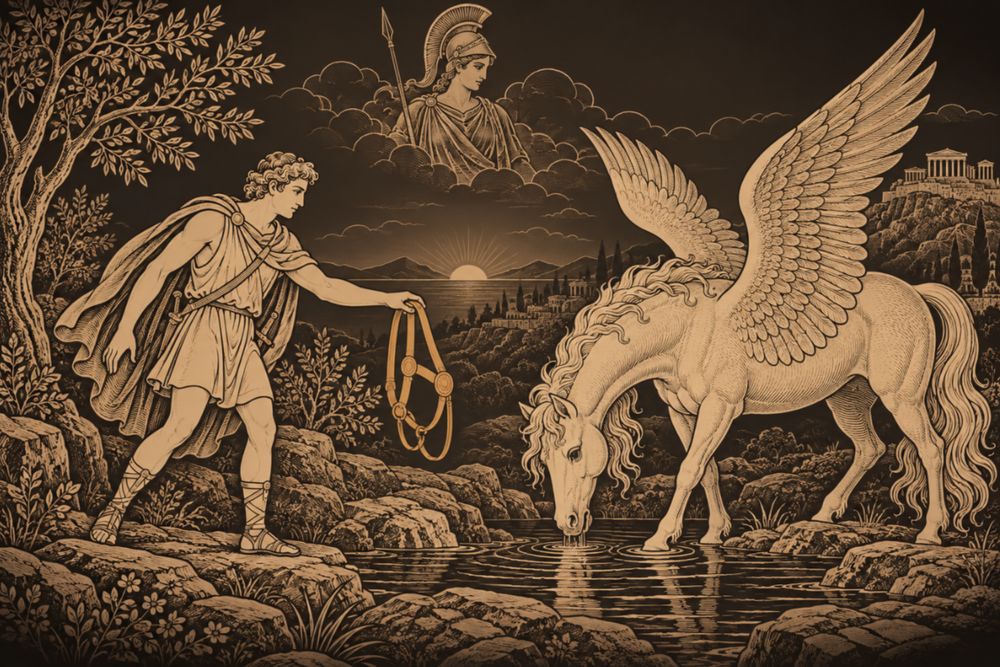
Bellerophon brings the golden bridle
Generated by AI from this page's own facts, not an ancient image or evidence of anything. How this site uses generated images
until the maiden Pallas brought to him a bridle with golden cheek-pieces. The dream suddenly became waking reality, and she spoke: “Are you sleeping, king, son of Aeolus? Come, take this charm for the horse; and, sacrificing a white bull, show it to your ancestor, Poseidon the Horse-Tamer.”
Once the bridle was on, nothing more was needed. Pindar says Bellerophon stretched the gentle charmed bridle around the jaws of the horse and caught the winged horse. Mounted on its back and armoured in bronze, he began at once to play with weapons. Poseidon is the god to whom the sacrifice is owed. Apollodorus makes him the horse's father, so the gift of the bridle and the duty to the sire come from two different gods.
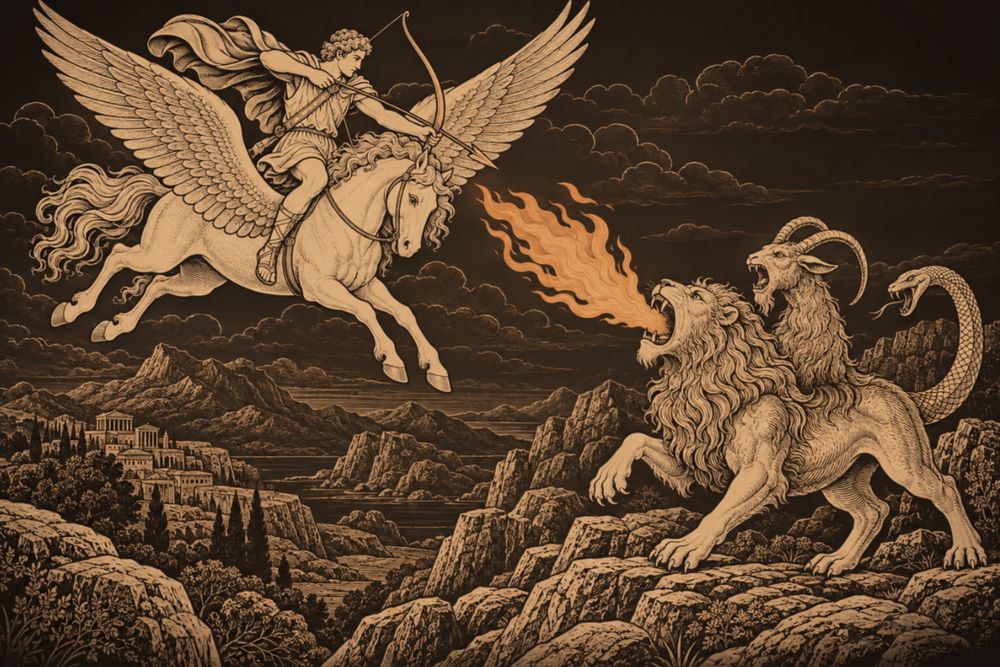
Bellerophon and Pegasus against the Chimera
Generated by AI from this page's own facts, not an ancient image or evidence of anything. How this site uses generated images
The Chimera is where the horse pays off, and the sources disagree about how much. Homer says only that Bellerophon slew her, trusting in the signs of the gods. She was of divine stock, in the fore part a lion, in the hinder a serpent, and in the midst a goat, breathing blazing fire. Hesiod, listing the monsters of Typhon's line, says of the Chimera only: "Her did Pegasus and noble Bellerophon slay."
Apollodorus gives the method. Bellerophon mounted his winged steed, and soaring on high shot down the Chimera from the height. Pindar puts the whole Lycian campaign in the air. From the chilly bosom of the lonely air, he says, Bellerophon attacked the Amazons and killed the fire-breathing Chimaera and the Solymi. Here the horse turns a task built to kill him into the first of his victories.
The Chimera is only the first of the king's traps, and Homer and Apollodorus keep the same order. Next Bellerophon fought the Solymi, which Homer's Glaucus calls the mightiest battle of warriors that Bellerophon ever entered. Third he slew the Amazons. On his way back the king chose the bravest men of Lycia for an ambush, and Bellerophon killed them all.
Then the king knew him for the valiant offspring of a god. He kept Bellerophon in Lycia and gave him his daughter and half his royal honour. In Apollodorus he names the daughter Philonoe and leaves Bellerophon the kingdom at his death. In Homer the Lycians also mark out an estate of orchard and ploughland for him.
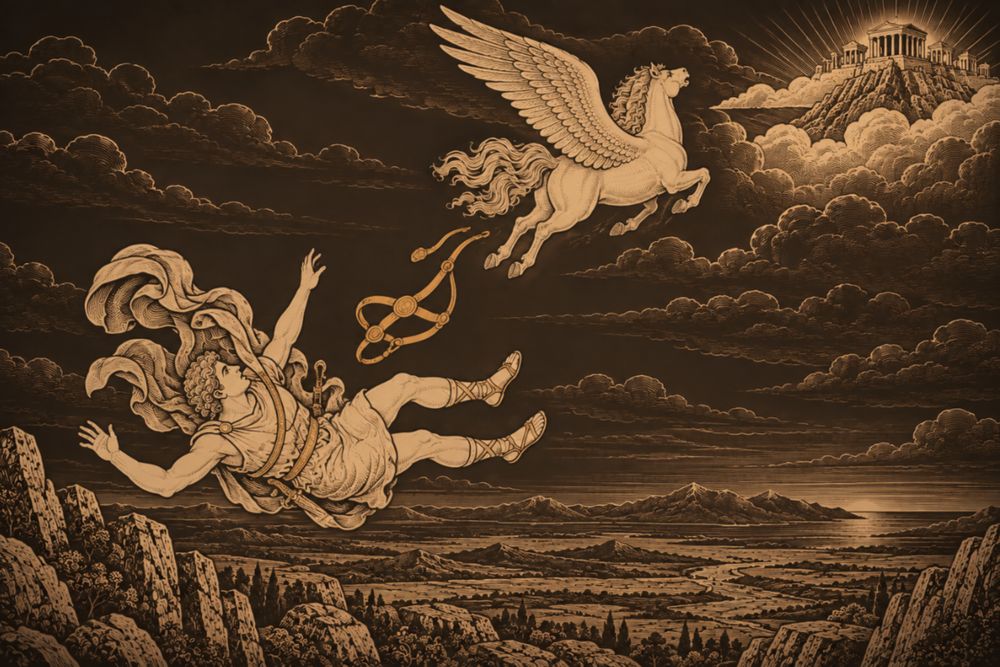
Bellerophon falls from Pegasus
Generated by AI from this page's own facts, not an ancient image or evidence of anything. How this site uses generated images
The ending is where the sources split, and the two oldest do not mention each other's version. Homer has no flight. When Bellerophon came to be hated by all the gods, he wandered alone over the Aleian plain, devouring his own soul and shunning the paths of men. Ares killed his son Isander, and Artemis killed his daughter in wrath. Homer gives no reason for the gods' hatred.
Pindar's Olympian 13 declines to say how he died. It says only that Pegasus has found shelter in the ancient stables of Zeus on Olympus. Isthmian 7 is blunter and gives the fall as a lesson: a man who looks to things far away is too short to reach the bronze-floored home of the gods.
winged Pegasus threw his master Bellerophon, who wanted to go to the dwelling-places of heaven and the company of Zeus.
Pindar adds a maxim: a thing that is sweet beyond measure is awaited by a most bitter end. The horse that made Bellerophon's victories possible is the same horse that ends them, and the sin is hubris in the plainest sense, a mortal reaching for a place among the gods. Hesiod's Pegasus never needed a rider to get there. He flew to Zeus alone and carries his thunder and lightning.
What Followed
Bellerophon's line outlives him. In the Iliad his daughter Laodameia lay with Zeus and bore Sarpedon, and Hippolochus was the father of Glaucus, the man telling the story to Diomedes. Diomedes recalls that his own grandfather Oeneus once hosted Bellerophon for twenty days, so the two men agree not to fight and to exchange armour.
Pegasus has a separate afterlife. Hesiod has him living in the house of Zeus, bringing him thunder and lightning. Pindar says the same horse found shelter in the ancient stables of Zeus on Olympus once Bellerophon's story was done.
Which Greek hero tamed Pegasus?
Bellerophon. In Pindar's Olympian Ode 13 he struggled to harness the winged horse beside a spring until Athena brought him a bridle with golden cheek-pieces in a dream. Homer's Iliad, the oldest account of his adventures, never mentions the horse. Hesiod names Pegasus beside Bellerophon as the Chimera's killers, and Apollodorus has him mount Pegasus for the fight.
Pindar, Olympian Ode 13.63-92
What Greek god is associated with Pegasus?
Three gods touch the horse, each differently. Apollodorus calls Pegasus the offspring of Medusa and Poseidon, so Poseidon is his father. Athena brings the golden bridle that lets Bellerophon tame him in Pindar. Zeus is the horse's master in the end: Hesiod says Pegasus lives in his house and brings him thunder and lightning.
Apollodorus, Library 2.3.1-2.3.2
Who was Bellerophon in Greek mythology?
A hero from Ephyre, son of Glaucus and grandson of Sisyphus in Homer. He was falsely accused by the wife of King Proetus and sent to Lycia with a tablet asking for his death. He survived every task the Lycian king set, from the Chimera to an ambush of the best Lycian warriors, and was rewarded with the king's daughter and half his honour.
Homer, Iliad 6.155-170
Did Pegasus belong to Hercules?
No. The sources give Pegasus to no owner in Heracles's story. Hesiod says he flew to Zeus and brings him thunder, and names Pegasus and Bellerophon as the Chimera's slayers. Heracles appears in the same stretch of the Theogony, killing the Hydra with Iolaus, which may explain the mix-up. The horses Heracles handles in Apollodorus are the man-eating mares of Diomedes.
Hesiod, Theogony 313-325
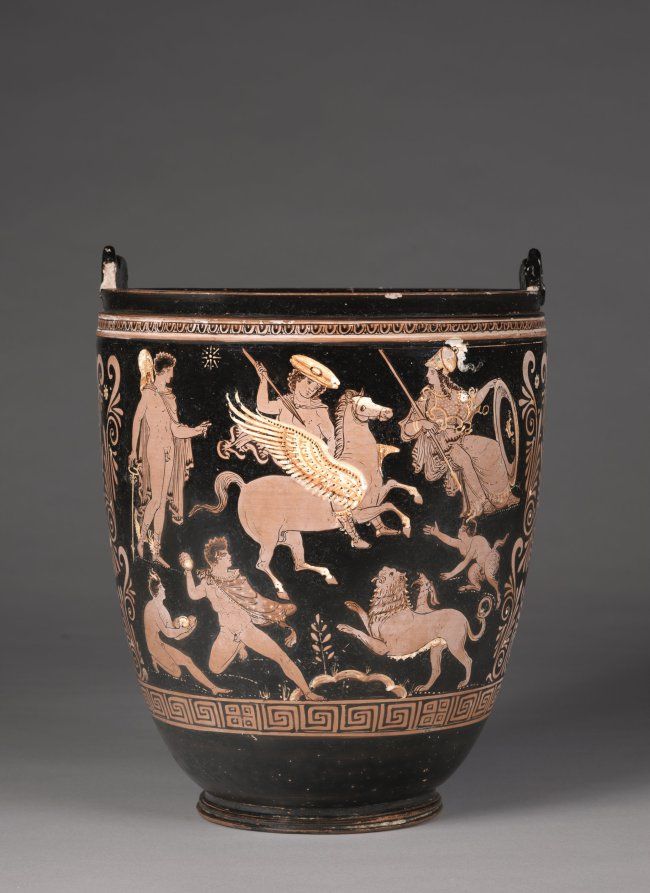
Red-Figure Situla (Deep Bucket): Bellerophon Slaying Chimaera (A); Dionysos, Maenads, Eros (B) - South Italian, Apulian, c. 350 BCE, ceramic
The Cleveland Museum of Art, Cleveland, OH, 1977.179. CC0
Where Accounts Differ
- pegasus-absent-from-homer
- taming-told-only-by-pindar
- pegasus-and-zeus-before-or-after-bellerophon
- bellerophons-end
- poseidon-as-father-or-ancestor
- anteia-or-stheneboea
- Pegasus is absent from Homer. Iliad 6.179-183 says Bellerophon slew the Chimaera trusting in the signs of the gods and names no horse or weapon. Hesiod, Theogony 319-325, names Pegasus beside him, Apollodorus, Library 2.3.2, has him shoot her down from the air, and Pindar, Olympian Ode 13.63-92, puts the whole campaign in the air.
- The taming of Pegasus is told only by Pindar among the works cited here. Olympian Ode 13.63-92 gives the golden bridle, the dream and the altar of Athena. Apollodorus, Library 2.3.2, has Bellerophon simply mount the horse, and Hesiod, Theogony 278-286, sends Pegasus to Zeus with no mention of a rider.
- Pegasus's place is given two ways. Hesiod, Theogony 281-286, has him fly to the house of Zeus straight from his birth and bring him thunder and lightning. Pindar, Olympian Ode 13.63-92, has him serve Bellerophon and only afterwards find shelter in the stables of Zeus on Olympus.
- Bellerophon's end is told two ways. Homer, Iliad 6.200-205, has the gods hate him and him wander alone over the Aleian plain, with no horse and no fall. Pindar, Isthmian Ode 7.44-47, has Pegasus throw him as he tries to reach the company of Zeus, and Olympian Ode 13.63-92 declines to tell his death.
- Whether Poseidon is Bellerophon's father is not settled by these sources. Pindar, Olympian Ode 13.63-92, has Athena tell him to show the bridle to his ancestor Poseidon the Horse-Tamer, as the Perseus English renders the word. Homer, Iliad 6.155, makes him the son of Glaucus, son of Sisyphus, and Apollodorus, Library 2.3.1, agrees.
- The names differ between Homer and Apollodorus. Homer calls the slandering queen Anteia and leaves the Lycian king and his daughter unnamed. Apollodorus, Library 2.3.1-2.3.2, calls the queen Stheneboea, the king Iobates and the daughter Philonoe.
Read the full source verification →
Mythology
Figures In This Myth
Also Connected
Related Terms
Sources
- Homer, Iliad 6.155-170
- Homer, Iliad 6.171-190
- Homer, Iliad 6.191-205
- Hesiod, Theogony 278-286
- Hesiod, Theogony 313-325
- Pindar, Olympian Ode 13.63-92
- Pindar, Isthmian Ode 7.44-47
- Apollodorus, Library 2.3.1-2.3.2
- Apollodorus, Library 2.5.8