Sisyphus
Sisyphus was the founder and king of Ephyra, later called Corinth, whom Homer's Iliad calls the craftiest of men. In the Odyssey, Odysseus sees him in Hades pushing a monstrous stone uphill that always rolls back. Homer gives no reason. Apollodorus and Pausanias say he told the river god Asopus that Zeus had carried off his daughter Aegina.
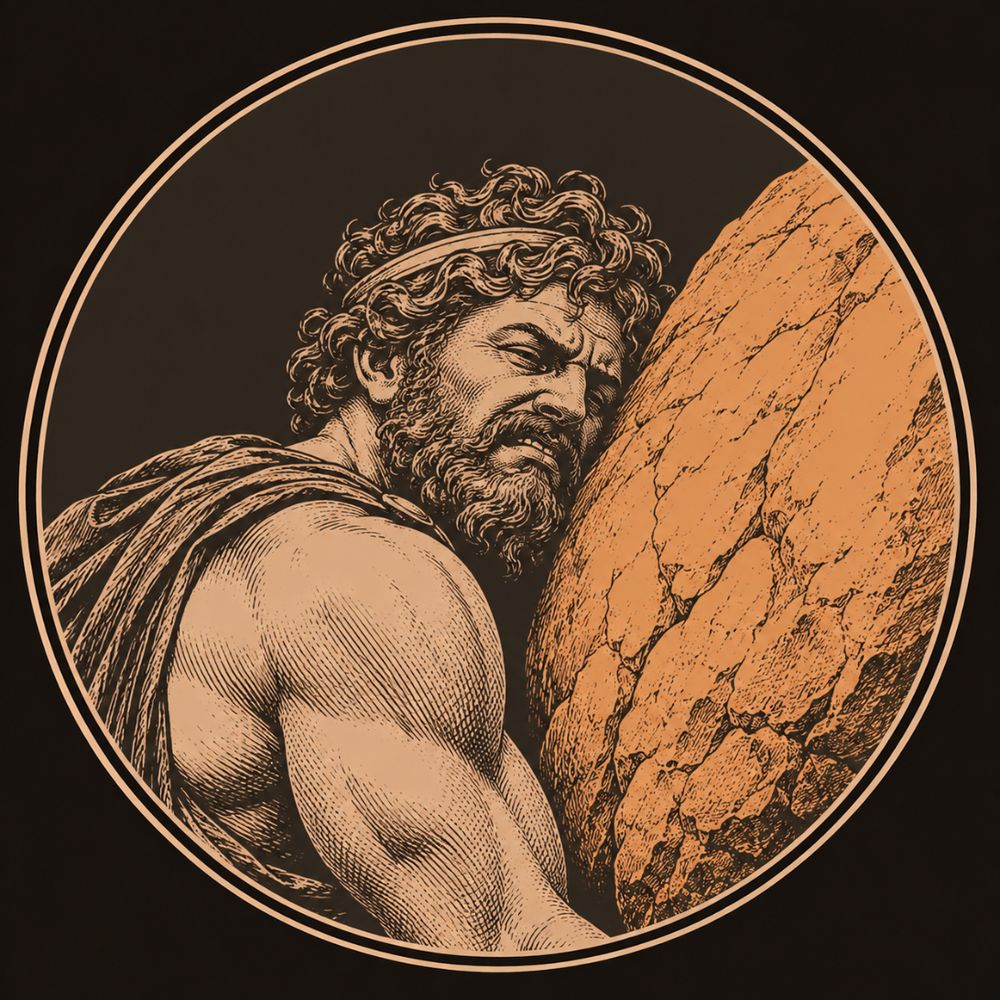
Sisyphus, bronze medallion illustration
Generated by AI from this page's own facts, not an ancient image or evidence of anything. How this site uses generated images
Sections on this page
Core Myth
Sisyphus is the cleverest mortal in Greek myth and one of its best-known sinners. In Homer's Iliad, the Lycian warrior Glaucus traces his own descent from him. There is a city Ephyre, Glaucus says, where Sisyphus lived, the craftiest of men, son of Aeolus. Sisyphus fathered Glaucus, and Glaucus fathered the hero Bellerophon.
Apollodorus's Library fills in the family. His father Aeolus, son of Hellen, ruled the lands around Thessaly and had seven sons, Sisyphus among them. Sisyphus founded Ephyra, which Apollodorus says is now called Corinth. He married Merope, a daughter of Atlas.
The punishment is older than any explanation of it. In Book 11 of Homer's Odyssey, Odysseus sees Sisyphus among the dead in the underworld, in violent torment. He braces with hands and feet and thrusts a monstrous stone toward the crest of a hill. Just before it goes over, its weight turns it back, and the ruthless stone rolls down to the plain. He strains again, sweating, with dust rising from his head. Homer names no crime. The whole arc, from the informing to the stone, is told in Sisyphus and the Boulder.
Apollodorus supplies one. Zeus had secretly carried off Aegina, daughter of the river god Asopus. When Asopus came looking for her, Sisyphus betrayed the secret. In a later book Apollodorus adds that Asopus came to Corinth and learned from Sisyphus who the abductor was. Asopus pursued Zeus until Zeus drove him back to his own streams with thunderbolts.
Pausanias tells the same story with a price attached. On the summit of Acrocorinth, he says, a spring rises behind the temple of Aphrodite. Sisyphus would not tell Asopus what he knew until Asopus gave him that spring. Once he had it, he informed. For this, Pausanias says, Sisyphus is punished in Hades, and then he adds: if anyone believes the story.
A second tradition makes Sisyphus the man who got out of death. The elegies of Theognis say he persuaded Persephone with wheedling words and returned from Hades to the light of the sun, something no one else had contrived. A darker version has him bind Death in chains until Ares sets Death free. It is not in the Homer, Apollodorus or Pausanias passages on Sisyphus. J. G. Frazer's notes to Apollodorus trace it to an ancient commentary on Iliad 6.153.
At home Sisyphus founded more than a city. Pausanias says a dolphin brought the drowned boy Melicertes ashore at the Isthmus. Sisyphus found him, buried him there, and established the Isthmian Games in his honor, one of the Panhellenic Games. Apollodorus agrees that Sisyphus instituted the games for Melicertes. Pausanias also reports a tradition that Medea, leaving Corinth, handed the kingdom over to Sisyphus.
Corinth remembered him with pride. Pindar's thirteenth Olympian Ode was written for a Corinthian victor. Promising not to falsify the story of Corinth, Pindar names Sisyphus first, very shrewd in his devising, like a god.
What is Sisyphus the myth about?
It is about a clever king who crossed the gods and was punished forever. Homer's Iliad calls Sisyphus of Ephyre the craftiest of men. Homer's Odyssey shows him in Hades, pushing a monstrous stone toward a hilltop, only for it to roll back each time. Apollodorus and Pausanias explain the punishment: he told the river god Asopus that Zeus had carried off his daughter Aegina. The elegies of Theognis add that he talked Persephone into letting him return from Hades.
Homer, Odyssey 11.593-600
Why did Sisyphus push the rock?
Because it was his punishment in Hades, and the stone never stays at the top. Homer's Odyssey describes the work but gives no reason. Each time Sisyphus nears the crest, the weight turns the stone back and he must begin again. Apollodorus says he is punished for Aegina, daughter of Asopus: when Zeus secretly carried her off, Sisyphus betrayed the secret to her father. Pausanias tells the same story, adding that Sisyphus traded the information for a spring on Acrocorinth. He hedges it: if anyone believes the story.
Apollodorus, Library 1.9.3
Is Sisyphus related to Odysseus?
Not in Homer. Homer's Odyssey calls Odysseus the son of Laertes and names his mother as Anticleia, daughter of Autolycus. Later writers make Sisyphus his real father, usually as an insult. Sophocles's Philoctetes calls Odysseus the offspring of Sisyphus that was bought by Laertes. In Euripides's Iphigenia at Aulis, Agamemnon calls him the son of Sisyphus. In Ovid's Metamorphoses, Ajax says Odysseus comes from the blood of Sisyphus and resembles him in theft and fraud. None of these speakers is a friend of Odysseus.
Euripides, Iphigenia at Aulis 524-526
What is the moral of the story of Sisyphus?
No ancient author states one outright, and the sources draw different lessons. In Homer's Odyssey, Sisyphus is one of the great sinners Odysseus sees punished in Hades, beside Tityus and Tantalus. Apollodorus and Pausanias make his crime informing on Zeus, so exposing a god's secret carries a price. Theognis uses him differently: in his elegies, most people value wealth above everything, even above the wit of Sisyphus, who came back from Hades. The best-known modern moral, that one must imagine Sisyphus happy, is Albert Camus's, from 1942.
Pausanias, Description of Greece 2.5.1
What is Sisyphus a metaphor for?
Today he stands for endless, futile labor: a task that must be started again the moment it seems finished. That image comes from Homer's Odyssey, where the stone rolls back each time it nears the crest. In antiquity his name also stood for cunning. Homer's Iliad calls him the craftiest of men, and Pindar calls him shrewd like a god. Tragedians called Odysseus a son of Sisyphus to call him a cheat. Albert Camus's The Myth of Sisyphus (1942) made him the absurd hero, a modern reading, not an ancient one.
Pindar, Olympian Ode 13.49-54
How did Sisyphus cheat death?
The ancient sources tell two stories. Theognis's elegies say Sisyphus persuaded Persephone with wheedling words and came back from Hades to the light of the sun, something no one else had contrived. In the second story he binds Death in chains until Ares sets Death free. That version is not in the Homer, Apollodorus or Pausanias passages on Sisyphus. J. G. Frazer's notes to Apollodorus trace it to an ancient commentary on Iliad 6.153, and say the story was the theme of plays by Aeschylus, Sophocles and Euripides.
Later Traditions
Later poets turned his name into an insult aimed at Odysseus. In Homer's Odyssey, Odysseus is the son of Laertes, and his mother Anticleia is the daughter of Autolycus. The tragedians hint at another father. The chorus of Sophocles's Ajax speaks of the man born of the abject line of Sisyphus. In Euripides's Iphigenia at Aulis, Agamemnon fears the army will learn that he promised Artemis his daughter Iphigenia. The son of Sisyphus knows all, he warns, and Menelaus answers with Odysseus's name.
Sophocles's Philoctetes is the bluntest. Philoctetes calls Odysseus the offspring of Sisyphus that was bought by Laertes. In Ovid's Metamorphoses, Ajax makes the same charge in the contest for the arms of Achilles. Odysseus, he says, is sprung from the blood of Sisyphus and just like him in theft and fraud. None of these speakers is a friend of Odysseus.
Ovid keeps Sisyphus at his stone. When Juno goes down to the underworld in the Metamorphoses, she sees him chasing or pushing the stone that always comes back, near Tantalus. She asks why this one of the brothers suffers eternal punishment while his brother Athamas lives in a rich palace. When Orpheus sings to the dead, Sisyphus sits idle on his rock, the moment told in Orpheus in the Underworld.
Pausanias saw him in paint as well. In Polygnotus's picture of the underworld at Delphi, Sisyphus, son of Aeolus, is trying his hardest to push the rock up a cliff. His grave was harder to find. Citing the poet Eumelus, Pausanias says Sisyphus was buried on the Isthmus, but few Corinthians, even in his own day, knew where.
Modern Influence
The best-known modern reading is Albert Camus's essay The Myth of Sisyphus, published in 1942. Camus calls Sisyphus the absurd hero, punished for his scorn of the gods, his hatred of death and his passion for life. The essay ends: "The struggle itself toward the heights is enough to fill a man's heart. One must imagine Sisyphus happy."
That is a twentieth-century philosophical reading, not an ancient one. Camus also credits Homer with the story of Death in chains, which the Odyssey's scene of the stone does not contain. The ancient sources treat the stone as a punishment and say nothing about happiness.
Also Connected
4 recorded connections, each with the ancient line behind it.
Connected
-
Pausanias reports that Medea, leaving Corinth after Jason sailed away, handed the kingdom over to Sisyphus. Pindar's thirteenth Olympian Ode names both in its praise of Corinth.
-

Homer makes Odysseus the child of Laertes. Later writers give him Sisyphus as his true father, usually as an insult. In Euripides's Iphigenia at Aulis, Agamemnon warns that Sisyphus's offspring knows all, and Menelaus answers with Odysseus's name.
-
In Homer's Odyssey, Odysseus sees Tantalus and then Sisyphus among the dead, and Homer describes both as in violent torment: Tantalus reaching for water and fruit, Sisyphus pushing a stone that rolls back.
-

Apollodorus says Sisyphus is punished in Hades because he betrayed to the river god Asopus that Zeus had secretly carried off Aegina.
Where Accounts Differ
- why Sisyphus was punished
- how Sisyphus escaped death
- whether Sisyphus was Odysseus's father
- which Aeolus fathered Sisyphus
- whether Homer tells of Death in chains
- The sources give different reasons for the punishment. Homer (Odyssey 11.593-600) describes the stone and names no crime. Apollodorus (Library 1.9.3, 3.12.6) says Sisyphus revealed to Asopus that Zeus had carried off Aegina. Pausanias (2.5.1) adds that he traded the secret for a spring on Acrocorinth, and reports the punishment only if anyone believes the story.
- Sisyphus's escapes from death are separate traditions. Theognis (699-718 in Edmonds's numbering) says he persuaded Persephone and returned from Hades. The chaining of Death, freed by Ares, is not in the Homer, Apollodorus or Pausanias passages cited here; Frazer's note to Apollodorus 1.9.3 traces it to a scholiast on Iliad 6.153.
- Odysseus's father is disputed. Homer (Odyssey 11.405-406, 11.84-86) makes him the son of Laertes and Anticleia. Sophocles (Ajax 189-190; Philoctetes 416-418), Euripides (Iphigenia at Aulis 524-526) and Ovid (Metamorphoses 13.31-33) call him a son or descendant of Sisyphus, always in the mouths of hostile or wary speakers.
- The Aeolus who fathers Sisyphus is the son of Hellen in Apollodorus (Library 1.7.3). He should not be confused with the keeper of the winds whom Odysseus visits in the Odyssey.
- Camus (The Myth of Sisyphus, 1942) attributes the chaining of Death to Homer. The Homer passages on Sisyphus cited here (Iliad 6.152-155, Odyssey 11.593-600) do not contain it.
Read the full source verification →
Mythology
Appears In
Related Terms
Referenced By
Sources
- Homer, Iliad 6.152-155
- Homer, Odyssey 11.593-600
- Homer, Odyssey 11.84-86
- Homer, Odyssey 11.405-406
- Apollodorus, Library 1.7.3
- Apollodorus, Library 1.9.3
- Apollodorus, Library 3.4.3
- Apollodorus, Library 3.12.6
- Pausanias, Description of Greece 2.1.3
- Pausanias, Description of Greece 2.2.2
- Pausanias, Description of Greece 2.3.11
- Pausanias, Description of Greece 2.5.1
- Pausanias, Description of Greece 10.31.10
- Pindar, Olympian Ode 13.49-54
- Sophocles, Ajax 189-190
- Euripides, Iphigenia at Aulis 524-531
- Ovid, Metamorphoses 4.460
- Ovid, Metamorphoses 4.465-467
- Ovid, Metamorphoses 10.44
- Ovid, Metamorphoses 13.25-26
- Ovid, Metamorphoses 13.31-33
- Theognis, Elegiac Poems 699-718, in J. M. Edmonds, Elegy and Iambus, vol. 1 (Loeb, 1931), Perseus Digital Library
- Sophocles, Philoctetes 416-418, Perseus Digital Library (English translation)
- J. G. Frazer, notes to Apollodorus, Library 1.9.3 (Loeb, 1921), Perseus Digital Library
- Albert Camus, The Myth of Sisyphus (1942), trans. Justin O'Brien