Philoctetes
Philoctetes was the Greek archer who owned the bow of Heracles. Ovid says he lit the hero's funeral pyre and got the bow as his reward. Homer's Iliad says the Greeks left him on Lemnos with a snakebite that would not heal. Ten years later a prophecy said Troy could not fall without that bow, so they fetched him back, and he shot Paris.
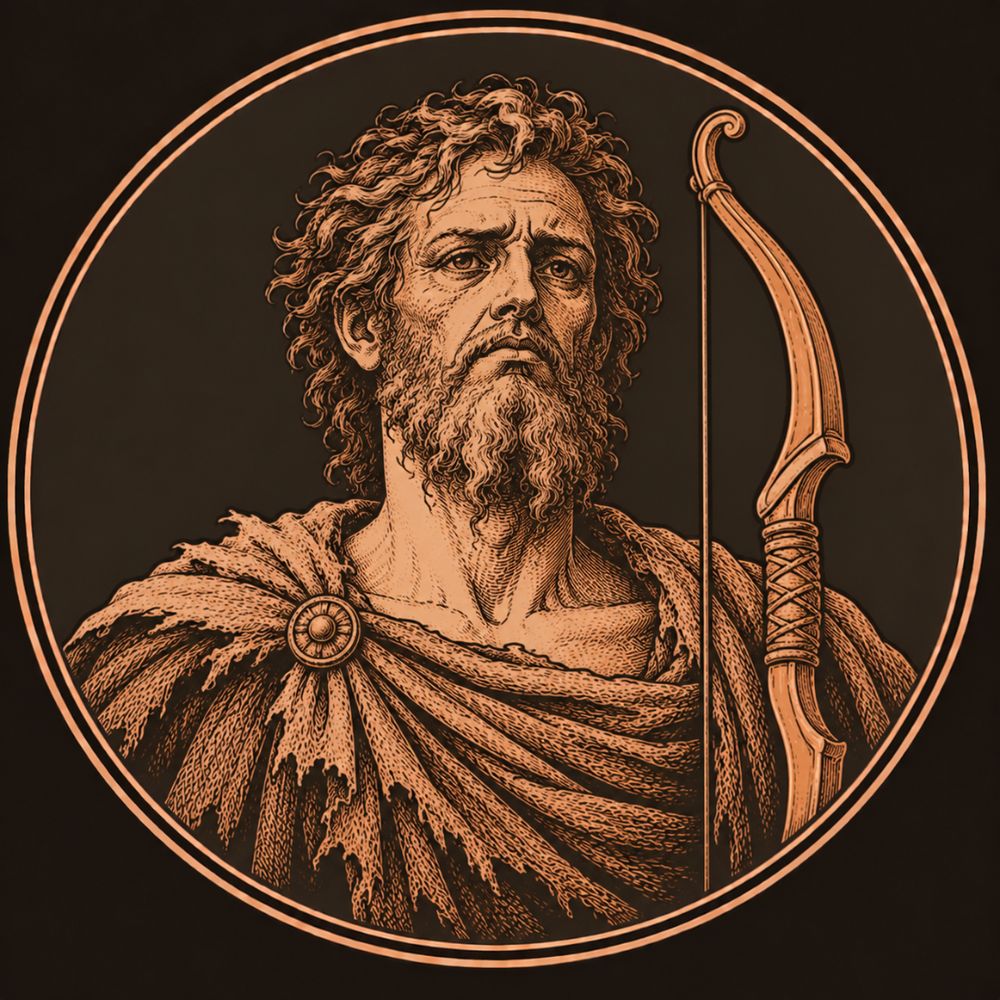
Philoctetes, bronze medallion illustration
Generated by AI from this page's own facts, not an ancient image or evidence of anything. How this site uses generated images
Sections on this page
Core Myth
Homer's catalogue of ships makes Philoctetes the leader of seven ships from Methone, Thaumacia, Meliboea and Olizon, each rowed by fifty men skilled with the bow. By the time the catalogue is told, he is not at Troy. The Iliad says he lay suffering on sacred Lemnos, where the Achaeans had left him with an evil wound from a deadly water-snake. The poem adds that the Argives would soon remember him. In the Odyssey, Odysseus admits that only Philoctetes beat him with the bow at Troy, and Nestor lists him among the chiefs who came home safely.
The bow came from Heracles. Ovid's Metamorphoses says that when the dying hero built his pyre on Mount Oeta, he told Philoctetes to put a torch to it and take his bow and quiver in return. Apollodorus's Library tells it differently: no one would light the pyre until Poeas, Philoctetes's father, passed by looking for his flocks, and it was Poeas who received the bow. The arrows carried a poison of their own. Apollodorus says Heracles had dipped them in the gall of the Hydra.
Apollodorus's Epitome describes the wound. On the voyage to Troy, while the Greeks sacrificed to Apollo, a water-snake came from the altar and bit Philoctetes. The sore would not heal and its stench became unbearable. On Agamemnon's orders, Odysseus put him ashore on Lemnos with the bow, and he lived by shooting birds. In Sophocles's Philoctetes he has survived there ten years in a cave, dragging his foot to fetch water and firewood, and cursing the sons of Atreus and Odysseus.
Then the Greeks learned they needed him. Apollodorus says the seer Calchas told them Troy could not be taken without the bow and arrows of Heracles. Odysseus sailed to Lemnos with Diomedes, got the weapons by craft, and persuaded Philoctetes to come. At Troy the physician Podalirius cured him, and he shot Paris, whom Apollodorus calls Alexander. In Sophocles, the god Heracles appears at the end and gives the same orders: go to Troy, be healed, kill Paris with my bow, and sack the city.
What is the story of Philoctetes?
Philoctetes was a Greek archer who owned the bow of Heracles. Homer's Iliad lists him as a leader of seven ships, then says the Greeks left him on Lemnos with a wound from a water-snake. Apollodorus's Epitome says the wound stank so badly that Odysseus put him ashore on Agamemnon's orders. In the tenth year of the war, a prophecy said Troy could not fall without the bow. Odysseus fetched him, a physician healed him, and he shot Paris.
Apollodorus, Epitome 5.8
What did Odysseus do to Philoctetes?
He abandoned him and later tricked him. Apollodorus's Epitome says Odysseus, on Agamemnon's orders, put the wounded Philoctetes ashore on Lemnos. In Sophocles's Philoctetes, Odysseus admits in the opening lines that he left him there. Ten years later he returns with Neoptolemus and tells the young man to win the bow by deceit, since force would fail against arrows that never miss. Philoctetes curses the sons of Atreus and Odysseus for his suffering, and at one point aims an arrow at him.
Sophocles, Philoctetes 1-11
What was the relationship between Philoctetes and Hercules in Greek mythology?
Philoctetes inherited the bow of Heracles, the Greek name of Hercules. Ovid's Metamorphoses says the dying hero told Philoctetes to light his pyre on Mount Oeta and gave him the bow and quiver in return. In Sophocles's Philoctetes, the hero himself says he did that service for the son of Zeus and received the bow for it. At the end of the play Heracles, now a god, appears to him and sends him to Troy to kill Paris with the bow.
Sophocles, Philoctetes 799-803
Why is Philoctetes a satyr in Hercules?
Only in Disney's 1997 film. There Philoctetes, called Phil and voiced by Danny DeVito, is an old satyr who trains heroes, Hercules among them. The ancient Philoctetes is a man, a Greek archer and the son of Poeas in Homer's Odyssey and Sophocles's play. He never trains Heracles. He receives his bow, and in Sophocles the deified Heracles guides him instead. The film took the name and left the story behind.
Homer, Odyssey 3.188-191
Where was Philoctetes bitten by the snake?
The sources disagree. Sophocles's Philoctetes says he came too near the serpent guarding the roofless sanctuary of Chryse. Pausanias describes Chryse as an island near Lemnos, later swallowed by the sea, where the accident was said to have happened. Apollodorus's Epitome puts the bite at a sacrifice to Apollo, told right after the Greeks land at Tenedos. Hyginus's Fabulae places it on Lemnos and says Juno sent the snake. Homer's Iliad only says the Achaeans left him on Lemnos with the wound.
Sophocles, Philoctetes 1326-1328
Why did the Greeks need Philoctetes to take Troy?
Because a prophecy said the city could not fall without the bow of Heracles, which he held. Apollodorus's Epitome gives the prophecy to the Greek seer Calchas in the tenth year of the war. In Sophocles's Philoctetes it comes from Helenus, a captured Trojan seer, who adds that Troy must fall that very summer. Sophocles's Odysseus puts it plainly: his arrows alone will capture Troy. Once healed at Troy, Philoctetes shot Paris with that bow.
Sophocles, Philoctetes 1336-1342
Later Traditions
Sophocles's Philoctetes is the fullest surviving telling. Odysseus brings Achilles's young son Neoptolemus and has him win the wounded man's trust with a false story. During an attack of pain, Philoctetes hands the boy his bow for safekeeping. Neoptolemus then turns against the lie and gives the bow back. When Odysseus steps in, Philoctetes aims an arrow at him, and Neoptolemus stops the shot. Only the appearance of Heracles persuades Philoctetes to sail for Troy.
Writers placed the bite in different spots. Sophocles's Neoptolemus says Philoctetes came too near the serpent that guards the roofless sanctuary of Chryse, and Philoctetes says the fleet reached Lemnos from sea-washed Chryse. Pausanias knew Chryse as an island a short sail from Lemnos where the accident was said to have happened, and says the sea later swallowed it. Apollodorus's Epitome sets the snakebite at a sacrifice to Apollo, told just after the Greeks land on Tenedos. Hyginus's Fabulae says the snake struck on Lemnos itself, sent by Juno, the Roman Hera, because Philoctetes alone had dared to build Heracles's pyre.
His return home was told in more than one way. The Odyssey has Nestor say he reached home safely. A later tradition preserved with Apollodorus's Epitome says he was driven to Campania in Italy, fought the Lucanians, settled at Crimissa near Croton and Thurium, and dedicated his bow in a sanctuary of Apollo the Wanderer. Pausanias saw a painting at the gateway to the Athenian Acropolis that showed Odysseus on Lemnos taking away the bow of Philoctetes.
Modern Influence
Disney's 1997 animated film Hercules borrows the name for an entirely different figure. Its Philoctetes, called Phil and voiced by Danny DeVito, is a crotchety old satyr, half man and half goat, who trains heroes including Achilles and Hercules. The ancient Philoctetes is a mortal archer, not a satyr. In the ancient story the debt runs the other way: Philoctetes inherits the hero's bow, and in Sophocles the deified Heracles guides him.
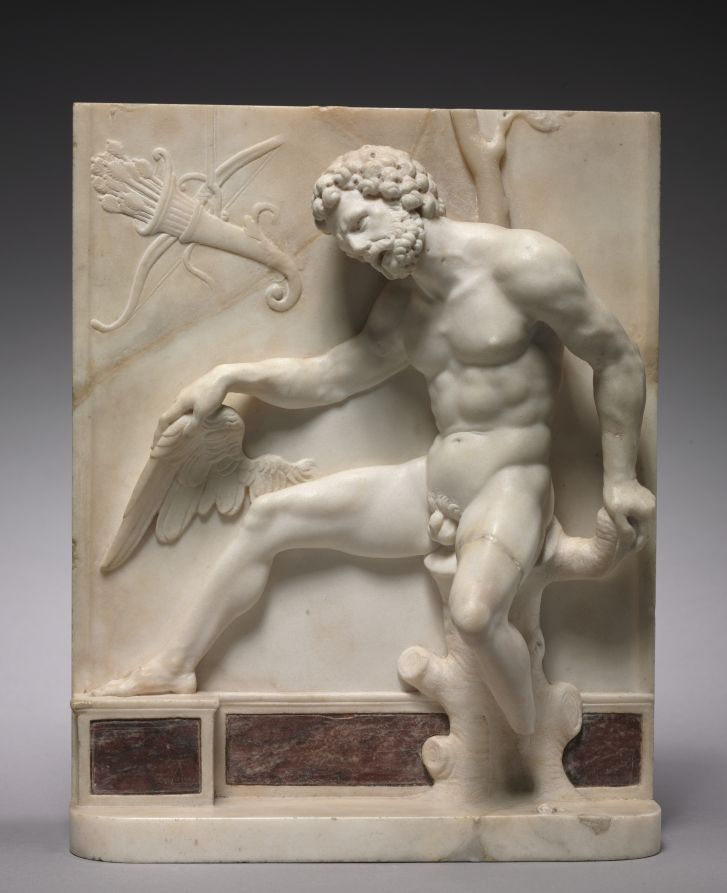
Philoctetes on the Island of Lemnos - Italy, c. 1510–1515, marble
The Cleveland Museum of Art, Cleveland, OH, 1973.168. CC0
Also Connected
4 recorded connections, each with the ancient line behind it.
Allies
-

Philoctetes holds the bow Heracles gave him for the pyre on Oeta. In Sophocles the deified Heracles appears to him on Lemnos and sends him to Troy with it.
Enemies
-

On Agamemnon's orders, Odysseus put the wounded Philoctetes ashore on Lemnos with his bow. Philoctetes curses him for it in Sophocles's play.
Connected
-

In Sophocles, the deified Heracles promises to send Asclepius to Troy to heal the wound of Philoctetes. Apollodorus names the healer as Podalirius instead.
-
Diomedes sails with Odysseus to Lemnos to bring Philoctetes and the bow of Heracles to Troy. Sophocles gives this errand to Neoptolemus instead.
Where Accounts Differ
- where the snake bit Philoctetes
- who lit the pyre of Heracles
- who fetched Philoctetes from Lemnos
- who prophesied that Troy needed the bow
- who healed Philoctetes
- who ordered Philoctetes abandoned
- where Philoctetes settled after Troy
- Where the snake bit him differs by source. Sophocles (Philoctetes 1326-1328) names the serpent guarding the sanctuary of Chryse, and Pausanias (8.33.4) places the accident on an island called Chryse near Lemnos, since sunk. Apollodorus (Epitome 3.27) sets it at a sacrifice to Apollo, told right after the landing at Tenedos (Epitome 3.26). Hyginus (Fabulae 102) sets it on Lemnos. The Iliad (2.716-725) says only that he was left on Lemnos with the wound.
- Who lit the pyre of Heracles differs. Apollodorus (Library 2.7.7) says Poeas, Philoctetes's father, lit it and received the bow. Ovid (Metamorphoses 9.229-235) says Heracles told Philoctetes to light it, and Sophocles (Philoctetes 799-803) has Philoctetes say he did that service and was given the bow. Hyginus (Fabulae 102) says he alone dared to build it.
- Who fetched him from Lemnos differs. Apollodorus (Epitome 5.8) and Hyginus (Fabulae 102) send Odysseus with Diomedes. Sophocles's Philoctetes (1-11) sends Odysseus with Neoptolemus, the son of Achilles.
- Who revealed that Troy needed the bow differs. Apollodorus (Epitome 5.8) names the Greek seer Calchas; Sophocles (Philoctetes 1336-1342) names the captured Trojan seer Helenus; Hyginus (Fabulae 102) speaks only of an oracle.
- Who healed him differs. Apollodorus (Epitome 5.8) names the physician Podalirius. In Sophocles, Neoptolemus says the sons of Asclepius will heal him (Philoctetes 1326-1342), and Heracles says he will send Asclepius himself to Troy (1437-1438).
- Who ordered him put ashore differs. Apollodorus (Epitome 3.27) and Hyginus (Fabulae 102) name Agamemnon. Sophocles's Odysseus (Philoctetes 1-11) says he acted on the command of the two chieftains, and Philoctetes blames the sons of Atreus and Odysseus together (311-313).
- His homecoming differs. The Odyssey (3.188-191) has Nestor report that he came home safely. The tradition preserved with Apollodorus (Epitome 6.15b), from Tzetzes's scholia on Lycophron, says he was driven to Italy and settled at Crimissa.
Read the full source verification →
Mythology
Appears In
Related Terms
Referenced By
Sources
- Homer, Iliad 2.716-725
- Homer, Odyssey 3.188-191
- Homer, Odyssey 8.219-220
- Apollodorus, Library 2.5.2
- Apollodorus, Library 2.7.7
- Apollodorus, Epitome 3.26
- Apollodorus, Epitome 3.27
- Apollodorus, Epitome 5.8
- Apollodorus, Epitome 6.15b
- Sophocles, Philoctetes 1-11
- Sophocles, Philoctetes 111-115
- Sophocles, Philoctetes 261-270
- Sophocles, Philoctetes 311-313
- Sophocles, Philoctetes 762-778
- Sophocles, Philoctetes 799-803
- Sophocles, Philoctetes 1286-1305
- Sophocles, Philoctetes 1326-1328
- Sophocles, Philoctetes 1336-1342
- Sophocles, Philoctetes 1409-1433
- Sophocles, Philoctetes 1437-1438
- Ovid, Metamorphoses 9.172-272
- Ovid, Metamorphoses 13.45-54
- Pausanias, Description of Greece 1.22.6
- Pausanias, Description of Greece 8.33.4
- Hyginus, Fabulae 102