Lemnos
Lemnos is a Greek island that myth names for three things: the place where the Greeks left the wounded archer Philoctetes, the favourite land of Hephaestus and the island of the women who killed their men.
Heracles' bow left on the Lemnian shore
Generated by AI from this page's own facts, not an ancient image or evidence of anything. How this site uses generated images
Sections on this page
In Practice
Homer says the Achaeans left Philoctetes in sacred Lemnos with a snakebite (Iliad 2.716-725). Apollodorus tells of the Lemnian women and Aphrodite's anger (Library 1.9.17).
The best-known story is that of Philoctetes. Apollodorus says a water-snake bit him at a sacrifice to Apollo, and that Odysseus, on the orders of Agamemnon, put him ashore on Lemnos because the wound stank (Epitome 3.27). In Sophocles, Odysseus describes the shore as untrodden by men and not lived in (Philoctetes 1-11). Years later Odysseus and Diomedes return for him and his bow, and he shoots Paris after Podalirius heals him (Epitome 5.8).
Lemnos is also a god's land. In the Odyssey, Hephaestus pretends to leave for Lemnos so that Ares will come to Aphrodite. Homer calls Lemnos the land far dearest to him and names the Sintians as the people he goes to visit (Odyssey 8.283-294).
The third tale concerns the women. Apollodorus says the Lemnian women did not honour Aphrodite, and the goddess afflicted them with a foul smell. The Argonauts later land there under Jason (Library 1.9.17). The island belongs to the heroic age, and the Greek heroes cluster gathers the figures tied to it.
Why did Aphrodite curse Lemnos?
Apollodorus gives a single reason: the Lemnian women did not honour Aphrodite. In answer she visited them with a noisome smell. He says their husbands then turned away from them and took captive women from Thrace as their partners. The sources checked here give no other cause for the curse, and they do not describe a cult of the goddess on the island.
Apollodorus, Library 1.9.17
Why weren't there any men on the island of Lemnos?
In Apollodorus the women killed them. Slighted by their husbands, who had taken Thracian concubines, the Lemnian women put to death both their fathers and their husbands. Hypsipyle alone saved her father Thoas, by hiding him, and she came to rule the island. Ovid's Ulysses calls Lemnos the country of Hypsipyle and says it was notorious from older times for the women's murder of their husbands.
Apollodorus, Library 1.9.17
What happened when the Argonauts reached Lemnos?
Apollodorus says the Argonauts put in at Lemnos under Jason and had relations with the women. Hypsipyle bore Jason two sons, Euneus and Nebrophonus. The Argonauts then sailed on. The island is a stop on the voyage and not its goal, and the page for Jason is where the whole voyage is told.
Apollodorus, Library 1.9.17
Was Lemnos inhabited when Philoctetes was left there?
The sources checked here do not agree. Sophocles opens his play with Odysseus describing the shore of Lemnos as untrodden by men and not inhabited. Apollodorus has the Lemnian women and Hypsipyle on the island earlier in the heroic age. Neither text tries to join the two accounts, and the sources checked here do not settle how the stories fit together.
Sophocles, Philoctetes 1-11
What is Lemnos known for?
Lemnos is known through three stories, not through a description of the island. Homer and Sophocles make it the place of Philoctetes's abandonment. Homer makes it the land dearest to Hephaestus. Apollodorus and Ovid make it the island of the women who killed their husbands. Apollodorus also says Philoctetes lived there on the birds he shot with the bow of Heracles.
Apollodorus, Epitome 3.27
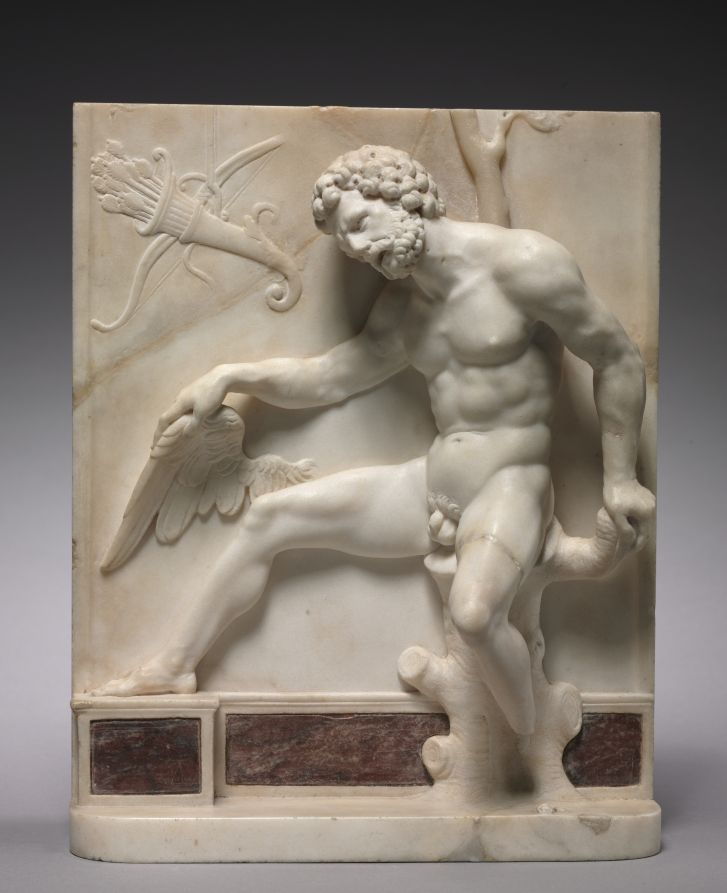
Philoctetes on the Island of Lemnos - Italy, c. 1510–15, marble
The Cleveland Museum of Art, Cleveland, OH, 1973.168. CC0
Where Accounts Differ
- Whether Lemnos was inhabited: Sophocles's empty shore against Apollodorus's Lemnian women
- Whether Lemnos was inhabited: Sophocles has Odysseus call the shore of Lemnos untrodden and not lived in (Philoctetes 1-11), while Apollodorus gives the island a population of Lemnian women under Hypsipyle (Library 1.9.17). This page reports both and does not decide between them.
Where This Appears
Referenced By
Sources
- Homer, Iliad 2.716-725
- Homer, Odyssey 8.283-294
- Sophocles, Philoctetes 1-11
- Apollodorus, Library 1.9.17
- Apollodorus, Epitome 3.27
- Apollodorus, Epitome 5.8
- Ovid, Metamorphoses 13.399-428