Neoptolemus
Neoptolemus, also called Pyrrhus, is the son of Achilles and Deidamia. Brought from Scyros after his father's death, he fought in the final stage of the Trojan War and hid in the wooden horse. In the sack of Troy he killed King Priam at an altar. He was later killed at Delphi, by Orestes in some accounts and by Delphians in others.
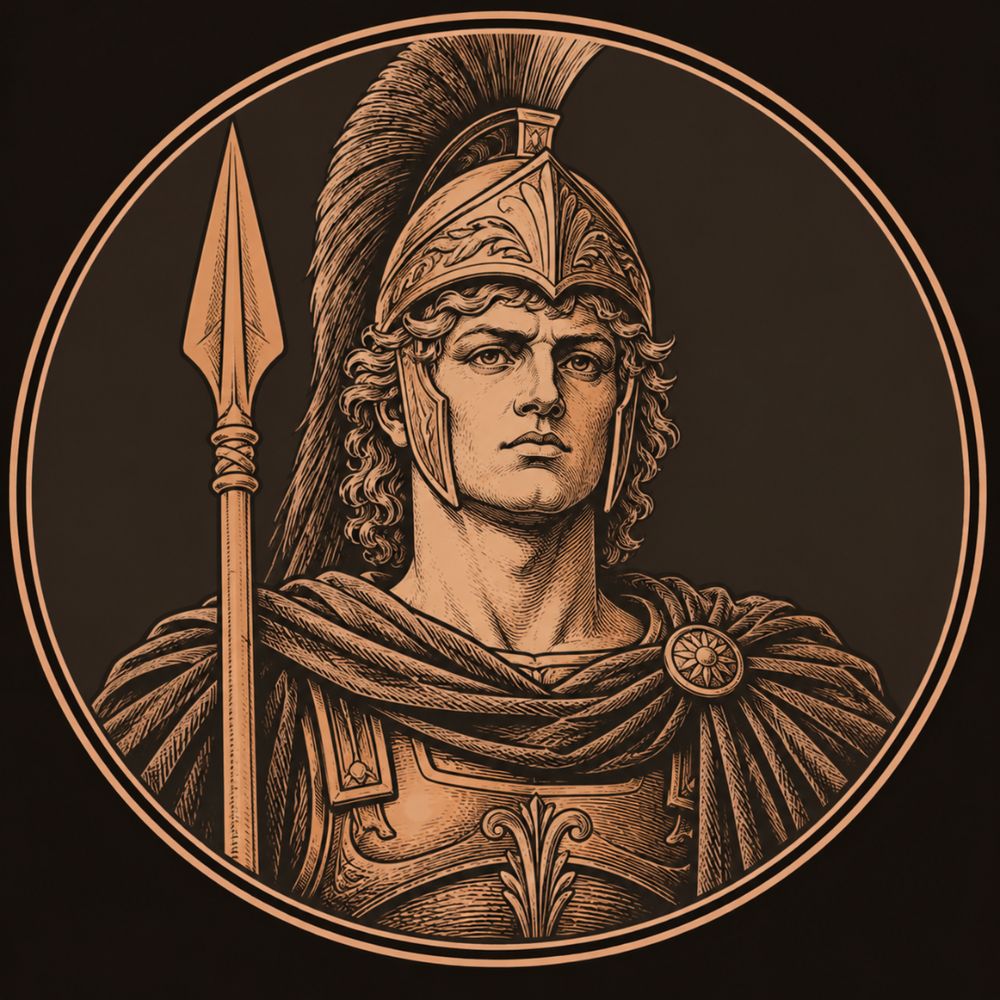
Neoptolemus, bronze medallion illustration
Generated by AI from this page's own facts, not an ancient image or evidence of anything. How this site uses generated images
Sections on this page
See Neoptolemus in the Greek family tree.
Core Myth
Neoptolemus is the son of Achilles. Apollodorus's Library says Thetis hid the young Achilles on Scyros, dressed as a girl at the court of King Lycomedes. There he fathered a son on the king's daughter Deidamia. The boy was called Pyrrhus at first and later Neoptolemus. In Homer's Iliad, Achilles weeps for his dead friend and thinks of the son being reared for him in Scyros, if he is still alive.
After Achilles died, the Greeks learned they needed that son. Apollodorus's Epitome says the captured seer Helenus named three conditions for taking Troy. One was that Neoptolemus should fight on their side. Odysseus and Phoenix sailed to Scyros and persuaded Lycomedes to let him go, and Odysseus gave him his father's arms. Homer's Odyssey names Odysseus alone as the man who brought him.
At Troy he killed Eurypylus, son of Telephus, who had come to help the Trojans with an army of Mysians. Homer's Odyssey and Apollodorus's Epitome both record the kill.
Sophocles's Philoctetes sends him with Odysseus to bring the archer Philoctetes and his bow to Troy. Odysseus tells him to win the bow with a lie. Neoptolemus answers that he would rather fail honorably than win by deceit, but he is reluctant to be called a traitor and goes along. He tells Philoctetes a false story of being cheated of his father's arms. Then his conscience turns. He confesses the plot, and in the end he hands the bow back over Odysseus's protests. Heracles appears and tells the two men to guard each other like twin lions, and to show reverence to the gods when they plunder Troy.
Neoptolemus was among the Greeks inside the wooden horse. In Homer's Odyssey, Odysseus says the other leaders wept and trembled there. The young man never went pale. He kept gripping his sword hilt and begging to be let out.
His acts in the sack are the ones later writers remember. Apollodorus's Epitome says he killed Priam at the altar of Zeus of the Courtyard, where the king had taken refuge. In Euripides's Hecuba, the ghost of Priam's son Polydorus says his father fell at the altar by the hands of Achilles's murderous son.
Virgil's Aeneid turns this into a full scene. Pyrrhus breaks down the palace doors with an axe and kills Priam's son Polites before his father's eyes. Priam curses him and says Achilles treated a suppliant with more honor. Pyrrhus tells him to carry that news to his father himself. Then he drags the old king through his son's blood and kills him at the altar.
When the captives were shared out, Apollodorus's Epitome says, Neoptolemus received Andromache, the widow of Hector. Euripides's Trojan Women agrees. The Greeks also killed Polyxena, daughter of Priam and Hecuba, on Achilles's grave. In Euripides's Hecuba, Neoptolemus does it himself. He pours an offering to his father's spirit, draws a golden sword and cuts her throat, half glad and half sorry in his pity for her.
The Trojan Women has him leave Troy in haste. He hears that Acastus has driven his grandfather Peleus from his kingdom, and sails at once with Andromache. Apollodorus's Epitome gives another route. He waited two days on Tenedos on Thetis's advice, then went overland with Helenus to the Molossians. Phoenix died on the way. Neoptolemus conquered the Molossians, ruled them and fathered Molossus by Andromache. Pausanias says he settled in Epirus following the oracles of Helenus and had three sons by Andromache, Molossus, Pielus and Pergamus, but none by Hermione.
Hermione was the daughter of Menelaus and Helen. In Homer's Odyssey, Menelaus had promised her to Achilles's son at Troy. When Telemachus reaches Sparta, Menelaus is holding the wedding feast and sending her to the city of the Myrmidons. Euripides's Andromache makes the marriage a feud. Orestes says Menelaus betrothed Hermione to him first, and that Neoptolemus mocked him for killing his mother when he asked for her back.
His death came at Delphi. In Euripides's Andromache, he had once gone to the oracle to demand satisfaction from Apollo for his father's death. Now he returned to make amends. A messenger tells Peleus the rest. Orestes spread a rumour that he had come to plunder the temple. Armed men hid among the laurels and stabbed him from behind while he prayed. He fought them off from the altar steps until a voice rang out from the inner shrine. Then a Delphian's blade struck him through the side, and the crowd stabbed and stoned his body.
Pindar's seventh Nemean ode tells it more gently. Neoptolemus came to the great navel of the earth, the omphalos, with offerings from the spoils of Troy. He quarrelled over the meat of his sacrifice, and a man struck him with a knife. Pindar says it was fated that one of the race of Aeacus should stay forever in Apollo's grove, presiding over the processions for heroes.
What is Neoptolemus known for?
He is known for finishing his father's war and for the killings that ended it. Apollodorus's Epitome says the seer Helenus told the Greeks that Troy would not fall unless Neoptolemus fought for them, so Odysseus and Phoenix fetched him from Scyros. In Homer's Odyssey, Odysseus remembers him as the one leader who showed no fear inside the wooden horse. In the sack of the city he killed Priam at an altar, as Apollodorus's Epitome and Virgil's Aeneid both tell it.
Apollodorus, Epitome 5.10-5.11
Was Neoptolemus evil?
The ancient sources disagree. Homer's Odyssey admires him as a fearless fighter and a sound speaker in council. Euripides and Virgil show him killing the helpless. Euripides's Hecuba has him cut the throat of Priam's daughter Polyxena on Achilles's grave. Virgil's Aeneid has him kill Priam's son Polites before the old king's eyes, then kill Priam at the altar. Sophocles's Philoctetes gives him a conscience: he refuses to keep a bow he won by a lie and hands it back.
Virgil, Aeneid 2.469-558
Who killed Neoptolemus?
The sources name different killers, but all place his death at Delphi. In Euripides's Andromache, Orestes plans the ambush and a Delphian strikes the fatal blow. Apollodorus's Epitome says Orestes killed him, or that Machaereus the Phocian did after Neoptolemus plundered the temple. Pindar's seventh Nemean ode tells of a quarrel over sacrificial meat and a man with a knife. Pausanias says the priest of Apollo killed him at the temple hearth.
Apollodorus, Epitome 6.14
Who was Neoptolemus in the Odyssey?
He is talked about but never appears. In the underworld, the ghost of Achilles asks Odysseus for news of his son. Odysseus says he brought the boy from Scyros himself. He was always first to speak in council, and in battle he ran far ahead of the rest. He killed Eurypylus, son of Telephus, and sailed home from Troy unwounded. In Book 4, Menelaus sends his daughter Hermione to marry him, as he had promised at Troy.
Homer, Odyssey 11.505-540
Why is Neoptolemus called Pyrrhus?
Pyrrhus was his first name. Apollodorus's Library says Achilles, hidden at the court of King Lycomedes on Scyros, fathered a son on Deidamia who was named Pyrrhus and later called Neoptolemus. Pausanias cites the lost epic Cypria for the reason. Lycomedes named him Pyrrhus, and Phoenix renamed him Neoptolemus, young soldier, because Achilles was young when he went to war. Homer uses only Neoptolemus. Virgil's Aeneid mostly calls him Pyrrhus.
Pausanias, Description of Greece 10.26.4
Later Traditions
Who killed him is the sharpest disagreement in his story. Euripides's Andromache makes Orestes the planner and a Delphian the killer, and at the close Thetis says his tomb will proclaim his death at Orestes's hand. Euripides's Orestes has Apollo foretell that he will die by a Delphian sword and never marry Hermione. Apollodorus's Epitome gives two versions. Orestes killed him, or Machaereus the Phocian did, after Neoptolemus robbed the temple's offerings and set it on fire. Pausanias names the priest of Apollo, who killed him at the hearth of the temple. Elsewhere Pausanias says the Pythia ordered the Delphians to kill him.
Pindar told the death twice. In his sixth Paean, a song for the Delphians known from papyrus, Apollo swears that the man who killed old Priam at the altar will never reach home or old age. The god then kills him in his own precinct, during a dispute with the temple attendants over their dues. The seventh Nemean ode tells the death without blame and protests that the poet has never done violence to Neoptolemus with cruel words.
The altar links his crime to his death. Pausanias reports a saying: Neoptolemus killed Priam at the altar of Zeus of the Courtyard and was himself killed by the altar of Apollo at Delphi. From then on, to suffer what one has done to another was called the Punishment of Neoptolemus. Pausanias also lists him among the attackers of the Delphic sanctuary, beside the Phlegyans and the Gauls.
Not every poet put Priam's death at the altar. Pausanias reports that the epic poet Lescheos had Neoptolemus drag the king away from it and kill him at the gate of his own palace. Lescheos also said Neoptolemus threw Hector's baby son Astyanax from the tower of his own accord. In Euripides's Trojan Women, the Greek assembly decides the child's death on Odysseus's advice.
Delphi still honored him. Pausanias saw his grave in an enclosure to the left as one leaves the temple, and says the Delphians sacrificed to him every year as a hero. In Euripides's Andromache, Thetis orders his body buried by the Pythian altar as a reproach to Delphi.
Homer's portrait is the kindest. The Odyssey praises his courage in the horse and his speaking in council, and Nestor reports that he led the Myrmidons home safe. The killing of Priam, the sacrifice of Polyxena and the death of Astyanax come from the lost later epics, as Apollodorus and Pausanias report them, and from Euripides and Virgil.
Modern Influence
Two famous later works call him Pyrrhus. In Shakespeare's Hamlet, Hamlet asks a visiting player for the speech about Priam's slaughter, which begins with "the rugged Pyrrhus, like the Hyrcanian beast." Jean Racine's Andromaque, first performed before the court of Louis XIV in 1667, makes Pyrrhus a king torn between Hermione, who loves him, and Andromache, whom he loves. Hermione demands his death from Oreste, and when Pyrrhus is killed she turns on Oreste in fury.
Lineage
See the full family tree1 recorded relation, each with the ancient line behind it.
Parents
-

Apollodorus's Library says Achilles, hidden at the court of Lycomedes on Scyros, fathered a son by the king's daughter Deidamia, named Pyrrhus and later called Neoptolemus.
Also Connected
5 recorded connections, each with the ancient line behind it.
Allies
-

In Homer's Odyssey, Odysseus tells the ghost of Achilles that he brought Neoptolemus from Scyros and saw his courage inside the wooden horse. Sophocles's Philoctetes sets them against each other over the stolen bow.
Enemies
-

At the close of Euripides's Orestes, Apollo foretells that Neoptolemus will die by a Delphian sword when he demands satisfaction for Achilles's death. Pindar's sixth Paean makes Apollo his killer.
-
Apollodorus's Epitome records that the Greeks slaughtered her daughter Polyxena on Achilles's grave, and that Neoptolemus took Andromache while Odysseus took Hecuba. In Euripides's Hecuba, Neoptolemus cuts Polyxena's throat himself.
Connected
-
In Homer's Odyssey, Menelaus sends his daughter Hermione to marry Achilles's son, keeping a promise made at Troy. Euripides's Andromache says he had first betrothed her to Orestes.
-
Peleus is his grandfather. In Euripides's Trojan Women, Neoptolemus sails from Troy in haste on hearing that Acastus has driven Peleus from his kingdom.
Where Accounts Differ
- Pyrrhus or Neoptolemus
- who fetched him from Scyros
- where Priam died
- who killed Astyanax
- Hermione's marriage
- who killed Neoptolemus
- Homer's hero or the tragedians' killer
- His two names are explained differently. Apollodorus's Library says he was born Pyrrhus and later called Neoptolemus. Pausanias cites the Cypria: Lycomedes named him Pyrrhus and Phoenix renamed him Neoptolemus. Homer uses only Neoptolemus, and Virgil's Aeneid mostly Pyrrhus.
- Who fetched him from Scyros differs. Homer's Odyssey names Odysseus alone. Apollodorus's Epitome names Odysseus and Phoenix. In Sophocles's Philoctetes, Neoptolemus says Odysseus came with the man who fostered his father.
- Where Priam died differs. Apollodorus's Epitome puts it at the altar of Zeus of the Courtyard, and Euripides's Hecuba and Virgil's Aeneid also place it at an altar. Pausanias reports that Lescheos had Priam dragged from the altar and killed at his palace gate.
- Who killed Astyanax differs. Pausanias reports that Lescheos made it Neoptolemus's own act. Euripides's Trojan Women makes it a decision of the Greek assembly on Odysseus's advice. Apollodorus's Epitome says only that the Greeks threw him from the battlements.
- His marriage to Hermione is told differently. Homer's Odyssey has Menelaus keep a promise made at Troy. Euripides's Andromache says Hermione was betrothed to Orestes first. Apollodorus's Epitome says Neoptolemus carried her off when Orestes went mad. Euripides's Orestes has Apollo say Neoptolemus will never marry her.
- Who killed him and why he went to Delphi differ. Euripides's Andromache has him come to make amends to Apollo and die in an ambush planned by Orestes, struck by a Delphian. Euripides's Orestes says he will die by a Delphian sword when he demands satisfaction for his father. Apollodorus's Epitome names Orestes, or Machaereus the Phocian after Neoptolemus robbed and burned the temple. Pindar's seventh Nemean ode tells of a quarrel over sacrificial meat, and his sixth Paean makes Apollo the killer. Pausanias names the priest of Apollo, and elsewhere says the Pythia ordered the Delphians to kill him.
- Homer's Odyssey admires him and brings him home safe. The killings of Priam, Polyxena and Astyanax come from the later epics, as Apollodorus and Pausanias report them, and from Euripides and Virgil. Sophocles's Philoctetes shows him refusing to profit from a lie.
Read the full source verification →
Mythology
Appears In
Related Terms
Referenced By
Sources
- Homer, Iliad 19.326-333
- Homer, Odyssey 3.188-190
- Homer, Odyssey 4.1-9
- Homer, Odyssey 11.505-540
- Pindar, Nemean Odes 7.33-7.47
- Pindar, Nemean Odes 7.102-7.105
- Sophocles, Philoctetes 50-95
- Sophocles, Philoctetes 343-360
- Sophocles, Philoctetes 895-915
- Sophocles, Philoctetes 1222-1234
- Sophocles, Philoctetes 1286-1292
- Sophocles, Philoctetes 1433-1440
- Euripides, Andromache 10-15
- Euripides, Andromache 49-55
- Euripides, Andromache 967-981
- Euripides, Andromache 1085-1165
- Euripides, Andromache 1239-1245
- Euripides, Hecuba 21-24
- Euripides, Hecuba 518-570
- Euripides, Trojan Women 15-17
- Euripides, Trojan Women 270-275
- Euripides, Trojan Women 709-725
- Euripides, Trojan Women 1123-1142
- Euripides, Orestes 1653-1657
- Virgil, Aeneid 2.469-558
- Apollodorus, Library 3.13.8
- Apollodorus, Epitome 5.10
- Apollodorus, Epitome 5.11
- Apollodorus, Epitome 5.12
- Apollodorus, Epitome 5.21
- Apollodorus, Epitome 5.23
- Apollodorus, Epitome 6.12
- Apollodorus, Epitome 6.13
- Apollodorus, Epitome 6.14
- Pausanias, Description of Greece 1.11.1
- Pausanias, Description of Greece 1.13.9
- Pausanias, Description of Greece 4.17.4
- Pausanias, Description of Greece 10.7.1
- Pausanias, Description of Greece 10.24.4
- Pausanias, Description of Greece 10.24.6
- Pausanias, Description of Greece 10.25.9
- Pausanias, Description of Greece 10.26.4
- Pausanias, Description of Greece 10.27.2
- J. G. Frazer, Apollodorus: The Library, notes to Epitome 5.10-5.23 and 6.12-6.14 (Loeb, 1921)
- J. E. Sandys, The Odes of Pindar, Including the Principal Fragments, Paean 6 (Loeb, 1915)
- William Shakespeare, Hamlet, Act 2, Scene 2
- Jean Racine, Andromaque (1667)