Priam
Priam was the last king of Troy and, by Homer's count, the father of fifty sons, Hector and Paris among them. In the Iliad he is old and gentle, and blames the gods rather than Helen for the war. After Achilles kills Hector, Priam crosses the Greek camp by night to ransom the body. When Troy falls, Achilles's son Neoptolemus kills him at an altar.
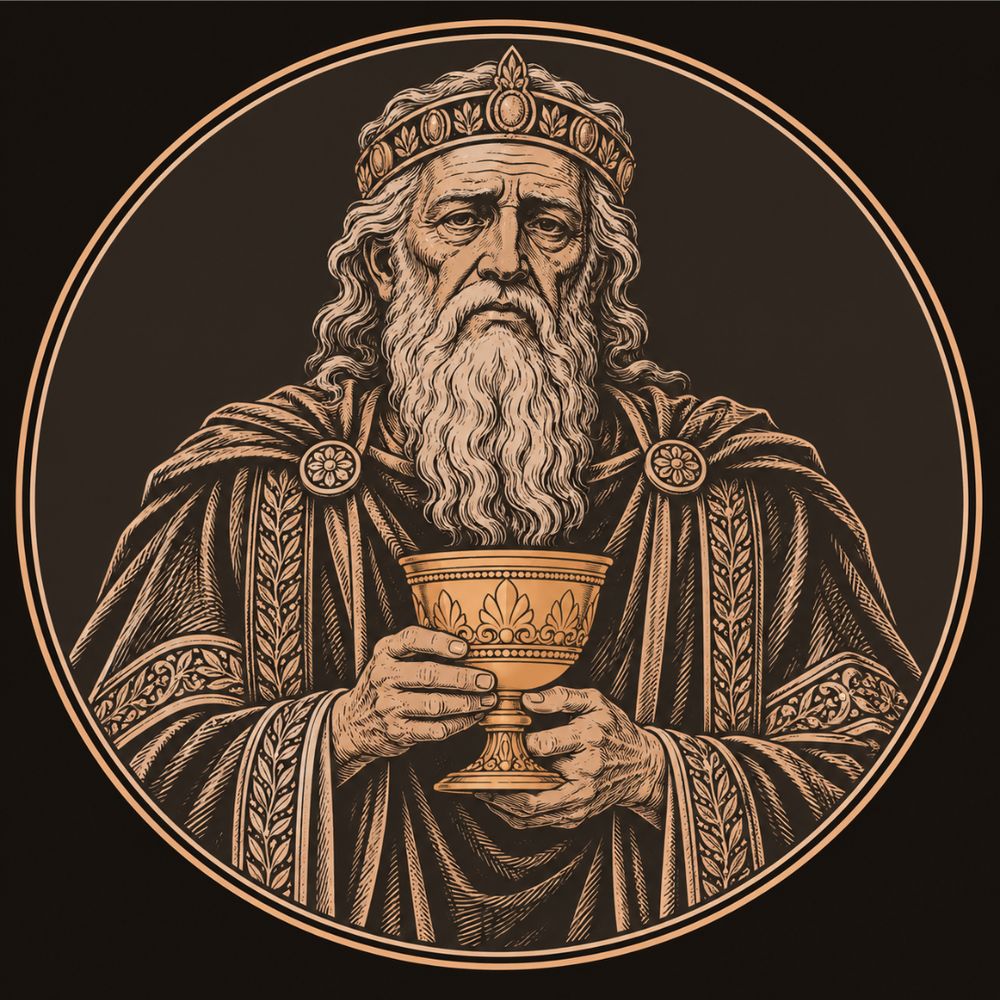
Priam, bronze medallion illustration
Generated by AI from this page's own facts, not an ancient image or evidence of anything. How this site uses generated images
Sections on this page
See Priam in the Greek family tree.
Core Myth
Priam was not always called Priam. Apollodorus says that when Heracles took Troy, he shot down King Laomedon and all his sons except the youngest, Podarces. He gave Laomedon's daughter Hesione to Telamon and let her take one captive with her. She chose her brother. Heracles ruled that the boy must first be a slave and then be ransomed. When he was sold, Hesione paid with the veil from her head, and from then on Podarces was called Priam.
Apollodorus says Priam came to the throne after that sack. His first wife, Arisbe, bore him Aesacus, an interpreter of dreams. Priam then gave Arisbe to Hyrtacus and married Hecuba, whose first son was Hector. Before her second child was born, Hecuba dreamed she gave birth to a firebrand that burned the whole city. Aesacus read the dream as ruin for Troy, and Priam had the newborn exposed on Mount Ida. The child survived and grew up to be Paris.
Homer's Iliad shows Priam as an old king who no longer fights. He sits with the elders at the Scaean gates when Helen comes onto the wall. He calls her to sit beside him, tells her she is not to blame, and says the gods roused the war against him. Then he asks her to name the Greek chiefs on the plain, among them Agamemnon and Odysseus. He recalls once fighting as an ally of the Phrygians on the Sangarius, on the day the Amazons came.
In Book 22, Priam is the first to see Achilles racing toward the city. From the wall he begs Hector to come inside. Achilles has already made him bereft of many sons, he says, and two more, Lycaon and Polydorus, are missing. He foresees his own end: sons killed, daughters dragged away, and himself torn at his door by the dogs he fed at his table. Hector does not listen.
After Hector's death, Zeus sends Iris to tell Priam to ransom the body, going alone but for an old herald. Hecuba begs him not to go. Priam loads a wagon with robes, ten talents of gold, tripods, cauldrons and a precious cup from Thrace. Hermes, in the likeness of a young prince, guides him through the Greek camp by night. Inside Achilles's hut, Priam clasps his knees and kisses the hands that killed his sons.
Priam asks Achilles to remember his own father, Peleus, who is as old as he is. Achilles weeps for Peleus and for Patroclus while Priam weeps for Hector. Achilles has the body washed and returned, eats with Priam, and grants a truce for the funeral: nine days of mourning, the burial on the tenth, the mound on the eleventh. Hermes wakes Priam before dawn and leads him out. His daughter Cassandra is the first in Troy to see him return.
In the Iliad, how did Priam die?
He does not die in the Iliad. The poem ends with Hector's funeral while Priam is still king. It gives him a foreboding instead: in Book 22 he pictures himself struck down at his door and torn by the dogs he reared at his table. The death itself comes from later works. Apollodorus's Epitome, Euripides and Virgil all make Achilles's son Neoptolemus the killer, at an altar inside Troy.
Homer, Iliad 22.25-78
How many children did Priam have besides Hector?
In the Iliad, Priam tells Achilles he had fifty sons when the Greeks came, nineteen born to one mother and the rest to women of the palace. Hector was one of the fifty. Apollodorus names them instead: Aesacus by his first wife Arisbe, ten sons and four daughters by Hecuba, and thirty-six more sons and four more daughters by other women. Hecuba's daughters include Cassandra and Polyxena. Apollodorus adds that Troilus was said to be a son of Apollo, not of Priam.
Homer, Iliad 24.493-497
In Homer's Iliad, why did Priam choose to go to Achilles instead of Agamemnon to ask for his son's body back?
Because Achilles held the body and Zeus sent Priam to him. Achilles had killed Hector and kept the corpse by his ships. Zeus tells Thetis to have her son accept a ransom, then sends Iris to order Priam to go to Achilles alone, with only an old herald. Agamemnon was a danger, not a help. Before dawn Hermes warns Priam that if Agamemnon learned he was in the camp, his surviving sons would have to pay three times the ransom to free him.
Homer, Iliad 24.143-158
Why didn't Priam just send Helen back the moment she arrived to Troy?
The Iliad puts the refusal on Paris. In Book 7, the Trojan elder Antenor proposes giving Helen and her treasure back to the sons of Atreus. Paris refuses to give up his wife but offers the treasure, with more from his own store. Priam does not overrule him. He sends the herald Idaeus to the Greeks with Paris's offer and a request for a truce to burn the dead. Idaeus adds that the Trojans themselves were urging Paris to give her up.
Homer, Iliad 7.345-397
Who does Priam blame for the Trojan War?
The gods. Sitting on the wall of Troy in Iliad Book 3, Priam calls Helen dear child and tells her she is nowise to blame in his eyes. It is the gods, he says, who roused the tearful war of the Achaeans against him. He says it just after the city's elders murmur that she should be sent away on the ships. In Book 24 he tells the Trojans crowding his portico that Zeus has brought this sorrow on him.
Homer, Iliad 3.161-165
What was the fate of Priam's family after the fall of Troy?
Most of it was destroyed. Apollodorus's Epitome says Neoptolemus killed Priam at the altar, Menelaus killed his son Deiphobus, and the Locrian Ajax violated his daughter Cassandra at the image of Athena. In Euripides's Trojan Women, Hecuba says she saw her sons slain and Priam butchered on his own hearth, and that she will be taken to Greece as a slave. In Euripides's Hecuba, their youngest son Polydorus, sent to Thrace for safety, is murdered by his host for the gold.
Euripides, Trojan Women 470-500
Later Traditions
The Iliad ends with Hector's funeral, before Troy falls, so Priam's death comes from later works. Apollodorus's Epitome says Neoptolemus killed him where he had taken refuge, at the altar of Zeus of the Courtyard. Euripides agrees in two plays. In the Trojan Women, Poseidon says Priam lies dead at the altar of the god who guarded his house, Zeus Herkeios in the Greek. In the Hecuba, the ghost of Polydorus says his father fell butchered at the god-built altar by Achilles's son.
Virgil turns the death into a full scene. In Aeneid Book 2, the aged king straps on armor he can no longer carry, and Hecuba draws him to an altar in the palace court. Neoptolemus, called Pyrrhus, kills their son Polites before his father's eyes. Priam curses him, saying Achilles showed more respect to a suppliant, and throws a spear that barely sticks in his shield. Pyrrhus drags the old king through his son's blood and drives the sword in to the hilt. Virgil leaves the headless body unburied on the shore. Earlier in the same book, Priam has the captive Sinon unbound and tells him he will be one of the Trojans.
Not every poet put the killing at the altar. Pausanias reports that the poet Lescheos said Priam was dragged away from the altar and killed by Neoptolemus at the gate of his own palace. Elsewhere Pausanias records a saying, the Punishment of Neoptolemus: the man who killed Priam at the altar of Zeus Herkeios was himself killed beside Apollo's altar at Delphi.
Priam's children are counted differently too. In the Iliad he tells Achilles he had fifty sons, nineteen from one mother and the rest from women of the palace. Apollodorus names his children instead of giving a total, and even single sons move between mothers. Homer's Priam names Laothoe as the mother of Lycaon and Polydorus, but Euripides and Apollodorus make Polydorus a son of Hecuba. In Euripides's Hecuba, Priam sends that youngest son to his Thracian guest-friend Polymestor with gold, and Polymestor murders him for it once Troy has fallen.
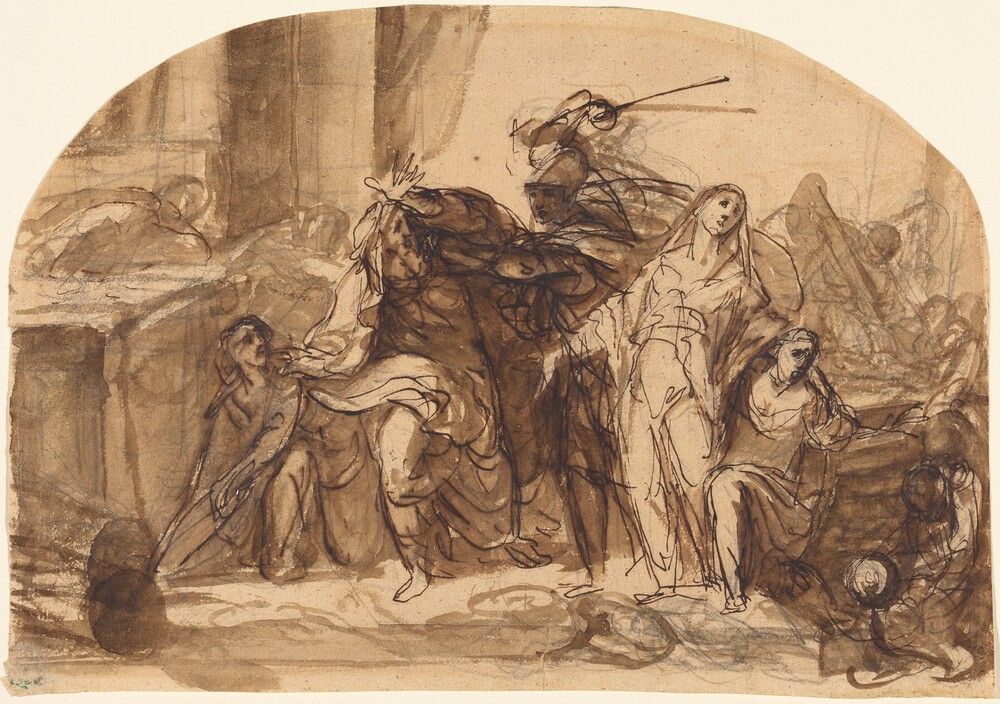
The Death of Priam - Michael Lukas Leopold Willmann, c. 1660, pen and brown ink with brown washes over graphite on tan laid paper
National Gallery of Art, Washington, DC, 1992.16.1. CC0
Lineage
See the full family tree2 recorded relations, each with the ancient line behind it.
Children
-
Hector was the first child Hecuba bore. In Iliad Book 22 Priam begs him from the wall not to face Achilles alone.
-
After Hecuba dreamed she bore a firebrand that burned the city, Priam had the newborn exposed on Mount Ida.
Also Connected
9 recorded connections, each with the ancient line behind it.
Allies
-

Sent by Zeus, Hermes guides Priam through the Greek camp by night and reveals himself at Achilles's hut.
Connected
-

Priam kisses the hands that killed his sons and ransoms Hector's body. Achilles weeps with him, for Peleus and for Patroclus.
-
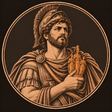
Homer says Aeneas bore a grudge against Priam, who did not honour him for all his bravery.
-
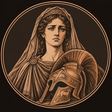
Andromache came from Thebe to Priam's house with a rich dowry as Hector's bride, and so became Priam's daughter-in-law.
-
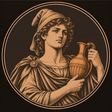
Both belong to the Trojan royal house. In Homer's genealogy Ganymede is a brother of Ilus, grandfather of Priam.
-
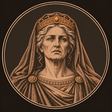
Hecuba is Priam's wife and queen. When he resolves to ransom Hector from Achilles, she tells him his heart is iron and begs him to stay.
-
On the wall of Troy, Priam tells Helen he does not blame her for the war and asks her to name the Greek chiefs.
-

Heracles took Troy and killed Laomedon with his other sons, but spared Podarces, whom Hesione ransomed with her veil.
-
In Virgil, Sinon is brought bound before Priam, who orders him unbound and asks what the horse means. Sinon's false answer persuades the Trojans to take it in.
Where Accounts Differ
- where Neoptolemus killed Priam
- how many sons Priam had
- who was the mother of Polydorus
- who was Hecuba's father
- Priam's death absent from the Iliad
- Where Priam died differs by source. Apollodorus (Epitome 5.21) and Euripides (Trojan Women 15-17, Hecuba 22-24) place his death at the household altar of Zeus Herkeios, and Pausanias (4.17.4) repeats that tradition. Virgil (Aeneid 2.506-558) has Pyrrhus drag him to the altar in the palace court and kill him there. Pausanias (10.27.2) reports that the poet Lescheos had him dragged away from the altar and killed at his palace gate.
- The Iliad (24.493-497) gives Priam fifty sons, nineteen by one mother. Apollodorus (Library 3.12.5) names forty-seven sons in all and says Troilus was said to be Hecuba's son by Apollo.
- Polydorus has two mothers. In the Iliad (22.46-48) he is Laothoe's son, while Euripides (Hecuba 1-30) and Apollodorus (Library 3.12.5) make him Hecuba's. In Iliad Book 22 Priam cannot find him among the Trojans in the city; in Euripides he is murdered in Thrace by Polymestor.
- Hecuba's father is named differently. Euripides (Hecuba 1-30) calls her daughter of Cisseus, and Apollodorus (Library 3.12.5) offers Dymas, Cisseus, or the river Sangarius.
- The Iliad does not narrate Priam's death. His own speech in Book 22 foresees it, and the accounts of the killing all come from later works.
Read the full source verification →
Mythology
Appears In
Related Terms
Referenced By
Sources
- Homer, Iliad 3.146-244
- Homer, Iliad 3.161-165
- Homer, Iliad 7.345-397
- Homer, Iliad 13.459-461
- Homer, Iliad 22.25-78
- Homer, Iliad 22.59-76
- Homer, Iliad 24.143-158
- Homer, Iliad 24.159-227
- Homer, Iliad 24.228-262
- Homer, Iliad 24.334-467
- Homer, Iliad 24.477-551
- Homer, Iliad 24.493-497
- Homer, Iliad 24.552-676
- Homer, Iliad 24.677-706
- Apollodorus, Library 2.6.4
- Apollodorus, Library 3.12.5
- Apollodorus, Epitome 5.21
- Apollodorus, Epitome 5.22
- Virgil, Aeneid 2.506-558
- Virgil, Aeneid 2.145-150
- Euripides, Hecuba 1-30
- Euripides, Trojan Women 15-17
- Euripides, Trojan Women 470-500
- Pausanias, Description of Greece 10.27.2
- Pausanias, Description of Greece 4.17.4