Ganymede
Ganymede was a prince of Troy, a son of Tros in Homer, whom the gods carried up to Olympus for his beauty to serve as Zeus's cupbearer. The Homeric Hymn to Aphrodite says Zeus took him in a whirlwind and made him deathless and unageing. Ovid has Zeus seize him in the form of an eagle. His father received divine horses as recompense.
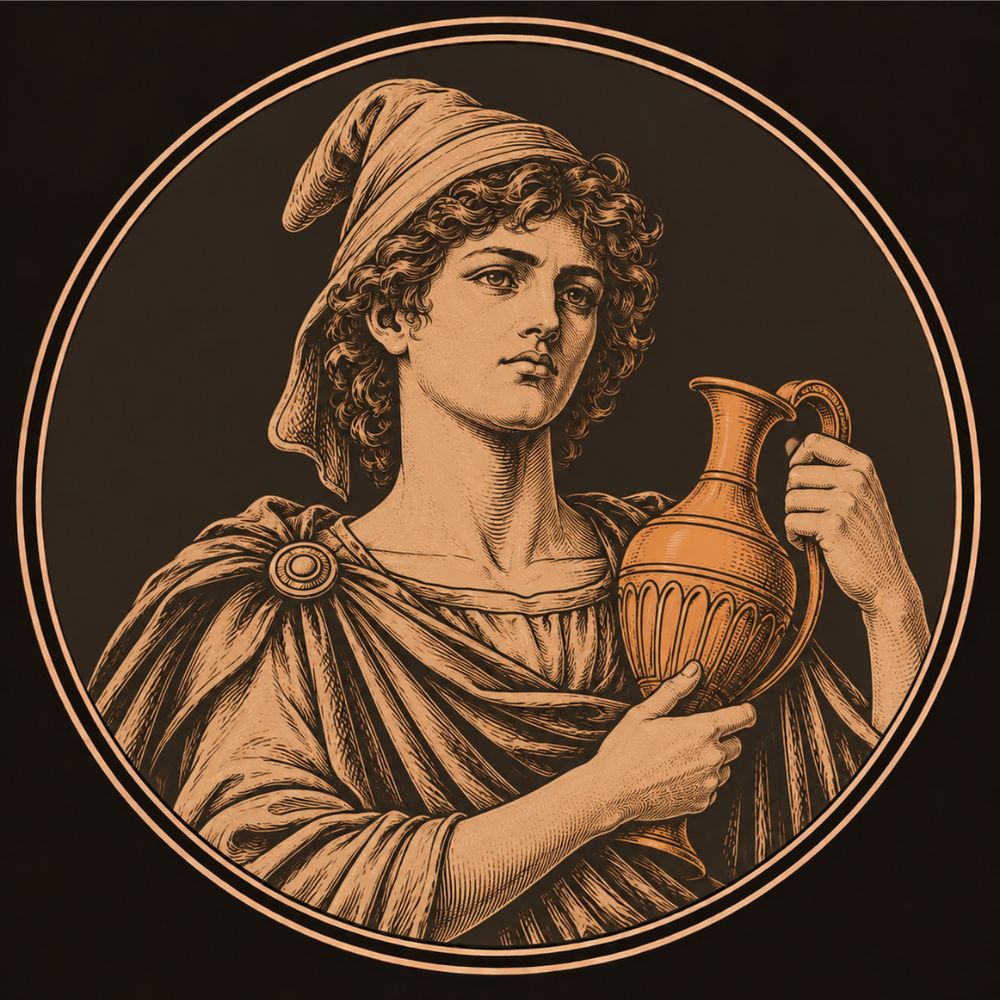
Ganymede, bronze medallion illustration
Generated by AI from this page's own facts, not an ancient image or evidence of anything. How this site uses generated images
Sections on this page
Core Myth
Ganymede belongs to the royal house of Troy. In Iliad Book 20, Aeneas recites the line to Achilles: Dardanus, son of Zeus, then Erichthonius, then Tros. Tros had three sons, Ilus, Assaracus and godlike Ganymede, who was born the fairest of mortal men. Ilus's line runs down to Priam, and Assaracus's to Anchises and Aeneas. Homer lists no children for Ganymede.
Homer tells his fate in one sentence. Because of his beauty, Aeneas says, the gods caught him up on high to be cupbearer to Zeus and to dwell with the immortals. The Iliad names the gods as a group here, not Zeus alone. The same poem also shows Hebe pouring nectar for the gods as they sit in council at the start of Book 4.
The Homeric Hymn to Aphrodite tells the story at more length. Aphrodite tells it to Anchises as proof that his family is the most godlike of mortals. Wise Zeus, she says, carried off golden-haired Ganymede for his beauty. He was to live among the deathless gods, honored by all of them, and draw red nectar from a golden bowl in the house of Zeus. His father Tros did not know where the heaven-sent whirlwind had taken his son, and mourned him without end.
Zeus pitied Tros and gave him high-stepping horses, the kind that carry the immortals, as recompense for his son. At Zeus's command, Hermes, the slayer of Argus, told Tros that his son would be deathless and unageing, like the gods. Tros stopped mourning and drove his storm-footed horses with joy. The hymn then turns to Eos and Tithonus, another Trojan taken by a god, whose immortality came without youth.
The horses outlast the story. In Iliad Book 5, Diomedes tells Sthenelus to seize the horses of Aeneas, because they come from the stock Zeus gave Tros as recompense for Ganymede, the best horses under the dawn and the sun. Anchises had secretly put his mares to that stock without the knowledge of Laomedon, and gave two of the foals to Aeneas.
Why did Zeus fall in love with Ganymede?
For his beauty, in every ancient account, though the oldest ones do not call it love. In Iliad Book 20, Aeneas says the gods caught Ganymede up because he was the fairest of mortal men, to pour wine for Zeus and live among the immortals. The Homeric Hymn to Aphrodite makes it Zeus's own act, for the same reason. Later writers add desire. Ovid says Zeus burned with love for him, and Plato's Phaedrus speaks of Zeus in love with Ganymede.
Homeric Hymn to Aphrodite 202-217
How did Zeus compensate Ganymede's parents?
With horses, in the oldest sources. The Homeric Hymn to Aphrodite says Zeus pitied the grieving Tros and gave him high-stepping horses like those that carry the gods. He also sent Hermes to tell Tros that his son would be deathless and unageing. The Iliad remembers the same gift in Book 5, where Aeneas's horses descend from it. A fragment of the Little Iliad names a different gift: a golden vine made by Hephaestus, given to Laomedon.
Homer, Iliad 5.265-267
Who are Ganymede's parents?
His father is usually Tros, the king who gave Troy its name. The Iliad makes Ganymede the third son of Tros, beside Ilus and Assaracus. Apollodorus agrees and names his mother as Callirrhoe, a daughter of the river Scamander. A second tradition makes him a son of Laomedon instead. Euripides's chorus in the Trojan Women calls him that, and so does the Little Iliad fragment about the golden vine.
Apollodorus, Library 3.12.2
Was Hera jealous of Ganymede?
In Roman poetry, yes; in the early Greek sources checked here, no. Homer and the Homeric Hymn to Aphrodite describe no jealousy and present his service as an honor. The resentment comes from Roman poets. Virgil opens the Aeneid by listing Juno's grievances against Troy, and one of them is the honor given to the stolen Ganymede. Ovid says Ganymede still serves nectar to Jupiter against Juno's will.
Virgil, Aeneid 1.28
Where was Ganymede abducted?
On Mount Ida, near Troy, in Virgil's version. A cloak described in Aeneid Book 5 shows the young prince hunting deer with a javelin on the wooded slopes of Ida when Jupiter's eagle snatches him up. His old guardians and his hounds are left below. Homer and the Homeric Hymn to Aphrodite do not name a place. Ovid calls him only a Phrygian, meaning a Trojan.
Virgil, Aeneid 5.250-257
Later Traditions
Later accounts give the abduction to an eagle, and they do not agree on who the eagle was. A papyrus fragment of the Hesiodic Catalogue of Women says an eagle caught up Ganymede for Zeus. Apollodorus says Zeus carried him up on an eagle and appointed him cupbearer of the gods in heaven. In Ovid's Metamorphoses, Zeus turns himself into the eagle, the one bird able to bear his thunderbolts, and snatches the Trojan boy himself.
Virgil gives the scene a place. In Aeneid Book 5, Aeneas awards a cloak woven with the story. Young Ganymede chases deer with a javelin through the forests of Mount Ida, until the armor-bearing eagle of Jupiter swoops down and carries him off in its talons. His aged guardians stretch their hands to the sky in vain, and his hounds bark at the air.
Homer and the Hymn speak of beauty and service. Other writers make Zeus a lover. Ovid says the king of the gods once burned with love for Ganymede. Pindar's first Olympian Ode sets him beside Pelops, whom Poseidon, overcome with desire, carried to the house of Zeus, where Ganymede later came to perform the same service. In Plato's Phaedrus, Socrates names the stream of desire after Zeus's love for Ganymede. The Athenian speaker in Plato's Laws says everyone accuses the Cretans of inventing the Ganymede story to excuse their own practice.
Hera's resentment belongs mostly to the Roman poets. Virgil counts the honors paid to the stolen Ganymede among the grievances that feed Juno's anger at the Trojans. Ovid ends his version by saying that Ganymede still mixes the cups and serves nectar to Jupiter, against Juno's will.
Not every source makes Tros his father. In Euripides's Trojan Women, the chorus calls Ganymede the son of Laomedon, filling Zeus's cups while his homeland burns in the Trojan War. A fragment of the Little Iliad, quoted by an ancient commentator on that passage, has Zeus give Laomedon a golden vine made by Hephaestus as the price for Ganymede. Apollodorus keeps Tros as the father but puts the divine mares in Laomedon's hands. Laomedon promised them to Heracles for saving his daughter Hesione, then refused to pay.
Modern Influence
Ganymede's name reached the night sky twice. The Astronomica attributed to Hyginus reports that many people identified the constellation Aquarius, the water-pourer, with him. In January 1610, Galileo observed the moons of Jupiter. Simon Marius, following a suggestion from Johannes Kepler, named them after the god's loves, and described Ganymede as the son of Tros carried to heaven by Jupiter in the form of an eagle. Ganymede is the largest moon in the solar system.
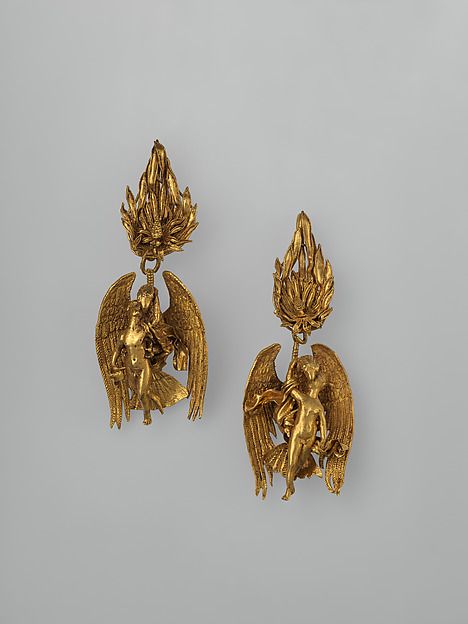
Pair of gold earrings with Ganymede and the eagle - Greek, ca. 330–300 BCE, Gold
Metropolitan Museum of Art, New York, NY, 37.11.9, .10. CC0
Also Connected
6 recorded connections, each with the ancient line behind it.
Enemies
-

Virgil counts the honors given to the stolen Ganymede among Juno's grievances against Troy. Homer and the Homeric Hymn to Aphrodite describe no such hostility.
Connected
-
Aeneas names Ganymede among the three sons of Tros when he recites his Trojan lineage to Achilles.
-

Aphrodite tells the story of Ganymede to Anchises as proof that his Trojan family is the most godlike of mortals.
-

Heracles saves Hesione for the mares Zeus gave in compensation for Ganymede, and Laomedon's refusal to hand them over leads to the first sack of Troy.
-
Both belong to the Trojan royal house. In Homer's genealogy Ganymede is a brother of Ilus, grandfather of Priam.
-

Zeus carries off Ganymede for his beauty to pour nectar for the gods, and has Hermes tell Tros that his son will be deathless and unageing.
Where Accounts Differ
- who carried Ganymede off: the gods, a whirlwind, an eagle, or Zeus as an eagle
- whether Ganymede's father was Tros or Laomedon
- whether the recompense was horses or a golden vine
- whether Zeus took Ganymede as cupbearer or as lover
- Hera's jealousy absent from the early Greek sources
- Who took Ganymede differs by source. The Iliad (20.231-235) says the gods caught him up. The Homeric Hymn to Aphrodite (202-217) makes it Zeus, and has Tros speak of a heaven-sent whirlwind. A papyrus fragment of the Hesiodic Catalogue of Women says an eagle caught him up for Zeus, and Apollodorus (Library 3.12.2) says Zeus carried him up on an eagle. Virgil (Aeneid 5.250-257) sends Jupiter's armor-bearing eagle. In Ovid (Metamorphoses 10.155-161), Zeus becomes the eagle himself.
- Ganymede's father is Tros in the Iliad (20.231-235), the Homeric Hymn to Aphrodite and Apollodorus (Library 3.12.2). Euripides's Trojan Women calls him the son of Laomedon; the Greek of line 822 names Laomedon, though the Perseus English translation renders it only as Phrygian boy. A fragment of the Little Iliad, quoted by a scholiast on that line, also connects him with Laomedon.
- The recompense differs. The Homeric Hymn to Aphrodite (202-217) and the Iliad (5.265-267) give Tros divine horses. The Little Iliad fragment gives Laomedon a golden vine made by Hephaestus. Apollodorus (Library 2.5.9) has the mares in Laomedon's keeping, promised to Heracles and withheld.
- Homer and the Homeric Hymn to Aphrodite present Ganymede's place on Olympus as service and honor. Ovid (Metamorphoses 10.155-161) and Plato's Phaedrus make Zeus his lover, and Plato's Laws reports that the Cretans were accused of inventing the story.
- Hera's anger is a Roman addition in the sources checked for this page: Virgil (Aeneid 1.28) and Ovid (Metamorphoses 10.155-161). The Iliad holds both figures without setting them against each other: Hebe pours nectar for the gods in council (4.1-4), and Ganymede is cupbearer to Zeus (20.231-235).
Read the full source verification →
Mythology
Appears In
Related Terms
Referenced By
Sources
- Homer, Iliad 20.231-235
- Homer, Iliad 5.263-273
- Homer, Iliad 4.1-4
- Homeric Hymn to Aphrodite 202-217
- Apollodorus, Library 3.12.2
- Apollodorus, Library 2.5.9
- Pindar, Olympian Ode 1.36-45
- Euripides, Trojan Women 820-839
- Virgil, Aeneid 1.28
- Virgil, Aeneid 5.250-257
- Ovid, Metamorphoses 10.155-161