The Trojan War
The Trojan War is the legendary ten-year siege of Troy fought by a coalition of Greek kings under Agamemnon, sparked by the Trojan prince Paris taking Helen from her husband Menelaus. Homer's Iliad, the fullest surviving account, actually narrates only a few weeks near the war's tenth year: the quarrel between Achilles and Agamemnon, Patroclus's death, and Hector's death.
Sections on this page
What Led To It
The war's cause lies further back than the siege itself. The Judgement of Paris is that cause: at a wedding feast the goddess Strife threw a golden apple marked 'for the fairest', and Zeus sent Hera, Athena and Aphrodite to the Trojan prince Paris to judge between them. Each goddess offered a bribe; Paris chose Aphrodite's promise of the most beautiful woman alive, which won him Helen, already married to the Spartan king Menelaus, and earned Troy the lasting hostility of the two goddesses he passed over. Homer's Iliad alludes to this judgement only once, in a single late passage calling Paris's choice a grievous folly that brought disaster on his own people; the connected story of the judgement and of Helen's journey to Troy survives complete only in the much later Apollodorus.
The Myth
Homer's Iliad opens in the tenth year of the siege, when Agamemnon, commander of the combined Greek army, is forced to give up his own captive to end a plague and seizes Achilles's prize Briseis instead. The insult drives Achilles to withdraw from the fighting, and the Greeks suffer badly without him. Diomedes, king of Argos, becomes one of the war's fiercest fighters in his absence: in a single day of fighting he wounds the goddess Aphrodite and taunts her openly, a feat no other mortal in the poem repeats. When the Trojan prince Hector kills Achilles's companion Patroclus, grief and rage bring Achilles back into the war. He kills Hector in single combat outside the city walls, drags the body behind his chariot, and only relents when King Priam comes in person to beg for his son's corpse - the scene on which the Iliad ends.
The Iliad ends before Troy actually falls and never narrates the war's last stroke. That account comes from Homer's own later Odyssey, which already treats the story as familiar when a bard sings of the making of the Horse of Wood, that Epeius built with Athena's help, and Odysseus dragged inside the city filled with armed men. Apollodorus's Epitome supplies the fuller version: the Greeks hid their best fighters inside the horse, burned their own camp, and pretended to sail home, leaving a single man, Sinon, to signal the fleet back once the Trojans had dragged the horse inside their walls and gone to sleep off a night of feasting.
What Followed
The war's end did not bring peace to its victors. Agamemnon returned to Mycenae only to be killed by Aegisthus, with his wife Clytemnestra's help, cut down at a feast in his own hall; Homer has Agamemnon's own shade describe the murder to Odysseus in the underworld, and later prose tradition adds the detail of a sleeveless, neckless robe that trapped his arms as he was struck down, and Apollodorus adds that his daughter Electra smuggled the young Orestes to safety in Phocis, from where he later returned to kill his father's murderers. Menelaus, by contrast, is one of the few major Greek leaders the war does not eventually kill: Homer's Odyssey has him take a slower, eight-year route home before a prophecy promises him the Elysian plain rather than an ordinary death. Odysseus's own return took ten more years and became the subject of Homer's Odyssey in full.
How much of the Trojan War does Homer's Iliad actually narrate?
Only a few weeks near the end of the war's tenth year. The poem opens with Agamemnon and Achilles's quarrel, covers the fighting that follows Achilles's withdrawal and return, and ends with Hector's funeral, where his wife Andromache leads the wailing and his mother Hecuba laments him. It never narrates the war's beginning, the wooden horse, or the fall of Troy itself, all of which the poem's first audience is assumed to already know.
Homer, Iliad, Book 1
What actually caused the Trojan War?
The mythic cause is the Judgement of Paris: the Trojan prince chose Aphrodite as fairest among three goddesses in exchange for the most beautiful woman alive, and she guided him to Helen, already married to the Spartan king Menelaus. Homer's Iliad only alludes to this judgement once, near its very end; the full connected story is preserved only in much later prose, chiefly Apollodorus.
Homer, Iliad 24.25-30
How did the Trojan War end?
After ten years of failed direct siege, the Greeks built a hollow wooden horse, hid their best fighters inside it, and pretended to sail home. The Trojans dragged the horse inside their own walls as a trophy; that night the hidden warriors climbed out and opened the gates to the returning army, and Troy fell.
Homer, Odyssey 8.492-495
Why did Achilles withdraw from the fighting, and what brought him back?
Agamemnon seized Achilles's war prize Briseis to replace a captive he had been forced to give up, a public insult that drove Achilles to pull himself and his soldiers out of the war. He returned only after his companion Patroclus, wearing Achilles's own armor, was killed by Hector - grief and rage at that death, not any change of heart toward Agamemnon, is what brings him back.
Homer, Iliad, Book 1
What did Diomedes do in the war that no other mortal in the Iliad matches?
In a single day's fighting, Diomedes wounds the goddess Aphrodite in the wrist as she carries her son Aeneas from the battlefield, then taunts her openly as she flees in pain. No other mortal fighter in the Iliad draws divine blood and lives to be named for it.
Homer, Iliad 5.330-352
Was Helen actually at Troy for the whole war?
Homer's Iliad and Odyssey both keep her at Troy throughout the siege. Herodotus reports a separate, rationalizing Egyptian tradition instead, in which the real Helen never reached Troy at all and spent the war under the protection of the Egyptian king Proteus, while the Trojans and Greeks fought for ten years over a woman who was never in the city.
Herodotus, Histories 2.112-2.120
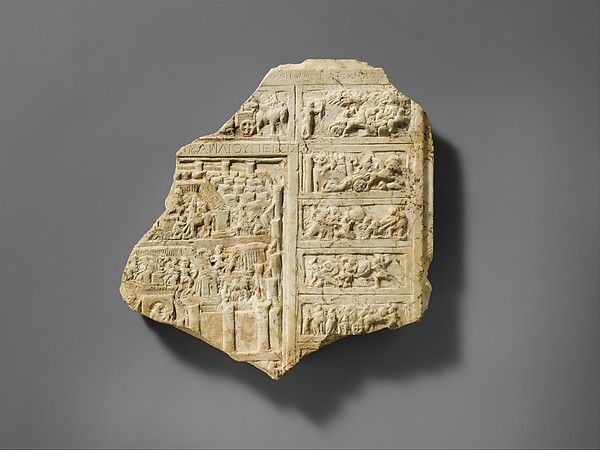
Marble relief fragment with scenes from the Trojan War - Roman, 1st half of 1st century CE, Marble, Palombino
Metropolitan Museum of Art, New York, NY, 24.97.11. CC0
Where Accounts Differ
- iliad-scope-vs-full-war
- helen-in-troy-vs-helen-in-egypt
- Homer's Iliad narrates only about fifty days near the end of the war's tenth year and never depicts the war's beginning (the Judgement of Paris, Helen's abduction) or its end (the wooden horse, the sack of Troy); those episodes survive complete only in much later prose, chiefly Apollodorus's Epitome, composed centuries after Homer.
- Herodotus reports a rival tradition in which Helen never reached Troy at all and spent the war in Egypt; this entry follows Homer's own account, in which she is at Troy throughout, and records the disagreement rather than resolving it.
Read the full source verification →
Mythology
Figures In This Myth
- Character Achilles
- Character Odysseus
- Character Agamemnon
- Character Diomedes
- Character Helen
- Character Hector
- Character Paris
- Character Menelaus
- Character Ajax
- Character Aeneas
- Character Clytemnestra
- Character Peleus
- Character Priam
- Character Electra
- Character Ganymede
- Character Patroclus
- Character Hecuba
- Character Iphigenia
- Character Orestes
- Character Andromache
- Character Neoptolemus
- Character Nestor
- Character Philoctetes
- Character Laocoön
- Character Sinon
Related Terms
Referenced By
Sources
- Homer, Iliad, Book 1
- Homer, Iliad, Book 18
- Homer, Iliad, Book 22
- Homer, Iliad, Book 24
- Homer, Iliad 5.330-352
- Homer, Iliad 24.25-30
- Homer, Odyssey 8.492-495
- Homer, Odyssey 11.409-434
- Apollodorus, Epitome 6.23-6.25
- Herodotus, Histories 2.112-2.120
- Timothy Gantz, Early Greek Myth (1993)