Patroclus
Patroclus was the son of Menoetius and the closest companion of Achilles at Troy. In Homer's Iliad he killed a boy over a game of dice as a child and was raised in Peleus's house beside Achilles. He later wears Achilles's armor into battle, kills Sarpedon, and is struck down by Apollo, Euphorbus and Hector. His death brings Achilles back into the war.
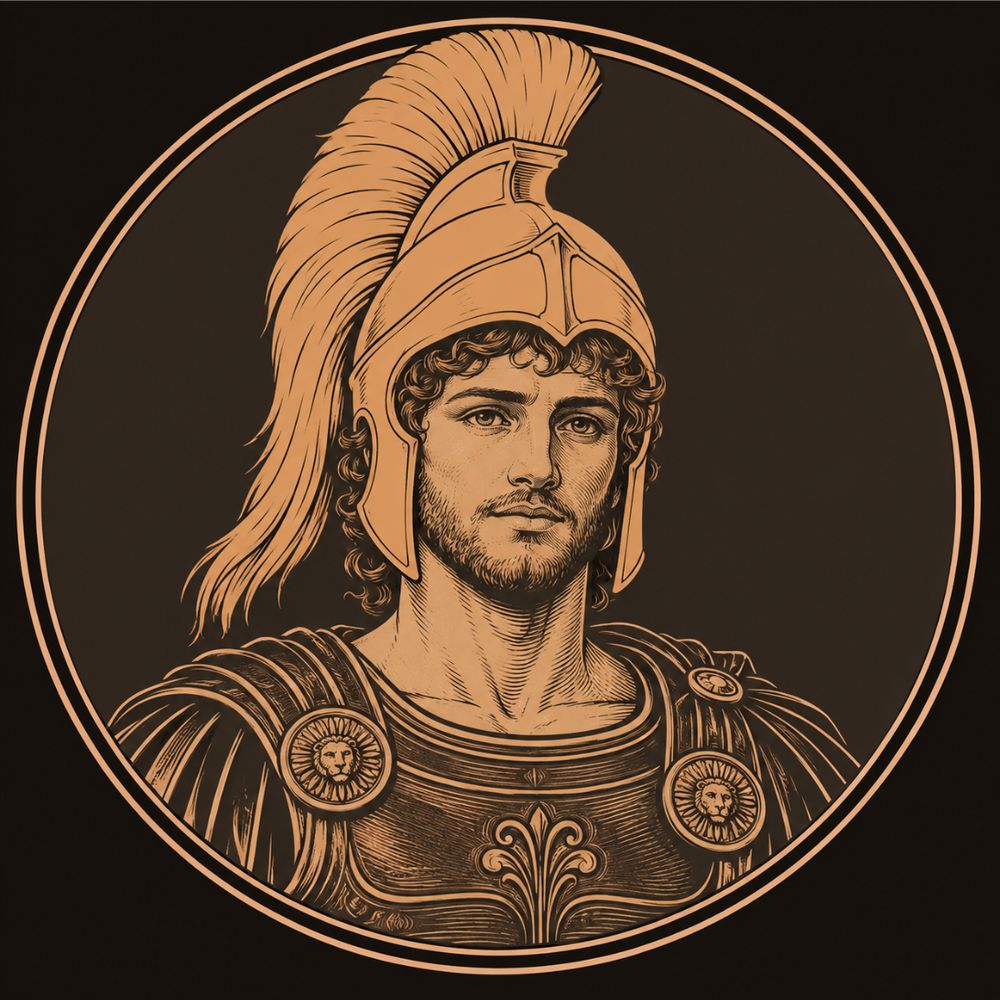
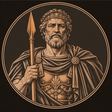
Patroclus, bronze medallion illustration
Generated by AI from this page's own facts, not an ancient image or evidence of anything. How this site uses generated images
Sections on this page
Core Myth
Patroclus came to Peleus as an exile. In Iliad Book 23 his ghost reminds Achilles why. As a little boy in Opus he killed the son of Amphidamas in anger over a game of dice, though he did not mean to. His father Menoetius brought him to Phthia, where Peleus reared him and named him Achilles's squire. Apollodorus's Library gives the dead boy a name, Clitonymus. Strabo reports that the people of Opus called him Aeanes.
In the Iliad Patroclus is Achilles's steadiest companion. In Book 1 he leads out Briseis when Agamemnon's heralds come to take her. In Book 9 he sits alone across from Achilles when the embassy arrives. In Book 11 Achilles sends him to Nestor, and the poet says this was the beginning of his doom. Nestor reminds him of Menoetius's parting advice: Achilles is higher in birth, but Patroclus is the elder and should counsel him.
Nestor also gives him the plan that kills him. If Achilles will not fight, Nestor says in Book 11, let him send Patroclus in his armor. The Trojans might take him for Achilles and draw back. In Book 16 Patroclus weeps before Achilles and calls him pitiless. Achilles lends him the armor and the Myrmidons, but orders him to come back once the Trojans are driven from the ships.
Patroclus does not come back. He drives the Trojans from the ships and kills Sarpedon, a son of Zeus. Then he chases the rout to the walls of Troy. Three times he climbs the wall and three times Apollo pushes him off. At the fourth attempt Apollo warns him that Troy is not fated to fall to him. Later, charging the Trojans a fourth time, Patroclus meets Apollo, who strikes him from behind and knocks the helmet from his head. Euphorbus spears him in the back, and Hector drives a spear into his belly.
Dying, Patroclus tells Hector that fate and Apollo killed him, and among men Euphorbus. Hector is only the third. He warns Hector that he will soon fall to Achilles. Menelaus stands over the body in Book 17, and the Greeks fight through Book 17 to carry it back. When Achilles hears the news in Book 18, he tells Thetis he wants to die at once, since he failed to help his friend.
Achilles returns to battle, kills Hector and gives Patroclus a hero's funeral. The ghost comes to him in Book 23 and asks for one thing: that their bones lie together in the golden urn Thetis gave. Achilles burns twelve Trojan youths on the pyre, and the Greeks gather Patroclus's bones into a golden urn. In the Odyssey's underworld, the ghost of Agamemnon tells Achilles that his bones now lie mingled with those of Patroclus.
Did Achilles love Patroclus?
Yes, and the Iliad shows it in his grief. When the news comes, Achilles pours dust over his head and lies stretched out in it. Homer never calls them lovers, though. He shows companions raised in one house, and Patroclus's ghost asks only that their bones share one urn. Later writers went further. Aeschylus's lost Myrmidons made them lovers, and Apollodorus's Library calls Patroclus Achilles's beloved.
Homer, Iliad 18.22-27
Who killed Patroclus in Greek mythology?
Hector deals the killing blow, but the Iliad shares the killing among three. Apollo strikes first, knocking off his helmet and armor. Euphorbus spears him in the back, and Hector finishes him with a spear thrust. Dying, Patroclus himself says fate and Apollo killed him, then Euphorbus, and that Hector is only the third. He had also ignored Achilles's order to turn back once the ships were safe.
Homer, Iliad 16.844-854
Why did Patroclus pretend to be Achilles?
To frighten the Trojans. He wears Achilles's armor so they will mistake him for Achilles, though he never claims the name in words. The idea is Nestor's. In Book 11 he tells Patroclus to ask for the armor, so the Trojans might draw back and let the tired Greeks recover. In Book 16 Patroclus repeats the request and Achilles grants it. Apollodorus's Epitome says the ruse worked: seeing him, the Trojans thought he was Achilles and fled.
Homer, Iliad 11.794-803
What was Patroclus known for?
For being Achilles's closest companion, and for dying in his place. In the Iliad he is gentle, and Briseis mourns him as a man who was always kind to her. His great day comes in Book 16. Wearing Achilles's armor, he drives the Trojans from the Greek ships and kills Sarpedon, a son of Zeus. He is killed at the walls of Troy, and his death sends Achilles back into the war to kill Hector.
Homer, Iliad 16.419-507
What was the age gap between Achilles and Patroclus?
No ancient source gives a number of years. The Iliad says only that Patroclus was the elder. His father Menoetius reminds him that Achilles is higher in birth, but Patroclus is older, so he should guide him with good advice. Plato's Symposium turns on the same point. Its speaker Phaedrus argues that Achilles, the younger and still beardless, must have been the beloved, not the lover as Aeschylus made him.
Homer, Iliad 11.786-787
Later Traditions
Homer names Patroclus's father, Menoetius son of Actor, and gives him Opus as a home. Apollodorus adds a mother, and cannot settle on one. She is Sthenele, daughter of Acastus, or Periopis, daughter of Pheres, or, as Philocrates says, Polymele, daughter of Peleus. The last would make Patroclus the nephew of Achilles's father. Pindar's ninth Olympian Ode adds a deed from outside the Iliad: Patroclus alone stood beside Achilles when Telephus routed the Greeks on the plain of Teuthras.
Whether the two were lovers is a question the ancient sources already argued. The Iliad calls them companions and never says more. Aeschylus's lost tragedy the Myrmidons made them lovers. Athenaeus quotes one of its lines, a reproach over too frequent kisses. In Plato's Symposium, the speaker Phaedrus accepts they were lovers but says Aeschylus has the roles backwards. Achilles, he argues, was the younger and beardless one, as Homer says.
Apollodorus's Library takes the later view as settled. After telling how Patroclus fled to Peleus, it says he became Achilles's beloved. Its Epitome retells Iliad Book 16 in brief: the Trojans took Patroclus for Achilles, he killed Sarpedon, and Hector killed him after Euphorbus wounded him first. Ajax, it adds, rescued the body with difficulty. The wider war is told in the Trojan War and the Trojan Cycle.
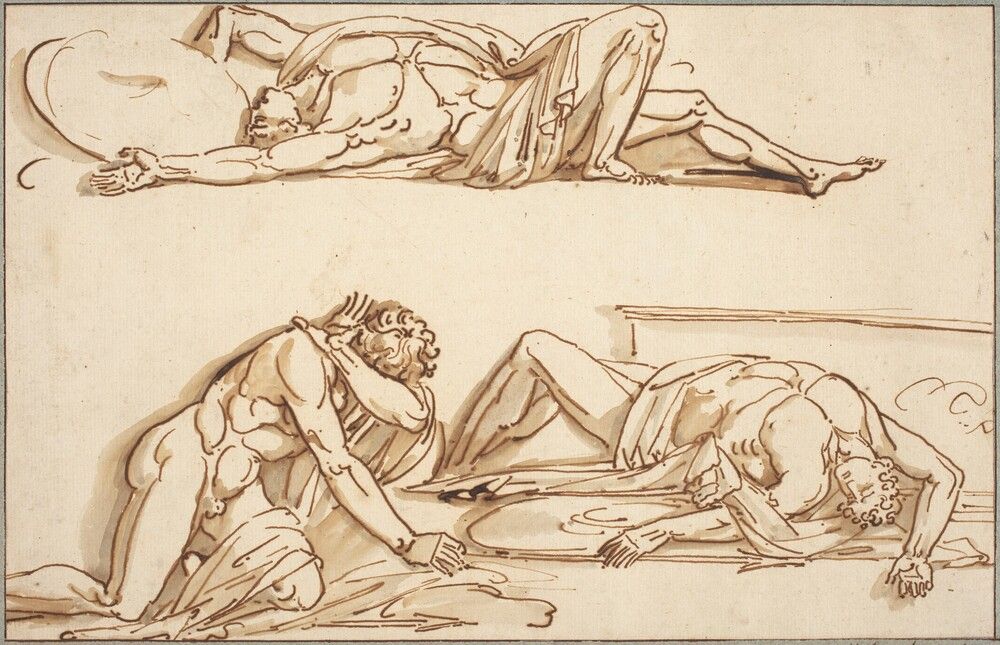
Achilles and Patroclus - Philippe-Auguste Hennequin, 1784/1789, pen and brown ink with brown and brown-gray wash on laid paper
National Gallery of Art, Washington, DC, 2009.70.141. CC0
Also Connected
7 recorded connections, each with the ancient line behind it.
Allies
-

Raised together in Peleus's house after Patroclus fled Opus, the two fight side by side at Troy. Patroclus's ghost asks Achilles that their bones share one golden urn.
-
In the fierce fight over Patroclus's corpse, Apollodorus says, Ajax rescued the body with difficulty.
-
Menelaus is the first to stand over Patroclus's body and defend it from the Trojans at the start of Iliad Book 17.
Connected
-

Apollo throws Patroclus back from the wall of Troy three times, then strikes him from behind and knocks off his helmet, leaving him open to Euphorbus and Hector.
-

Briseis mourns Patroclus as a man who was always kind to her and who promised to make her the wife of Achilles.
-
Nestor tells Patroclus to ask Achilles for his armor, so the Trojans might take him for Achilles and draw back.
-
When Menoetius brought the young exile from Opus, Peleus received Patroclus into his house, reared him and named him Achilles's squire.
Where Accounts Differ
- name of the boy Patroclus killed
- who was Patroclus's mother
- whether Patroclus and Achilles were lovers
- who killed Patroclus
- who rescued Patroclus's body
- The boy Patroclus killed is named differently. The Iliad (23.85-88) calls him only the son of Amphidamas. Apollodorus (Library 3.13.8) names him Clitonymus, and Strabo (Geography 9.4.2) says the people of Opus called him Aeanes.
- Patroclus's mother is not settled. Homer names only his father, Menoetius son of Actor (Iliad 11.785). Apollodorus (Library 3.13.8) offers Sthenele daughter of Acastus, Periopis daughter of Pheres, or, following Philocrates, Polymele daughter of Peleus.
- The Iliad does not call Patroclus and Achilles lovers. Aeschylus's lost Myrmidons did, as a line quoted by Athenaeus (Deipnosophists 13.79) shows, and Apollodorus (Library 3.13.8) calls Patroclus Achilles's beloved. In Plato's Symposium (179e-180a) the speaker Phaedrus says Aeschylus made Achilles the lover wrongly, since Achilles was the younger; the Iliad (11.786-787) calls Patroclus the elder.
- The Iliad (16.844-850) gives Patroclus three killers: Apollo, Euphorbus and Hector, with Hector third. Apollodorus (Epitome 4.6) names Euphorbus and Hector and leaves out Apollo.
- Who carried the body back differs in emphasis. In Iliad Book 17 Menelaus stands over the body and several Greeks fight for it. Apollodorus (Epitome 4.7) says Ajax rescued it with difficulty.
Read the full source verification →
Mythology
Appears In
Referenced By
Sources
- Homer, Iliad 1.337-347
- Homer, Iliad 9.190-191
- Homer, Iliad 11.602-604
- Homer, Iliad 11.785-789
- Homer, Iliad 11.794-803
- Homer, Iliad 16.33-45
- Homer, Iliad 16.64-96
- Homer, Iliad 16.419-507
- Homer, Iliad 16.698-711
- Homer, Iliad 16.786-857
- Homer, Iliad 17.1-11
- Homer, Iliad 18.95-100
- Homer, Iliad 18.324-327
- Homer, Iliad 19.287-300
- Homer, Iliad 23.65-92
- Homer, Iliad 23.175-176
- Homer, Iliad 23.243-254
- Homer, Odyssey 24.76-79
- Apollodorus, Library 3.13.8
- Apollodorus, Epitome 4.6
- Apollodorus, Epitome 4.7
- Pindar, Olympian Ode 9.70-79
- Strabo, Geography 9.4.2