Hector
Hector, eldest son of King Priam of Troy, commands the Trojan army throughout Homer's Iliad and is honored by both sides as the city's staunchest defender. He kills Achilles's companion Patroclus in battle, drawing the enraged Achilles back into the war; Achilles kills Hector in single combat outside Troy's walls and drags his body back to the Greek camp before Priam ransoms it.
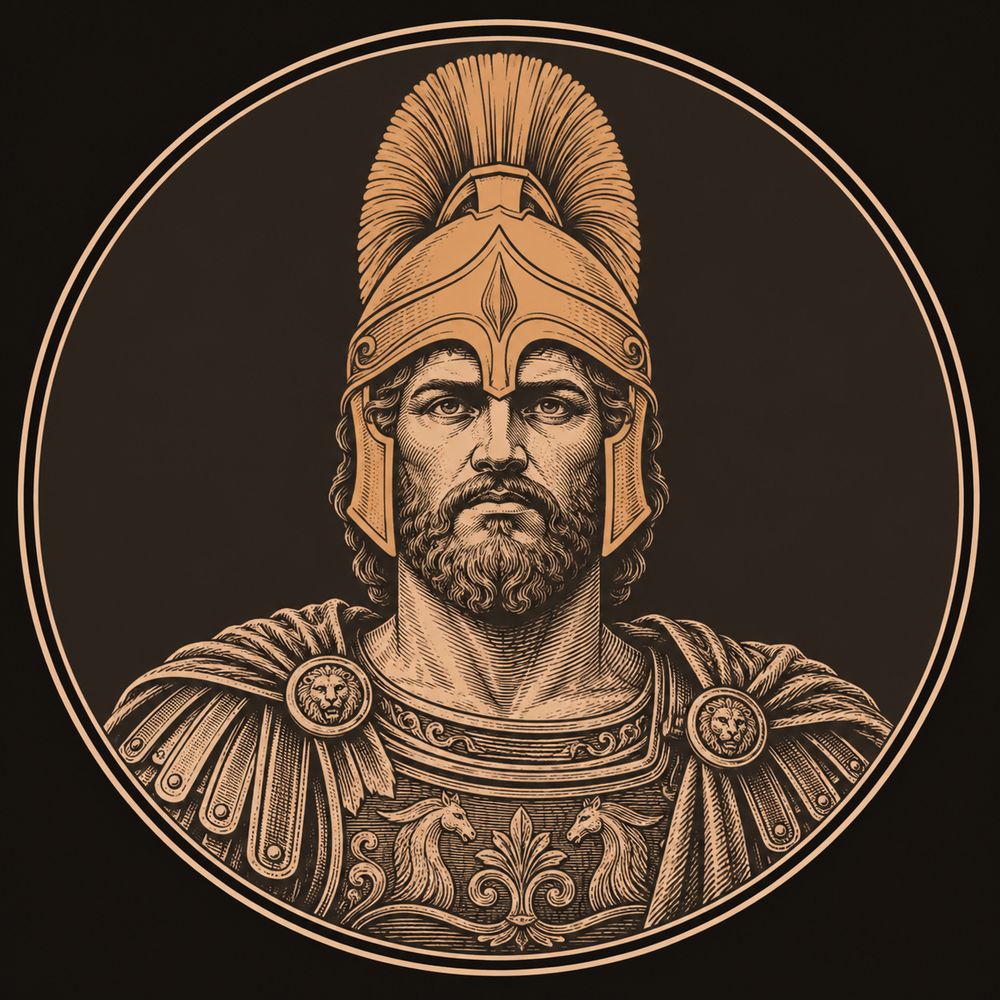
Hector, Bronze Medallion Illustration
Generated by AI from this page's own facts, not an ancient image or evidence of anything. How this site uses generated images
Sections on this page
See Hector in the Greek family tree.
Core Myth
Hector, eldest son of King Priam and Queen Hecuba, commands the Trojan army and is honored on both sides of the war as the city's greatest fighter and its last real defense. When Achilles withdraws from the fighting after his quarrel with Agamemnon, Hector drives the Greeks back toward their own ships and kills Achilles's companion Patroclus, who was wearing Achilles's own armor - though Patroclus's own dying words insist that the god Apollo and the spearman Euphorbus struck him down first, and Hector only delivered the final blow. Hector strips the armor from the body and boasts over him that even Achilles could not save him. That death draws Achilles back into the war with rage aimed squarely at Hector.
Earlier in the war, Hector fights a different Greek champion to a draw: a full day's single combat against Ajax, broken off at nightfall by heralds as an even match. Rather than parting as enemies, the two exchange gifts of respect, Hector's sword for Ajax's war-belt - the same sword Ajax later uses to kill himself, in a detail Homer's Iliad itself never mentions.
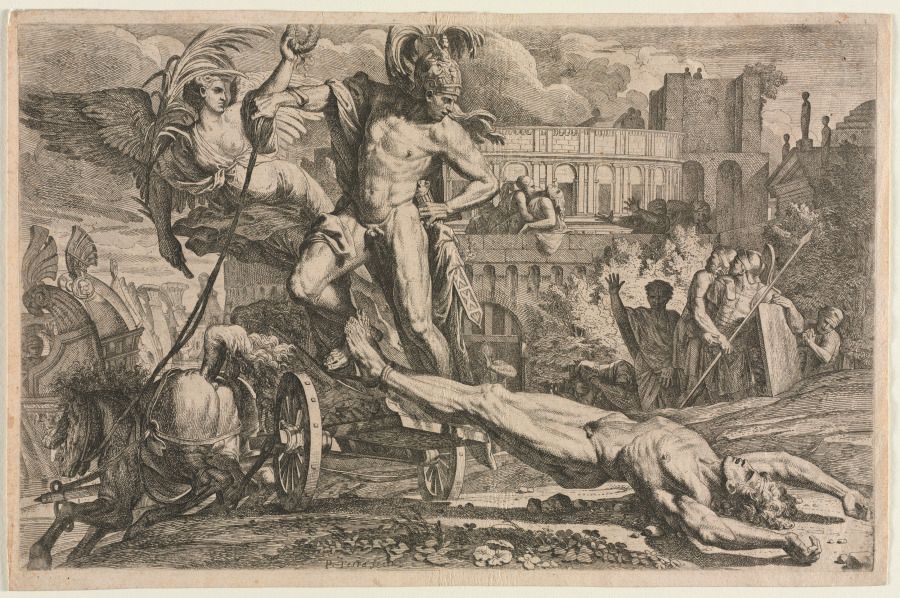
Achilles Dragging the Body of Hector - Italy, 1648, etching
The Cleveland Museum of Art, Cleveland, OH, 1981.95. CC0
Tricked by Athena, disguised as his brother Deiphobus, into standing his ground rather than retreating inside the walls, Hector finally faces Achilles alone; Achilles drives his spear through the one gap in Hector's armor, at the throat, and kills him, then ties the body to his chariot and drags it back to the Greek camp. King Priam eventually comes to Achilles's tent in person to beg for his son's corpse, and the Iliad ends with the Trojans burning Hector's body and burying his bones beneath a stone mound.
How does Hector actually die in the Iliad?
Athena disguises herself as Hector's brother Deiphobus and persuades him to stand and face Achilles rather than retreat inside the walls, then secretly abandons him once the fight begins. Achilles's first spear-throw misses, but his second finds the one gap in Hector's armor at the throat, and Hector falls, begging unsuccessfully for his body to be returned to his family.
Homer, Iliad 22.248-290
Did Hector really kill Patroclus single-handedly?
Not according to Patroclus's own dying words. As Patroclus lies fatally wounded, he tells Hector that the god Apollo struck the armor from his shoulders and the spearman Euphorbus wounded him first, and that Hector is only the third to strike him and finishes what the other two began.
Homer, Iliad 16.818-850
What did Achilles do to Hector's body immediately after killing him?
Achilles pierces the tendons of both of Hector's feet, ties the body to his chariot by the ankles, and drags it back toward the Greek camp in full view of the mourning Trojans watching helplessly from the city walls above.
Homer, Iliad, Book 22
How was Hector's body eventually returned to Troy?
After days of Achilles dragging the corpse around Patroclus's tomb, the gods intervene, and King Priam travels to the Greek camp in person, alone but for a herald, to beg Achilles for his son's body. Achilles, moved by the old man's grief, agrees to a truce and releases the body for burial.
Homer, Iliad, Book 24
How does Homer's Iliad end, as far as Hector is concerned?
The poem closes with Hector's funeral: nine days spent gathering wood, the body burned on the tenth, his bones gathered into a golden urn wrapped in purple cloth, and a mound raised over the grave while the Trojans hold a funeral feast in Priam's palace.
Homer, Iliad 24.776-800
Does the Iliad say what happened to Hector's family after Troy fell?
No. Homer's Iliad ends with Hector's funeral, years before the city itself falls, and never narrates the sack of Troy or the fate of his wife Andromache and infant son Astyanax. Those events survive only in much later prose summaries such as Apollodorus's Epitome.
Apollodorus, Epitome
Later Traditions
Homer's Iliad ends with Hector's funeral and never narrates the fall of Troy itself. The fate of his infant son Astyanax, thrown from the city walls after its capture so that he could never grow up to avenge his father, is preserved only in later summaries such as Apollodorus's Epitome, composed centuries after Homer, not in the Iliad itself.
Lineage
See the full family tree3 recorded relations, each with the ancient line behind it.
Parents
-

At Hector's death Hecuba leads the Trojan women's lament, calling him her boast night and day in the city.
-

Hector was the first child Hecuba bore. In Iliad Book 22 Priam begs him from the wall not to face Achilles alone.
Siblings
-

Both are sons of King Priam and Queen Hecuba of Troy; Hector publicly rebukes Paris for retreating from Menelaus rather than fighting the war he caused.
Also Connected
4 recorded connections, each with the ancient line behind it.
Allies
-
The seer Helenus tells Aeneas and Hector that the war-toil of the Trojans rests on them above all others; both descend from Tros, through Assaracus and Ilus.
Enemies
-

Hector's killing of Patroclus draws Achilles back into the war with rage aimed squarely at him, driving the Iliad's final books toward their duel.
-
Ajax and Hector fight a full day's single combat outside Troy that ends in a draw at nightfall; the two part as respectful enemies and exchange gifts, Hector's sword for Ajax's war-belt.
Connected
-

Andromache is Hector's wife. At the Scaean gate she begs him to stay on the wall, telling him he is now her father, mother, brother and husband.
Where Accounts Differ
- patroclus-death-hector-not-sole-killer
- astyanax-fate-absent-from-iliad
- Patroclus's own dying words in the Iliad credit the god Apollo and the spearman Euphorbus with striking him down first, naming Hector only as the third and final blow; this entry follows that account rather than treating Hector as Patroclus's sole killer.
- Homer's Iliad ends with Hector's funeral and never narrates the fall of Troy or the fate of his family; the death of his son Astyanax is preserved only in later summaries such as Apollodorus's Epitome, composed centuries after Homer.
Read the full source verification →
Mythology
Appears In
Related Terms
Referenced By
Sources
- Homer, Iliad 7.206-312
- Homer, Iliad 16.818-850
- Homer, Iliad, Book 22
- Homer, Iliad 22.248-290
- Homer, Iliad, Book 24
- Homer, Iliad 24.776-800
- Apollodorus, Epitome
- Timothy Gantz, Early Greek Myth (1993)