Paris
Paris, a son of King Priam of Troy, judged Aphrodite fairest of three goddesses for her promise of the world's most beautiful woman - Helen, already married to the Spartan king Menelaus. Taking Helen to Troy started the war. Paris survives Homer's Iliad, but later tradition has him kill Achilles with an arrow, then die the same way, shot by Philoctetes with Heracles's poisoned arrows.

Paris, Trojan prince and shepherd
Generated by AI from this page's own facts, not an ancient image or evidence of anything. How this site uses generated images
Sections on this page
See Paris in the Greek family tree.
Core Myth
Paris, also called Alexander, was a son of King Priam and Queen Hecuba of Troy. Before his birth, a prophecy warned that he would bring ruin on the city, and the infant was exposed on Mount Ida to die; shepherds raised him instead, and he grew up tending flocks with no idea of his royal birth. Years later, at the wedding of the mortal Peleus and the sea nymph Thetis, parents of the future Achilles, the goddess Strife threw down a golden apple marked "for the fairest," and Hera, Athena and Aphrodite each claimed it. Rather than judge between them himself, Zeus sent the three goddesses to Paris on Mount Ida. Each offered him a bribe in private: Hera promised kingship over all of Asia, Athena promised victory and wisdom in war, and Aphrodite promised him the most beautiful woman alive. Paris chose Aphrodite, the choice later called the Judgement of Paris, and sailed for Sparta to claim his prize.
In Sparta, King Menelaus welcomed Paris as a guest for nine days before leaving for Crete to attend his grandfather's funeral. With Menelaus away, Paris persuaded Helen, Menelaus's wife, to leave with him, taking a large share of the household's wealth and abandoning Helen's nine-year-old daughter Hermione. The two sailed for Troy by night. Menelaus's return to an empty palace became the occasion for a vast Greek coalition, led by his brother Agamemnon, to sail against Troy and win her back.
What was the Judgement of Paris?
At the wedding of Peleus and Thetis, the goddess Strife threw down a golden apple marked for the fairest, and Hera, Athena and Aphrodite each claimed it. Zeus sent the three to the Trojan prince Paris on Mount Ida to judge between them. Each offered a private bribe - kingship, victory in war, or the most beautiful woman alive - and Paris chose Aphrodite's offer, a decision that won him Helen and started the Trojan War.
Apollodorus, Epitome 3.2
Why did Paris choose Aphrodite over Hera and Athena?
Apollodorus's Epitome gives Paris a straightforward reason: of the three bribes on offer, kingship, military victory, and the most beautiful woman alive, he wanted Helen more than power or glory. Homer's Iliad treats the choice itself as settled history and only alludes to it once, calling it a grievous folly that brought disaster on Paris's own people rather than explaining his reasoning in detail.
Apollodorus, Epitome 3.2
Did Paris actually fight in the Trojan War?
Rarely, and not well by his own army's standards. Homer's Iliad shows him challenging the Greeks to single combat in Book 3, then retreating at the sight of Menelaus until his brother Hector shames him into fighting. Aphrodite rescues him mid-duel before Menelaus can kill him, and the Iliad gives him no other major combat scene, though later tradition credits him with killing Achilles.
Homer, Iliad 3.340-382
Did Paris really kill Achilles?
According to Apollodorus's Epitome, yes: Paris shoots Achilles in the heel at the Scaean Gate with Apollo guiding the arrow. Homer's Iliad ends before Achilles's death and never narrates it, so this account, along with the detail of a vulnerable heel, comes entirely from later tradition rather than from Homer himself.
Apollodorus, Epitome 5.3
How did Paris die?
Apollodorus's Epitome has the Greeks learn from the prophet Calchas that Troy cannot fall without the bow and poisoned arrows of Heracles, so Odysseus and Diomedes fetch their current owner, the archer Philoctetes, to the siege. Once cured of an old wound, Philoctetes shoots Paris with the same poisoned arrows, and the wound kills him not long before Troy itself falls.
Apollodorus, Epitome 5.8
Later Traditions
Homer's Iliad, set in the war's tenth year, gives Paris a mixed reputation. In Book 3 he challenges the Greeks to single combat, then quails and retreats at the sight of Menelaus advancing to fight him. His own brother Hector rebukes him for it in front of the whole army, telling him he should never have been born rather than bring shame like this on Troy. When the duel finally happens, Menelaus overpowers Paris quickly, but Aphrodite snaps his helmet strap at the last moment and carries him off in a mist to his own bedchamber, leaving Menelaus the technical victor but without his prize.
Later epic tradition credits Paris with a far greater kill than any he manages in the Iliad itself. Guided by the god Apollo, he shoots Achilles in the heel at the Scaean Gate, the blow that finally brings down Troy's greatest enemy - the death of Achilles, which the Iliad never reaches, since the poem ends before either man's death is narrated. Ancient audiences saw the killing as a lesser way to win a fight: Achilles had chosen a short life in exchange for undying kleos, the glory that came from dying in the front rank of battle, and Paris takes it from him with an arrow from a distance rather than a spear at close range. Paris's own end comes not long after in the same tradition. Calchas prophesies that Troy cannot fall without the bow and poisoned arrows of Heracles, so the Greeks fetch their old owner, the archer Philoctetes, to the siege, and he kills Paris with them, clearing one more obstacle before the Trojan Horse ends the war. A lost tragedy of Sophocles is said to have dramatized this final duel, though only Apollodorus's summary of the episode survives complete.
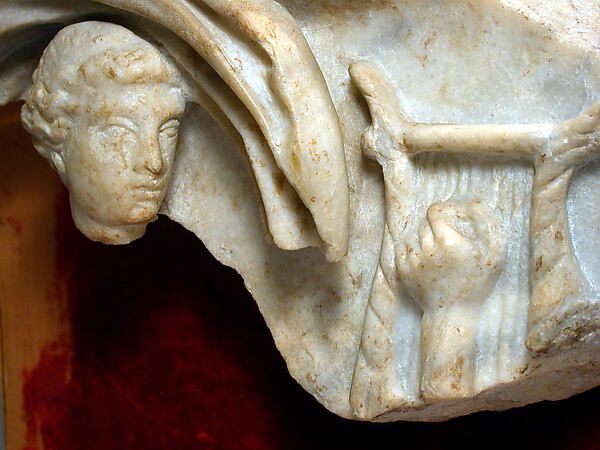
Marble sarcophagus fragment of "The Judgement of Paris" - Roman, ca. 3rd century CE, Marble
Metropolitan Museum of Art, New York, NY, 2021.40.5. CC0
Lineage
See the full family tree3 recorded relations, each with the ancient line behind it.
Parents
-

Before Paris was born, Hecuba dreamed she brought forth a firebrand that burned the city, and the baby was exposed on Mount Ida.
-

After Hecuba dreamed she bore a firebrand that burned the city, Priam had the newborn exposed on Mount Ida.
Siblings
-

Both are sons of King Priam and Queen Hecuba of Troy; Hector publicly rebukes Paris for retreating from Menelaus rather than fighting the war he caused.
Also Connected
2 recorded connections, each with the ancient line behind it.
Enemies
-

Paris's abduction of Menelaus's wife Helen makes the two archenemies for the whole war; they meet in single combat in Iliad Book 3, and only Aphrodite's rescue of Paris keeps Menelaus from killing him on the spot.
Connected
-

Paris persuades Helen to leave Sparta with him while her husband Menelaus is away in Crete, and the two live together at Troy for the length of the siege that follows.
Where Accounts Differ
- paris-death-philoctetes-arrow
- judgement-of-paris-allusion-vs-full-narrative
- Homer's Iliad never narrates the Judgement of Paris, Paris's abduction of Helen, or his own death; it alludes to the judgement only once, near the poem's end, and ends before either the death of Achilles or of Paris. The connected story of all three survives complete only in Apollodorus's much later Epitome.
- Ancient tradition credits Sophocles with a lost tragedy dramatizing Philoctetes's killing of Paris; only Apollodorus's brief summary of the episode survives today, and this entry follows that summary rather than the lost play.
Read the full source verification →
Mythology
Appears In
Related Terms
Referenced By
Sources
- Apollodorus, Epitome 3.2
- Apollodorus, Epitome 3.3
- Homer, Iliad 3.38-57
- Homer, Iliad 3.340-382
- Apollodorus, Epitome 5.3
- Apollodorus, Epitome 5.8
- Timothy Gantz, Early Greek Myth (1993)