The Judgement of Paris
The Judgement of Paris is the divine beauty contest that gives the Trojan War its mythic cause. At the wedding of Peleus and Thetis, three goddesses bribe the Trojan prince Paris for a golden apple marked "for the fairest," and his choice of Aphrodite's reward, Helen, sets the whole war in motion.
Sections on this page
What Led To It
The judgement's occasion is a wedding no one meant to trouble. Every Olympian is invited to the marriage of Peleus and Thetis except Eris, goddess of Strife, and her golden apple, tossed into the feast marked "for the fairest," is a calculated act of revenge for the snub rather than a random provocation. The dispute it starts among Hera, Athena and Aphrodite is settled only because Zeus, unwilling to judge his own wife and daughters, hands the decision to a mortal shepherd instead.
The Myth
At the wedding of the mortal Peleus and the sea nymph Thetis, parents of the future Achilles, every god and goddess is invited except Eris, the goddess of Strife, a deliberate slight she repays by throwing a golden apple marked "for the fairest" into the feast. Hera, Athena and Aphrodite each claim the apple as their own, and rather than judge between three goddesses himself, Zeus sends Hermes to lead them to a young man living as a shepherd on Mount Ida: Paris, a son of King Priam of Troy who had been exposed there as an infant after a prophecy warned he would bring ruin on the city.
Each goddess offers Paris a private bribe. Hera promises him kingship over all of Asia. Athena promises him victory and wisdom in war. Aphrodite promises him the most beautiful woman alive. Paris chooses Aphrodite's offer, a decision Homer's own Iliad calls a grievous folly that would cost his people dearly, and one that earns Troy the lasting hostility of the two goddesses he passed over for the rest of the war.
Aphrodite's promised prize is Helen, already married to the Spartan king Menelaus. Guided by the goddess, Paris sails to Sparta, is welcomed there as a guest, and leaves with Helen while Menelaus is away in Crete for his grandfather's funeral. That single choice on a mountainside becomes the mythic spark for the ten-year siege of Troy that follows.
What Followed
The Judgement's most direct consequence is the Trojan War itself, which grows out of Paris's abduction of Helen: Hera and Athena side firmly against Troy for the rest of the war because of the goddesses Paris passed over, while Menelaus and his brother Agamemnon lead the Greek coalition that besieges the city to win Helen back. Homer's Iliad treats all of this as settled background rather than plot, alluding to the judgement only once, in a single passage near the poem's own end.
What did the three goddesses each offer Paris in the Judgement of Paris?
Hera offered him kingship over all of Asia, Athena offered victory and wisdom in war, and Aphrodite offered him the most beautiful woman alive. Paris chose Aphrodite's bribe over the other two, a decision that won him Helen and, with her, the ten-year war fought to win her back.
Apollodorus, Epitome 3.2
Does Homer's Iliad tell the story of the Judgement of Paris directly?
No. The Iliad alludes to it only once, in a single passage near the poem's very end, calling Paris's choice a grievous folly that brought disaster on his own people. It never narrates the wedding, the golden apple, or the three goddesses' bribes, treating the whole episode as background its audience is assumed to already know.
Homer, Iliad 24.25-30
What happened right after Paris chose Aphrodite?
Guided by the goddess, Paris sailed to Sparta and was welcomed there as a guest of King Menelaus for nine days. When Menelaus left for Crete to attend his grandfather's funeral, Paris persuaded Helen to leave with him for Troy, taking a share of the household's wealth and abandoning her young daughter Hermione.
Apollodorus, Epitome 3.3
Why does the fullest account of the Judgement of Paris come from Apollodorus rather than Homer?
The earliest full telling of the wedding-feast quarrel likely belonged to the Cypria, an epic poem that once covered the events leading up to the Iliad but now survives only in fragments and later summaries. With that poem lost, Apollodorus's Epitome, composed centuries after Homer, is the earliest source that still tells the judgement as a connected story rather than a passing allusion.
How did the Judgement of Paris affect the rest of the Trojan War?
The two goddesses Paris passed over never forgive Troy for it. Hera and Athena work against the city for the whole ten-year war as a direct result of his choice, while Aphrodite, the goddess he favored, continues to protect Paris himself even after the fighting turns against him.
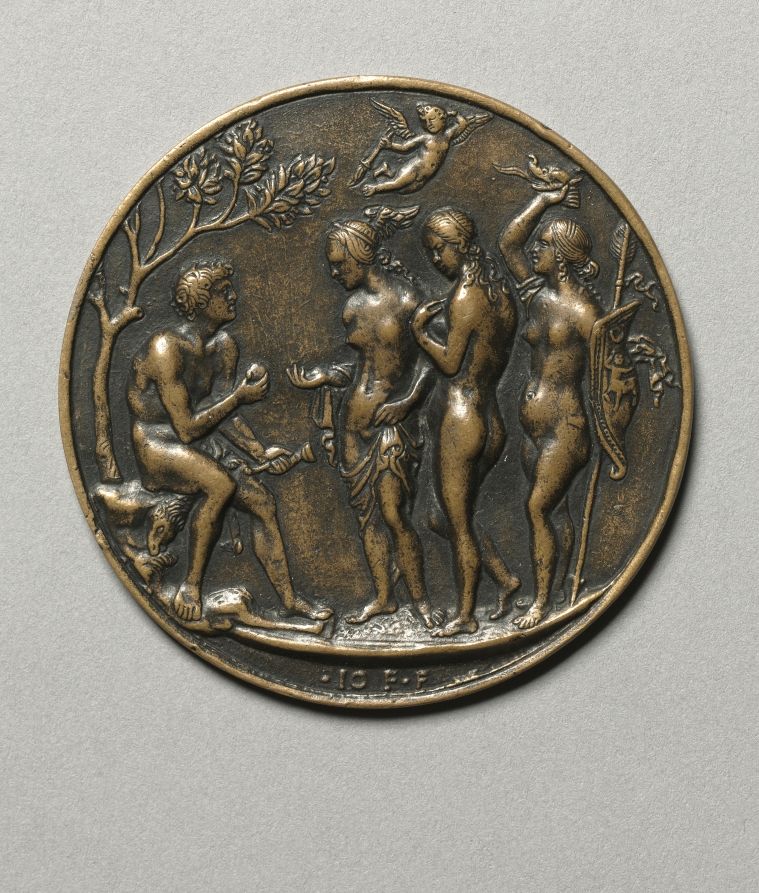
Judgment of Paris - Italy, Padua, early 16th century, c. 1505, bronze
The Cleveland Museum of Art, Cleveland, OH, 1984.54. CC0
Where Accounts Differ
- judgement-of-paris-allusion-vs-full-narrative
- Homer's Iliad alludes to the Judgement of Paris only once, in a single late passage near the poem's end, and never narrates the judgement itself. The connected story - the wedding, the golden apple, the three bribes - survives complete only in Apollodorus's much later Epitome; the earlier epic Cypria, which likely told it first, survives only in fragmentary summaries, not as a citable connected text.
- This entry follows Apollodorus's Epitome for the mechanics of the judgement, including the specific bribes and the nine days Paris spent as Menelaus's guest, since no earlier complete source for those details exists.
Read the full source verification →
Mythology
Figures In This Myth
Referenced By
Sources
- Apollodorus, Epitome 3.2
- Apollodorus, Epitome 3.3
- Homer, Iliad 24.25-30
- Timothy Gantz, Early Greek Myth (1993)