Atreus
Atreus is a mortal king of Mycenae, son of Pelops and father of Agamemnon and Menelaus, not a god. Apollodorus says he won the throne when the sun reversed its course, banished his brother Thyestes and served him his own sons at a banquet. Thyestes's son Aegisthus later killed him. Aeschylus makes his name the root of the family's curse.
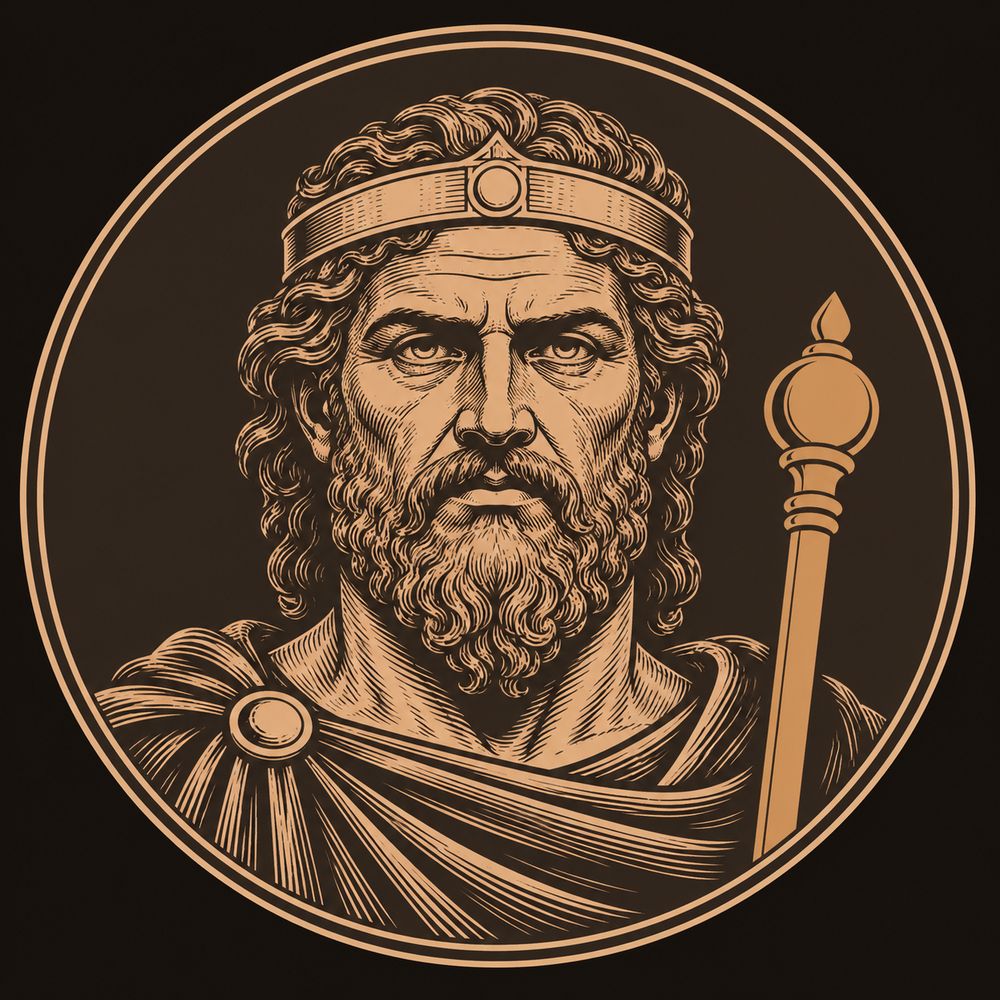
Atreus holding the sceptre of Mycenae
Generated by AI from this page's own facts, not an ancient image or evidence of anything. How this site uses generated images
Sections on this page
See Atreus in the Greek family tree.
Core Myth
Atreus belongs to the third generation of a family that Greek writers trace back to Tantalus. Euripides's Iphigenia in Tauris says Pelops came to Pisa with swift horses and married the daughter of Oenomaus, and that she bore Atreus, whose children are Menelaus and Agamemnon (Iphigenia in Tauris 1-41). Homer shows what he left to them. The sceptre that Hephaestus made went from Zeus to Hermes, from Hermes to Pelops, and from Pelops to Atreus, the shepherd of the host. At his death Atreus left it to Thyestes, and Thyestes left it to Agamemnon (Iliad 2.100-108). His family's later history is told on the page for the House of Atreus.
Apollodorus's Epitome tells how the sceptre passed between the brothers. Atreus's wife Aerope loved Thyestes. Atreus had vowed to sacrifice the best of his flock to Artemis, and when a golden lamb appeared he failed to keep the vow (Epitome 2.10). He killed the lamb and hid it in a box, and Aerope gave the box to Thyestes. The Mycenaeans had been told to choose a king from the sons of Pelops, and Thyestes won the throne by producing the lamb (Epitome 2.11). Zeus then sent Hermes to Atreus with a test. Atreus would be king if the sun went backward. Thyestes agreed, the sun set in the east, and Atreus took the kingdom and banished his brother (Epitome 2.12).
Atreus took his revenge as a host. Apollodorus says he lured Thyestes back with a show of friendship and killed Thyestes's sons, although they had taken refuge at the altar of Zeus. He served their flesh to their father, then showed him the remains and drove him out (Epitome 2.13). In Aeschylus the survivor tells it. Aegisthus says Atreus drove Thyestes from the house, that Thyestes returned as a suppliant at the hearth, and that Atreus fed him a meal of his own children. Thyestes kicked over the table and cursed the whole house of Pelops (Agamemnon 1583-1611).
Thyestes asked an oracle how to avenge himself. Apollodorus says it told him to father a son by his own daughter. The son was Aegisthus, and when he grew up he killed Atreus and gave the kingdom back to Thyestes (Epitome 2.14). His sons Agamemnon and Menelaus are the leaders of the Greek army in the Trojan War.
What was Atreus the god of?
He was not a god of anything. No source checked here makes Atreus divine. Euripides makes him the son of Pelops and a daughter of Oenomaus, and Homer calls him the shepherd of the host and a holder of the sceptre. The gods act around him: Hermes brings Zeus's offer about the sun, and Pan or Hermes supplies the golden lamb in different poets. Atreus remains a mortal king.
Homer, Iliad 2.100-108
Who is the son of Atreus in The Odyssey?
The Odyssey's patronymic points to Agamemnon. In Zeus's opening speech Aegisthus kills the son of Atreus on his return, and Orestes will avenge him. Menelaus is the other son of Atreus, per Euripides, and he appears in the poem as the king of Sparta whom Telemachus visits. Orestes is Atreus's grandson, not his son, since Agamemnon is his father.
Homer, Odyssey 1.29-43
What was the curse of Atreus?
In Aeschylus the curse is first spoken by Thyestes, not by Atreus. After eating his children Thyestes overturns the table and calls down ruin on the whole house of Pelops. Later in the play Clytemnestra blames the ancient spirit of Atreus for Agamemnon's death, so the grudge of the banquet is made to explain the killing a generation on.
Aeschylus, Agamemnon 1583-1611
How did Atreus die?
Apollodorus says Aegisthus killed him. Thyestes had asked an oracle how to take revenge and was told to father a son by his own daughter, and that son, once grown and aware of his birth, killed Atreus and gave the kingdom back to Thyestes. Aeschylus's Aegisthus describes his own return differently, saying justice brought him home as a grown man.
Apollodorus, Epitome 2.14
Later Traditions
Homer uses the name mostly as a patronymic. In the first speech of the Odyssey, Zeus says Aegisthus took the wedded wife of the son of Atreus and killed him on his return, and that vengeance for the son of Atreus will come from Orestes (Odyssey 1.29-43). The tragedians give the founder of the line a darker place. In the Agamemnon, Clytemnestra tells the chorus that the killer is not her but the ancient bitter spirit of Atreus, the grim banqueter, which paid for the slain children with a full-grown victim (Agamemnon 1497-1504).
The origin of the golden lamb changes from poet to poet. In Euripides's Electra the god Pan brings the lamb to the Argive hills, and Thyestes persuades Atreus's wife to steal it. The chorus there says it gives small belief to the tale of the sun turning back (Electra 699-746). In Euripides's Orestes the lamb comes from Hermes, the son of Maia (Orestes 982-1000). The sources name three different origins for the lamb.
2 recorded relations, each with the ancient line behind it.
Children
-
Euripides's Iphigenia in Tauris opens by tracing Agamemnon's line back through Pelops, then tells of the sacrifice of Agamemnon's daughter.
-
The prologue of Euripides's Iphigenia in Tauris traces the line from Pelops down to the two brothers who led the Greeks to Troy.
Where Accounts Differ
- source of the golden lamb
- how Atreus's rule ended: Aegisthus or exile
- The golden lamb has no single giver. Apollodorus, Epitome 2.10-11, has it appear in Atreus's flock. Euripides, Electra 699-746, brings it from Pan, and Euripides, Orestes 982-1000, says it was sent by Hermes, the son of Maia.
- Who ended Atreus's rule is told two ways. Apollodorus, Epitome 2.14, has Aegisthus kill him. Aeschylus, Agamemnon 1583-1611, has Aegisthus say he was an infant when Atreus drove Thyestes out and that justice brought him home grown.
Read the full source verification →
Mythology
Appears In
Related Terms
Referenced By
Sources
- Euripides, Iphigenia in Tauris 1-41
- Homer, Iliad 2.100-108
- Homer, Odyssey 1.29-43
- Apollodorus, Epitome 2.10
- Apollodorus, Epitome 2.11
- Apollodorus, Epitome 2.12
- Apollodorus, Epitome 2.13
- Apollodorus, Epitome 2.14
- Aeschylus, Agamemnon 1497-1504
- Aeschylus, Agamemnon 1583-1611
- Euripides, Electra 699-746
- Euripides, Orestes 982-1000
- J. G. Frazer, Apollodorus: The Library (Loeb, 1921), notes to Epitome 2.10-2.14