House of Atreus
The House of Atreus is the royal family of Mycenae whose members kill one another across five generations, from Tantalus to Orestes. The sources trace the curse to a chariot race won by treachery, a golden lamb and a banquet of children. In Aeschylus it ends only when Athena and an Athenian jury acquit Orestes of killing his mother.
Sections on this page
What Led To It
The house takes its name from Atreus, but the story starts with his grandfather. Euripides's Orestes has Electra name the line: Tantalus, Pelops, Atreus, then Agamemnon and Menelaus. Aeschylus treats the killings as one inheritance rather than separate crimes. His Agamemnon, Libation Bearers and Eumenides follow the family from the murder of a king to the trial of his son.
The myth runs alongside the Trojan War. Agamemnon's death is the homecoming that the war's story leaves waiting for him.
The Myth
The House of Atreus has no single curse and no single beginning. The sources start it in different places, and this page follows them across five generations, from Tantalus to Orestes. Apollodorus's Epitome says Pelops was slaughtered and boiled at a banquet of the gods and came back to life fairer than ever. Pindar refuses the story. His first Olympian Ode says he will speak contrary to earlier tales. He cannot call one of the blessed gods a glutton. In his version Tantalus gave the banquet, Poseidon carried the boy off for love, and an envious neighbour invented the rumour. Where Pindar denies the crime, other writers open the family's history with it.
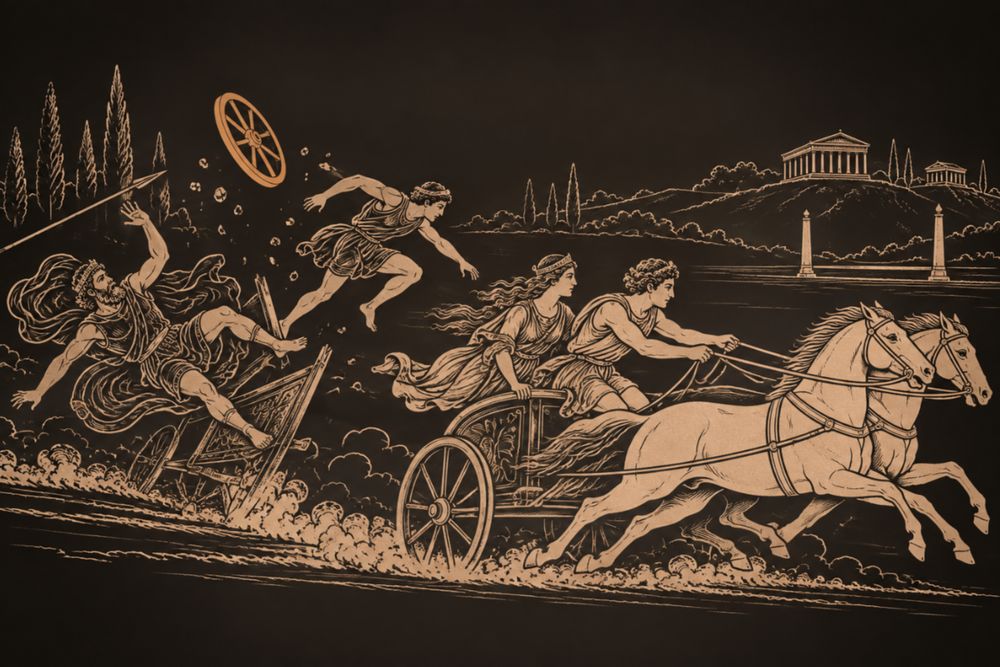
The race of Pelops
Generated by AI from this page's own facts, not an ancient image or evidence of anything. How this site uses generated images
Pelops grew up to win a wife, and the winning is the second crime. Oenomaus, king of Pisa, had a daughter, Hippodamia. The Epitome says each suitor had to flee with her in his chariot. Oenomaus chased him in armour and killed him if he caught him. Pindar says thirteen suitors had died. Apollodorus says some count twelve.
Pelops prayed to Poseidon on the shore, and in Pindar the god gave him a golden chariot with untiring winged horses. Apollodorus adds a human helper. Hippodamia fell for Pelops and persuaded Myrtilus, the son of Hermes and Oenomaus's own charioteer, to help him. Myrtilus, who loved her, left the linchpins out of the wheels, and Oenomaus was dragged to death. Some say Pelops killed him. As he died, Oenomaus cursed Myrtilus.
The reward was worse than the bargain. On the way home Myrtilus tried to force himself on Hippodamia while Pelops fetched water. Pelops threw him into the sea, and as he fell Myrtilus cursed the house of Pelops. Pindar's account of the race names no Myrtilus. In Euripides's Orestes the chorus traces the family's ruin to the moment Pelops hurled the murdered charioteer into the sea near Geraestus.
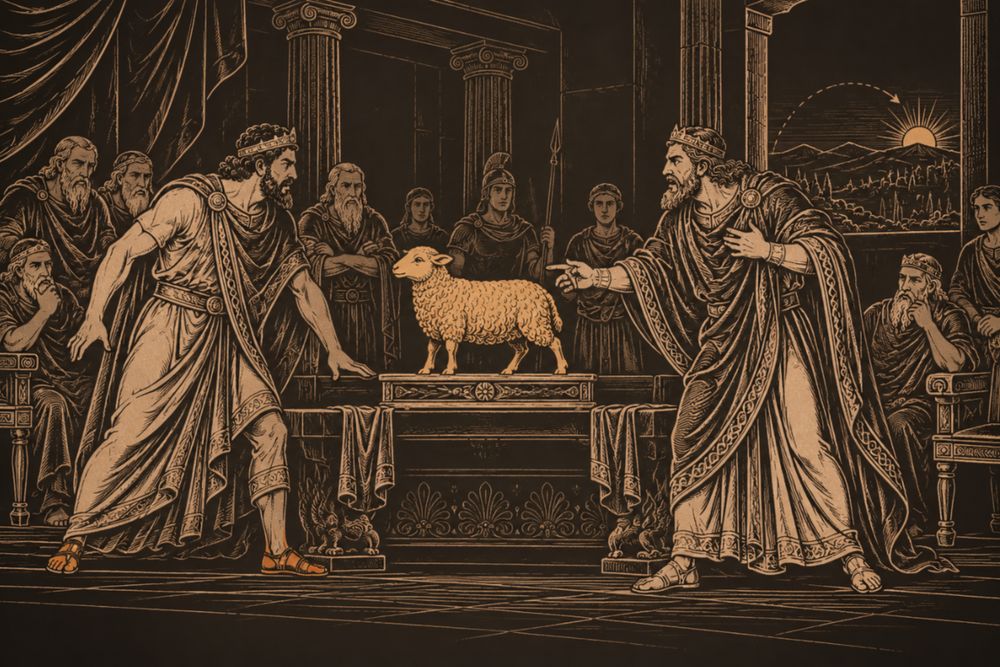
The golden lamb
Generated by AI from this page's own facts, not an ancient image or evidence of anything. How this site uses generated images
Pelops fathered several sons, among them Atreus and Thyestes. Apollodorus says Atreus's wife Aerope loved Thyestes. Atreus had vowed to sacrifice the finest of his flock to Artemis. When a golden lamb appeared, he kept it hidden in a chest instead of sacrificing it, and Aerope gave it to Thyestes.
The people of Mycenae had an oracle telling them to choose a Pelopid as king. Thyestes told the crowd that the kingdom belonged to whoever owned the golden lamb, and Atreus agreed. Thyestes produced it and was made king. Zeus then sent Hermes to Atreus with a counter-offer. Atreus should be king if the sun went backward. Thyestes agreed, the sun set in the east, and Atreus took the throne and banished his brother.
The sources tell the lamb differently. In Euripides's Electra the god Pan brings it to the Argive hills, and Thyestes persuades Atreus's wife to steal it. Even there the chorus says it has small belief in the sun turning back. In Euripides's Orestes the lamb comes from Hermes, the son of Maia, and Strife turns the sun. Pausanias saw the grave of Thyestes on the road from Mycenae to Argos. A stone ram marks it, because Thyestes won the golden lamb by seducing his brother's wife.
Atreus took his revenge as a host. He learned of the adultery, sent a herald to Thyestes offering peace, and lured him home. Apollodorus says he killed Thyestes's three sons, though they had taken refuge at the altar of Zeus. He then served them to their father at a banquet. Pausanias calls it the slaughter of the children and the banquet of which the poets tell. A host had betrayed the oldest rule of hospitality.
Aeschylus tells it through the survivor. In the Agamemnon, Aegisthus says Thyestes came back as a suppliant and was welcomed with a show of friendship. When Thyestes saw what he had eaten, he kicked over the table and cursed the whole line of Pelops. Earlier in the play Cassandra sees the murdered children as ghosts sitting before the palace, a vision the chorus cannot read.
Thyestes then sought vengeance through the oracle. Apollodorus says it told him to father a son by his own daughter. That son, Aegisthus, killed Atreus when he grew up and gave the kingdom back to Thyestes. Aeschylus's Aegisthus tells it differently. He calls himself Thyestes's third child, a baby in swaddling clothes when Atreus drove them out. He says justice brought him home as a grown man.
The curse reached the next generation in the sons of Atreus, Agamemnon and Menelaus. Agamemnon led the Greeks to Troy and came home with Cassandra to a wife and a cousin who were waiting. Their own stories are told on their pages. What matters here is who was blamed for the murder. In the Odyssey, Menelaus hears from Proteus that Aegisthus set a watchman, hid twenty men in the hall and invited Agamemnon to a feast. Agamemnon was killed there, as an ox is killed at the stall, along with his companions.
Aeschylus moves the blow to Clytemnestra. She says she cast a robe over him like a net, struck him three times and glories in the deed. Then she disowns her own hand. The killer, she tells the chorus, is the ancient bitter spirit of Atreus, the grim banqueter. It has paid for the slain children with a full-grown victim. Apollodorus's Epitome names both Aegisthus and Clytemnestra as the killers. Aegisthus then ruled Mycenae.
Justice arrived in the next generation. Apollodorus says Electra smuggled her young brother Orestes to Strophius in Phocis, who raised him with his own son Pylades. Grown, Orestes asked the god at Delphi whether to avenge his father, and the god allowed it. He came home in secret and killed both his mother and Aegisthus. The Odyssey, more briefly, has Menelaus told that Orestes may have slain Aegisthus and be holding his funeral feast.
Aeschylus shows what the killing costs. In the Libation Bearers, Orestes says Apollo threatened him with plagues and the Furies of his father if he left the murder unavenged. At the moment of decision he wavers, and Pylades reminds him of the oracles and the sworn pact. After the deed Orestes sees the Furies, wrapped in dark robes and hung with snakes, and runs from the house. He is now hunted for a mother's blood.
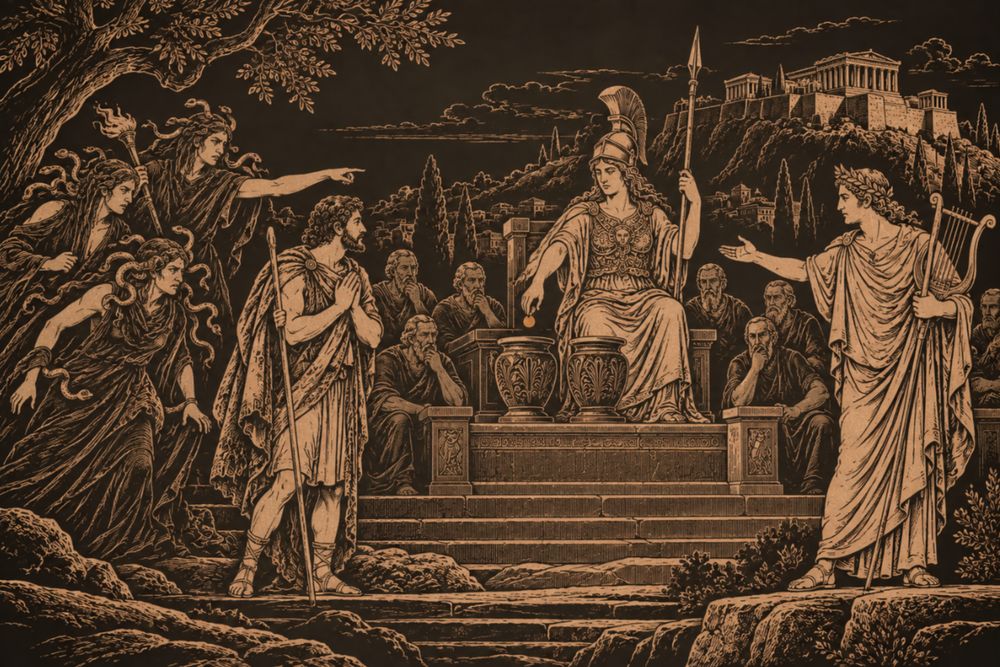
Orestes before the Areopagus
Generated by AI from this page's own facts, not an ancient image or evidence of anything. How this site uses generated images
The cycle ends at Athens. Apollodorus says Orestes, maddened and pursued by the Furies, went to Athens and was tried on the Areopagus. Aeschylus stages the trial in the Eumenides. Athena will not decide a case of murder alone. She says either course, expelling the Furies or letting them stay, brings disaster on her city. So she selects jurors and founds a court for all time.
The jury splits. Athena says she will cast her vote for Orestes because no mother bore her, and that he wins on a tie. Apollo tells the jurors that a single ballot has set a house upright. Athena announces the result: the votes are equal and Orestes is acquitted. He swears that no Argive leader will ever march against Athens. The Furies are angry until Athena promises them a sanctuary and honour in her land. The chain of killing ends because a city put the question to a vote.
For you have not been defeated; the trial resulted fairly in an equal vote, without disgrace to you; but clear testimony from Zeus was present, and he himself who spoke the oracle himself gave witness that Orestes should not suffer harm for his deed. Do not be angry, do not hurl your heavy rage on this land, or cause barrenness, letting loose drops whose savage spirit will devour the seed. For I promise you most sacredly that you will have a cavernous sanctuary in a righteous land, where you will sit on shining thrones at your hearths, worshipped with honor by my citizens here.
What Followed
Orestes's story does not stop with the acquittal in Aeschylus. Apollodorus says he later fetched the wooden image from the land of the Taurians, came back to Mycenae, married Hermione (or, in some tellings, Erigone) and fathered Tisamenus. He died from a snake bite at Oresteum in Arcadia.
The Furies are not destroyed. In the Eumenides Athena promises them a sanctuary and honour in her land. She says the court she founded will always exist.
Afterlife and Modern Influence
Greek tragedy kept returning to the house. Frazer's notes to the Epitome record that Sophocles wrote an Atreus and a Thyestes, and Euripides a Thyestes, whose plots are not certainly known. Frazer also lists Seneca's Latin Thyestes among the tellings of the banquet.
What was the curse of the House of Atreus?
No single curse explains it. Apollodorus says Myrtilus, thrown into the sea by Pelops, cursed the house of Pelops as he fell. In Aeschylus, Aegisthus says Thyestes cursed the line of Pelops after Atreus served him his own sons. Euripides's Orestes ties the curse to the golden lamb. The sources name different causes, and the result is the same in each: a chain of family killings from Atreus to Orestes.
Apollodorus, Epitome 2.8
Who was Atreus in Greek mythology?
Atreus was a son of Pelops and king of Mycenae. Apollodorus says his wife Aerope loved his brother Thyestes, and that Atreus took the throne when the sun reversed its course. He killed Thyestes's sons and served them to their father. In Aeschylus, Clytemnestra calls the spirit behind Agamemnon's death the ancient bitter spirit of Atreus, that grim banqueter. He is the father of Agamemnon and Menelaus.
Apollodorus, Epitome 2.10
Why is it called the House of Atreus?
It is named for Atreus, the ancestor whose crimes fix the family's fate in tragedy, and for his sons Agamemnon and Menelaus, whom the Odyssey calls the sons of Atreus. In Aeschylus, Clytemnestra blames the ancient bitter spirit of Atreus for Agamemnon's death. Aegisthus, in the same play, says Thyestes cursed the line of Pelops, so the sources also push the guilt further back.
Aeschylus, Agamemnon 1497-1504
Can you summarize the House of Atreus?
Pelops wins Hippodamia by a chariot race and throws Myrtilus into the sea. His sons Atreus and Thyestes fight over the throne of Mycenae, and Atreus serves Thyestes his own children. Atreus's son Agamemnon is killed on his return from Troy. His son Orestes kills his mother and Aegisthus, is pursued by the Furies, and is acquitted by Athena's court in Athens.
Apollodorus, Epitome 6.25
How did the House of Atreus end?
In Aeschylus it ends in Athens. Orestes stands trial on the Areopagus, the jury votes equally and Athena's decision acquits him. Athena then promises the Furies a sanctuary and honour in her land. Apollodorus adds a quiet coda: Orestes marries Hermione, has a son named Tisamenus and dies of a snake bite in Arcadia.
Aeschylus, Eumenides 752-753
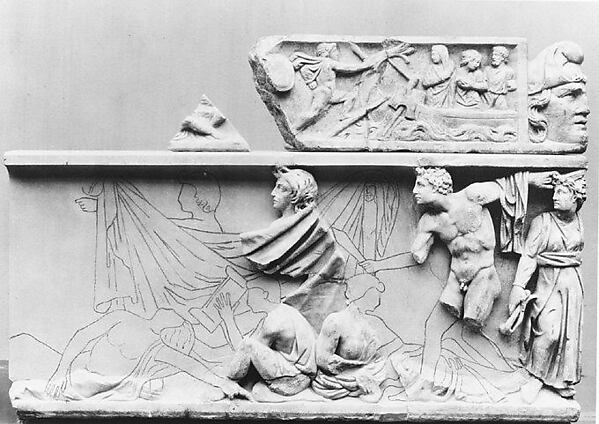
Fragmentary marble sarcophagus with scenes from the Oresteia - Roman, mid-2nd century CE, Marble-Luni
Metropolitan Museum of Art, New York, NY, 28.57.8a–d. CC0
Where Accounts Differ
- pelops-cauldron-feast-accepted-or-rejected
- golden-lamb-origin
- sun-reversal-meaning
- aegisthus-birth-and-role
- who-killed-agamemnon
- who-prosecuted-orestes
- Pelops's cauldron banquet is disputed. Apollodorus, Epitome 2.3, says Pelops was slaughtered and boiled at a banquet of the gods and restored. Pindar, Olympian Ode 1.25-53, rejects the tale as a malicious rumour and says Poseidon carried the boy to Olympus.
- The origin of the golden lamb differs. Apollodorus, Epitome 2.10-11, has Atreus vow the best of his flock to Artemis and hide the lamb. Euripides, Electra 699-746, brings it from Pan. Euripides, Orestes 982-1000, says it was sent by Hermes, the son of Maia.
- Why the sun turned back is not settled. Apollodorus, Epitome 2.12, makes it a sign that Atreus's claim to the throne was just, sent by Zeus through Hermes. Frazer's note there records a version favoured by Latin poets in which the sun reverses in horror at the banquet. Euripides, Electra 699-746, has the chorus say it gives the report small belief.
- Aegisthus's origin differs. Apollodorus, Epitome 2.14, says Thyestes fathered him on his own daughter on an oracle's advice and that he killed Atreus. Aeschylus, Agamemnon 1583-1611, has Aegisthus call himself Thyestes's third child, a baby when the two were exiled, with no mention of incest.
- Who killed Agamemnon differs. Homer, Odyssey 4.512-537, names Aegisthus and a banquet ambush. Aeschylus, Agamemnon 1379-1392, gives the blow to Clytemnestra. Apollodorus, Epitome 6.23, names both, and Frazer's note there lists the sources for each version.
- The prosecutor is not fixed. Frazer's note to Apollodorus, Epitome 6.25, says Orestes is variously reported to have been brought to trial by the Furies, by Tyndareus or by Erigone, the daughter of Aegisthus and Clytemnestra. Aeschylus, Eumenides 734-753, has the Furies prosecute and has Athena vote for Orestes, so that the tie acquits him.
Read the full source verification →
Mythology
Figures In This Myth
Also Connected
Related Terms
Referenced By
Sources
- Homer, Odyssey 4.512-537
- Pindar, Olympian Ode 1.25-53
- Pindar, Olympian Ode 1.67-96
- Apollodorus, Epitome 2.3
- Apollodorus, Epitome 2.5
- Apollodorus, Epitome 2.6
- Apollodorus, Epitome 2.7
- Apollodorus, Epitome 2.8
- Apollodorus, Epitome 2.10
- Apollodorus, Epitome 2.11
- Apollodorus, Epitome 2.12
- Apollodorus, Epitome 2.13
- Apollodorus, Epitome 2.14
- Apollodorus, Epitome 6.23
- Apollodorus, Epitome 6.24
- Apollodorus, Epitome 6.25
- Apollodorus, Epitome 6.27
- Apollodorus, Epitome 6.28
- Aeschylus, Agamemnon 1217-1222
- Aeschylus, Agamemnon 1379-1392
- Aeschylus, Agamemnon 1497-1504
- Aeschylus, Agamemnon 1583-1611
- Aeschylus, Libation Bearers 269-296
- Aeschylus, Libation Bearers 899-930
- Aeschylus, Libation Bearers 1048-1062
- Aeschylus, Eumenides 470-489
- Aeschylus, Eumenides 734-741
- Aeschylus, Eumenides 749-753
- Aeschylus, Eumenides 752-753
- Aeschylus, Eumenides 754-777
- Aeschylus, Eumenides 795-807
- Euripides, Electra 699-746
- Euripides, Orestes 982-1000
- Pausanias, Description of Greece 2.18.1
- J. G. Frazer, Apollodorus: The Library (Loeb, 1921), notes to Epitome 2.3-2.15 and 6.23-6.28