Orestes
Orestes is the son of Agamemnon and Clytemnestra. Sent away as a boy when his father was murdered, he comes home grown and kills his mother and her lover Aegisthus. Homer's Odyssey praises the revenge. Aeschylus makes it a pollution: the Furies drive Orestes mad until a court at Athens acquits him on a tied vote.
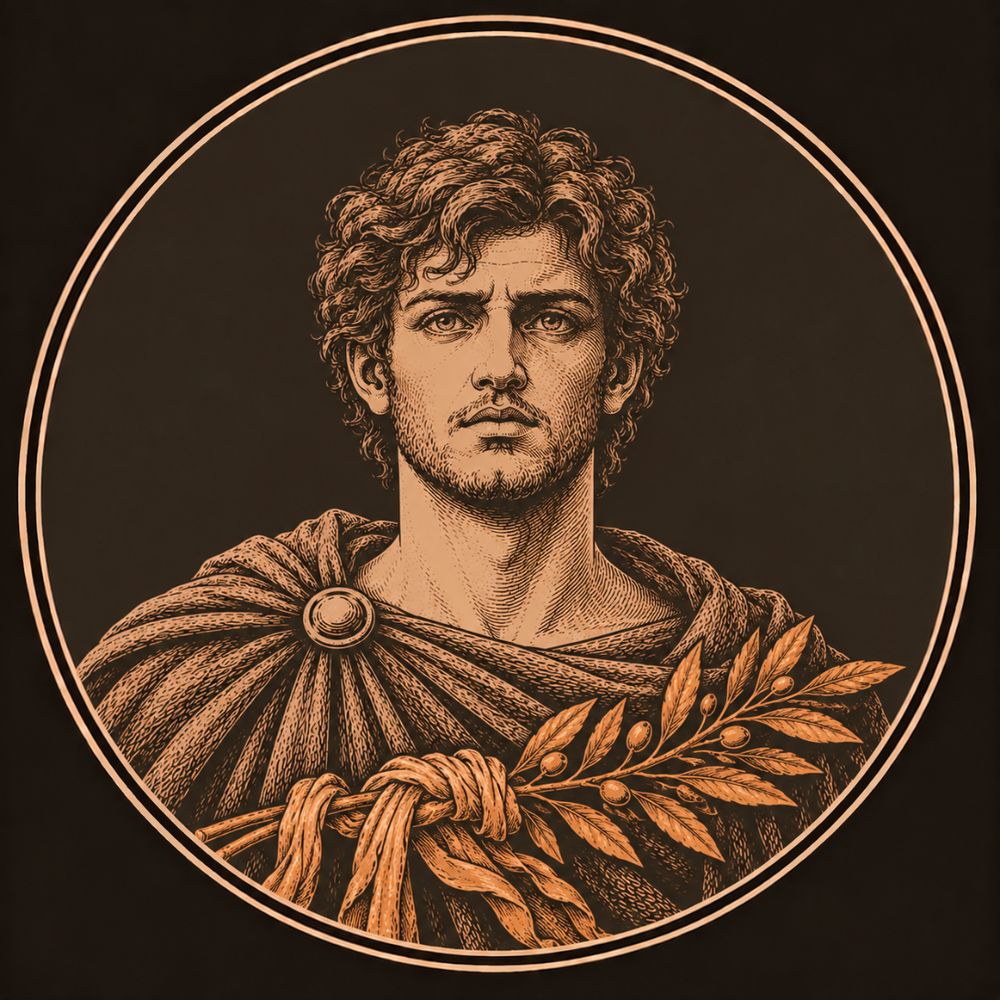
Orestes, bronze medallion illustration
Generated by AI from this page's own facts, not an ancient image or evidence of anything. How this site uses generated images
Sections on this page
See Orestes in the Greek family tree.
Core Myth
Orestes is the only son of Agamemnon and Clytemnestra. In Euripides's Orestes, his sister Electra names the family: three daughters, Chrysothemis, Iphigenia and herself, and one son. When Agamemnon came home from Troy, Clytemnestra and her lover Aegisthus murdered him. The boy was taken to safety. Pindar's eleventh Pythian ode and Apollodorus's Epitome send him to Strophius, an old friend of the family who lived at the foot of Parnassus in Phocis. Apollodorus adds that Strophius raised him with his own son Pylades, who became Orestes's lifelong companion.
Who saved the child is disputed. Apollodorus's Epitome gives the rescue to Electra. In Sophocles's Electra, an old servant says he carried the boy away after receiving him from his sister. Euripides's Electra credits the old servant alone, and Pindar credits the nurse Arsinoe.
Grown to manhood, Orestes asked Apollo's oracle at Delphi how to avenge his father. Apollodorus's Epitome says the god gave him leave. In Aeschylus's Libation Bearers he says Apollo threatened him with plagues and the Furies of his father if he did not act. Sophocles's Electra has the god order him to strike alone and by stealth.
In Aeschylus's play he lays a lock of his hair on his father's tomb and comes to the palace disguised as a stranger from Phocis, with Pylades. He kills Aegisthus first. When his mother bares the breast that nursed him, he hesitates and asks Pylades what to do. Pylades answers that Apollo's oracles outweigh every human enemy. Orestes kills her, then displays the robe in which she had trapped his father.
The punishment follows at once. At the end of the Libation Bearers, Orestes sees the Furies as Gorgon-like women wreathed in snakes. The chorus cannot see them. He leaves for Delphi as a suppliant. In Aeschylus's Eumenides the priestess finds him at the omphalos, bloody sword in hand, with the Furies asleep around him. Apollo sends him on to Athens under Hermes's escort.
At Athens Athena sets up a court of citizens on the Areopagus to try him. Orestes admits the killing and says Apollo shares the responsibility. Athena casts her vote for him, and the ballots come out equal, which acquits him. Orestes swears that Argos will never march against Athens, and goes home to rule his father's house.
Euripides tells the aftermath differently. In his Orestes, six days after the killing, Orestes lies sick and raving while Electra nurses him, and Argos votes to put both of them to death. With Pylades they seize Hermione, the daughter of Menelaus and Helen, as a hostage. Apollo appears at the end and settles everything: Orestes will spend a year in Parrhasia in Arcadia, stand trial at Athens and marry Hermione.
In Euripides's Iphigenia in Tauris the trial did not end the madness. Some of the Furies refused the verdict and kept hunting him. Apollo then sent him to the land of the Taurians to steal an image of Artemis. There he found his sister Iphigenia serving as priestess, and the two escaped together with the statue.
Apollodorus's Epitome ends his story in Arcadia. Orestes married Hermione, or in some accounts Erigone, fathered Tisamenus, and died from a snakebite at Oresteum. Herodotus reports that the Spartans later found his giant bones at Tegea, on an oracle's instruction, and carried them home.
What is the story of Orestes?
Orestes is Agamemnon's son, sent away as a child when his mother Clytemnestra and her lover Aegisthus murdered his father. Pindar and Apollodorus say he grew up with Strophius at the foot of Parnassus. As a man he asked Apollo at Delphi about revenge, returned with his friend Pylades and killed them both. In Aeschylus's Libation Bearers and Eumenides, the Furies then drive him mad. He flees to Delphi and then Athens, where the court of the Areopagus acquits him on a tied vote.
Apollodorus, Epitome 6.25
Who is Orestes in the Odyssey?
In Homer's Odyssey he is the example of a good son. Zeus opens the poem by recalling how Orestes killed Aegisthus, who had seduced Agamemnon's wife and murdered him. Athena, disguised as a guest, tells Telemachus to win the same fame. Nestor says Aegisthus ruled Mycenae for seven years, until Orestes came back in the eighth and killed him. Homer never describes the killing of Clytemnestra, only a funeral feast held over his mother and Aegisthus.
Homer, Odyssey 3.303-310
What crime did Orestes commit?
He killed his mother, Clytemnestra, to avenge his father. In Aeschylus's Libation Bearers he kills Aegisthus first and then her, after she pleads with him by the breast that nursed him. In Sophocles's Electra she dies first, while Electra urges him on from outside. Euripides's Electra has him cover his eyes and drive the sword into her throat. In each play Orestes says Apollo ordered it. Before Athena's court in Aeschylus's Eumenides, he admits the killing and says Apollo shares the blame.
Aeschylus, Libation Bearers 896-900
Why does Orestes go mad?
The Furies of his murdered mother drive him mad. In Aeschylus's Libation Bearers the madness starts the moment the killing is done: he sees the Furies as snake-wreathed Gorgons that no one else can see. Euripides's Orestes shows him six days later, starving, raving and trying to shoot the Furies with a bow Apollo gave him. Pausanias reports an Arcadian story that he bit off his own finger to break the fit. Euripides's Iphigenia in Tauris says the madness outlasted even his acquittal.
Aeschylus, Libation Bearers 1048-1061
Who was Orestes in love with?
The ancient sources give him a wife and a friend, not a love story. His wife is Hermione, daughter of Menelaus and Helen. In Euripides's Andromache she was promised to him before being given to Neoptolemus, whom Orestes then helps kill. Euripides's Orestes has Apollo foretell the marriage, and Apollodorus's Epitome names Hermione or Erigone as his wife. His closest bond is with Pylades. In Euripides's Iphigenia in Tauris each friend insists on dying so that the other can live.
Euripides, Orestes 1625-1665
Later Traditions
Homer and the tragedians judge Orestes differently. Homer's Odyssey never mentions the matricide directly. It holds him up as the model son who killed his father's murderer and won fame among all men. Nestor adds that Orestes held a funeral feast over his hateful mother and Aegisthus. The Furies, the madness and the trial belong to later poets, above all Aeschylus.
His acquittal is told in several ways. Aeschylus's Eumenides has Athena found the Areopagus court for his case, with the Furies as prosecutors. Euripides's Electra says the hill had already tried Ares for murder. Apollodorus's Epitome names three possible accusers: the Furies, Clytemnestra's father Tyndareus, or Erigone, daughter of Aegisthus. Pausanias reports Peloponnesian antiquarians who named Perilaus, a cousin of Clytemnestra, instead. Euripides's Iphigenia in Tauris makes the verdict incomplete, since some Furies rejected it.
His cure has a local version too. Pausanias saw a sanctuary called Maniae, or Madnesses, near Megalopolis in Arcadia. The Arcadians said the Furies appeared to Orestes black until he bit off one of his own fingers. Then they looked white and he regained his senses. Pausanias also saw the stone at Troezen where nine men purified him of the killing.
His marriage is the sharpest disagreement. In Euripides's Andromache, Orestes says Menelaus first promised him Hermione, then gave her to Neoptolemus, son of Achilles. When he asked for her back, Neoptolemus taunted him with his mother's murder. Orestes then plotted his rival's death at Delphi, and a messenger reports that he was among the ambush in the sanctuary. Euripides's Orestes has Apollo predict instead that Neoptolemus will never marry Hermione and will die by a Delphian sword. Apollodorus's Epitome records both endings: Orestes killed Neoptolemus, or a Phocian named Machaereus did.
Pausanias adds that the Spartans accepted Orestes as their king, because his mother was a daughter of Tyndareus. His son by Hermione, Tisamenus, succeeded him. Pausanias cites the epic poet Cinaethon for a second son, Penthilus, by Erigone.
Modern Influence
Orestes returns in two landmark modern plays. Jean Racine's Andromaque, first performed before the court of Louis XIV in 1667, makes him a lover. His Oreste loves Hermione, who wants only Pyrrhus, the tragedy's name for Neoptolemus. Jean-Paul Sartre's The Flies opened in occupied Paris in June 1943. Sartre turns the matricide into an act of freedom: his Orestes takes the town's guilt on himself and walks into exile with the Furies behind him.
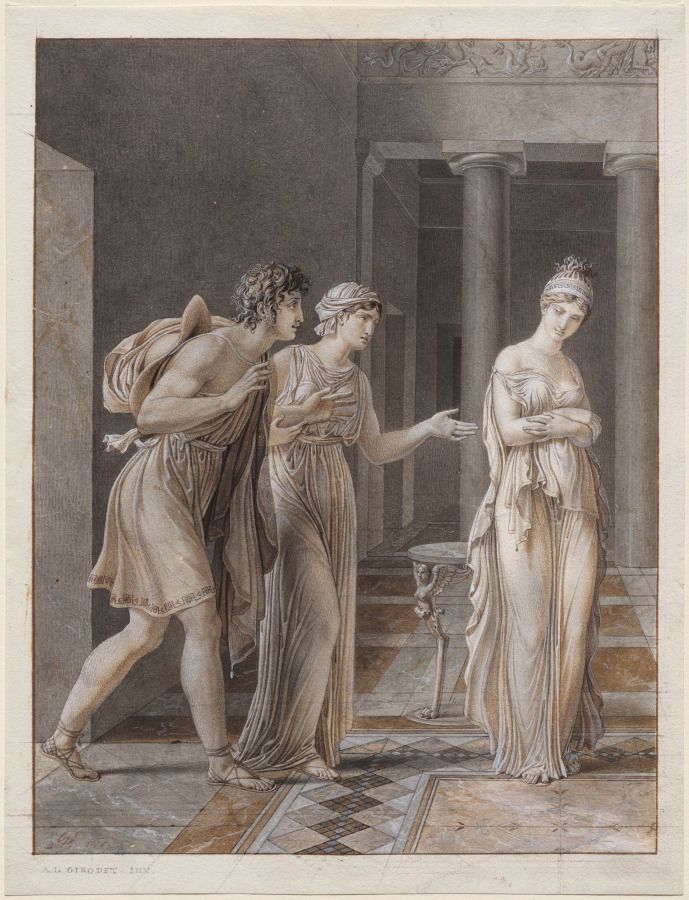
The Meeting of Orestes and Hermione - France, early 19th Century, c. 1800, pen and brown and black ink, point of brush and brown and gray wash, with black chalk and graphite, heightened with white gouache, on cream wove paper
The Cleveland Museum of Art, Cleveland, OH, 1989.101. CC0
Lineage
See the full family tree3 recorded relations, each with the ancient line behind it.
Parents
-
Zeus opens Homer's Odyssey by recalling that Orestes took vengeance for his father on Aegisthus once he came to manhood.
-
Electra lists the children in the prologue of Euripides's Orestes, three daughters and one son, all from the one mother who killed her husband.
Siblings
-
Electra says she shared in the killing of their mother as far as a woman could, and nurses Orestes through the madness that followed.
Also Connected
3 recorded connections, each with the ancient line behind it.
Allies
-

Apollo promises never to abandon his suppliant, admits he persuaded Orestes to kill his mother, and sends him to Athens under Hermes's escort.
-

After his acquittal on equal votes, Orestes hails Pallas as the saviour of his house and swears that Argos will never march against Athens.
Connected
-
At the close of Euripides's Orestes, Apollo stops Orestes holding a sword to Hermione, tells Menelaus to leave him to rule Argos, and foretells that Orestes will marry her.
Where Accounts Differ
- who saved the young Orestes
- where Orestes grew up
- Homer's hero or the tragedians' matricide
- the trial and its accusers
- where the madness ended
- Hermione and the death of Neoptolemus
- Orestes's death and grave
- Who saved the young Orestes is disputed. Apollodorus's Epitome credits Electra. Sophocles's Electra has the old servant carry him off after receiving him from Electra. Euripides's Electra credits the old servant alone. Pindar's eleventh Pythian ode credits the nurse Arsinoe.
- Where he grew up differs. Pindar's eleventh Pythian ode and Apollodorus's Epitome place him with Strophius at the foot of Parnassus in Phocis. In Murray's translation of Homer's Odyssey, Nestor says Orestes came back from Athens.
- Homer's Odyssey praises Orestes for killing Aegisthus and only hints at his mother's death through her funeral feast. The Furies, the madness and the trial come from later poets, above all Aeschylus's Libation Bearers and Eumenides.
- His acquittal is told differently. Aeschylus's Eumenides has Athena found the Areopagus court for his trial, with the Furies as accusers. Euripides's Electra says the court first tried Ares. Apollodorus's Epitome names the Furies, Tyndareus or Erigone as possible accusers, and Pausanias reports Perilaus. Euripides's Iphigenia in Tauris says some Furies rejected the verdict and kept pursuing him until he fetched the Taurian image of Artemis.
- Where the madness ended differs. Aeschylus's Eumenides ends it with the verdict at Athens. Euripides's Iphigenia in Tauris ends it with the Taurian image. Pausanias reports an Arcadian tradition that he recovered at a place called Ace after biting off a finger, and that this came before the Areopagus trial.
- His marriage and Neoptolemus's death differ. Euripides's Andromache has Hermione promised first to Orestes, then given to Neoptolemus, whom Orestes plots to kill at Delphi. Euripides's Orestes has Apollo say Neoptolemus will never marry her. Apollodorus's Epitome says Orestes killed Neoptolemus, or that Machaereus the Phocian did. Apollodorus's Epitome and Pausanias disagree on his wife: Hermione, or Erigone, whom Pausanias names as the mother of a bastard son.
- His death is recorded only by Apollodorus's Epitome, as a snakebite at Oresteum in Arcadia. Herodotus and Pausanias place his grave at Tegea, from which the Spartans took his bones.
Read the full source verification →
Mythology
Appears In
Related Terms
Referenced By
Sources
- Homer, Odyssey 1.29-43
- Homer, Odyssey 1.298-300
- Homer, Odyssey 3.193-200
- Homer, Odyssey 3.303-310
- Pindar, Pythian Ode 11.17-11.35
- Aeschylus, Libation Bearers 1-10
- Aeschylus, Libation Bearers 269-295
- Aeschylus, Libation Bearers 555-560
- Aeschylus, Libation Bearers 896-900
- Aeschylus, Libation Bearers 869-890
- Aeschylus, Libation Bearers 973-1005
- Aeschylus, Libation Bearers 1021-1040
- Aeschylus, Libation Bearers 1048-1061
- Aeschylus, Eumenides 34-60
- Aeschylus, Eumenides 64-90
- Aeschylus, Eumenides 276-285
- Aeschylus, Eumenides 443-465
- Aeschylus, Eumenides 470-485
- Aeschylus, Eumenides 681-705
- Aeschylus, Eumenides 734-740
- Aeschylus, Eumenides 752-775
- Sophocles, Electra 1-20
- Sophocles, Electra 30-50
- Sophocles, Electra 1404-1416
- Sophocles, Electra 1424-1427
- Euripides, Electra 10-20
- Euripides, Electra 1221-1226
- Euripides, Electra 1240-1275
- Euripides, Orestes 20-34
- Euripides, Orestes 34-45
- Euripides, Orestes 253-275
- Euripides, Orestes 940-955
- Euripides, Orestes 1095-1110
- Euripides, Orestes 1625-1665
- Euripides, Iphigenia in Tauris 77-93
- Euripides, Iphigenia in Tauris 595-605
- Euripides, Iphigenia in Tauris 674-685
- Euripides, Iphigenia in Tauris 939-985
- Euripides, Iphigenia in Tauris 1446-1460
- Euripides, Iphigenia in Tauris 1465-1470
- Euripides, Andromache 960-985
- Euripides, Andromache 993-1005
- Euripides, Andromache 1115-1120
- Herodotus, Histories 1.67
- Herodotus, Histories 1.68
- Apollodorus, Epitome 6.14
- Apollodorus, Epitome 6.24
- Apollodorus, Epitome 6.25
- Apollodorus, Epitome 6.26
- Apollodorus, Epitome 6.27
- Apollodorus, Epitome 6.28
- Pausanias, Description of Greece 2.18.6
- Pausanias, Description of Greece 2.31.4
- Pausanias, Description of Greece 3.11.10
- Pausanias, Description of Greece 8.34.1
- Pausanias, Description of Greece 8.34.2
- Pausanias, Description of Greece 8.34.3
- Pausanias, Description of Greece 8.34.4
- Pausanias, Description of Greece 8.54.4
- J. G. Frazer, Apollodorus: The Library, notes to Epitome 6.14 and 6.24-28 (Loeb, 1921)
- Jean Racine, Andromaque (1667)
- Jean-Paul Sartre, Les Mouches (The Flies, 1943)