Telemachus
Telemachus is the son of Odysseus and Penelope, left a newborn when his father sailed for Troy. In the first four books of Homer's Odyssey, Athena sends him to Pylos and Sparta for news of his father. On his return he meets Odysseus in disguise, and the two kill Penelope's suitors together. A lost epic, the Telegony, later married him to Circe.
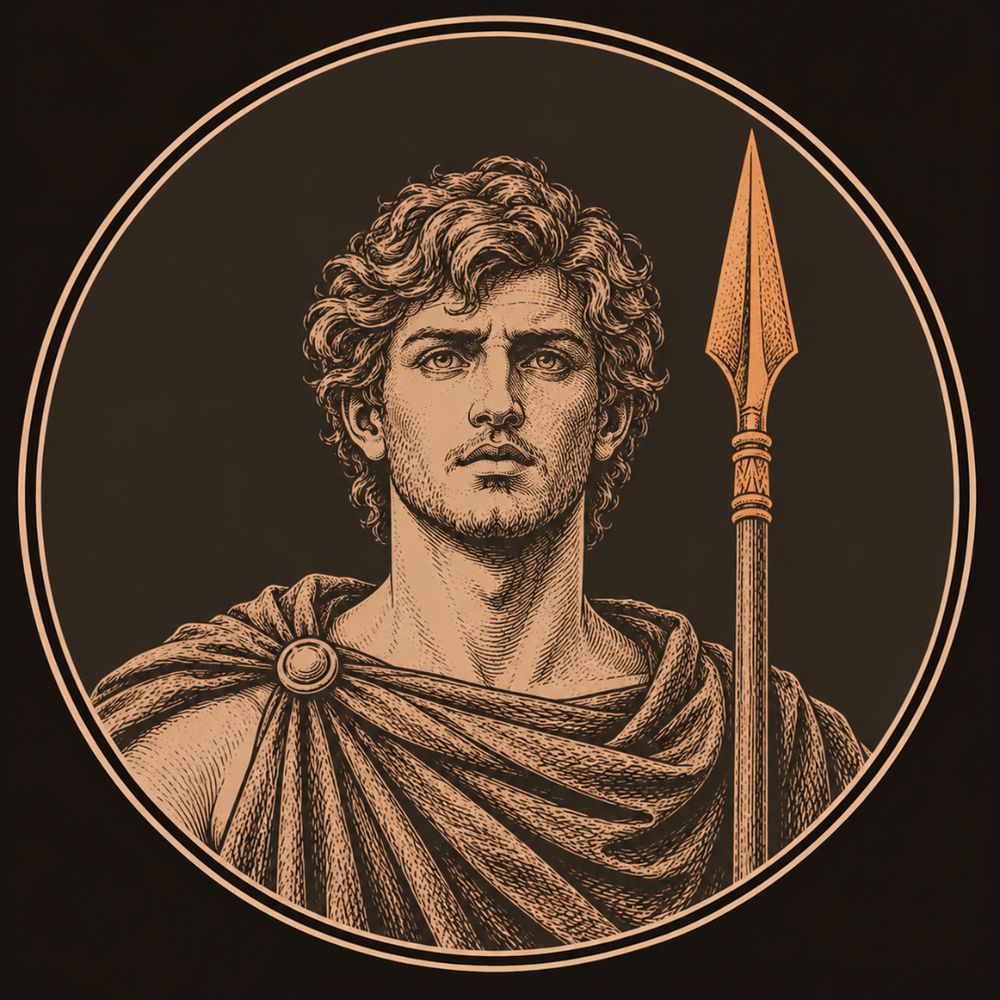
Telemachus, bronze medallion illustration
Generated by AI from this page's own facts, not an ancient image or evidence of anything. How this site uses generated images
Sections on this page
See Telemachus in the Greek family tree.
Core Myth
Telemachus was a baby when the war began. In Homer's Odyssey, Helen says Odysseus left him a newborn child when the Greeks sailed for Troy. Apollodorus's Epitome tells how his infancy ended the war's first trick. Odysseus feigned madness to stay home, and Palamedes snatched the child from Penelope's arms and drew a sword on him. Fearing for his son, Odysseus admitted the pretence and went to war.
Twenty years later, the Odyssey finds him grown and powerless. Suitors for his mother fill the palace and eat through his father's herds. Athena arrives disguised as Mentes, a Taphian chief, and asks whether he is truly Odysseus's son. His answer is bleak: his mother says so, but no man knows his own parentage. She tells him to seek news in Pylos and Sparta, and to plan how to kill the suitors.
The next day he calls the first Ithacan assembly since his father left. He demands that the suitors leave his house, then dashes the staff to the ground and bursts into tears. Nobody helps. Athena, now in the likeness of Mentor, gathers a crew and a ship for him. He swears the old nurse Eurycleia to silence and sails by night without telling his mother.
At Pylos he tells Mentor that a young man is ashamed to question an elder. Nestor has no news of Odysseus. When Mentor leaves in the form of a sea-eagle, Nestor recognises Athena and says the gods are guiding the boy. Nestor's youngest daughter Polycaste bathes him, and his son Peisistratus drives him to Sparta. There Helen knows him at once by his likeness to his father. Menelaus passes on what the sea god Proteus told him: Odysseus is alive, held by the nymph Calypso.
Back in Ithaca, the suitors learn of the voyage and set an ambush in the strait between Ithaca and Samos. Athena warns Telemachus in Book 15 and tells him to sail by night. He lands safely and goes to the hut of the swineherd Eumaeus. In Book 16 Athena restores Odysseus's true shape, and the father reveals himself. Telemachus at first thinks he is a god. Then the two embrace and weep, wailing louder than birds robbed of their young.
In Book 21 Telemachus tries his father's bow first. He sets up the axes and makes the bow quiver three times. On the fourth try he might have strung it, but Odysseus nods to stop him. In the fight of Book 22 he kills the suitor Amphinomus with a spear, fetches armour from the storeroom, and admits he left its door open. In Book 24 he stands beside his father and grandfather Laertes, who rejoices to see son and grandson vying in courage.
What was Telemachus known for?
He is known for the search for his father and for fighting beside him. The first four books of Homer's Odyssey, often called the Telemachy, follow him from Ithaca to Pylos and Sparta. Athena sends him there to ask Nestor and Menelaus for news of Odysseus. She also tells him to plan the suitors' deaths, since he is no longer a child. In Books 16 to 22 he meets his disguised father and helps him kill the suitors.
Homer, Odyssey 1.280-297
Who did Telemachus fall in love with?
Homer's Odyssey gives him no love story. It only looks ahead to a marriage: Athena says the gods will show him a noble bride, and Helen gives him a robe for his bride to wear. Later writers disagree about who she was. The Hesiodic Catalogue, quoted by Eustathius, names Polycaste, the daughter of Nestor who bathes him at Pylos. The lost Telegony, as Proclus summarises it, married him to Circe.
Homer, Odyssey 15.120-130
Did Telemachus marry Circe?
Only in a late ending to his story. Proclus's summary of the Telegony, a lost epic by Eugammon of Cyrene, says Circe made Telemachus and Penelope immortal. Then Telegonus married Penelope and Telemachus married Circe. Hyginus's Fabulae 127 agrees and gives Telemachus and Circe a son, Latinus. Homer's Odyssey knows nothing of this. Apollodorus's Epitome tells the same Telegonus story but marries only Telegonus and Penelope, and leaves Telemachus out.
Hyginus, Fabulae 127
Did Odysseus love Telemachus?
The sources show it plainly. In Apollodorus's Epitome, Odysseus drops his feigned madness when Palamedes threatens the baby with a sword, rather than risk his son. In Homer's Odyssey Book 16, Odysseus kisses the young man and lets fall the tears he had held back until then. When Telemachus believes him, both weep aloud like birds robbed of their young. Odysseus also trusts him with the plan against the suitors and tells no one else at first.
Homer, Odyssey 16.186-219
Is Telemachus good or bad?
Homer's Odyssey presents him as loyal and brave, but not gentle. He defends his mother's house, faces down the suitors in assembly, and fights beside his father. In Book 22 he saves the singer Phemius and the herald Medon, who cared for him as a child. Yet he also chooses how the disloyal maids die. Odysseus orders them killed with swords. Telemachus refuses them a clean death and hangs them with a ship's cable.
Homer, Odyssey 22.461-473
Did Telemachus have any brothers?
Not in Homer. In Odyssey Book 16 Telemachus says Zeus made his house run in a single line: Laertes, Odysseus and he were each an only son. Later works gave Odysseus more children. Apollodorus's Epitome names Telegonus by Circe, Polypoetes by the Thesprotian queen Callidice, and Poliporthes, born to Penelope after the return. Eustathius says the Telegony's author gave Odysseus and Penelope a second son, Acusilaus.
Homer, Odyssey 16.117-120
Later Traditions
The Odyssey ends before Telemachus marries, and later sources give him two different wives. The Hesiodic Catalogue of Women, quoted by the Byzantine scholar Eustathius, says Nestor's daughter Polycaste bore him a son, Persepolis. That is the same Polycaste who bathes him in Odyssey Book 3.
The strangest ending comes from the Telegony, a lost epic by Eugammon of Cyrene. Proclus's summary says Telegonus, a son of Odysseus by Circe, killed his father without knowing him. He carried the body to Circe's island with Penelope and Telemachus. Circe made them immortal, Telegonus married Penelope, and Telemachus married Circe. Hyginus's Fabulae tells the same story and adds a son for Telemachus and Circe: Latinus, who gave his name to the Latin language.
Apollodorus's Epitome follows the Telegony only in part. It has Telegonus kill Odysseus with a spear barbed with a stingray's spine, marry Penelope, and go with her to the Islands of the Blest. It says nothing of Telemachus marrying anyone. Hyginus also changes the story of his infancy. In Fabulae 95, Odysseus yokes a horse and an ox to a plough, and Palamedes sets the baby in front of it.
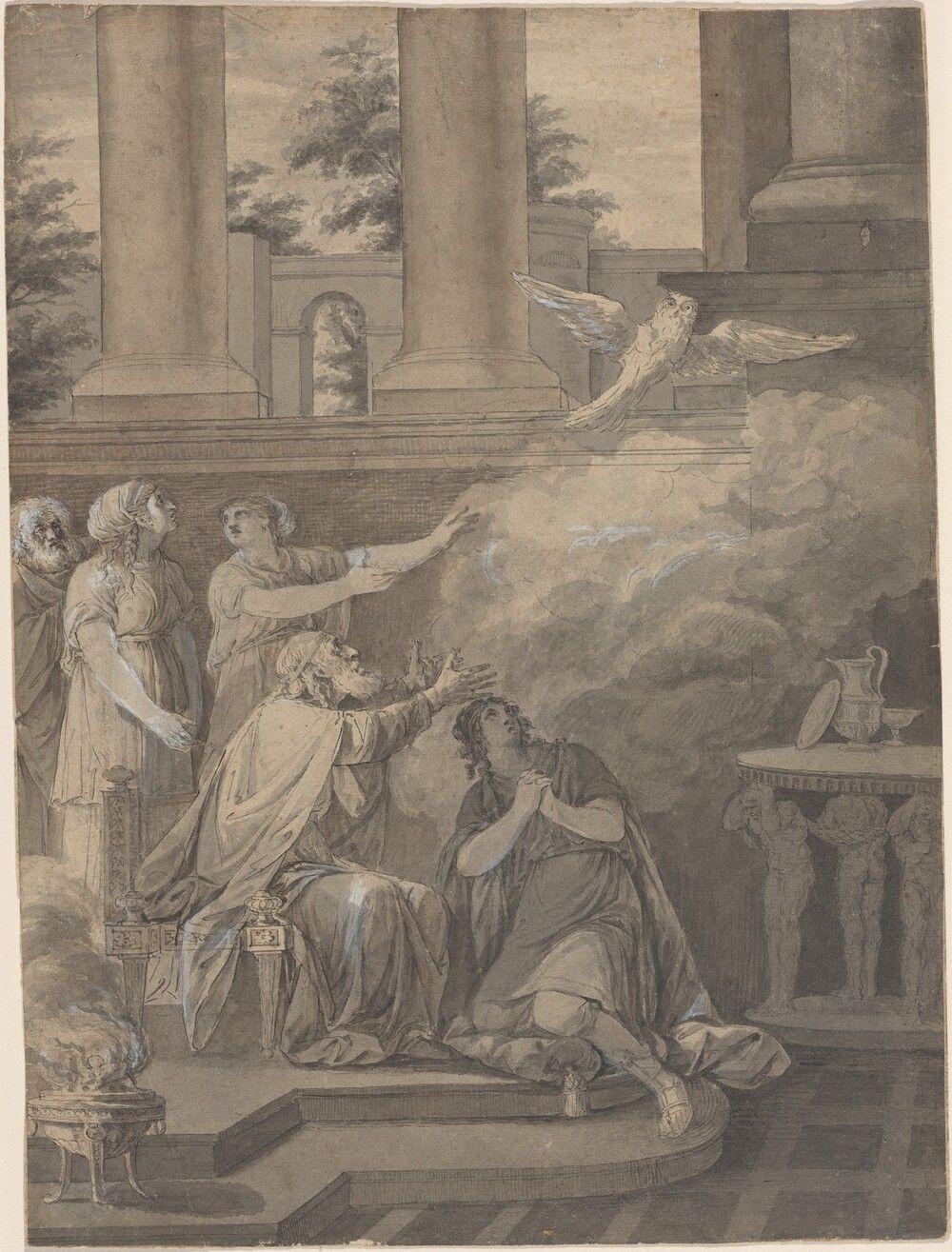
Pallas Athene in the Form of a Bird Leaving Nestor and Telemachus - Jean-Jacques-François Le Barbier I, c. 1780, pen and black ink with gray and brown washes over graphite, heightened with white, on laid paper
National Gallery of Art, Washington, DC, 1992.61.2. CC0
Lineage
See the full family tree3 recorded relations, each with the ancient line behind it.
Parents
-

Telemachus is Odysseus's only son by Penelope in Homer; he says Laertes, Odysseus and he were each an only son.
-
Penelope is Telemachus's mother; in Book 1 of the Odyssey he sends her back from the hall to her loom, and she goes, taking his words to heart.
Children
-
Only Hyginus (Fabulae 127) makes Telemachus the father of Latinus, by Circe. Hesiod's Theogony and Apollodorus make Odysseus the father, and Virgil makes it Faunus.
Also Connected
5 recorded connections, each with the ancient line behind it.
Allies
-

Athena, disguised as Mentes and then Mentor, sends Telemachus to Pylos and Sparta and sails with him; Nestor recognises her when she leaves as a sea-eagle.
-
Nestor hosts Telemachus at Pylos, tells him of the Greek homecomings, and sends him to Sparta with his son Peisistratus.
Connected
-

In the Telegony tradition Telemachus marries Circe after Odysseus's death; Hyginus gives them a son, Latinus. Homer and Apollodorus do not have this marriage.
-
Helen recognises Telemachus in Sparta by his likeness to Odysseus, and later gives him a robe for his future bride.
-
Menelaus hosts Telemachus in Sparta, tells him Proteus saw Odysseus held by Calypso, and sends him home with gifts.
Where Accounts Differ
- sword or plough in the madness test
- who Telemachus married
- how the Telegony ends
- whether Telemachus had brothers
- late and indirect sources for his marriage
- How Palamedes exposed Odysseus's feigned madness differs. Apollodorus (Epitome 3.7) has him snatch the infant Telemachus from Penelope and draw a sword as if to kill him. Hyginus (Fabulae 95) has Odysseus yoke a horse and an ox to a plough, and Palamedes set the baby in front of it.
- Telemachus's wife is named two ways. The Hesiodic Catalogue of Women, quoted by Eustathius, gives Polycaste, daughter of Nestor, and their son Persepolis. Proclus's summary of the Telegony and Hyginus (Fabulae 127) give Circe. The Odyssey names no wife, though Polycaste bathes him at Pylos (3.464-468).
- The Telegony's ending differs by source. Proclus's summary has Circe make Penelope and Telemachus immortal, with Telegonus marrying Penelope and Telemachus marrying Circe. Hyginus (Fabulae 127) agrees on both marriages and adds a son, Latinus. Apollodorus (Epitome 7.36-37) marries only Telegonus and Penelope, has Circe send them to the Islands of the Blest, and says nothing of Telemachus.
- Homer makes Telemachus an only son (Odyssey 16.117-120). Apollodorus (Epitome 7.35) gives Penelope a second son, Poliporthes, born after Odysseus's return, and Eustathius says the Telegony's author gave the couple a son named Acusilaus.
- The Polycaste marriage survives only through Eustathius's Byzantine commentary on the Odyssey, which quotes the Hesiodic Catalogue.
Read the full source verification →
Mythology
Related Terms
Referenced By
Sources
- Homer, Odyssey 1.205-220
- Homer, Odyssey 1.280-297
- Homer, Odyssey 1.345-359
- Homer, Odyssey 2.25-27
- Homer, Odyssey 2.35-81
- Homer, Odyssey 2.267-270
- Homer, Odyssey 2.370-420
- Homer, Odyssey 3.20-28
- Homer, Odyssey 3.184-185
- Homer, Odyssey 3.371-379
- Homer, Odyssey 3.464-468
- Homer, Odyssey 3.475-485
- Homer, Odyssey 4.138-146
- Homer, Odyssey 4.555-560
- Homer, Odyssey 4.660-672
- Homer, Odyssey 15.1-35
- Homer, Odyssey 15.120-130
- Homer, Odyssey 15.550-557
- Homer, Odyssey 16.117-120
- Homer, Odyssey 16.186-219
- Homer, Odyssey 16.299-303
- Homer, Odyssey 21.118-135
- Homer, Odyssey 21.343-353
- Homer, Odyssey 22.89-98
- Homer, Odyssey 22.100-111
- Homer, Odyssey 22.150-159
- Homer, Odyssey 22.354-360
- Homer, Odyssey 22.435-473
- Homer, Odyssey 24.505-515
- Apollodorus, Epitome 3.7
- Apollodorus, Epitome 7.32
- Apollodorus, Epitome 7.33
- Apollodorus, Epitome 7.35
- Apollodorus, Epitome 7.36
- Apollodorus, Epitome 7.37
- Hyginus, Fabulae 95
- Hyginus, Fabulae 127
- H. G. Evelyn-White, Hesiod, the Homeric Hymns and Homerica (1914): Catalogue of Women fragment 12 (Eustathius on Polycaste) and Telegony fragments 1 (Proclus, Chrestomathia) and 2 (Eustathius)