Latinus
Latinus is the king of Latium who received Aeneas in Italy and gave him his daughter Lavinia. Virgil's Aeneid makes him a son of Faunus and the nymph Marica, descended from Saturn. Hesiod's Theogony calls him a son of Odysseus and Circe, and Hyginus a son of Telemachus and Circe. Livy says he either fought Aeneas first or welcomed him at once.
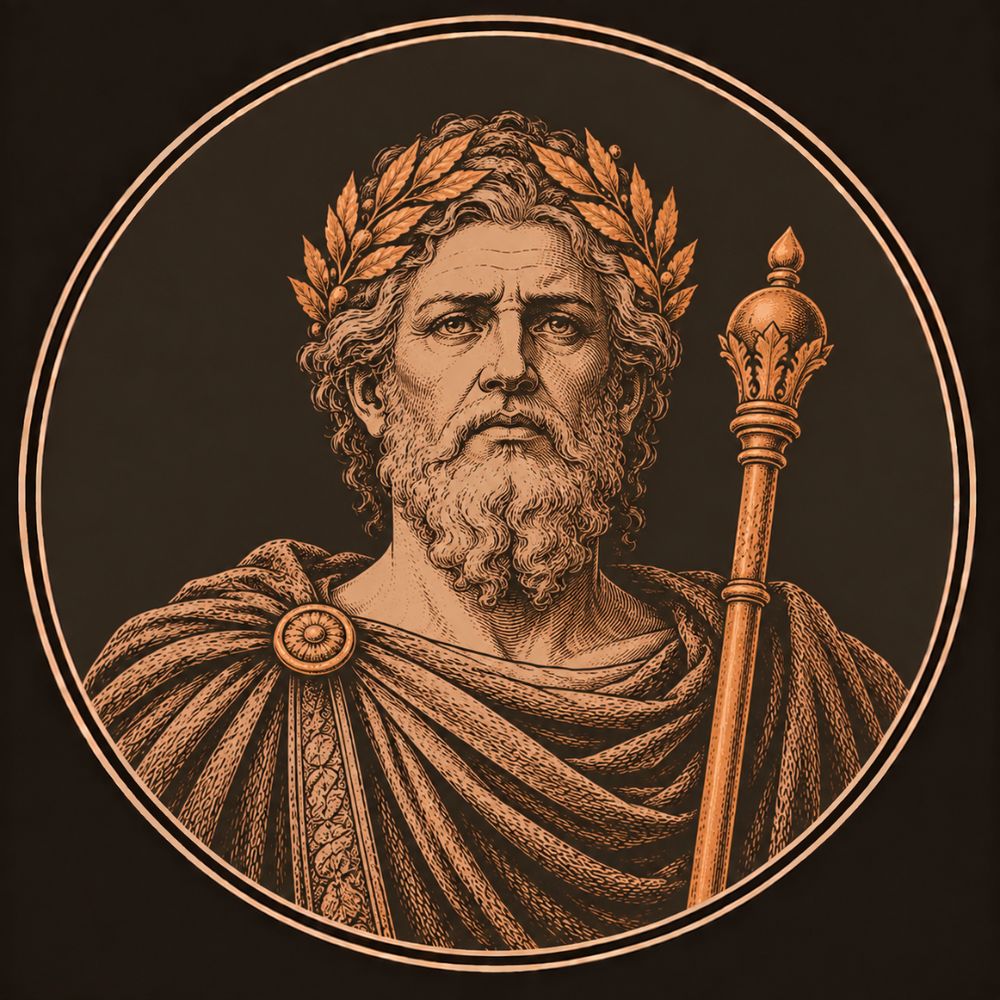
Latinus, bronze medallion illustration
Generated by AI from this page's own facts, not an ancient image or evidence of anything. How this site uses generated images
Sections on this page
Core Myth
Virgil opens the second half of the Aeneid with Latinus. He is an old king who has long ruled fields and towns in peace. Virgil says he was the son of Faunus and the Laurentine nymph Marica. Faunus was the son of Picus, and Picus traced his line to Saturn. Latinus had no living son, since his only boy was taken in early youth. A single daughter, Lavinia, now of an age to marry, kept his house.
Many suitors sought Lavinia, and the handsomest was Turnus, whom the queen pressed to make her son-in-law. The gods sent warnings against the match. Virgil says a swarm of bees settled on the laurel that Latinus had dedicated to Phoebus, and a seer read it as a foreign army arriving. Then, as Lavinia stood beside her father at the altar, her hair seemed to catch fire. The sign promised her fame but foretold a great war for her people.
Troubled, Latinus went to the oracle of his father Faunus beneath Albunea. He sacrificed a hundred sheep and lay on their fleeces. A voice from the grove told him not to marry his daughter to a Latin. Foreign sons-in-law would come, it said, whose blood would carry his name to the stars. Latinus did not keep the answer to himself, and Rumour had spread it through Italy by the time the Trojan ships came into the Tiber.
In the Aeneid, Latinus received the Trojan envoys in the palace of his grandfather Picus. Virgil adds that Circe, who loved Picus, struck him with her golden wand and turned him into a bird. Latinus listened to the envoy Ilioneus in silence, thinking of the oracle. He then offered friendship and his daughter to Aeneas, whom he took to be the promised son-in-law. He sent Aeneas a chariot and a pair of horses from the line that Circe bred in secret from her father's immortal horses.
The peace did not hold. Juno sent the Fury Allecto to madden Queen Amata and Turnus, and Amata pleaded with Latinus against the Trojan match. He stood firm. When the Latins demanded war, Virgil says Latinus stood like a rock against the sea, then gave up the reins of rule and shut himself in his palace. He refused to open the Gates of War, whose threshold Janus guards, so Juno burst them open with her own hand.
In Book 12 Latinus rides out in a four-horse chariot for the single combat of Aeneas and Turnus. His brow is ringed with twelve golden rays, which Virgil calls a sign of the Sun, his grandfather. Aeneas promises that Latinus will keep his arms and his power as father-in-law. Latinus swears the treaty with his hand raised to heaven. When the Rutulians break the truce, Latinus flees, carrying his gods away from the broken oath.
Who was Latinus in Greek mythology?
In Greek sources Latinus is a son of Odysseus, not a Roman native. Hesiod's Theogony says Circe bore Odysseus two sons, Agrius and Latinus, who ruled over the Tyrsenians in a recess of the holy islands. Apollodorus names Calypso as his mother. The Greek historian Dionysius of Halicarnassus reports that he was really a son of Heracles, raised as the son of Faunus. In Roman tradition he is the king of the Aborigines in Latium who received Aeneas.
Hesiod, Theogony 1011-1014
Was Latinus the son of Odysseus or of Telemachus?
Different sources say each. Hesiod's Theogony makes Latinus the son of Odysseus and Circe, and brother of Agrius. Apollodorus also names Odysseus, but with Calypso as the mother. Hyginus puts him a generation later: after Telegonus killed Odysseus, Telemachus married Circe, and their son was Latinus. Roman writers usually give neither. Virgil's Aeneid makes Latinus a son of Faunus and the nymph Marica, and Dionysius of Halicarnassus reports that his real father was Heracles.
Hyginus, Fabulae 127
Who did Latinus marry?
His wife was Amata in Virgil's Aeneid. She favoured Turnus as Lavinia's husband, and the Fury Allecto drove her to rage against the Trojan match. When she believed Turnus dead, she hanged herself, and Latinus tore his robes and poured dust on his white hair. Dionysius of Halicarnassus also names Amata as Latinus's wife. A different Greek account, from Callias and reported by Dionysius, says a Trojan woman named Rome married Latinus and bore him three sons.
Virgil, Aeneid 12.593-611
Who is King Latinus' daughter?
Lavinia, his only child after his son died young, according to Virgil's Aeneid. Omens marked her: bees swarmed on her father's laurel, and her hair seemed to catch fire at the altar. The oracle of Faunus told Latinus to marry her to a foreigner. Livy says Aeneas named his town Lavinium after her. After Aeneas died, Livy adds, Lavinia ruled as regent for her son, and her force of character kept the Latin state intact.
Virgil, Aeneid 7.45-106
Did Aeneas marry Lavinia?
Yes, in Livy and Dionysius of Halicarnassus, and by promise in Virgil. Livy says Latinus gave Aeneas his daughter after their treaty, and Aeneas named Lavinium after his wife. Dionysius says Latinus gave Lavinia to Aeneas once the Trojan town was built. Virgil's Aeneid ends before any wedding. In Book 12 Aeneas says only that the Trojans will build him a city and Lavinia will give it her name, and Latinus swears to the treaty.
Livy, Ab Urbe Condita 1.1
How did King Latinus die?
Livy and Dionysius of Halicarnassus say he fell in battle against the Rutulians. In Livy, Turnus went to war because Lavinia had been promised to him. The Rutulians lost, but the Aborigines and Trojans lost their leader Latinus. Dionysius names the rebel leader Tyrrhenus, a nephew of Queen Amata, and says Latinus and Tyrrhenus both died in a sharp battle. Virgil's Aeneid does not kill him. He mourns Amata's suicide and is still watching the final duel as the poem ends.
Livy, Ab Urbe Condita 1.2
Later Traditions
Livy gives two versions of Latinus's first meeting with the Trojans. In one, he led the Aborigines out against the newcomers, was defeated in battle, and then made peace and a marriage alliance. In the other, he stepped out before the lines and asked who the strangers were. Hearing that they were Trojans led by Aeneas, he gave his right hand in friendship, made a treaty, and gave Aeneas his daughter.
Dionysius of Halicarnassus tells a third version. Latinus was already at war with the Rutulians when raiders began stripping his coast. He marched against them, but a divinity of the place came to him in a dream and told him to receive the Greeks. Aeneas had a matching dream from his own household gods. The two kings met, made a treaty, exchanged children as hostages and fought the Rutulians together. Latinus then gave Aeneas his daughter Lavinia.
Greek writers gave Latinus a Greek father. Hesiod's Theogony says Circe bore Odysseus two sons, Agrius and Latinus, who ruled the Tyrsenians far off in the holy islands. Apollodorus makes Latinus a son of Odysseus by Calypso instead. Hyginus moves him a generation down. After Odysseus died, Telemachus married Circe, and their son Latinus gave his name to the Latin language.
Dionysius reports yet another father. Some said Heracles had a son by a Hyperborean girl he had brought as a hostage. Before leaving for Argos he married her to Faunus, king of the Aborigines, and so Latinus was generally thought to be the son of Faunus rather than of Heracles. Dionysius repeats the claim when he dates Aeneas's landing, saying Latinus passed for Faunus's son but was really the son of Heracles.
Livy says the victorious Aborigines and Trojans lost their leader Latinus in the war with Turnus. Aeneas then gave both peoples the one name of Latins. Dionysius puts Latinus's death in the fourth year after Aeneas left Troy. The Rutulians had rebelled under Tyrrhenus, a nephew of Queen Amata, angry that Latinus had given Lavinia to an outsider. Latinus and Tyrrhenus both fell, Aeneas won, and he succeeded to his father-in-law's kingdom.
Lineage
See the full family tree5 recorded relations, each with the ancient line behind it.
Parents
-

Only Apollodorus makes Calypso the mother of Latinus by Odysseus. Hesiod's Theogony gives Calypso two other sons, Nausithous and Nausinous, and makes Circe the mother of Latinus.
-

disputed
Hesiod's Theogony makes Circe the mother of Latinus and Agrius by Odysseus. Hyginus (Fabulae 127) also makes her his mother, but by Telemachus. Virgil gives his mother as the nymph Marica instead.
-

Dionysius of Halicarnassus reports that Heracles fathered Latinus on a Hyperborean girl and then married her to Faunus, so that Latinus passed for the son of Faunus.
-

disputed
Hesiod's Theogony and Apollodorus both make Odysseus the father of Latinus, by Circe and by Calypso respectively. Hyginus makes Latinus his grandson through Telemachus, and Virgil names Faunus as the father.
-
Only Hyginus (Fabulae 127) makes Telemachus the father of Latinus, by Circe. Hesiod's Theogony and Apollodorus make Odysseus the father, and Virgil makes it Faunus.
Also Connected
3 recorded connections, each with the ancient line behind it.
Allies
-
Latinus makes a treaty with Aeneas and gives him his daughter Lavinia. Livy records two traditions: a defeat in battle followed by peace, or friendship offered before any fighting. In Virgil's Aeneid he welcomes the Trojans at once and swears the treaty in Book 12.
Connected
-
Latinus is urged to open the Gates of War that Janus guards, refuses, and hides away, so Juno opens them herself.
-
Turnus is the suitor Queen Amata favours for Lavinia. In Book 7 Latinus follows the oracle of Faunus and offers her to Aeneas. In Book 12 he tells Turnus he set the gods' command aside once, out of affection for him and pity for the queen.
Where Accounts Differ
- who was Latinus's father
- whether the Theogony lines are Hesiod's
- whether Latinus fought Aeneas before the treaty
- how Latinus died
- whether Latinus descends from Saturn or the Sun
- who Latinus married
- Latinus's father differs by source. Hesiod (Theogony 1011-1014) names Odysseus and Circe. Apollodorus (Epitome 7.24) names Odysseus and Calypso. Hyginus (Fabulae 127) names Telemachus and Circe. Virgil (Aeneid 7.47-49) names Faunus and the nymph Marica. Dionysius (Roman Antiquities 1.43 and 1.44) reports that his real father was Heracles and that Faunus only married his mother.
- The Theogony lines on Circe's sons are doubted. J. G. Frazer's note to Apollodorus Epitome 7.24, printed with the Perseus translation, judges them probably not Hesiod's but a later addition meant to give the Latins a Greek ancestry. They are cited here as part of the transmitted Theogony.
- Whether Latinus fought Aeneas first differs. Livy (1.1) records both traditions: defeat in battle followed by peace, or a parley and treaty before any fighting. Dionysius (1.57-59) has Latinus march against the Trojans and then make a treaty after matching dreams. In Virgil (Aeneid 7.249-285) Latinus offers friendship to the envoys at once, and war comes only through Juno, Amata and Turnus.
- Latinus's death differs. Livy (1.2) says he fell in the war with Turnus and the Rutulians. Dionysius (1.64) places his death in a later battle against Rutulians led by Tyrrhenus, a nephew of Amata. Virgil's Aeneid never tells his death; he mourns Amata (12.609-611) and is still watching the final duel (12.707).
- Virgil gives two ancestries at once. At Aeneid 7.47-49 Latinus descends from Saturn through Picus and Faunus. At 12.164 his crown of rays is a sign of the Sun, his grandfather. The Sun is Circe's father in the Theogony, but Virgil does not explain the link, and none is drawn here.
- Whom Latinus married differs. Virgil (Aeneid 7.343, 12.593-611) and Dionysius (1.64) name Amata. Dionysius (1.72) reports Callias's account that a Trojan woman named Rome married Latinus.
- Hesiod, Apollodorus, Virgil's Aeneid and Livy are cited from the Perseus translations and checked by the site's citation validator. Aeneid line numbers were checked by hand against the Latin text on Perseus and The Latin Library. Hyginus is checked against the Mary Grant translation on ToposText, and Dionysius's chapters against Earnest Cary's Loeb translation on LacusCurtius. Neither is in the live citation registry.
Read the full source verification →
Mythology
Appears In
Related Terms
Sources
- Hesiod, Theogony 1011-1014
- Apollodorus, Epitome 7.24
- Hyginus, Fabulae 127
- Virgil, Aeneid 7.45-49
- Virgil, Aeneid 7.50-106
- Virgil, Aeneid 7.170-191
- Virgil, Aeneid 7.249-285
- Virgil, Aeneid 7.343-373
- Virgil, Aeneid 7.585-622
- Virgil, Aeneid 11.469-472
- Virgil, Aeneid 12.18-31
- Virgil, Aeneid 12.161-211
- Virgil, Aeneid 12.216-286
- Virgil, Aeneid 12.593-611
- Virgil, Aeneid 12.707
- Livy, Ab Urbe Condita 1.1
- Livy, Ab Urbe Condita 1.2
- Livy, Ab Urbe Condita 1.3
- Dionysius of Halicarnassus, Roman Antiquities 1.43
- Dionysius of Halicarnassus, Roman Antiquities 1.44
- Dionysius of Halicarnassus, Roman Antiquities 1.57
- Dionysius of Halicarnassus, Roman Antiquities 1.58
- Dionysius of Halicarnassus, Roman Antiquities 1.59
- Dionysius of Halicarnassus, Roman Antiquities 1.60
- Dionysius of Halicarnassus, Roman Antiquities 1.64
- Dionysius of Halicarnassus, Roman Antiquities 1.72