Calypso
Calypso is a nymph and goddess who lives alone on the island of Ogygia. In Homer's Odyssey she rescues the shipwrecked Odysseus and holds him for seven years, hoping to make him her husband. She offers him immortality, but he still longs for home. When Zeus sends Hermes to command his release, she helps him build a raft and sends him off.
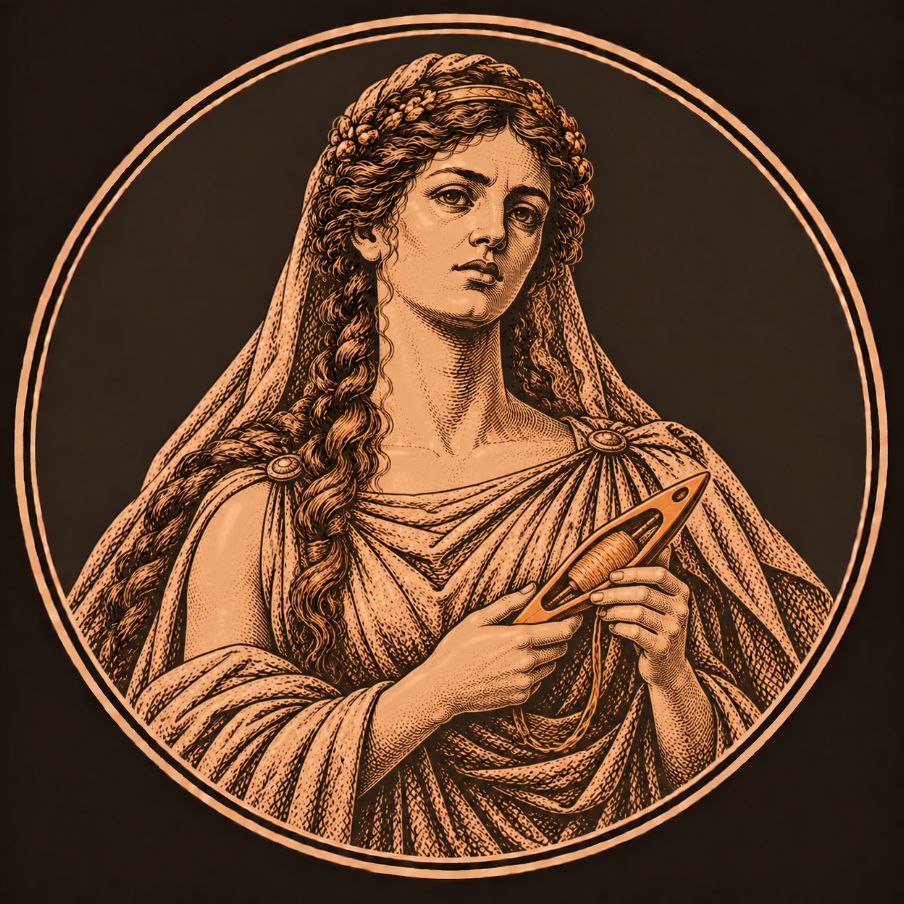
Calypso, bronze medallion illustration
Generated by AI from this page's own facts, not an ancient image or evidence of anything. How this site uses generated images
Sections on this page
See Calypso in the Greek family tree.
Core Myth
Homer's Odyssey opens with Calypso already holding its hero. Every other survivor of Troy is home, but the "queenly nymph Calypso" keeps Odysseus in her hollow caves, wanting him for her husband (Odyssey 1.13-15). Athena tells the gods that she is a daughter of Atlas, living on a wooded island at "the navel of the sea" (1.50-54). Odysseus later names the island Ogygia (7.244).
He reached her alone. Zeus had wrecked his last ship with a thunderbolt. Odysseus drifted on the keel for nine days, and on the tenth night the gods brought him to Ogygia (7.249-255). Calypso took him in, fed him and promised to make him immortal and ageless. In Odysseus's own words, she "could never persuade the heart in my breast" (7.255-258). Even the sea god Proteus, far away in Egypt, knows he is trapped there, weeping, with no ship or crew (4.555-560).
In Book 5, Athena raises his case again, and Zeus sends Hermes with the order to release him (5.1-42). Hermes finds Calypso singing at her loom, weaving with a golden shuttle, in a cave ringed by alder, poplar and cypress (5.55-75). She answers the order with a protest: the gods, she says, begrudge goddesses who take mortal lovers. She cites Eos, whose Orion was shot by Artemis, and Demeter, whose Iasion was struck down by Zeus (5.116-128).
She obeys all the same. She finds Odysseus weeping on the shore and tells him to build a raft, without mentioning Hermes. Suspicious, he makes her swear an oath by the Styx that she plans him no harm (5.160-191). Over a last meal she asks whether he would really leave, and offers again to make him immortal. Odysseus grants that Penelope cannot match a goddess in beauty, but says he still longs for home every day (5.203-224).
Calypso gives him a bronze axe and an adze, shows him where the seasoned trees grow, and brings augers and cloth for a sail (5.228-261). On the fifth day she bathes and dresses him, loads the raft with wine, water and food, and sends a gentle wind. She tells him to keep the Bear on his left as he sails. He sails for seventeen days and on the eighteenth sights the land of the Phaeacians (5.262-281). There Poseidon catches sight of him and raises the storm that breaks the raft. Ashore on Scheria, he meets the princess Nausicaa, who alone stands her ground (Odyssey 6.127-141).
How long did Odysseus stay with Calypso?
Seven years, in Homer's Odyssey. Odysseus tells the Phaeacian queen Arete that he stayed on Ogygia for seven years, wetting with tears the immortal clothes Calypso gave him. She sent him away when the eighth year came round. Later sources shorten the stay. Apollodorus's Epitome says five years. Hyginus's Fabulae says one year, until Mercury, at Jupiter's command, told her to release him.
Homer, Odyssey 7.253-261
Why did Calypso let Odysseus leave?
Because Zeus ordered it. Athena pleaded for Odysseus, and Zeus sent Hermes to tell Calypso that it was his fixed will. Calypso protested that the gods begrudge goddesses their mortal lovers, then admitted that no god can evade the will of Zeus. When she told Odysseus to build a raft, she did not mention Hermes and spoke of her own compassion. Odysseus himself was never sure. He told Arete she sent him off either because of a message from Zeus or because her own mind had changed.
Homer, Odyssey 5.116-144
Why couldn't Odysseus leave Calypso?
He had no way to cross the sea. Athena tells the gods that Calypso keeps him on her island by force. He has no ships with oars and no comrades to carry him home. His last crew had drowned when Zeus struck their ship. Calypso gives the same reason to Hermes: she has no ships and no men to send him with. Only once Zeus orders his release does she supply tools and timber for a raft.
Homer, Odyssey 5.13-17
Why does Odysseus reject Calypso's offer?
Because he wants to go home more than he wants to live forever. At their last meal Calypso says that if he knew the suffering ahead, he would stay and be immortal. She adds that she is no less beautiful than his wife. Odysseus agrees that Penelope is a mortal who cannot match her. He still wishes, he says, every day to reach home, and he will endure whatever a god sends him at sea.
Homer, Odyssey 5.203-224
Does Odysseus have kids with Calypso?
Not in Homer, whose Odyssey never mentions a child. Other sources disagree about how many there were. The closing lines of Hesiod's Theogony say that Calypso, "bright goddess", joined with Odysseus in love and bore him two sons, Nausithous and Nausinous. Apollodorus's Epitome gives her a single son by him, named Latinus. So the answer depends on which ancient author you follow, and no source gives any story about these children.
Hesiod, Theogony 1017-1018
Who was the father of Calypso?
In Homer, the Titan Atlas. Athena calls her the daughter of Atlas, who knows the depths of every sea and holds the pillars that keep earth and heaven apart. Odysseus repeats the parentage later in the poem. Hyginus's Fabulae agrees and names Pleione as her mother. Hesiod's Theogony, however, lists a Calypso among the daughters of Oceanus and Tethys, and Apollodorus lists one among the Nereids, daughters of Nereus.
Homer, Odyssey 7.244-246
What happened to Calypso after Odysseus left?
Homer does not say. Once she sends him off with a gentle wind, the Odyssey never returns to Ogygia, and Calypso appears again only when the voyage is recalled. The one ancient account of her end is in Hyginus's Fabulae. It lists Calypso, daughter of Atlas, among women who killed themselves, and says she did so out of love for Ulysses. No other ancient source supports it.
Hyginus, Fabulae 243
Later Traditions
Her parentage depends on the source. Homer twice makes her a daughter of Atlas (Odyssey 1.52, 7.245). Hyginus's Fabulae names Atlas and Pleione as her parents, which makes her a sister of Maia. Hesiod's Theogony instead lists a "charming Calypso" among the daughters of Oceanus and Tethys (Theogony 359). The Homeric Hymn to Demeter puts a Calypso among Persephone's companions in the same kind of list (422). Apollodorus's Library names a Calypso among the Nereids, daughters of Nereus and Doris (1.2.7). None of these catalogues says whether its Calypso is the nymph of Ogygia.
The length of the stay varies too. Homer gives seven years (Odyssey 7.259). Apollodorus's Epitome gives five, and Hyginus says she kept him "a whole year" (Fabulae 125). Hyginus also places her on Aeaea, the island that belongs to Circe in the Odyssey, rather than on Ogygia.
Homer gives Calypso no children. Hesiod's Theogony says she bore Odysseus two sons, Nausithous and Nausinous (1017-1018). Apollodorus names a single son, Latinus (Epitome 7.24). Homer also says nothing of her fate once the raft leaves. Hyginus lists her among women who killed themselves, "out of love for Ulysses" (Fabulae 243), although Homer's Odysseus calls her immortal and ageless (Odyssey 5.218).
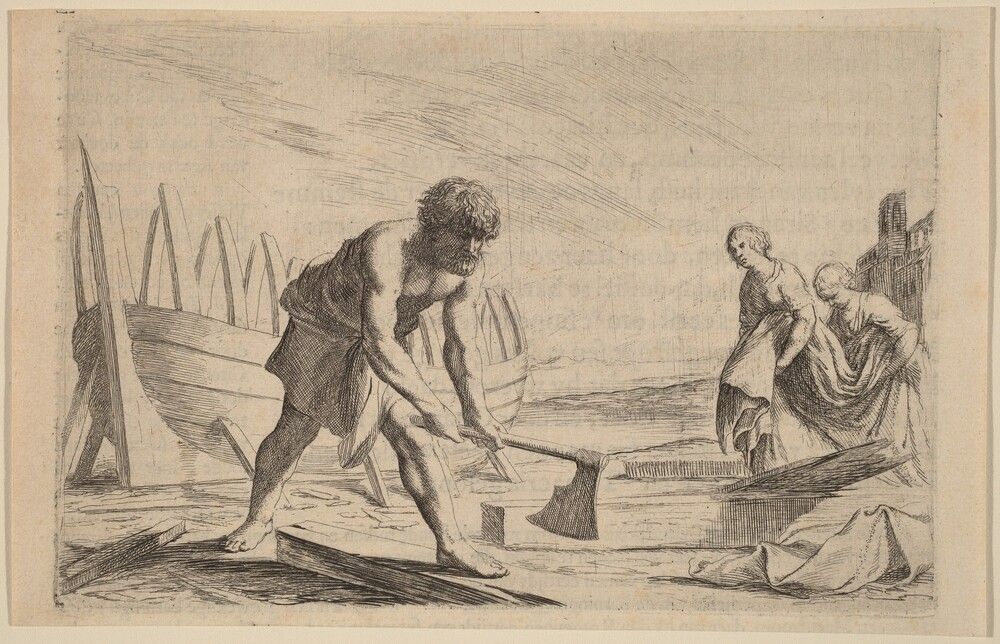
Ulysses on the Island of the Goddess Calypso - Willem Basse, 1634, etching and engraving on laid paper
National Gallery of Art, Washington, DC, 1994.70.5. CC0
Lineage
See the full family tree2 recorded relations, each with the ancient line behind it.
Parents
-

Homer names Atlas as her father twice (Odyssey 1.52, 7.245); Hesiod's Theogony instead lists a Calypso among the Oceanids.
Children
-
Only Apollodorus makes Calypso the mother of Latinus by Odysseus. Hesiod's Theogony gives Calypso two other sons, Nausithous and Nausinous, and makes Circe the mother of Latinus.
Also Connected
3 recorded connections, each with the ancient line behind it.
Connected
-

Calypso cites Eos's lost lover Orion as proof that the gods begrudge goddesses their mortal partners.
-

Hermes carries Zeus's order to Ogygia that Calypso must release Odysseus.
-

Calypso holds Odysseus on Ogygia, wanting him for her husband, until Zeus orders his release.
Where Accounts Differ
- who Calypso's parents were
- how long Odysseus stayed on her island
- whether Calypso had children by Odysseus
- where Calypso's island lay
- whether Calypso died after Odysseus left
- Calypso's parentage differs by source. Homer (Odyssey 1.52, 7.245) and Hyginus (Fabulae, Preface and 125) make her a daughter of Atlas, and Hyginus names Pleione as her mother. Hesiod (Theogony 359) lists a Calypso among the daughters of Oceanus and Tethys, as does the Homeric Hymn to Demeter (422), and Apollodorus (Library 1.2.7) lists one among the Nereids. None of the catalogues identifies its Calypso with the nymph of Ogygia.
- The length of Odysseus's stay differs by source: seven years in Homer (Odyssey 7.259), five in Apollodorus (Epitome 7.24), one year in Hyginus (Fabulae 125).
- Homer gives Calypso no children by Odysseus. Hesiod (Theogony 1017-1018) gives two sons, Nausithous and Nausinous; Apollodorus (Epitome 7.24) gives one, Latinus.
- Hyginus (Fabulae 125) sets Calypso's home on Aeaea, which the Odyssey gives to Circe; Homer calls her island Ogygia (Odyssey 7.244).
- Only Hyginus (Fabulae 243) says Calypso killed herself for love of Odysseus. Homer says nothing of her after the departure.
- The Odyssey is cited from A. T. Murray's translation, which Perseus serves in paragraph-sized sections; line numbers were checked against the Greek text on Perseus. Hyginus is cited from Mary Grant's translation, which is not in the site's line-checked registry.
Read the full source verification →
Mythology
Related Terms
Referenced By
Sources
- Homer, Odyssey 1.13-15
- Homer, Odyssey 1.50-54
- Homer, Odyssey 4.555-560
- Homer, Odyssey 5.1-42
- Homer, Odyssey 5.55-75
- Homer, Odyssey 5.116-144
- Homer, Odyssey 5.160-191
- Homer, Odyssey 5.203-224
- Homer, Odyssey 5.228-261
- Homer, Odyssey 5.262-281
- Homer, Odyssey 7.244-266
- Hesiod, Theogony 359
- Hesiod, Theogony 1017-1018
- Homeric Hymn to Demeter 422
- Apollodorus, Library 1.2.7
- Apollodorus, Epitome 7.24
- Hyginus, Fabulae, Preface
- Hyginus, Fabulae 125
- Hyginus, Fabulae 243
- Homer, Odyssey 6.127-141