Atlas
Atlas is a Titan, son of Iapetus, who fought against the Olympians in the Titanomachy and was punished by Zeus to stand at the western edge of the world and bear the sky on his shoulders forever. He later appears in the myths of both Heracles and Perseus.

Atlas, the Titan condemned to hold up the sky
Generated by AI from this page's own facts, not an ancient image or evidence of anything. How this site uses generated images
Sections on this page
What does the name "Atlas" mean? →
See Atlas in the Greek family tree. Looking for a name of your own? Try the mythological name generator.
Core Myth
Hesiod names Atlas a son of the Titan Iapetus and the Oceanid Clymene, making him a brother of Prometheus, Epimetheus, and Menoitios. Hesiod states his punishment plainly and without narrating the war that caused it: by Zeus's design, Atlas stands at the western edge of the earth, near where the Hesperides sing, holding up the broad sky with his head and untiring hands. Homer's Odyssey describes him differently but to the same effect, as the Titan who knows the depths of the sea and holds the tall pillars that keep earth and sky apart. Later mythographers supply the missing cause: Atlas fought on the Titans' side in the Titanomachy, and this endless labor was Zeus's individual sentence on him once the war was lost.
Apollodorus connects Atlas to two of the major heroic cycles. When Heracles came to fetch the golden apples of the Hesperides for his eleventh labor, he asked Atlas to pick them, since only Atlas could approach that garden safely, and briefly took the sky onto his own shoulders while Atlas did it. Atlas returned with the apples but tried to leave Heracles holding the sky permanently, offering to deliver them himself; Heracles pretended to agree but asked Atlas to hold the sky again just long enough for him to adjust a cushion on his shoulders, then walked off with the apples once Atlas had resumed the burden.
Why was Atlas condemned to hold up the sky?
Hesiod does not narrate the cause directly on the passage describing the punishment, but later mythographers agree it followed the Titanomachy: Atlas fought on the side of Kronos and the Titans against Zeus and the Olympians, and once the Titans lost, Zeus gave Atlas an individual sentence separate from the general imprisonment of the other Titans in Tartarus, setting him to hold the sky at the western edge of the world instead.
Hesiod, Theogony 517-520
How did Heracles get the golden apples from Atlas?
For his eleventh labor, Heracles needed the golden apples of the Hesperides, guarded in a garden only Atlas could safely approach as their father. Heracles offered to hold up the sky himself while Atlas fetched the apples. Atlas agreed, retrieved them, then tried to leave Heracles holding the sky permanently by offering to deliver the apples himself. Heracles pretended to accept, but asked Atlas to take the sky back briefly so he could adjust padding on his shoulders - and once Atlas resumed the burden, Heracles picked up the apples and left.
Apollodorus, Library 2.5.11
Did Perseus really turn Atlas to stone?
That version comes from Ovid, writing centuries after Hesiod and Apollodorus, who has Perseus ask the giant Atlas for hospitality, get refused, and use Medusa's severed head to turn him into the Atlas Mountains of North Africa. This account sits awkwardly beside the Heracles story, since in the standard genealogy Perseus's adventures happen a generation before Heracles is even born, meaning Atlas cannot both be turned to stone by Perseus and still be holding the sky for Heracles afterward. The two stories were not written to be read together.
Ovid, Metamorphoses 4.631-662
Who were Atlas's parents and children?
Hesiod makes Atlas a son of the Titan Iapetus and the Oceanid Clymene, and a brother of Prometheus, Epimetheus, and Menoitios. Among his children, the Pleiades - including Maia, the mother of Hermes by Zeus - and the Hesperides are the best attested, which is also why Atlas alone, of all the Titans, could safely enter the Hesperides' garden to pick their golden apples.
Hesiod, Theogony 507-511
Later Traditions
Ovid tells a separate, later story in which Perseus, refused hospitality by Atlas, turns him to stone with the head of Medusa, and the petrified Titan becomes the Atlas Mountains of North Africa - a story that cannot be reconciled with the version where Atlas is still holding the sky for Heracles, since Perseus's adventures come a generation earlier in the standard genealogy. Atlas became associated with cartography in the Renaissance: his name was given to collections of maps after Gerardus Mercator depicted him, still bent under his burden, on the title page of his 1595 map collection.

Plaque with figure of Atlas - Cypriot, Gold
Metropolitan Museum of Art, New York, NY, 74.51.3289. CC0
5 recorded relations, each with the ancient line behind it.
Parents
-

Their mother is Clymene, an Oceanid; Atlas is later condemned to hold up the sky for his role in the Titans' war against Zeus.
Siblings
-

Both are sons of the Titan Iapetus, named together with their brothers Prometheus and Menoetius.
-

Children
-
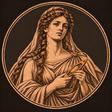
Homer names Atlas as her father twice (Odyssey 1.52, 7.245); Hesiod's Theogony instead lists a Calypso among the Oceanids.
-

Also Connected
2 recorded connections, each with the ancient line behind it.
Connected
-

Atlas fetched the golden apples of the Hesperides for Heracles's eleventh labor while Heracles held the sky in his place, then tried to leave him holding it for good.
-

Hesiod places Sleep's dwelling in the same remote region of the cosmos where Atlas stands holding up the sky.
Where Accounts Differ
- Ovid's petrification story vs. the Heracles timeline
- Ovid's story of Perseus petrifying Atlas into the Atlas Mountains cannot be reconciled with Apollodorus's account of Atlas still holding the sky when Heracles arrives a generation later; the two are separate literary traditions rather than one connected timeline.
Read the full source verification →
Mythology
Appears In
Related Terms
Referenced By
Sources
- Hesiod, Theogony 507-520
- Homer, Odyssey 1.52-54
- Apollodorus, Library 2.5.11
- Timothy Gantz, Early Greek Myth (1993)