Scylla and Charybdis
Scylla and Charybdis are the two sea monsters on either side of a narrow strait that Odysseus must pass after the Sirens. Circe tells him to steer close to six-headed Scylla and lose six men rather than risk the whole ship in Charybdis's whirlpool. He follows the advice, and Scylla takes six of his best men from the deck.
Sections on this page
What Led To It
Odysseus tells this episode himself, in the Odyssey's long account of his wanderings. At the end of it he says he has already told the tale of Ogygia in the hall of Alcinous and finds retelling it tiresome (Homer, Odyssey 12.448-453).
The Myth
The strait first appears in a speech, not on a voyage. After the Sirens, Circe tells Odysseus that two courses lie ahead. One passes the Planctae, the Wandering Rocks. Circe says only the Argo has ever sailed through them, and only because Hera loved Jason (Homer, Odyssey 12.55-72). The other course runs between two cliffs, and she describes both in turn (Homer, Odyssey 12.73-110).
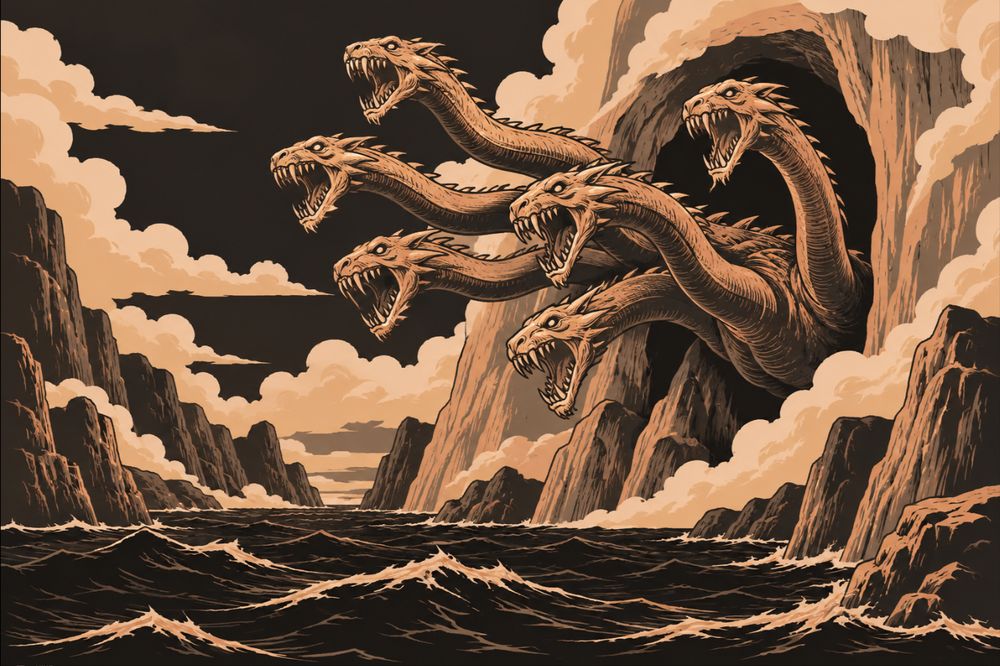
Scylla in her cave
Generated by AI from this page's own facts, not an ancient image or evidence of anything. How this site uses generated images
The first cliff is a smooth rock wrapped in cloud. A dim cave opens in it, and Circe says Scylla lives there, yelping terribly. She has twelve misshapen feet and six long necks. Each neck ends in a head with three rows of teeth. From the cave she reaches out, and every head snatches a man from any ship that passes (Homer, Odyssey 12.73-100).
The second cliff is lower and lies close to the first, with a wild fig tree over the water. Under it Charybdis sucks down the dark water three times a day and gives it back three times. Circe warns Odysseus not to be there when she gulps (Homer, Odyssey 12.101-107). Her advice follows from the two dangers.
it is better far to mourn six comrades in thy ship than all together.
Odysseus asks whether he can escape Charybdis and also fight off Scylla when she attacks his men (Homer, Odyssey 12.111-114). Circe answers that Scylla is no mortal. She calls her an immortal bane, dread and fierce and not to be fought with. The bravest course is flight. He must row past with all his strength and call on Scylla's mother Crataeis to stop her striking a second time (Homer, Odyssey 12.115-126).
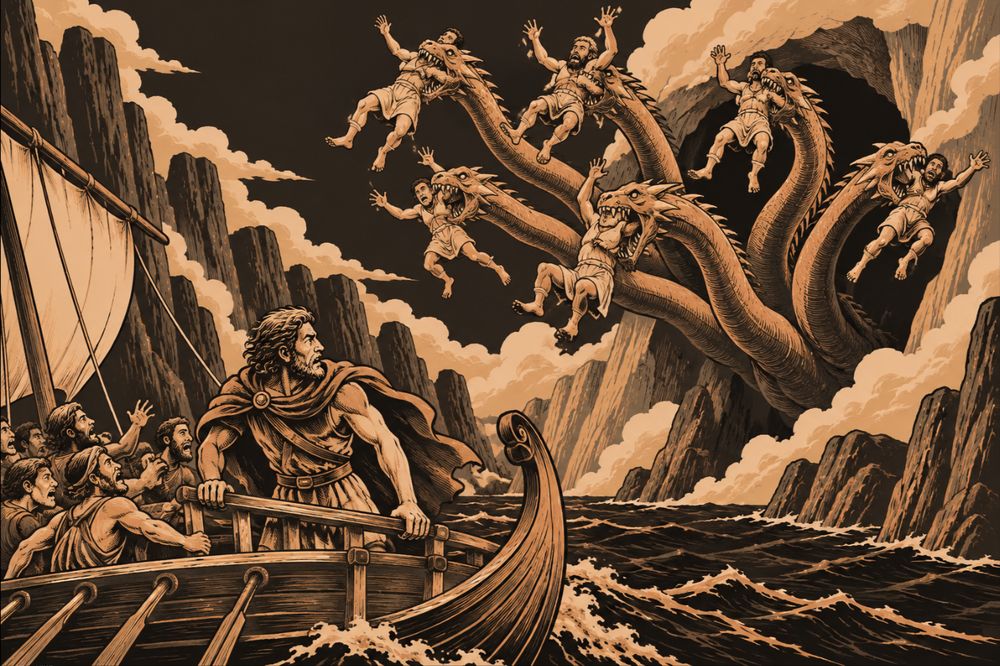
Scylla seizes six men from the ship
Generated by AI from this page's own facts, not an ancient image or evidence of anything. How this site uses generated images
On the ship Odysseus tells his men about Charybdis but not about Scylla, for fear they will stop rowing (Homer, Odyssey 12.223-225). The episode follows Odysseus and the Sirens in his own telling. The ship goes up the narrow strait with wailing. Charybdis gulps the sea down and boils it up again, and spray falls on both cliffs. When she swallows, the seabed shows, and the crew look at her in terror (Homer, Odyssey 12.234-244).
While they watch Charybdis, Scylla seizes six men, the strongest and best of the crew, from the hollow ship. Odysseus looks back and sees their hands and feet high above him. They call him by name for the last time. Scylla drags them up the cliff like a fisherman landing small fish, and eats them at her cave mouth while they scream and stretch out their hands to him. Odysseus says it was the most pitiful sight he saw on all his sea voyages (Homer, Odyssey 12.245-259).
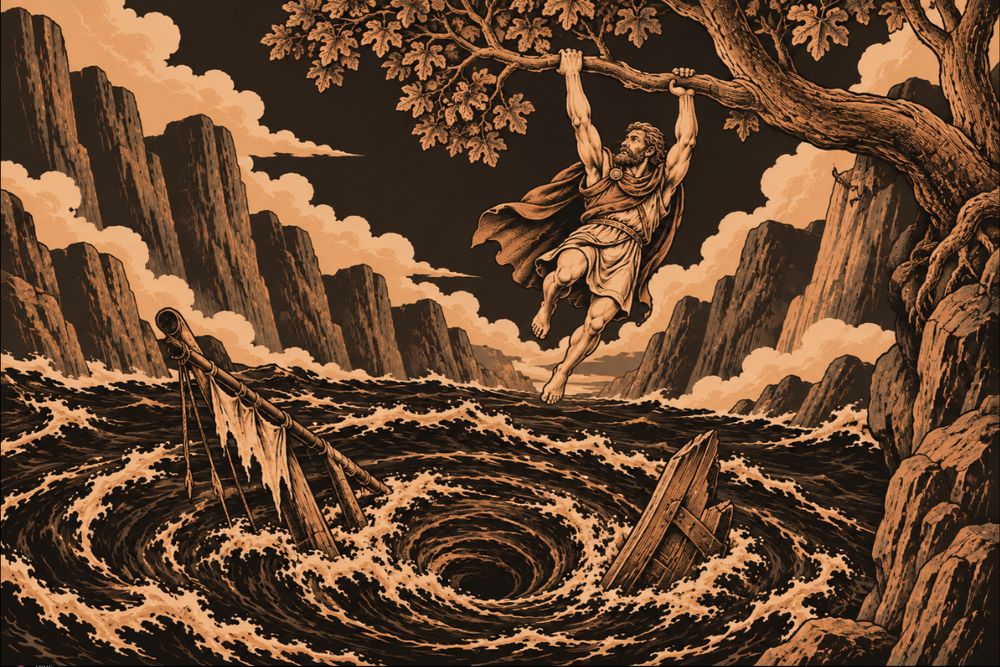
Odysseus clinging to the fig tree
Generated by AI from this page's own facts, not an ancient image or evidence of anything. How this site uses generated images
Odysseus reaches the strait a second time, and now he is alone. His men eat the cattle of Helios, and Zeus smashes the ship with a thunderbolt. Odysseus lashes the keel and mast together, and a south wind carries the raft back toward Charybdis at sunrise (Homer, Odyssey 12.403-429).
Charybdis sucks the raft down. Odysseus springs up and clings to the fig tree like a bat. He cannot get a foothold or reach the branches, so he hangs there until she gives back the mast and keel. When they rise he drops onto them and rows away. The father of gods and men does not let Scylla see him, and he drifts nine days to Ogygia (Homer, Odyssey 12.430-453).
What Followed
After the six deaths the ship sails on to the island of Helios, where Odysseus says he remembered the warnings of Tiresias and Circe to avoid it (Homer, Odyssey 12.260-276). The loss of the ship at the strait the second time follows from what the crew do there, and Odysseus's stay with Calypso follows from the raft. His journey is one of the returns from Troy.
In the Argonautica the Argo passes the same strait. Hera asks Thetis to keep the ship from Charybdis and from Scylla, and the Nereids guide it through (Apollonius of Rhodes, Argonautica 4.783-832; Argonautica 4.922-929).
Why did Odysseus choose Scylla instead of Charybdis?
He followed Circe's reckoning of loss. Scylla can take only as many men as she has heads, which is six, while Charybdis can take the whole ship. Odysseus therefore steers near Scylla's cliff. On the second passage he chooses nothing: the south wind carries his raft back to Charybdis, and only the fig tree saves him.
Homer, Odyssey 12.108-110
Why did Scylla only eat six men?
Because she has six heads, and each head takes one man. Circe describes six long necks, each ending in a head, and says that every head snatches a sailor. Homer says the six taken were the strongest and best of the crew. Scylla does not strike again in that passage, and the ship sails on.
Homer, Odyssey 12.73-100
Is Charybdis Scylla's sister?
Homer does not say so. He gives Scylla a mother, Crataeis, and names no mother or father for Charybdis, who appears only as a whirlpool under a fig tree. Apollonius makes Crataeis another name of Hecate and gives Scylla the father Phorcys, but he gives Charybdis no family either. The sources checked here make the two neighbours, not kin.
Homer, Odyssey 12.115-126
Can Scylla be fought or killed?
Not by Odysseus. When he asks whether he can fight her off, Circe tells him Scylla is immortal and cannot be fought, and that flight is best. He puts on his armour anyway and takes two spears to the fore-deck, but he cannot see her anywhere, and she takes six men without a blow struck.
Homer, Odyssey 12.226-233
Where are Scylla and Charybdis in real life?
The Odyssey passages checked here name no strait, island or coast for them. Circe describes two cliffs and a fig tree, nothing more. Later tradition places the pair in the Strait of Messina, but that placement is not in Homer's text, so it is a later identification and not an ancient claim made in the Odyssey.
Homer, Odyssey 12.73-110
Where Accounts Differ
- scylla-parentage
- argo-route-past-the-strait
- location-of-the-strait
- Scylla's parentage differs. Homer names only her mother Crataeis (Odyssey 12.124-126). Apollonius makes Crataeis another name of Hecate and names Phorcys as the father (Argonautica 4.783-832). Neither gives Charybdis a parent.
- The Argo's route differs. In Homer the Argo has passed the Planctae and Circe names no other ship there (Odyssey 12.69-72). In Apollonius the Argo goes past Scylla and Charybdis as well, and the Nereids guide it through the Wandering Rocks (Argonautica 4.922-929).
- The place of the strait is not given in the Odyssey passages cited here (12.73-110). The Strait of Messina is a later identification and is not drawn from Homer.
Read the full source verification →
Mythology
Figures In This Myth
Also Connected
Related Terms
Referenced By
Sources
- Homer, Odyssey 12.55-72
- Homer, Odyssey 12.73-100
- Homer, Odyssey 12.73-110
- Homer, Odyssey 12.101-107
- Homer, Odyssey 12.108-110
- Homer, Odyssey 12.111-114
- Homer, Odyssey 12.115-126
- Homer, Odyssey 12.223-225
- Homer, Odyssey 12.226-233
- Homer, Odyssey 12.234-244
- Homer, Odyssey 12.245-259
- Homer, Odyssey 12.260-276
- Homer, Odyssey 12.403-429
- Homer, Odyssey 12.430-453
- Homer, Odyssey 12.448-453
- Apollonius of Rhodes, Argonautica 4.783-832
- Apollonius of Rhodes, Argonautica 4.922-929