Odysseus and the Sirens
Odysseus beat the Sirens by following Circe's plan: his crew plugged their ears with wax and tied him upright to the mast, so he heard the song and could not steer toward it. Homer's Sirens offer knowledge of Troy and of everything on earth. Apollodorus says they died once a ship passed, and Apollonius has Orpheus outsing them.
Sections on this page
What Led To It
This episode follows Circe and the Swine in Odysseus's own telling. Circe's first instructions send him to the dead; her second set, given after his return, is this briefing. The Argo already appears in it. Circe says only that ship has ever passed the Planctae, and only because Hera loved Jason (Homer, Odyssey 12.69-72). Homer therefore knew a voyage of the Argonauts but puts the Sirens on Odysseus's route, not theirs.
The long journey home, or nostos, is the frame. Odysseus is trying to reach Ithaca, and the Sirens tempt him with something other than food or rest: learning.
The Myth
Odysseus's meeting with the Sirens begins with a briefing, not a ship. In the Odyssey he tells the story himself. Back on Aeaea after the visit to the dead, he says Circe told him the earlier trials were over and that a god would recall her words when he needed them (Homer, Odyssey 12.37-38).
The Sirens come first, Circe says. They beguile every man who comes near. Anyone who draws close unaware and hears their voice never gets home, so his wife and children never stand rejoicing beside him. The Sirens sit in a meadow and sing clearly, and around them lies a great heap of bones with the skin still shrivelling on them (Homer, Odyssey 12.39-46).
Her instructions are exact. Row past. Knead sweet wax and anoint the crew's ears so that none of them hears. If Odysseus himself wants to listen, the men must bind him hand and foot, upright against the step of the mast, with the rope ends fastened to the mast itself. If he begs to be freed, they must tie him with more bonds (Homer, Odyssey 12.47-54).
Circe speaks of "the two Sirens" and says nothing of their shape (Homer, Odyssey 12.52). Her warning then turns to the Planctae, beetling crags, and to two other routes between which she leaves the choice to him (Homer, Odyssey 12.55-65).
Odysseus shares the plan with his men, but not all of it. He says one or two of them should not hold the oracles alone, so that all may either die knowing or escape. He tells them Circe ordered them to avoid the Sirens' voice and flowery meadow, and that he alone may listen, bound fast, and must be tied tighter if he pleads (Homer, Odyssey 12.153-164).
The ship reached the island of the two Sirens on a fair, gentle wind. Then the wind dropped. A dead calm settled, and Odysseus says a god lulled the waves to sleep. The crew furled the sail, stowed it, took their seats and whitened the water with their fir oars (Homer, Odyssey 12.165-172).
Odysseus took his sharp sword and cut a great round cake of wax into small pieces. He kneaded it in his hands until the pressure and the rays of Helios warmed it soft, then anointed the ears of every man in turn (Homer, Odyssey 12.173-177).
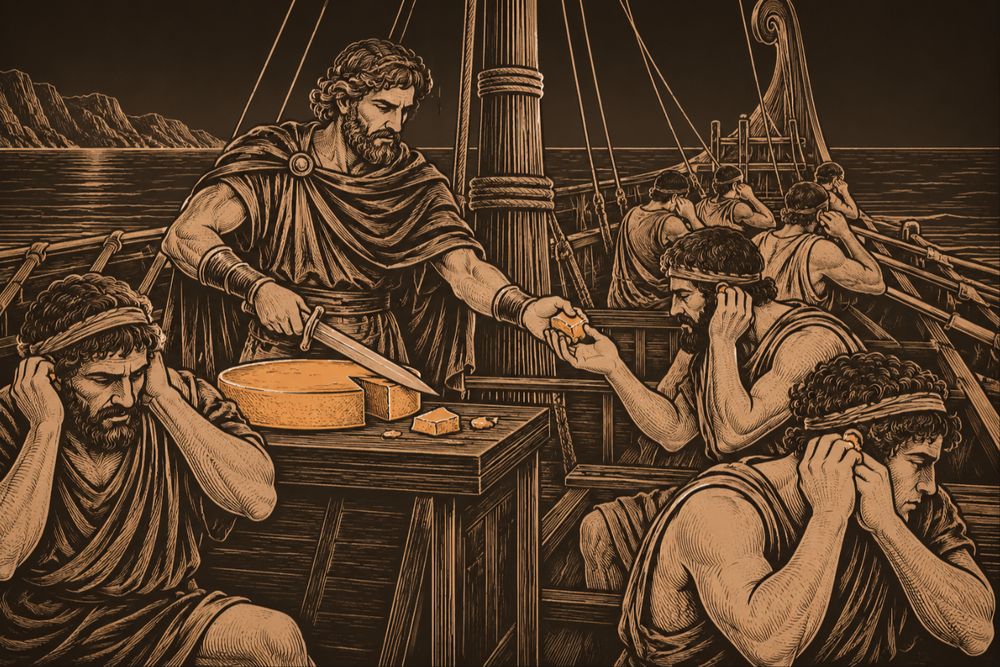
The wax
Generated by AI from this page's own facts, not an ancient image or evidence of anything. How this site uses generated images
The crew bound him hand and foot, upright in the mast-step, and made the ropes fast to the mast itself. Then they sat and struck the grey sea with their oars (Homer, Odyssey 12.177-180).
The Sirens noticed the ship when it came within shouting distance. Homer says they did not miss the swift vessel as it drew near, and they raised their clear-toned song (Homer, Odyssey 12.181-183). No man in the crew could hear it. The one man who could was tied where he could do nothing about it.
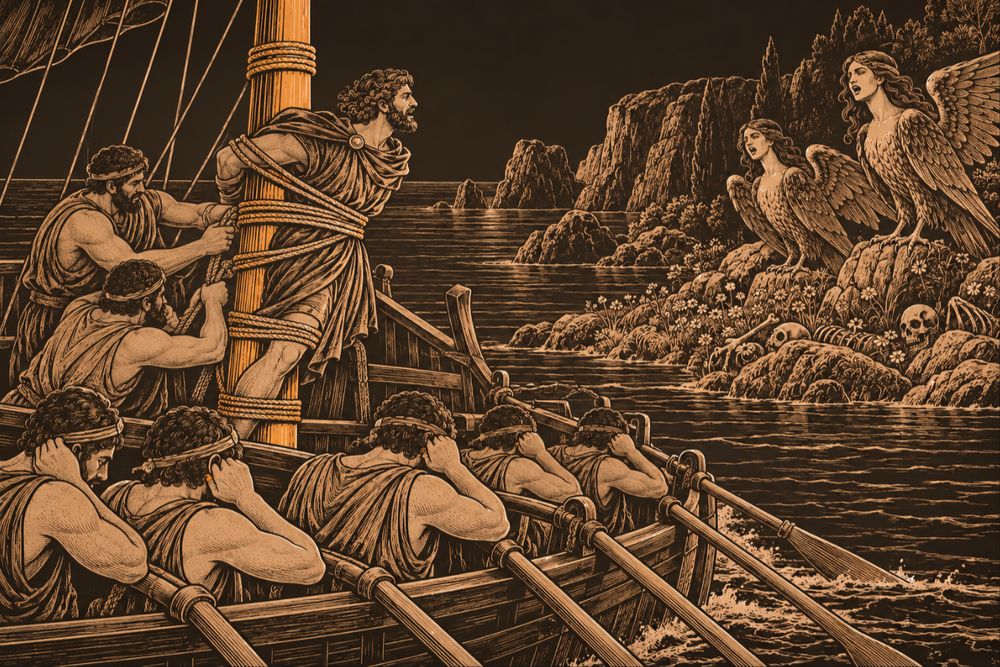
Odysseus at the mast
Generated by AI from this page's own facts, not an ancient image or evidence of anything. How this site uses generated images
Come hither, as thou farest, renowned Odysseus, great glory of the Achaeans; stay thy ship that thou mayest listen to the voice of us two. For never yet has any man rowed past this isle in his black ship until he has heard the sweet voice from our lips. Nay, he has joy of it, and goes his way a wiser man. For we know all the toils that in wide Troy the Argives and Trojans endured through the will of the gods, and we know all things that come to pass upon the fruitful earth.
The song does not promise pleasure. It promises knowledge. It names Odysseus, praises him, and offers to tell him about the war he fought and about everything that happens on earth. The Sirens also claim that no man has passed without stopping, which Circe's meadow of bones has already contradicted.
Odysseus says his heart wanted to listen. He nodded with his brows and told his men to loose him. They rowed on. Perimedes and Eurylochus stood up, bound him with more ropes and drew them tighter (Homer, Odyssey 12.192-196).
When the ship had passed and the voices had faded, the men took the wax from their ears and untied him (Homer, Odyssey 12.197-200). Homer does not say what the Sirens do afterward.
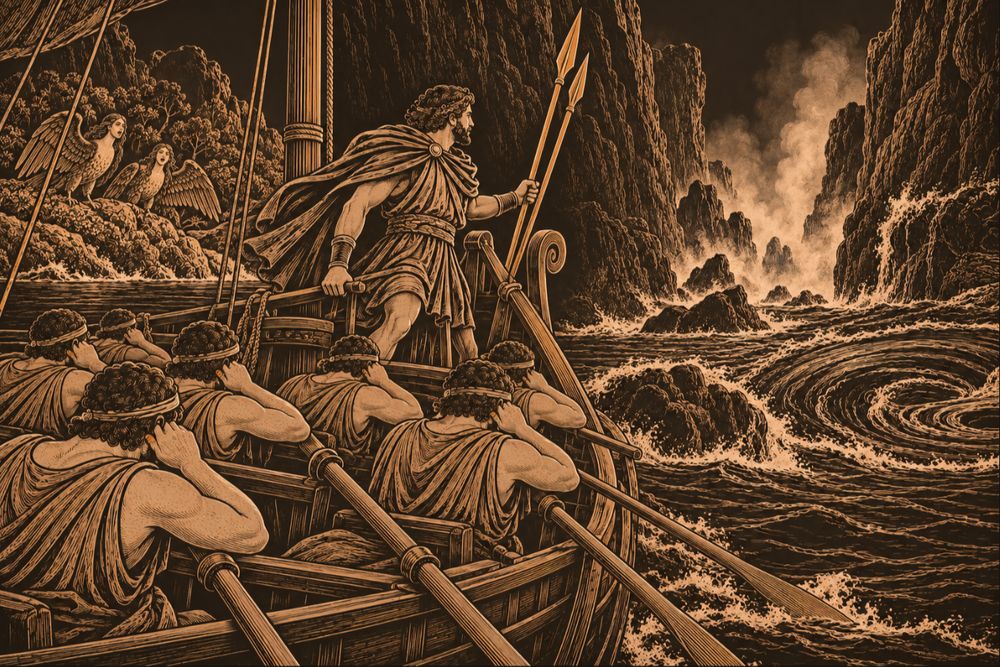
Rowing on toward the strait
Generated by AI from this page's own facts, not an ancient image or evidence of anything. How this site uses generated images
The relief lasted only until the island was behind them. Odysseus saw smoke and a great swell and heard a booming. The oars flew from his men's terrified hands and splashed in the surf. The ship stood still (Homer, Odyssey 12.201-206).
He went along the benches with gentle words. He reminded them of the Cyclops's cave, from which his courage and wit had rescued them, and told them to keep rowing and obey. He ordered the steersman to keep the ship away from the smoke and hug the cliff (Homer, Odyssey 12.207-221; compare Odysseus and the Cyclops).
One thing he kept from them. He did not mention Scylla, a bane with no cure, for fear the crew would stop rowing and huddle in the hold (Homer, Odyssey 12.223-225). Then he forgot Circe's order not to arm himself, put on his armour and took two spears to the fore-deck. He could not see her anywhere (Homer, Odyssey 12.226-233).
The ship sailed on up the narrow strait with wailing, Scylla on one side and Charybdis sucking down the sea on the other. Scylla then seized six of his best men from the ship (Homer, Odyssey 12.234-246).
What Followed
The Sirens are the last quiet moment before the strait. Odysseus sails on into Scylla's cliff and Charybdis's whirlpool, loses six men, and then reaches the island of Helios, where he says he remembered the warnings of Tiresias and Circe to avoid it (Homer, Odyssey 12.260-276).
What happens to them afterward depends on the author. Apollodorus and Hyginus say they died because a ship passed them, and the Argonaut version has them defeated by music instead of restraint.
How did Odysseus beat the Sirens?
He followed Circe's instructions, which combined two precautions. His crew stopped their ears with softened wax so that none of them heard the song. He had them tie him hand and foot upright against the mast, so that he could listen without being able to steer toward the island. He ordered them to bind him tighter if he begged to be freed, and two crewmen, Perimedes and Eurylochus, did so.
Homer, Odyssey 12.47-54; 12.153-200
What did Odysseus say about the Sirens?
In Homer he says little about them and never judges the song. His speech about them in book 12 is the briefing to his crew: Circe told them to avoid the Sirens' voice and meadow, and only he may listen, tied to the mast. Afterward he says his heart wanted to listen and that he signalled to be freed. He keeps Scylla secret from the crew, but not the Sirens.
Homer, Odyssey 12.153-164; 12.192-196
What do the Sirens in The Odyssey symbolize?
Homer gives no allegory. His Sirens offer wisdom about Troy and about everything on earth, and Circe's bones show the price. One ancient reading of that offer comes from Cicero, who says the Sirens do not tempt with the sweetness of their voices but with the promise of knowledge. Cicero adds that Homer knew a great man could not be held by a mere ditty.
Homer, Odyssey 12.184-191; Cicero, De Finibus 5.49
Did Odysseus cut off the Sirens' tails?
No. Odysseus never touches the Sirens in Homer. The only thing he cuts is the cake of wax for his crew's ears, which he slices with his sword. Homer gives no description of the Sirens' bodies. Ancient authors who do describe them, such as Apollodorus and Hyginus, give them the lower body of a bird, not a fish's tail.
Homer, Odyssey 12.173-177; Apollodorus, Epitome 7.18-7.19; Hyginus, Fabulae 125
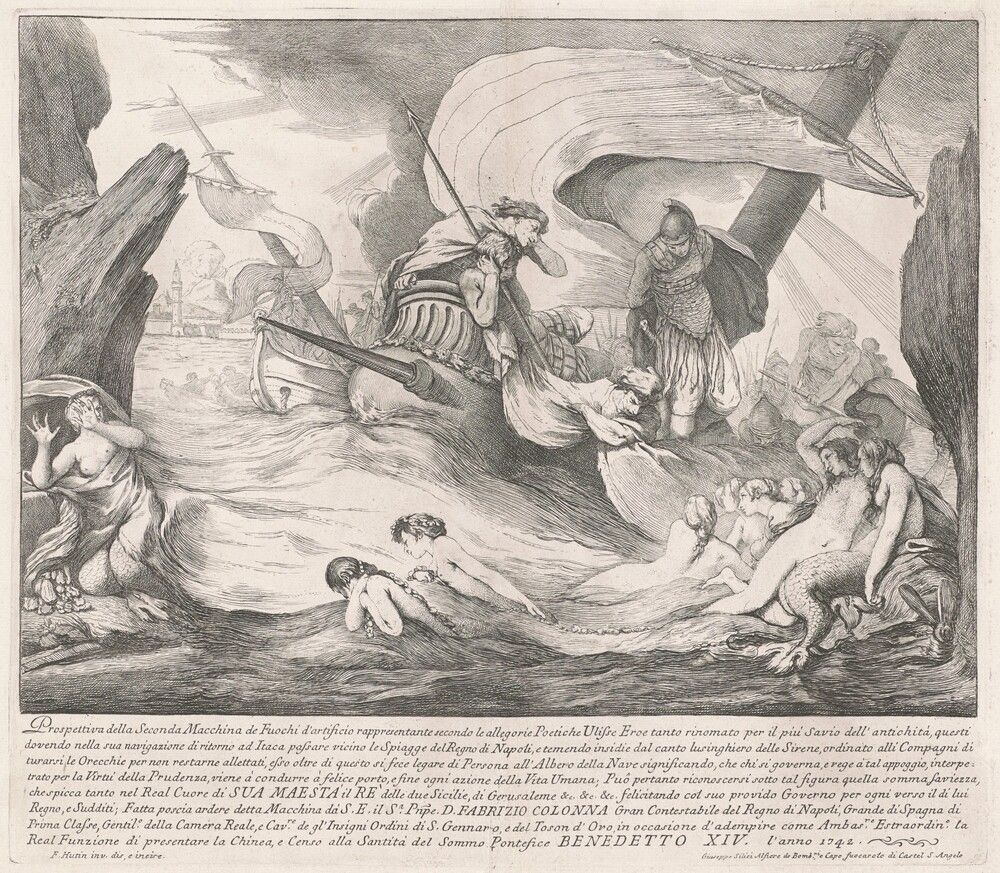
The Seconda Macchina for the Chinea of 1742: Ulysses and the Sirens - François Hutin, 1742, etching
National Gallery of Art, Washington, DC, 2016.121.8. CC0
Where Accounts Differ
- sirens-bodies-not-in-homer
- number-names-and-mother-of-the-sirens
- wax-and-mast-or-orpheus
- fate-of-the-sirens
- origin-of-the-bird-form
- song-as-promise-of-knowledge
- Homer never describes the Sirens' bodies. His Sirens are two, they sit in a meadow, and they sing (Odyssey 12.39-46, 12.52). Apollodorus says they had the forms of birds from the thighs (Epitome 7.18). Apollonius makes them part bird and part maiden (Argonautica 4.895-899). Hyginus gives them the upper body of a woman and the lower body of a bird (Fabulae 125). No account cited here gives them a fish's tail.
- Number, names and mother differ. Homer says two (Odyssey 12.52, 12.167). Apollodorus names three, Pisinoe, Aglaope and Thelxiepia, daughters of Achelous and the Muse Melpomene (Epitome 7.18). Hyginus also gives Melpomene (Fabulae 125, 141). Apollonius makes their mother the Muse Terpsichore (Argonautica 4.895-896).
- The way past them differs. In Homer and Apollodorus, Odysseus uses wax and the mast on Circe's advice (Odyssey 12.47-54, Epitome 7.18-7.19). In Apollonius, Orpheus stops the Argonauts from landing by playing his lyre until it overcomes the maidens' voice (Argonautica 4.903-909). The Argonaut Butes still swims toward them and is carried away to Lilybaeum by Aphrodite (Argonautica 4.912-919).
- Their fate differs. Homer is silent. Apollodorus says it was foretold that they would die when a ship passed them, and so they died (Epitome 7.19). Hyginus says the same prophecy applied to anyone who heard them and passed by, and that they threw themselves into the sea, leaving the place called Sirenides (Fabulae 141).
- The origin of their bird form is not in Homer. Apollonius says they once tended Demeter's unwed daughter and were then partly birds (Argonautica 4.896-899). Hyginus says they wandered after the rape of Proserpina and Ceres made them flying creatures for not helping (Fabulae 141).
- Homer gives no allegory. The song's content is knowledge of Troy and of all things on earth (Odyssey 12.189-191). Cicero reads it as an offer of knowledge rather than of sweet sound, in a passage where he translates the song into Latin himself (De Finibus 5.49). Cicero's reading is his own, and this page treats it as such.
Read the full source verification →
Mythology
Figures In This Myth
Also Connected
Related Terms
Referenced By
Sources
- Homer, Odyssey 12.37-38
- Homer, Odyssey 12.39-46
- Homer, Odyssey 12.47-54
- Homer, Odyssey 12.55-65
- Homer, Odyssey 12.69-72
- Homer, Odyssey 12.153-164
- Homer, Odyssey 12.165-172
- Homer, Odyssey 12.173-177
- Homer, Odyssey 12.177-180
- Homer, Odyssey 12.181-183
- Homer, Odyssey 12.184-191
- Homer, Odyssey 12.192-196
- Homer, Odyssey 12.197-200
- Homer, Odyssey 12.201-206
- Homer, Odyssey 12.207-221
- Homer, Odyssey 12.223-225
- Homer, Odyssey 12.226-233
- Homer, Odyssey 12.234-246
- Homer, Odyssey 12.260-276
- Apollodorus, Epitome 7.18-7.19
- Apollonius of Rhodes, Argonautica 4.891-919
- Hyginus, Fabulae 125
- Hyginus, Fabulae 141
- Cicero, De Finibus 5.49
- Sir James George Frazer, translation of Apollodorus, The Library, Loeb Classical Library (1921)