Circe and the Swine
Odysseus's men became swine on the island of Aeaea because Circe drugged their food and struck them with a wand. Homer gives her no motive. The god Hermes gave Odysseus an herb, moly, that made him immune. He forced Circe to swear an oath and restore his crew, and they stayed with her for a year.
Sections on this page
What Led To It
Circe's island follows the Cyclops and the Laestrygonians in Odysseus's own telling. He reaches Aeaea with his fleet gone and his crew broken, and the episode shows what remains of his leadership. Odysseus and the Cyclops supplies the crew's fear, and Eurylochus's charge that Odysseus's recklessness cost them their men in the Cyclops's cave is an open challenge to his command (Homer, Odyssey 10.428-437).
Circe is the sister of Aeetes and a child of Helios and Perse, according to both Homer (Odyssey 10.135-139) and Apollodorus (Epitome 7.14). Apollodorus adds that she was skilled in every enchantment. Frazer's note on the Perseus text observes that the Greek word for what she uses, pharmaka, meant drugs and charms at once.
The Myth
The episode opens with a crew at its lowest point. In Homer's Odyssey, Odysseus tells the story himself, and he says he reached Aeaea grieving for the comrades the Laestrygonians had killed. Aeaea was the home of Circe, whom he calls a dread goddess who speaks with human voice, a child of the sun god Helios and the Oceanid Perse (Homer, Odyssey 10.133-139).
The men landed and lay on the shore for two days. On the third morning Odysseus climbed a hill, saw smoke rising from Circe's halls, and killed a great stag on the way back. The crew ate well, but he told them plainly that he saw no way out. Homer says their spirit broke at once, remembering the Laestrygonian Antiphates and the man-eating Cyclops (Homer, Odyssey 10.144-202; compare Odysseus and the Cyclops).
Odysseus split the crew in two and they shook lots in a bronze helmet. The lot fell to Eurylochus, who set out with twenty-two men. Odysseus stayed behind with the rest (Homer, Odyssey 10.203-209).
Eurylochus's party found Circe's house of polished stone in a forest clearing. Wolves and mountain lions prowled around it, and Homer says Circe had bewitched them with drugs. They did not attack. They fawned on the men and wagged their tails, as dogs do around a master who brings scraps from the feast. Inside, someone was singing at a great loom (Homer, Odyssey 10.210-223).
Polites, the crewman Odysseus trusted most, called out, and Circe opened the doors. All the men followed her in except Eurylochus, who suspected a trap and stayed outside. She seated them and mixed a drink of cheese, barley meal, honey and Pramnian wine. Homer says she added baneful drugs, so that the men would utterly forget their native land (Homer, Odyssey 10.224-236).
When they had drunk, she struck them with her wand and drove them into the sties. They had the heads, voices and bristles of swine, but Homer says their minds stayed as they were. They wept in the pen while Circe threw them acorns and cornel fruit, the food of pigs (Homer, Odyssey 10.237-243).
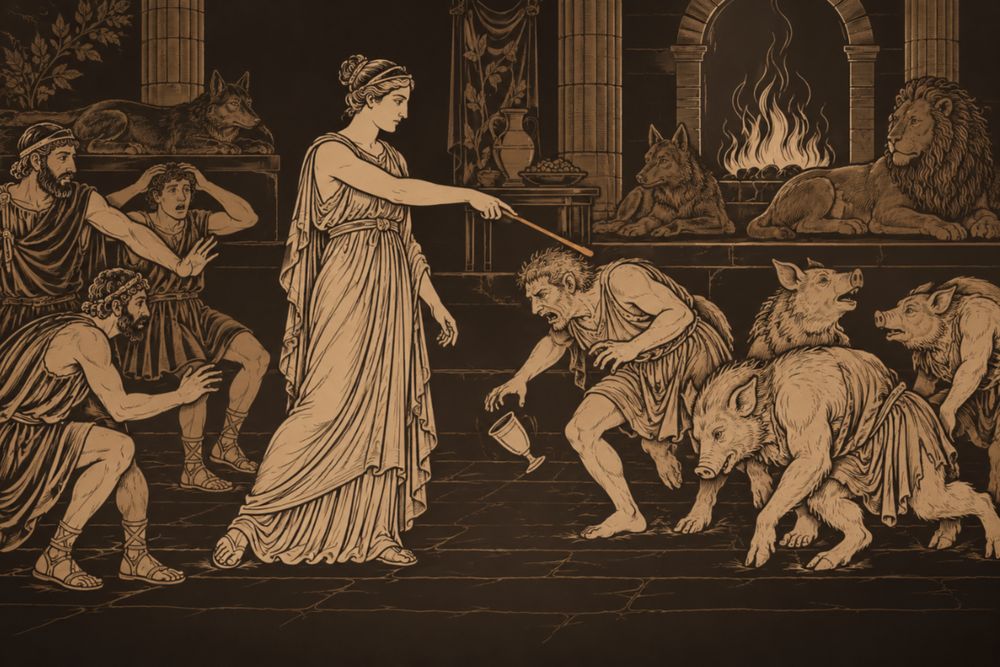
Circe's wand
Generated by AI from this page's own facts, not an ancient image or evidence of anything. How this site uses generated images
Eurylochus ran back to the ship. Homer says he was so shaken he could not speak at first. When he could, he reported what he had seen: the men had gone in, and none had come out again (Homer, Odyssey 10.244-260).
Odysseus took his sword and bow and ordered Eurylochus to lead him back. Eurylochus clung to his knees and begged him not to go, sure that neither of them would return. Odysseus told him to stay by the ship and eat and drink, and went alone (Homer, Odyssey 10.261-273).
On the way to the house, Hermes met him, disguised as a young man with the first down on his lip. Homer's Hermes says the crew are penned like swine and that Odysseus, if he goes in unprotected, will stay there with them. He then pulled a herb from the ground and told Odysseus how to use it (Homer, Odyssey 10.274-306).
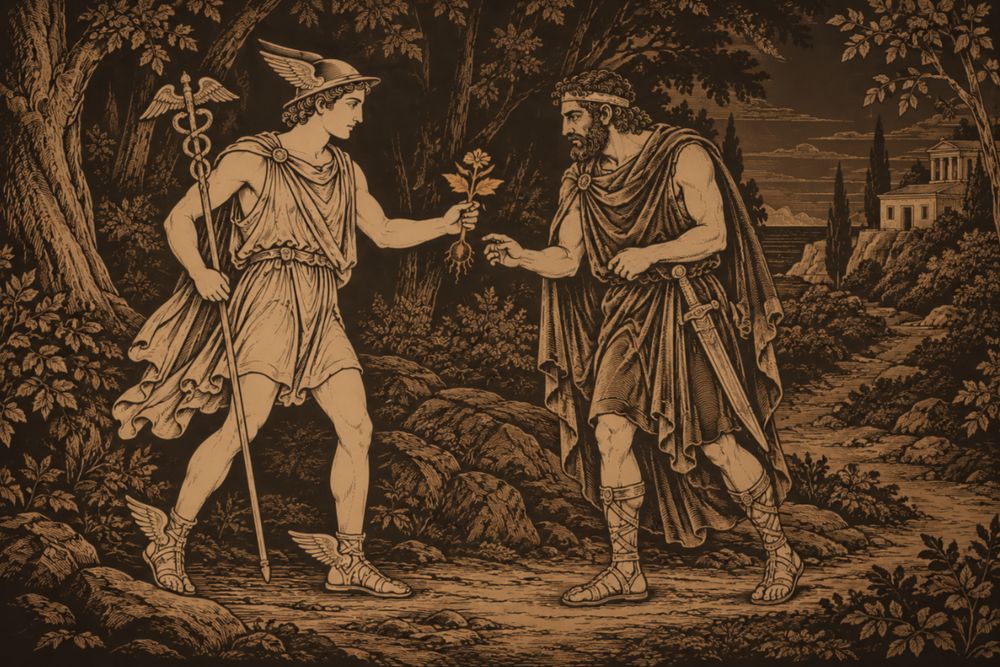
Hermes gives Odysseus the moly
Generated by AI from this page's own facts, not an ancient image or evidence of anything. How this site uses generated images
So saying, Argeiphontes gave me the herb, drawing it from the ground, and showed me its nature. At the root it was black, but its flower was like milk. Moly the gods call it, and it is hard for mortal men to dig; but with the gods all things are possible.
Hermes gave Odysseus his instructions. Take the herb and go in, because it will keep Circe's potion from working. When Circe strikes with her wand, draw the sword and rush at her as if to kill her. When she then invites him to her bed, accept, but first make her swear a great oath by the gods that she will plan no further harm, so she cannot unman him once he is undressed (Homer, Odyssey 10.281-301).
Odysseus followed the plan. Circe gave him the potion in a golden cup. He drank and nothing happened. She struck him with the wand and said, "Begone to the sty, and lie with the rest of your comrades." He drew his sword and rushed at her. She ran under the blade, clasped his knees and asked who he was (Homer, Odyssey 10.310-323).
Circe understood at once. No other man had ever resisted the drug, she said, so he must be Odysseus, whom Hermes had told her would come on his way home from Troy. She offered her bed. Odysseus refused until she swore the oath, and she swore it. Homer's Odysseus then lets her handmaids bathe and feed him, but he sits without touching the food until his men are free (Homer, Odyssey 10.324-380).
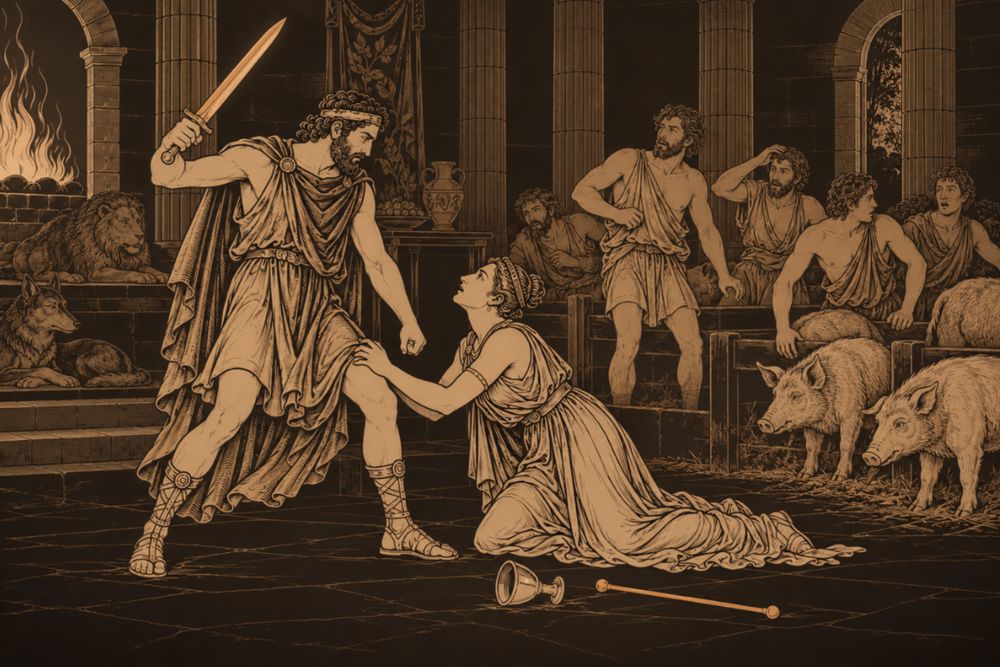
Odysseus draws his sword on Circe
Generated by AI from this page's own facts, not an ancient image or evidence of anything. How this site uses generated images
Circe went out with her wand, opened the sties and drove the men out in the shape of nine-year-old swine. She anointed each with another charm. The bristles fell away and they became men again, Homer says, younger, taller and handsomer than before. They knew Odysseus, clung to his hands and wept, and the house rang with it. Even Circe was moved to pity (Homer, Odyssey 10.388-399).
She told Odysseus to beach his ship, store his gear in caves and bring the rest of his crew. Eurylochus tried to stop them. He warned that she would turn them all into swine, wolves or lions to guard her house, and he blamed Odysseus's folly for the men lost in the Cyclops's cave. Odysseus considered cutting off his head. The others talked him out of it, and Eurylochus came along anyway, afraid of Odysseus's anger (Homer, Odyssey 10.428-445).
Circe told the whole crew to stop their mourning and eat until they had recovered the spirit they had when they first left Ithaca. They agreed, and they stayed for a full year, feasting on meat and sweet wine. When the seasons had turned, the men asked Odysseus to think of home (Homer, Odyssey 10.449-475).
Here the story turns from Circe's hall to the question of return, or nostos. Circe told Odysseus he could not sail home yet. He first had to travel to the house of Hades and consult the blind seer Tiresias, and she gave him detailed instructions for the rites (Homer, Odyssey 10.487-540). Odysseus wept at the news, and his men wept as well when he told them.
The episode ends with a death. Elpenor, the youngest crewman, had slept on the roof drunk. He heard the men moving, forgot the ladder and fell, breaking his neck (Homer, Odyssey 10.552-560).
What Followed
Odysseus does not leave Aeaea for home. He goes first to the edge of the world to speak with Tiresias, then returns to Aeaea, where the crew buries Elpenor and Circe gives her second set of warnings about the Sirens, Scylla and Charybdis (Homer, Odyssey 12.1-150). Her own page covers those instructions; this story ends where they begin, and Odysseus and the Sirens picks up the first of them.
Homer's drug is aimed at memory. In this episode Circe mixes it so that the men will forget their native land (Homer, Odyssey 10.236), and the year of feasting ends only when the crew remembers Ithaca. Later she tells the crew to eat until they recover the spirit they had when they first left home (Homer, Odyssey 10.460-465).
Why did Circe turn men into swine?
Homer gives no motive. In the Odyssey Circe simply mixes a drugged drink for the crewmen who enter her house and turns them into swine with her wand. The text does say what the drug is for: she added it to the food so that the men would utterly forget their native land. Eurylochus later guesses she would change them into swine, wolves or lions to guard her house, but that is his fear, not Circe's own explanation.
Homer, Odyssey 10.234-243
What did Circe do to Odysseus's men?
She welcomed Eurylochus's twenty-two men into her house, gave them a drink of cheese, barley meal, honey and Pramnian wine laced with drugs, then struck each with a wand and penned them in sties. They had the heads, voices and bristles of swine but kept their human minds. Circe fed them acorns. Eurylochus, who stayed outside, escaped to warn Odysseus.
Homer, Odyssey 10.224-243
What is moly in the Odyssey?
Moly is the herb Hermes gave Odysseus to protect him from Circe's drugs. Homer describes it as black at the root with a flower like milk, and says the gods call it moly and that it is hard for mortal men to dig. Homer does not say what the plant really is. Frazer's note on the Perseus text of Apollodorus reports that Theophrastus described a moly like Allium nigrum, a wild garlic, growing in Arcadia.
Homer, Odyssey 10.302-306
How did Odysseus free his men from Circe?
He drank her potion, protected by the moly, and drew his sword when her wand failed to change him. Circe then invited him to her bed. Odysseus made her swear a great oath not to harm him and refused to eat until his men were free. She anointed them with another charm and they became men again, younger and taller than before.
Homer, Odyssey 10.310-399
How long did Odysseus stay with Circe?
A full year. Homer says the crew feasted on meat and wine for a year, until the seasons had turned and the men urged Odysseus to remember his native land. Circe then told him he had to travel to the house of Hades to consult Tiresias before he could go home.
Homer, Odyssey 10.466-495
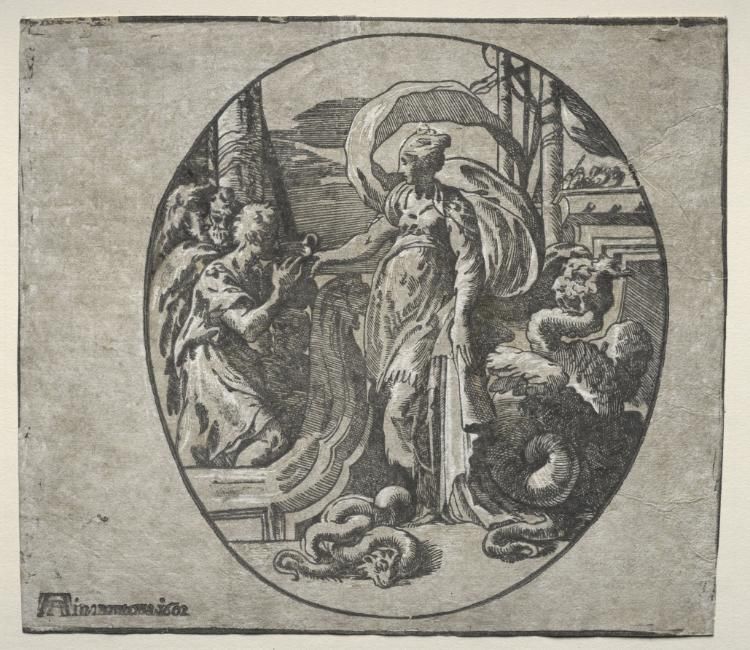
Circe Giving Drink to the Companions of Ulysses - Italy, 1540s, chiaroscuro woodcut
The Cleveland Museum of Art, Cleveland, OH, 1925.1220. CC0
Where Accounts Differ
- no-motive-for-circes-hostility
- swine-only-or-many-animals
- order-of-oath-and-rescue
- telegonus-son-of-circe
- macareus-as-narrator
- Homer gives no reason for Circe's hostility to the crew. Her drug is said to make the men forget their native land (Odyssey 10.236), and Eurylochus guesses that she keeps men as guards (10.432-434). Neither is a stated motive. This page reports that gap rather than filling it.
- The victims' shapes differ. In Homer the men become swine and keep their minds (Odyssey 10.239-240); the wolves and lions around her house are bewitched with her drugs (10.212-213). Apollodorus, Epitome 7.15, says she made some of the men wolves, some swine, some asses and some lions. Ovid, Metamorphoses 14.242-14.307, has Macareus describe the bristles, the loss of speech and the snout, and gives Circe's animals as wolves, bears and lionesses.
- The order of oath and rescue differs. In Homer Odysseus makes Circe swear the oath before he goes to her bed, then refuses food until his men are freed (Odyssey 10.343-385). Apollodorus, Epitome 7.16, says she appeased his wrath and restored his comrades, and only then did he take an oath and share her bed. Ovid's Macareus has the oath and the bed first, and Odysseus demanding his men's bodies as a marriage gift.
- Apollodorus, Epitome 7.16, says a son, Telegonus, was born of Odysseus and Circe. The Aeaea episode in Odyssey 10.133-574 names no child of the year on Aeaea.
- Ovid gives the narration to Macareus, a former companion of Ulysses now with Aeneas's crew, who tells it as a warning to the Trojans and says he was among the men transformed (Metamorphoses 14.242-14.307). In Homer, Odysseus tells the story himself and Macareus is not named in the Aeaea episode.
Read the full source verification →
Mythology
Figures In This Myth
Also Connected
Related Terms
Referenced By
Sources
- Homer, Odyssey 10.133-139
- Homer, Odyssey 10.144-202
- Homer, Odyssey 10.203-209
- Homer, Odyssey 10.210-223
- Homer, Odyssey 10.224-236
- Homer, Odyssey 10.237-243
- Homer, Odyssey 10.244-260
- Homer, Odyssey 10.261-273
- Homer, Odyssey 10.274-306
- Homer, Odyssey 10.302-306
- Homer, Odyssey 10.310-399
- Homer, Odyssey 10.428-445
- Homer, Odyssey 10.449-475
- Homer, Odyssey 10.487-540
- Homer, Odyssey 10.552-560
- Homer, Odyssey 12.1-150
- Apollodorus, Epitome 7.14-7.16
- Ovid, Metamorphoses 14.242-14.307
- Timothy Gantz, Early Greek Myth (1993)