Nausicaa
Nausicaa is the daughter of Alcinous and Arete, king and queen of the Phaeacians. Athena sends her a dream, and the next day she goes to the river to wash clothes. There she finds the shipwrecked Odysseus, gives him clothing and food, and tells him how to reach her parents. Homer leaves her at the door of the hall, wishing him a safe return.
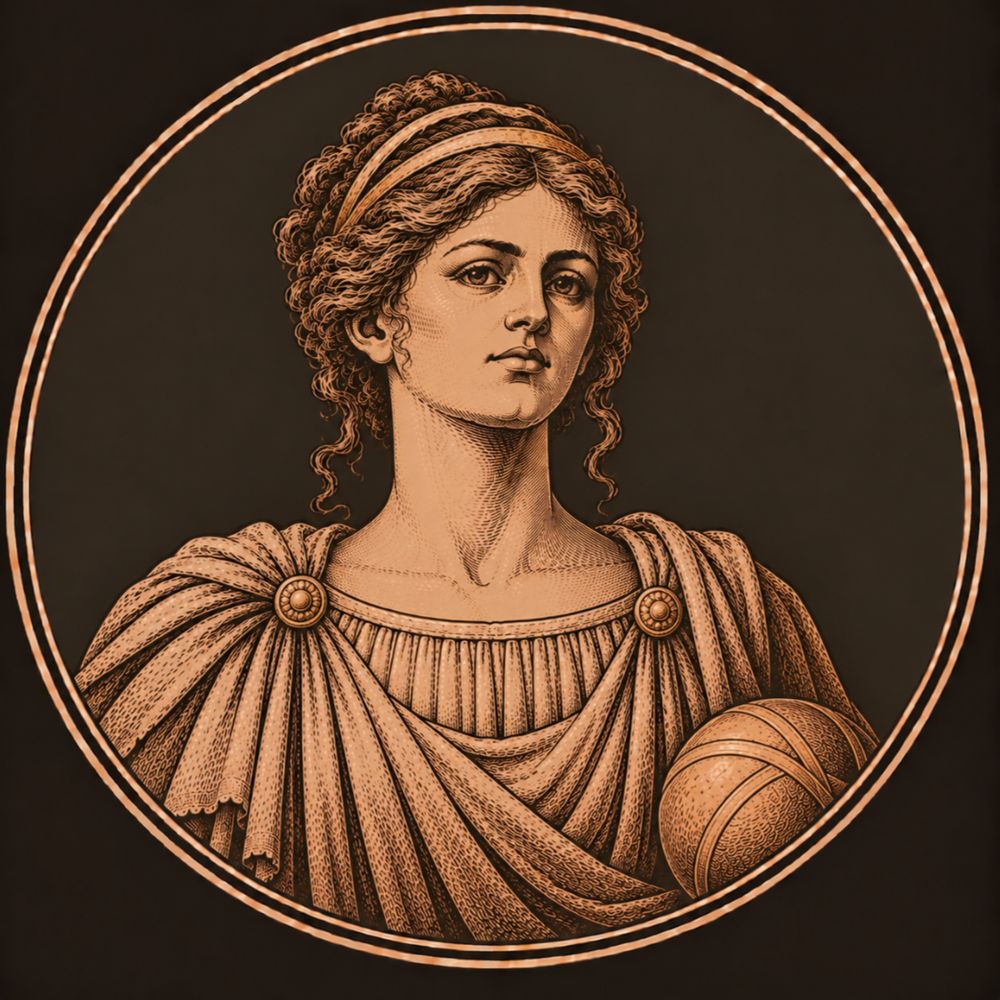
Nausicaa, bronze medallion illustration
Generated by AI from this page's own facts, not an ancient image or evidence of anything. How this site uses generated images
Sections on this page
Core Myth
Nausicaa is the daughter of King Alcinous of the Phaeacians and his wife Arete, and Alcinous's father Nausithous was a son of Poseidon (Odyssey 7.56-63), and she enters the Odyssey at the moment Odysseus needs her most. He lies asleep on the shore of Scheria after twenty days at sea. Homer says Athena goes to the Phaeacian palace to contrive his return, and she finds Nausicaa sleeping in a richly wrought chamber, a maiden like the immortal goddesses in form (Odyssey 6.1-20).
Athena takes the shape of a friend, the daughter of Dymas, and scolds Nausicaa for leaving her fine clothes unwashed. Her marriage is near, the dream says, and she has suitors among the noblest Phaeacians. Athena urges her to ask her father for a mule wagon and go to the washing tanks at daybreak (Odyssey 6.21-40). The plan is a wedding-preparation errand, and it puts Nausicaa on the shore at the right time.
In the morning Nausicaa asks her father for the wagon. She gives the laundry as her reason and does not name marriage, because Homer says she was ashamed to speak of it, but Alcinous understands and agrees (Odyssey 6.49-70). Her mother packs food, wine and olive oil in a gold flask. Nausicaa takes the whip and reins herself, and her handmaids come with her (Odyssey 6.71-84).
At the river the girls wash the clothes, spread them on the shore to dry, bathe and eat. Then they play at ball, with Nausicaa leading the song. Homer compares her to Artemis moving among her nymphs on the mountain, taller than all of them and easy to know (Odyssey 6.85-109). When the ball is thrown into a deep eddy, the cry wakes Odysseus. Homer says Athena arranged the toss so that he would wake and see the girl who would lead him to the city (Odyssey 6.110-126).
Odysseus comes out from the bushes holding a leafy branch before him, and the handmaids scatter in fear. Nausicaa alone stands her ground, because Athena puts courage in her heart (Odyssey 6.127-141). Odysseus chooses to keep his distance and speak gently rather than clasp her knees. He asks whether she is a goddess or a mortal, and compares her to Artemis (Odyssey 6.142-161). She answers that he seems neither evil nor witless and that Zeus gives men their lot, and she promises clothes and food. She tells her maids that strangers and beggars come from Zeus, and orders them to feed him and let him bathe (Odyssey 6.186-210).
The next lines give the only sign of feeling for him in Book 6. After his bath, Athena makes him taller and more handsome, and Nausicaa tells her maids that he seemed uncouth before but now looks like the gods. She wishes that a man like him might be called her husband and be pleased to stay (Odyssey 6.211-250). She says this to her maids, not to him, and she then acts with care for her name, not with hope.
Her directions are practical. She tells Odysseus to follow behind the wagon while they cross the fields, then wait in Athena's grove outside the city. She fears that townspeople will say she has brought home a foreign husband, and she says she would blame another girl for doing what she is doing (Odyssey 6.251-288). He should ask the way to Alcinous's house and go past the king to clasp her mother's knees, because if Arete favors him he will see his home again (Odyssey 6.289-315).
Homer brings her back once more. At the end of the Phaeacian feast Odysseus is bathed and dressed, and Nausicaa stands by the door-post of the hall, marvelling at him. She says, "Farewell, stranger, and hereafter even in thy own native land mayest thou remember me, for to me first thou owest the price of thy life" (Odyssey 8.457-468). Odysseus answers that he will pray to her as to a god all his days, because she gave him life. That is her last appearance in the poem.
What does Nausicaa do in the Odyssey?
She finds the shipwrecked Odysseus on the shore and helps him. After a dream from Athena, she takes the family's laundry to the river. When Odysseus appears, she stays where she is while her maids flee, gives him clothes, food and oil, and tells him how to reach her parents. She says goodbye to him at the palace in Book 8.
Homer, Odyssey 6.186-210
What is the relationship between Nausicaa and Odysseus?
Homer shows a host and a guest, not a courtship. She calls him a suppliant who must not go without clothing or aid. She wishes aloud that such a man might be called her husband, and her father says the same, but Odysseus goes home to Penelope. Her last words to him ask him to remember her.
Homer, Odyssey 6.211-250
Did Nausicaa want to marry Odysseus?
Homer suggests she was drawn to him but gives her no plan. After his bath she tells her maids she wishes a man like him might be called her husband and stay. Yet she worries about gossip and tells him to enter the city separately. She speaks of marriage to the maids, never to him.
Homer, Odyssey 6.211-250
Did Telemachus marry Nausicaa?
Not in the Odyssey, which ends before Telemachus marries. Eustathius, a twelfth-century commentator, says Aristotle and Hellanicus made Nausicaa the wife of Telemachus and mother of Perseptolis. The same writer also cites a Hesiodic line naming Polycaste instead. The original texts of Aristotle and Hellanicus on this are lost, so the claim rests on Eustathius.
Homer, Odyssey 8.457-468
Later Traditions
The Odyssey never says what happens to Nausicaa after Book 8. Alcinous had already said, in Odysseus's hearing, that he wished such a man would take his daughter to wife and stay, with a house and possessions, but that no Phaeacian would keep him against his will (Odyssey 7.311-316). Odysseus does not take up the offer, and Nausicaa is not part of the farewell talk that follows.
In Book 7 Alcinous also says his daughter was wrong not to bring the stranger to the house herself. Odysseus replies that she did tell him to follow with her maidens, and that he refused for fear and shame (Odyssey 7.299-307). That is not what she says in Book 6, where she tells him to walk behind and wait in the grove. Homer lets the reader see that Odysseus is shielding her from blame.
Apollodorus's Epitome sums up the encounter in one sentence. Nausicaa is washing clothes, Ulysses begs for her protection, and she brings him to Alcinous, who entertains him, gives gifts and sends him home with an escort (Epitome 7.25). The same passage adds that Poseidon, angry with the Phaeacians, turned the ship to stone and covered the city with a mountain.
Some later writers gave her a husband. Eustathius, the twelfth-century commentator on Homer, reports that Aristotle in his Constitution of the Ithacans and Hellanicus said Telemachus married Nausicaa, daughter of Alcinous, and that Perseptolis was their son. The same commentator also reports a Hesiodic line naming Nestor's daughter Polycaste as the mother, and that rival version is discussed on the page for Telemachus. Neither Aristotle's nor Hellanicus's own text survives here, so the claim rests on Eustathius alone.
Modern Influence
Her best-known modern afterlife is a theory about the poem's author. In The Authoress of the Odyssey (1897), Samuel Butler argued that the Odyssey was written by a young woman from Trapani in Sicily, who introduced herself into the work as Nausicaa. Classical scholars did not accept the theory, but Butler's book keeps the princess at the center of the question of who composed the poem.
The Japanese director Hayao Miyazaki took the name for the heroine of his Nausicaä of the Valley of the Wind. He has said the name comes from the Phaeacian princess of the Odyssey. He was drawn to her through Bernard Evslin's retelling in Gods, Demigods and Demons. That heroine is a new character, not a version of Homer's, but the name is Homer's.
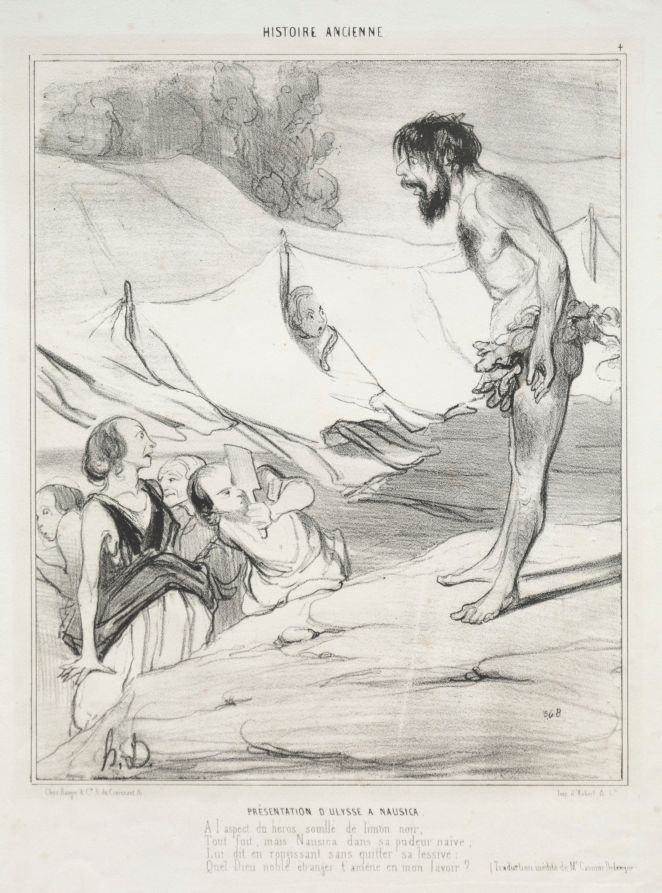
Introduction of Ulysses to Nausica - France, 19th century, 1842, lithograph
The Cleveland Museum of Art, Cleveland, OH, 1965.540. CC0
Also Connected
4 recorded connections, each with the ancient line behind it.
Connected
-

Homer compares Nausicaa at her ball game to Artemis among her nymphs, and Odysseus compares her to Artemis when he first speaks to her.
-

Athena appears to Nausicaa in a dream and sends her to the river so that she will meet Odysseus.
-

Nausicaa finds the shipwrecked Odysseus on the shore, clothes and feeds him, and sends him to her parents.
-

Nausicaa's great-grandfather is Poseidon, through Nausithous and Alcinous, and she describes his temple at the Phaeacian assembly place.
Where Accounts Differ
- whether Nausicaa married Telemachus
- what Nausicaa told Odysseus to do
- whether Nausicaa wanted Odysseus as a husband
- whether Nausicaa wrote the Odyssey
- Telemachus's marriage is told two ways. Eustathius reports that Aristotle (Constitution of the Ithacans) and Hellanicus made Telemachus marry Nausicaa and father Perseptolis, and that a Hesiodic line names Polycaste, daughter of Nestor, as Perseptolis's mother. The Odyssey names no wife. The Aristotle and Hellanicus texts are not available here, so the Nausicaa marriage is read only through Eustathius, whose line reference was not checked against the Greek.
- What Nausicaa told Odysseus differs between books. In Odyssey 6.255-288 she tells him to follow behind the wagon and wait in the grove. In 7.303-305 Odysseus tells Alcinous she bade him follow with her maids and he refused for fear. Homer does not comment.
- Whether she wished to marry him is not stated by her to him. She says only to her maids that she would like such a man for a husband (6.244-245). Alcinous says he wishes it aloud (7.311-316).
- Butler's claim that Nausicaa is the poem's authoress is his own argument in The Authoress of the Odyssey (1897). It has no ancient support and is not accepted by scholars.
- The Odyssey passages were read in the Murray translation on Perseus. Apollodorus's Epitome was read in Frazer's translation on Perseus. The Miyazaki link rests on a Wikipedia summary of his own essay, which was not seen directly.
Read the full source verification →
Mythology
Related Terms
Referenced By
Sources
- Homer, Odyssey 6.1-20
- Homer, Odyssey 6.49-70
- Homer, Odyssey 6.85-109
- Homer, Odyssey 6.127-141
- Homer, Odyssey 6.186-210
- Homer, Odyssey 6.211-250
- Homer, Odyssey 6.251-288
- Homer, Odyssey 6.289-315
- Homer, Odyssey 7.299-316
- Homer, Odyssey 7.56-63
- Homer, Odyssey 8.457-468
- Apollodorus, Epitome 7.25
- Eustathius, Commentary on the Odyssey, on the parentage of Perseptolis (quoted in 'The Sons of Odysseus, Part 1', Sententiae Antiquae, 2014, sententiaeantiquae.com)
- Samuel Butler, The Authoress of the Odyssey (London, 1897), Preface and chapter 1 (Project Gutenberg #49324)
- Wikipedia, Nausicaa (Nausicaa of the Valley of the Wind), origin of the name, citing Miyazaki's essay 'On Nausicaa' in Animage Special 1