Delos
Delos is the island where Leto bears Apollo in Greek myth.
Palm tree at Leto's birth
Generated by AI from this page's own facts, not an ancient image or evidence of anything. How this site uses generated images
Sections on this page
In Practice
The Homeric Hymn to Apollo says the other places she tried were too afraid to receive the god, and that Delos took her in only after she swore an oath that Apollo would build his temple there (Homeric Hymn to Apollo 49-88). The hymn places the birth beside a palm tree on the island (Homeric Hymn to Apollo 89-126).
The hymn lets the island speak. Delos tells Leto that it has only hard, rocky soil. It fears that Apollo will despise it and throw it into the sea once he sees the sun, and it asks for an oath first (Homeric Hymn to Apollo 49-88). Leto swears by Earth, wide Heaven and the water of the Styx that Apollo will have his altar and precinct on Delos and will honour it above all (Homeric Hymn to Apollo 89-126).
The labour then lasts nine days and nine nights. The goddesses with Leto send for Eileithyia, the goddess of childbirth, who arrives on Delos and ends the pains (Homeric Hymn to Apollo 89-126). Afterwards the hymn says that all Delos was laden with gold (Homeric Hymn to Apollo 135-139).
The island is also a meeting place. The hymn describes the Ionians gathering there with their children and wives for boxing, dancing and song. It names the Delian maidens as the attendants of Apollo (Homeric Hymn to Apollo 146-164). In the Odyssey Odysseus tells Nausicaa that he once saw a young palm shoot beside the altar of Apollo on Delos (Odyssey 6.186-210).
Plutarch links the island to the Athenian hero Theseus. On his way home from Crete, Theseus puts in at Delos, sacrifices, and dances with the young Athenians a dance that imitates the windings of the labyrinth (Plutarch, Life of Theseus).
What is the myth of Delos?
The myth is the birth of Apollo. In the Homeric Hymn to Apollo the other goddesses attend Leto, but Hera keeps Eileithyia away on Olympus. Iris is sent to fetch her with the promise of a golden necklace. Leto then clings to a palm tree and gives birth. Themis feeds the infant nectar and ambrosia, and Apollo declares that the lyre and the bow will be dear to him.
Why is Delos so famous?
Delos is famous as the birthplace of Apollo, and the sources add a festival and a hero's visit. The hymn says the Ionians gathered there for boxing, dancing and song, and that the Delian maidens sang of Apollo, Leto and Artemis. Plutarch says Theseus founded games on the island and was the first to give a palm to the victors. Homer mentions the palm beside Apollo's altar.
How did Delos get its name?
Apollodorus gives a story about the name, though not a meaning for it. Asteria, a daughter of Coeus, flung herself into the sea in the form of a quail to escape Zeus. A city was formerly called after her Asteria, he says, but afterwards it was named Delos. The sources checked here do not explain what the word Delos itself means.
Was Artemis also born on Delos?
The sources checked here do not agree. The Homeric Hymn to Apollo hails Leto for bearing Artemis in Ortygia and Apollo in rocky Delos, which separates the twins. The same hymn closes its Delos scenes with the maidens praising Apollo, Leto and Artemis together, so Artemis is honoured on the island without being born there in that passage.
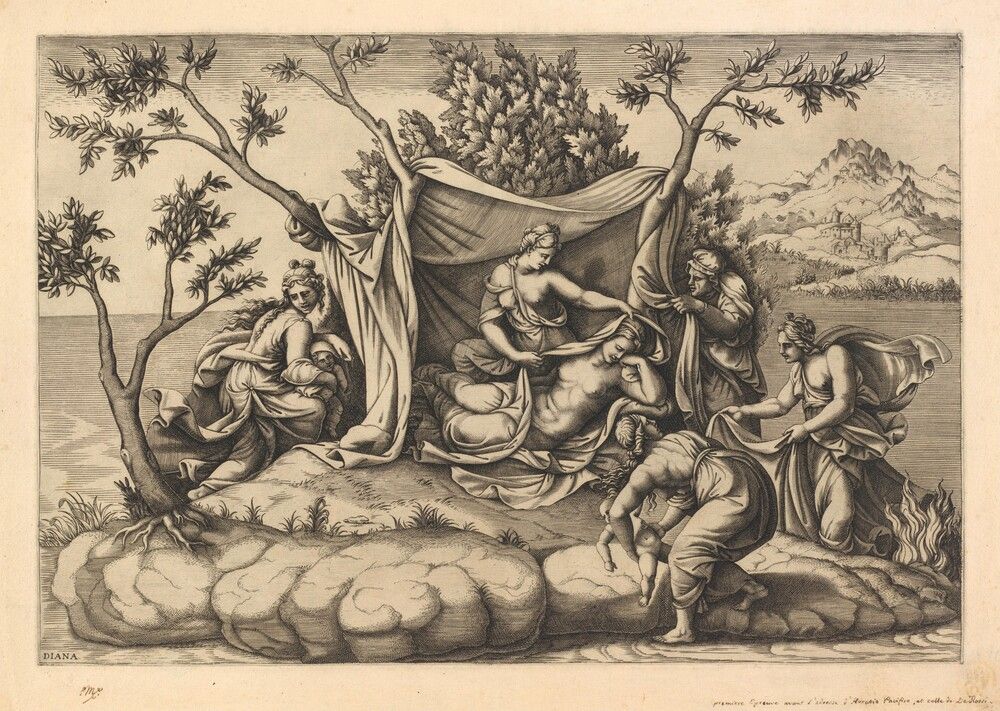
Latona Giving Birth to Apollo and Diana on the Island of Delos - Diana Scultori after Giulio Romano, 1561-1565, engraving on laid paper (with offset of Diana Scultori's "Snake Charmer" [B.44] on verso)
National Gallery of Art, Washington, DC, 1943.3.4619. CC0
Where Accounts Differ
- Artemis born on Ortygia or on Delos
- The Homeric Hymn to Apollo hails Leto for bearing Artemis in Ortygia and Apollo on Delos, while other accounts put both births on Delos. This page reports the hymn's wording and does not choose between them.