Penelope
Penelope is the wife of Odysseus and the mother of Telemachus. In Homer's Odyssey she waits twenty years on Ithaca, holding off a houseful of suitors by weaving a shroud by day and unravelling it by night. When Odysseus returns, she tests him with the secret of their olive-tree bed. Later writers disagreed, and some made her unfaithful or the mother of Pan.
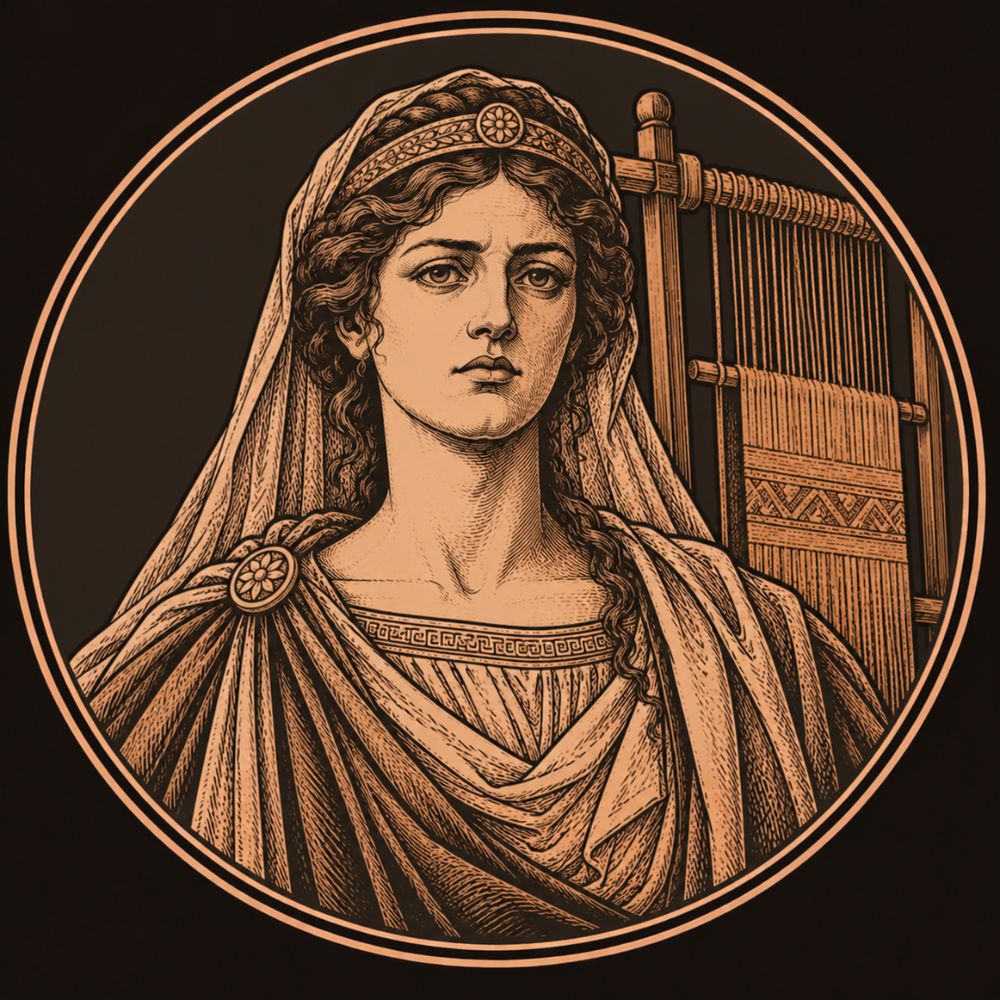
Penelope, bronze medallion illustration
Generated by AI from this page's own facts, not an ancient image or evidence of anything. How this site uses generated images
Sections on this page
See Penelope in the Greek family tree.
Core Myth
Penelope was the daughter of Icarius. Apollodorus's Library names her mother as Periboea, a Naiad nymph, and gives her five brothers. Icarius was a brother of Tyndareus, the Spartan king who married Leda. That made Penelope a cousin of Clytemnestra and, through Tyndareus's household, of Helen. When Helen's suitors crowded into Sparta, Odysseus told Tyndareus to bind them all by oath. In return, Tyndareus asked Icarius to give Penelope to Odysseus.
Pausanias heard two Spartan stories about the wedding. In one, Icarius held a foot-race for Penelope's suitors along the road later called the Aphetaid Road, and Odysseus won. In the other, Icarius begged the couple to settle in Lacedaemon and followed their chariot as they left. Odysseus told Penelope to choose between them. She said nothing and covered her face with a veil. Icarius understood, let her go, and set up a statue of Modesty at the spot.
Odysseus left for Troy while their son Telemachus was a baby. In Homer's Odyssey, twenty years later, suitors from Ithaca and the nearby islands fill her house and waste its wealth. In Book 1 she comes down from her room and asks the singer Phemius to stop his song of the Greeks' sorrowful return. Telemachus sends her back to her loom. She weeps for Odysseus until Athena closes her eyes in sleep.
Her best-known trick is the web. In Book 2 the suitor Antinous complains that she promised to marry once she finished a shroud for Odysseus's father Laertes. She wove it by day and unravelled it by night, and fooled them for three years. In the fourth year one of her women betrayed her. Antinous grudgingly admits that no woman of old, not even Tyro or Alcmene, matched her in cunning. In Book 19 Penelope tells the same story herself, and adds that her parents are pressing her to remarry.
Book 19 also brings her face to face with Odysseus, disguised as a beggar. He tells her a false tale of meeting her husband in Crete. She weeps while he hides his own tears. She then asks him to read a dream. An eagle killed her twenty geese, then spoke, saying the geese were the suitors and he was her husband. Penelope doubts it, since some dreams pass through the gate of ivory and deceive. Instead she announces a contest: she will marry whoever strings Odysseus's bow and shoots through twelve axes.
In Book 21 Athena puts the contest in her heart. Penelope fetches the bow from the storeroom and weeps over it before carrying it to the hall. Even after the suitors are dead, she will not trust the stranger. In Book 23 she tells the nurse Eurycleia to move Odysseus's bed out of the bridal chamber. Odysseus flares up: he built that bed around the trunk of a living olive tree, and no one could move it. Only the two of them and one maid knew this. Her knees give way, and she runs to embrace him.
Who did Penelope marry after Odysseus?
Telegonus, the son of Odysseus by Circe. The story comes from the Telegony, a lost epic by Eugammon of Cyrene, known through Proclus's summary. Telegonus came looking for his father, raided Ithaca and killed Odysseus without knowing who he was. He then carried the body, with Penelope and Telemachus, to Circe's island. Circe made them immortal, and Telegonus married Penelope while Telemachus married Circe. Apollodorus's Epitome agrees on the marriage but ends differently: Circe sends Telegonus and Penelope to the Islands of the Blest. Homer's Odyssey tells none of this.
Apollodorus, Epitome 7.37
Did Odysseus actually love Penelope?
Homer's Odyssey says he did, though he was not faithful to her. On Calypso's island the goddess offers him immortality if he stays. Odysseus admits that Penelope is less beautiful, since she is mortal. Yet he says he longs every day to reach home, and he chooses to go. That same night he lies with the nymph. When Penelope finally accepts him in Book 23, he weeps as he holds his true-hearted wife. She clings to him and cannot let go.
Homer, Odyssey 5.215-224
Are Penelope and Helen related?
Yes, they are cousins in Apollodorus's Library. Penelope's father Icarius and Tyndareus were brothers, sons of Perieres and Gorgophone. Tyndareus married Leda, the mother of Helen. Apollodorus adds a twist: Zeus, in the form of a swan, fathered Helen and Pollux, while Tyndareus fathered Castor and Clytemnestra. So Clytemnestra is Penelope's cousin by blood, and Helen is her cousin through Tyndareus's household. The families were bound in another way too. Tyndareus helped Odysseus win Penelope as thanks for the oath that protected Helen's husband.
Apollodorus, Library 3.10.6
Was Penelope older than Odysseus?
No surviving ancient source says so. Homer and Apollodorus give neither of them an age, and none of the texts cited here compares the two. The Odyssey only suggests that she married young. In Book 11 the ghost of Agamemnon recalls leaving her a bride newly wed, with a baby at her breast, when the Greeks sailed for Troy. In Book 23 Penelope says the gods begrudged the couple their youth together.
Homer, Odyssey 11.444-449
Was Penelope faithful to Odysseus?
In Homer, completely. Agamemnon's ghost praises her as loyally mindful of her husband and says the gods will make a song of her constancy. Later sources told darker stories. Apollodorus's Epitome records that some said Antinous seduced her, so Odysseus sent her back to her father Icarius, and at Mantinea she bore Pan to Hermes. Others said Odysseus killed her because of the suitor Amphinomus. Pausanias saw her supposed grave near Mantinea, where locals said Odysseus had cast her out for bringing lovers into his house.
Apollodorus, Epitome 7.38
How is Penelope related to Odysseus?
She is his wife, and the mother of his son Telemachus. Apollodorus's Library says Odysseus won her with help from her uncle Tyndareus. He advised Tyndareus to bind Helen's suitors by oath, and in return Tyndareus asked Icarius to give Penelope to him. In Homer's Odyssey, Agamemnon's ghost calls her the peerless daughter of Icarius and Odysseus's wedded wife. Later sources gave the couple a second son, named Poliporthes in Apollodorus and Ptoliporthes in the lost Thesprotis cited by Pausanias.
Homer, Odyssey 24.191-202
Later Traditions
The Odyssey closes her story with praise. In Book 24 the ghost of Agamemnon says Penelope stayed loyally mindful of her husband. The gods, he says, will make a song in honour of constant Penelope. He sets her against the daughter of Tyndareus, his own wife Clytemnestra, who killed her husband.
Other poets carried her story past Odysseus's death. Proclus's summary of the Telegony, a lost epic by Eugammon of Cyrene, says Telegonus, Odysseus's son by Circe, killed his father without knowing him. He took the body, with Penelope and Telemachus, to Circe's island. Circe made them immortal, and Telegonus married Penelope. Apollodorus's Epitome has the same marriage, but Circe sends the couple to the Islands of the Blest.
Darker versions also circulated. Apollodorus's Epitome reports that some said the suitor Antinous seduced her, and Odysseus sent her home to Icarius. At Mantinea in Arcadia she bore Pan to Hermes. Others said Odysseus killed her over the suitor Amphinomus. Pausanias saw a mound near Mantinea called her grave, where locals said Odysseus had cast her out for taking lovers. Herodotus reports that the Greeks made Penelope and Hermes the parents of Pan.
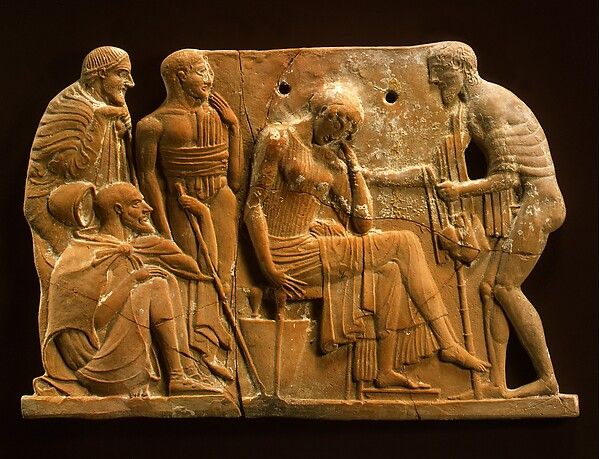
Terracotta plaque - Greek, Melian, ca. 460–450 BCE, Terracotta
Metropolitan Museum of Art, New York, NY, 30.11.9. CC0
2 recorded relations, each with the ancient line behind it.
Children
-

A variant tradition only: Herodotus says the Greeks named Penelope and Hermes as Pan's parents, and Apollodorus's Epitome reports that some placed the birth at Mantinea.
-
Penelope is Telemachus's mother; in Book 1 of the Odyssey he sends her back from the hall to her loom, and she goes, taking his words to heart.
Also Connected
3 recorded connections, each with the ancient line behind it.
Allies
-

Athena puts the contest of the bow into Penelope's heart, setting up the suitors' deaths, and elsewhere in the Odyssey sends her sleep when she weeps for Odysseus.
Connected
-
Penelope's father Icarius was the brother of Tyndareus, husband of Helen's mother Leda; Tyndareus won Penelope for Odysseus in return for his advice on the oath of Helen's suitors.
-

Odysseus and Penelope are husband and wife; in Homer's Odyssey she accepts him after twenty years only when he reveals the secret of the bed he built around a living olive tree.
Where Accounts Differ
- faithful or unfaithful
- whether Penelope was Pan's mother
- how Penelope's story ends
- how Odysseus won her
- whether Penelope had a second son
- who fathered Icarius
- an indirect source for the Telegony
- Homer makes Penelope the faithful wife: Agamemnon's ghost praises her constancy (Odyssey 24.191-202). Apollodorus (Epitome 7.38-39) reports two contrary stories without endorsing either: that Antinous seduced her and Odysseus sent her to Icarius, or that Odysseus killed her over Amphinomus. Pausanias (8.12.6) records a Mantinean story that Odysseus cast her out for bringing lovers into his house.
- Pan's mother is disputed. Herodotus (Histories 2.145) says the Greeks name Penelope and Hermes as Pan's parents, and dates that Pan about eight hundred years before his own time, after the Trojan War. Apollodorus (Epitome 7.38) places the birth at Mantinea after her disgrace.
- Her end differs by source. Proclus's summary of the Telegony has Circe make Penelope and Telemachus immortal, with Telegonus marrying Penelope. Apollodorus (Epitome 7.37) keeps the marriage but has Circe send Telegonus and Penelope to the Islands of the Blest. The Mantineans showed Pausanias her grave on the road to Orchomenus and said she died in Mantinea (8.12.5-6).
- How Odysseus won her is told two ways. Apollodorus (Library 3.10.9) makes her a reward from Tyndareus for Odysseus's advice about Helen's suitors. Pausanias (3.12.2) heard that Icarius held a foot-race for her suitors and Odysseus won it.
- A second son appears in later sources: Poliporthes in Apollodorus (Epitome 7.35), Ptoliporthes in the lost Thesprotis cited by Pausanias (8.12.6), and Acusilaus in Eustathius's report of the Telegony.
- Icarius's father is given two ways by Apollodorus himself. Library 3.10.3 makes Icarius and Tyndareus sons of Perieres and Gorgophone; 3.10.4 records that some call them sons of Oebalus by the nymph Batia. Either way, the two are brothers.
- The Telegony survives only in Proclus's prose summary and a few quotations, so its account of Penelope's marriage to Telegonus is indirect.
Read the full source verification →
Mythology
Related Terms
Referenced By
Sources
- Homer, Odyssey 1.328-364
- Homer, Odyssey 2.85-128
- Homer, Odyssey 5.215-224
- Homer, Odyssey 11.444-449
- Homer, Odyssey 19.124-163
- Homer, Odyssey 19.203-212
- Homer, Odyssey 19.535-581
- Homer, Odyssey 21.1-79
- Homer, Odyssey 23.153-230
- Homer, Odyssey 23.231-240
- Homer, Odyssey 24.191-202
- Apollodorus, Library 3.10.3
- Apollodorus, Library 3.10.4
- Apollodorus, Library 3.10.6
- Apollodorus, Library 3.10.7
- Apollodorus, Library 3.10.9
- Apollodorus, Epitome 7.31
- Apollodorus, Epitome 7.33
- Apollodorus, Epitome 7.35
- Apollodorus, Epitome 7.36
- Apollodorus, Epitome 7.37
- Apollodorus, Epitome 7.38
- Apollodorus, Epitome 7.39
- Pausanias, Description of Greece 3.12.2
- Pausanias, Description of Greece 3.20.10-11
- Pausanias, Description of Greece 8.12.5-6
- Herodotus, Histories 2.145
- Herodotus, Histories 2.146
- H. G. Evelyn-White, Hesiod, the Homeric Hymns and Homerica (1914): Telegony fragments 1 (Proclus, Chrestomathia) and 2 (Eustathius)