Saturn
Saturn is the Roman god who, according to Virgil's Aeneid, fled to Italy after Jupiter drove him from the sky and ruled Latium in a Golden Age of peace. Romans identified him with the Greek Kronos, but his cult was their own: a temple in the Forum that held the state treasury, and the December festival of the Saturnalia.
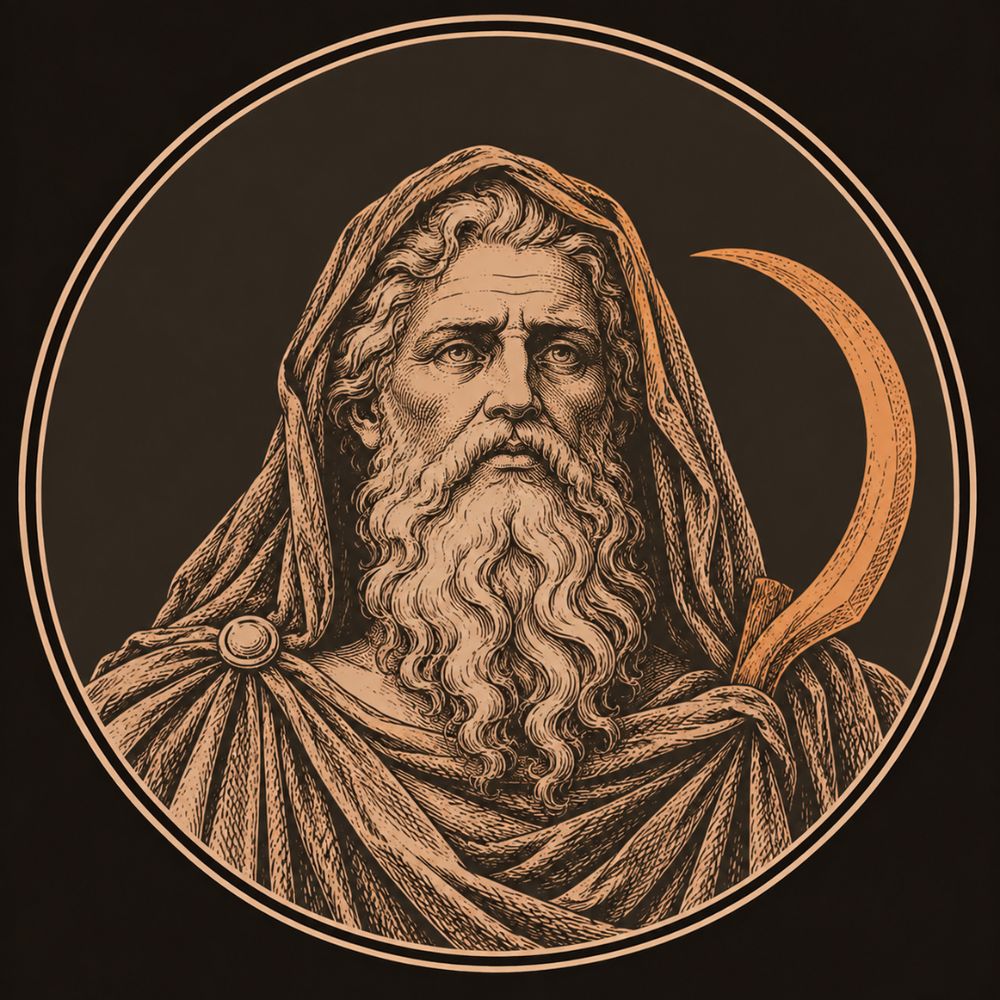
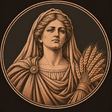
Saturn, bronze medallion illustration
Generated by AI from this page's own facts, not an ancient image or evidence of anything. How this site uses generated images
Sections on this page
Greek vs Roman: Kronos vs. Saturn → See how Kronos differs.
Core Myth
Virgil tells Saturn's story through King Evander, who guides Aeneas over the future site of Rome in Aeneid Book 8. Before Saturn came, Evander says, fauns, nymphs and a race of men born from tree trunks held the woods. They had no laws and no farming. They stored nothing and lived by hunting and wild fruit (Aeneid 8.314-318).
Saturn then came down from Olympus, fleeing the arms of Jupiter, an exile stripped of his kingdom (Aeneid 8.319-320). He gathered the scattered mountain people and gave them laws. He chose the name Latium because he had lain hidden (latuisset) safely on its shores (Aeneid 8.321-323). The golden centuries, Evander says, were under this king, who ruled his peoples in calm peace. A worse age followed slowly, bringing the madness of war and the love of gain (Aeneid 8.324-327). The Golden Age that Greek poets placed at the start of time, Virgil places on Italian soil.
The memory stays in the landscape. Evander shows Aeneas two ruined strongholds, one founded by father Janus and one by Saturn, named Janiculum and Saturnia (Aeneid 8.355-358). In Book 7, King Latinus traces his line through Faunus and Picus back to Saturn, the first founder of the blood (Aeneid 7.45-49). His palace keeps an ancient cedar statue of old Saturn beside two-faced Janus (Aeneid 7.177-181). Latinus calls his people Saturn's race, just not by chains or laws but of their own will, keeping the custom of the old god (Aeneid 7.202-204).
Are Saturn and Kronos the same?
Roman writers treated them as one god with two names. Dionysius of Halicarnassus says the god may be called Cronus, as the Greeks prefer, or Saturn, as the Romans do (Roman Antiquities 1.38). Cicero states that Saturn's Greek name is Kronos (De Natura Deorum 2.64). Yet the Roman god carries stories that Kronos does not: exile in Latium, a Golden Age on Italian soil, and a temple that held Rome's treasury. Modern reference works describe Saturn as originally an Italian god of agriculture who was identified with Kronos later. That is a modern view, not an ancient statement. The two are compared side by side in Kronos vs Saturn.
Dionysius of Halicarnassus, Roman Antiquities 1.38
Is Saturn the father of Jupiter?
Yes. In the Aeneid, Jupiter addresses Juno as his sister and Saturn's other child, which makes Saturn the father of both (Aeneid 12.830). Virgil's Evander says Saturn came to Latium fleeing the arms of Jupiter, a king whose realm had been taken (Aeneid 8.319-320). In Ovid's Fasti, Janus says Saturn was driven from the heavenly kingdom by Jove (Fasti 1.236). The Roman sources disagree on where the fallen father went. Virgil and the Fasti send him to Italy, while Ovid's Metamorphoses says he was sent down to dark Tartarus (Metamorphoses 1.113-114).
Virgil, Aeneid 12.830
Is Saturn the same as Hades?
No. Hades is the Greek god of the dead, and his Roman counterpart is Pluto, a separate god; the pair is compared in Hades vs Pluto. Saturn is related to Hades, not identical with him. In Hesiod's Theogony, Kronos, the god Romans equated with Saturn, fathers Hades with Rhea, along with Hestia, Demeter, Hera, Poseidon and Zeus (Theogony 453-458). Saturn's own Roman stories are set among the living. He rules Latium in a Golden Age of peace rather than a kingdom of the dead (Aeneid 8.319-325).
Virgil, Aeneid 8.314-327
What is a myth about Saturn?
The best-known Roman myth is Saturn's arrival in Italy. In Virgil's Aeneid, King Evander tells Aeneas that Saturn came down from Olympus as an exile, fleeing Jupiter. He found a wild people with no laws or farming, gathered them, and gave them laws (Aeneid 8.314-322). He named the land Latium because he had hidden there. His reign was the Golden Age, a time of calm peace, until war and greed crept in (Aeneid 8.323-327). In Ovid's Fasti, Janus adds that Saturn arrived by ship on the Tuscan river, and that Rome's bronze coins bore a ship to mark the guest god's coming (Fasti 1.233-240).
Virgil, Aeneid 8.314-327
Who is Saturn to Zeus?
Saturn is the Roman name for the father of Zeus. Roman authors equated Saturn with Kronos, who in Hesiod's Theogony fathers Zeus and his siblings with Rhea (Theogony 453-458). Cicero reports the Greek belief that Saturn mutilated his father Caelus and was then bound by his own son Jove (De Natura Deorum 2.63). Rome's name for Zeus is Jupiter, so Latin poetry shows the same bond as Saturn and Jupiter (Aeneid 12.830). The Greek succession story belongs to the Kronos page. Virgil's Roman version sends the deposed Saturn to Latium instead (Aeneid 8.319-320).
Cicero, De Natura Deorum 2.63-64
What was the Saturnalia?
The Saturnalia was Saturn's December festival in Rome. Livy says it was instituted in the same year the temple of Saturn was dedicated (Ab Urbe Condita 2.21). He later describes a sacrifice at the temple, a public banquet, and the cry of Saturnalia raised through the city for a day and a night, with the people told to keep the day forever (Ab Urbe Condita 22.1). Macrobius says the festival once lasted a single day and later spread over several (Saturnalia 1.10.2). He links the license given to slaves at the festival to Saturn's reign, when no one was yet divided into slave and free (Saturnalia 1.7.26).
Livy, Ab Urbe Condita 2.21
Later Traditions
Saturn's cult in Rome centered on his temple by the Forum (Macrobius, Saturnalia 1.8.1). Livy says a temple was dedicated to Saturn, and the Saturnalia instituted, in the consulship of Aulus Sempronius and Marcus Minucius, early in the Republic (Livy, Ab Urbe Condita 2.21). Dionysius of Halicarnassus reports that the Capitoline itself was once called the Saturnian hill (Roman Antiquities 1.34). He also says the whole peninsula was once called Saturnia, and that Italy's plenty made it fit land for the god (Roman Antiquities 1.36, 1.38).
Macrobius, writing his Saturnalia around 400 CE, explains why the Romans kept their state treasury, the aerarium, in Saturn's temple. No theft was committed in Italy while Saturn lived there, and under him nothing was anyone's private property (Saturnalia 1.8.3). He also describes the cult statue: its feet were bound with woollen bonds all year and loosed for the god's December festival (Saturnalia 1.8.5).
Virgil's Georgics ties Saturn to the farmer's life. Before the reign of the Dictaean king, Jupiter, and before men feasted on slaughtered oxen, golden Saturn lived that life on earth (Georgics 2.536-540). Cicero names the most distant planet known to him as Saturn's star (De Natura Deorum 2.52), and the planet still carries the god's name.
Roman writers took Ops to be his wife (Macrobius, Saturnalia 1.10.19). Ovid gives them three daughters, Juno, Ceres and Vesta (Fasti 6.285-286).
Lineage
See the full family tree3 recorded relations, each with the ancient line behind it.
Children
-

Jupiter addresses Juno as his sister and Saturn's other child. In the same scene Virgil calls her Saturn's daughter.
-

Jupiter calls Juno his sister and Saturn's other child, so Saturn is father to both. Virgil's Saturn reaches Latium as an exile fleeing Jupiter's arms (Aeneid 8.319-320).
-
Ovid says Juno and Ceres were born of Ops by Saturn's seed, and that Vesta was the third.
Also Connected
4 recorded connections, each with the ancient line behind it.
Allies
-
Evander shows Aeneas two ruined strongholds, one founded by Janus and one by Saturn (Aeneid 8.357-358). In Ovid's Fasti, Janus says he received the exiled Saturn in the land he ruled (Fasti 1.235-236).
Connected
-
King Evander tells Aeneas how the exiled Saturn gave laws to Latium and ruled its Golden Age, while guiding him over the future site of Rome.
-

Dionysius reports that followers of Hercules settled the Saturnian hill, later the Capitoline, and that Hercules set up an altar to Saturn there (1.38.2).
-
Macrobius says the Romans believed Ops to be Saturn's wife, so Saturnalia and Opalia fall in the same month. Varro pairs Saturn and Ops as the chief gods of Latium.
Where Accounts Differ
- Saturn as Kronos or a native Italian god
- who welcomed Saturn in Latium
- exile in Italy or prison in Tartarus
- who founded the temple of Saturn
- how long the Saturnalia lasted
- human sacrifice to Saturn
- Ancient writers equate Saturn with Kronos outright. Dionysius of Halicarnassus says the god may be called Cronus or Saturn (Roman Antiquities 1.38), and Cicero gives Kronos as Saturn's Greek name while deriving 'Saturnus' from being sated with years (De Natura Deorum 2.64). Dionysius also judges that the Capitoline was sacred to Saturn before Hercules came to Italy (Roman Antiquities 1.34). Macrobius notes that sacrifice at Saturn's altar was made by Greek rite, with the head uncovered (Saturnalia 1.8.2). The view that Saturn began as a separate Italian farming god, later merged with Kronos, is modern scholarship rather than an ancient claim.
- The sources differ on who received the exiled Saturn. In Virgil, Saturn arrives alone and civilizes Latium himself; Janus appears only as founder of a neighboring stronghold (Aeneid 8.319-323, 8.357-358). In Ovid's Fasti, Janus himself narrates Saturn's arrival by ship and calls him a guest received in the land where Janus then reigned (Fasti 1.233-248). Macrobius goes furthest: Janus welcomed Saturn, learned farming from him, shared the kingdom with him, and founded the Saturnalia after Saturn vanished (Saturnalia 1.7.21-24).
- The fate of the deposed Saturn varies. Virgil and Ovid's Fasti send him to Italy as an exile (Aeneid 8.319-320; Fasti 1.235-236). Ovid's Metamorphoses has him sent down to Tartarus (Metamorphoses 1.113-114). Cicero reports the Greek story that Jove threw him into bondage (De Natura Deorum 2.63).
- Livy dates the dedication of Saturn's temple and the first Saturnalia to the consulship of Aulus Sempronius and Marcus Minucius (Ab Urbe Condita 2.21). Macrobius lists rival founders: Tullus Hostilius after his triumphs; King Tarquinius, who let the contract, with the dictator Titus Larcius dedicating it (citing Varro); or a senate decree carried out by Lucius Furius (citing Gellius) (Saturnalia 1.8.1).
- Macrobius says the Saturnalia was once a single day, spread to several after Julius Caesar lengthened December, and cites older writers who already spoke of seven days (Saturnalia 1.10.2-3). Livy's account of a day-and-night celebration ordered to be kept forever is in Ab Urbe Condita 22.1.
- Dionysius alone among these sources reports that the ancients sacrificed human victims to Saturn, and that Hercules replaced them with effigies at his altar on the Saturnian hill (Roman Antiquities 1.38).
Read the full source verification →
Mythology
Equivalent Figures
Related Terms
Referenced By
Sources
- Virgil, Aeneid 7.45-49
- Virgil, Aeneid 7.177-181
- Virgil, Aeneid 7.202-204
- Virgil, Aeneid 8.314-327
- Virgil, Aeneid 8.355-358
- Virgil, Aeneid 12.830
- Virgil, Georgics 2.536-540
- Ovid, Fasti 1.233-240
- Ovid, Metamorphoses 1.113-114
- Livy, Ab Urbe Condita 2.21
- Livy, Ab Urbe Condita 22.1.19-20
- Dionysius of Halicarnassus, Roman Antiquities 1.34
- Dionysius of Halicarnassus, Roman Antiquities 1.36
- Dionysius of Halicarnassus, Roman Antiquities 1.38
- Cicero, De Natura Deorum 2.52
- Cicero, De Natura Deorum 2.63-64
- Hesiod, Theogony 453-458
- Macrobius, Saturnalia 1.10.19
- Ovid, Fasti 6.285-286
- Elizabeth Knowles (ed.), The Oxford Dictionary of Phrase and Fable, entry 'Saturn'