Kronos vs. Saturn
What is the Roman name of Kronos? The Roman name of Kronos is Saturn.
Romans treated Saturn as the Greek Kronos: both are the father who lost the sky to Jupiter or Zeus. The stories then split. Hesiod's Kronos mutilates his father and swallows his own children, while Virgil's Saturn arrives in Italy as an exile, teaches a wild people to live under law, and rules the Golden Age. Rome also gave Saturn a temple and the Saturnalia.
Sections on this page

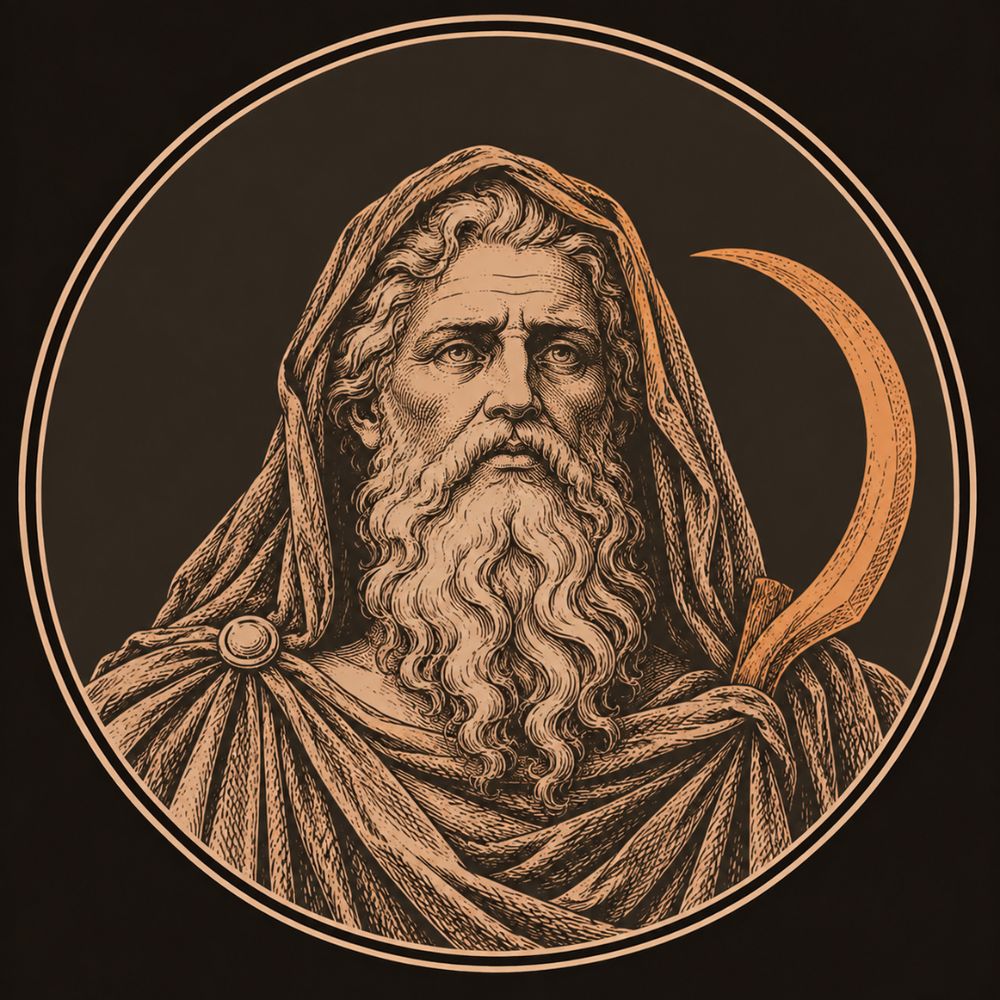
How They Compare
Kronos and Saturn share a family tree and a defeat, but Rome kept the god's downfall and rewrote what came after it. The Greek Kronos is a figure of dread whose reign ends in Tartarus. The Roman Saturn is a figure of nostalgia, the last king before history, whose memory Romans marked with a temple and a December festival.
Side by Side
| Aspect | Kronos | Saturn |
|---|---|---|
| Character | A violent Titan who takes a sickle to his father Ouranos and swallows each of his children as they are born, to avoid being overthrown. | A gentle old king who gathers scattered mountain people, gives them laws, and presides over a peaceful Golden Age. |
| Where the Golden Age happens | Hesiod places the golden race in the time when Kronos was reigning in heaven, so the age is cosmic and ends with the Olympians. | Virgil moves it to Italian soil: Saturn hides in Latium, which is named for that hiding, and rules there in calm peace. |
| After the fall | Bound among the defeated Titans in Tartarus in the Theogony, and in Pindar a ruler beside the Isles of the Blessed. | An exile who founds a kingdom in Italy in Virgil and the Fasti, though Ovid's Metamorphoses sends him to Tartarus. |
| Cult | Known in the sources used here mainly through myth and genealogy rather than through a Roman-style state temple and calendar. | A temple dedicated in the early Republic and the festival of the Saturnalia, both recorded by Livy. |
| Etymology and time | Cicero says the Greek name Kronos is the same as Chronos, a span of time. | Cicero derives Saturn from being filled (saturatur) with years, so a Latin word-play supports the same reading. |
Shared between both
- father of the gods who rule after him, including Jupiter and Juno in Rome and Zeus and Hera in Greece
- driven from power by his own son
- tied to a Golden Age when the earth gave food without labor
- carries a sickle
What is the difference between Kronos and Saturn?
The Romans identified the two, and Cicero says Saturn's Greek name is Kronos (De Natura Deorum 2.64). The differences are in tone and setting. Kronos castrates his father and swallows his children in Hesiod (Theogony 168-182, 453-467). Saturn arrives in Italy as an exile and gives a lawless people laws (Aeneid 8.314-325). Rome also built a temple and a festival for Saturn, which are Roman additions to the story.
Cicero, De Natura Deorum 2.64
Did Saturn eat his children like Kronos?
Hesiod's Kronos does it literally: he swallows Hestia, Demeter, Hera, Hades and Poseidon as each is born, and Rhea saves Zeus with a stone (Theogony 453-467, 485-491). The Roman Saturn of Virgil never does. Cicero mentions the tale only as an allegory, saying Saturn is feigned to devour his children because time consumes the years (De Natura Deorum 2.64). The Roman poets keep the fall and drop the feast.
Hesiod, Theogony 453-467
Was Kronos a good king like Saturn?
Partly. Hesiod's Works and Days says the golden race of men lived in the time of Kronos, when he was reigning in heaven (Works and Days 109-120), so the Greeks also remembered his rule as a good age. The same poet's Theogony shows the violent seizure of power that came first (Theogony 168-182). Virgil keeps only the gentle half and makes Saturn a lawgiver in Latium (Aeneid 8.319-327).
Hesiod, Works and Days 109-120
What happened to Kronos and Saturn after they lost power?
The sources split. In the Theogony Zeus overcomes Kronos and the Titans are bound in Tartarus (Theogony 717-735), while Pindar has Kronos ruling by the Isles of the Blessed (Olympian Ode 2.70-77). Virgil's Saturn flees Jupiter's arms and hides in Latium (Aeneid 8.319-323). Ovid's Metamorphoses instead says Saturn was sent down to dark Tartarus (Metamorphoses 1.113-114).
Virgil, Aeneid 8.319-323
Is Kronos the god of time, and is Saturn?
Cicero, writing for a Roman audience, says the Greek name Kronos is the same as Chronos, a space of time, and that Saturn is so called because he is filled with years (De Natura Deorum 2.64). This is an ancient word-play, not a shared origin. The Theogony never mentions Chronos, so the link is later and philosophical.
Cicero, De Natura Deorum 2.64
Did the Romans worship Saturn with a festival?
Yes. Livy says that under the consuls Aulus Sempronius and Marcus Minucius a temple was dedicated to Saturn and the Saturnalia was instituted (Ab Urbe Condita 2.21). The Saturnalia became one of Rome's best-known December festivals. The festival is one of the clearest Roman additions to the god.
Livy, Ab Urbe Condita 2.21
Where Accounts Differ
- where Saturn went after his fall
- where the Golden Age happened
- Where Saturn went after his fall differs by author. Virgil and Ovid's Fasti place him in Latium (Aeneid 8.319-323; Fasti 1.236), while Ovid's Metamorphoses says he was sent to Tartarus (Metamorphoses 1.113-114). Hesiod binds the Titans in Tartarus (Theogony 717-735), and Pindar has Kronos ruling in the Isles of the Blessed (Olympian Ode 2.70-77).
- The Golden Age is placed differently. Hesiod ties the golden race to the reign of Kronos in heaven (Works and Days 109-120), and Virgil places it on Italian soil under Saturn (Aeneid 8.324-327).
- Cicero equates Kronos with Chronos as a name for time, and derives Saturn from saturatur annis (De Natura Deorum 2.64). This is a Stoic etymology recorded by Cicero, not a claim the Theogony makes.
The Two Figures
Related Terms
Sources
- Hesiod, Theogony 168-182
- Hesiod, Theogony 453-467
- Hesiod, Theogony 485-491
- Hesiod, Theogony 717-735
- Hesiod, Works and Days 109-120
- Pindar, Olympian Ode 2.70-77
- Virgil, Aeneid 8.319-327
- Ovid, Metamorphoses 1.113-114
- Cicero, De Natura Deorum 2.64
- Livy, Ab Urbe Condita 2.21