Ops
Ops is the Roman goddess of plenty, wealth and the earth's help. Macrobius says the Romans took her to be Saturn's wife (Saturnalia 1.10.19). Varro derives her name from opus, work, and calls her the Earth (De Lingua Latina 5.64). Her festivals were the Opiconsiva and the Opalia. Her myth is thin. Later writers call her the Latin name of Rhea.
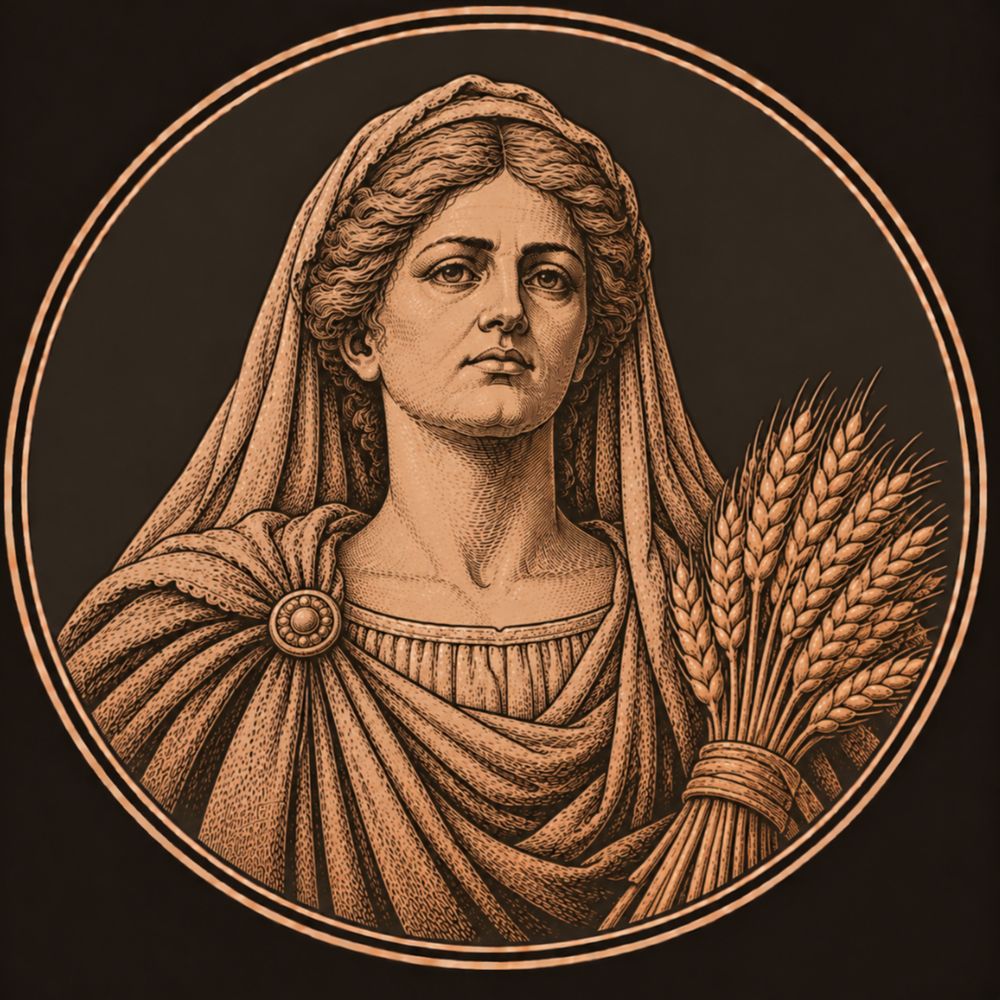
Ops, bronze medallion illustration
Generated by AI from this page's own facts, not an ancient image or evidence of anything. How this site uses generated images
Sections on this page
Core Myth
Ops has almost no story of her own. Roman writers give her a name, a marriage and a place in the calendar, and little else. Varro calls Saturn and Ops the chief gods in Latium, the local pair for Heaven and Earth (De Lingua Latina 5.57). He explains her name from opus, work. Earth is Ops because all work is in her and life needs work upon her, and she is called Mother because Earth is a mother (De Lingua Latina 5.64).
Macrobius, writing around 400 CE, states the marriage plainly. The Romans believed this goddess Ops to be the wife of Saturn, which is why Saturnalia and Opalia are kept in the same month. Both were thought to have found crops and fruit (Saturnalia 1.10.19). He adds that some took the pair for sky and earth, with Saturn named from satus, sowing, and Ops from ope, aid, or from opere, work (Saturnalia 1.10.20). Worshippers sit to pray to her and touch the ground on purpose, to show that mother earth is what mortals must seek (Saturnalia 1.10.21). The Opalia day now sits inside the Saturnalia, having first been assigned to Saturn and Ops together (Saturnalia 1.10.18). Varro also dates it: the Opalia of Ops follows on the third day after the Saturnalia begins (De Lingua Latina 6.22).
Her children come from poets and later writers, not from cult. Ovid explains why Vesta has virgin priestesses. Juno and Ceres were born of Ops from Saturn's seed, he says, and Vesta was the third (Fasti 6.285-286). The poet Ennius made the family a human dynasty. In his Euhemerus, as quoted by Lactantius, Saturn took Ops as his wife. Their mother Vesta, with Ceres and Ops as sisters, urged Saturn not to yield the kingdom to his brother Titan (Lactantius, Divine Institutes 1.14). Twins followed, Jupiter and Juno. Jupiter was hidden and given to Vesta to raise. Ops bore Neptune, and later Pluto, in secret from Saturn (Divine Institutes 1.14). Titan later seized Saturn and Ops and walled them in (Divine Institutes 1.14).
What is Ops the goddess of?
Ops is the Roman goddess of the earth's plenty, wealth and help. Varro calls her the Earth and derives her name from opus, work, because all work is done on her and life needs it (De Lingua Latina 5.64). Macrobius says she and Saturn were thought to have found crops and fruit (Saturnalia 1.10.19). He derives her name from ope, aid (Saturnalia 1.10.20). Romans also kept public money at her temple (Cicero, Philippics 1.17). Her surviving myth is thin, and she is a role more than a character.
Varro, De Lingua Latina 5.64
Was Ops the wife of Saturn?
Yes, in the sources that name her marriage. Macrobius says the Romans believed Ops to be the wife of Saturn (Saturnalia 1.10.19). In Ennius's Euhemerus, quoted by Lactantius, Saturn takes Ops as wife, and elsewhere in the same account she is his sister (Divine Institutes 1.14). Varro pairs them as the chief gods of Latium without using the word wife (De Lingua Latina 5.57). Ovid makes her mother of Juno, Ceres and Vesta by Saturn (Fasti 6.285-286).
Macrobius, Saturnalia 1.10.19
What does 'ops' mean in Greek?
Nothing. Ops is a Latin word, not a Greek one, and Roman writers tie it to Latin roots. Varro links it to opus, work (De Lingua Latina 5.64). Macrobius offers ope, aid, or opere, work (Saturnalia 1.10.20). The Greek counterpart, in later Roman writers, is Rhea. Lactantius says Rhea is the goddess Latin calls Ops (Divine Institutes 1.13). A Greek name that looks the same, Ops, belongs to Eurycleia's father in Homer, and it is unrelated (Odyssey 1.429).
Lactantius, Divine Institutes 1.13
Later Traditions
Rome's own cult of Ops was small and old. Varro lists a day named Opeconsiva, after the goddess Ops Consivia, whose shrine stood in the Regia. It was kept shut, and only the Vestal Virgins and the public priest could enter (De Lingua Latina 6.21). Varro does not explain the epithet Consivia. He also does not say where a separate temple stood.
She had a treasury as well. Cicero speaks of money kept at the temple of Ops. He wishes the money were still at Ops. It is bloodstained, he says, but needed now that it is not returned to its owners (Philippics 1.17). He later asks where the seven hundred million sesterces entered in the accounts at Ops are (Philippics 2.93). He also says Antony cleared a huge debt at the temple of Ops (Philippics 2.35). Here Ops is literally wealth, in a vault.
Macrobius preserves another identity. Cornelius Labeo held that the Bona Dea and the earth were one. The pontifical books, he says, invoked the same goddess as Bona, Fauna, Ops and Fatua. Ops was the name for the aid by which life is sustained (Saturnalia 1.12.21-22). Macrobius also cites Philochorus for an altar to Saturn and Ops that Cecrops set up in Attica, where fathers feasted with their slaves once the harvest was in (Saturnalia 1.10.22).
The Greek match came late and by translation. Lactantius, a Christian writing around 300 CE, retells Saturn's story from Ennius. He says Saturn's sister Rhea, whom Latin calls Ops, was forbidden by an oracle to rear sons. When Ops bore Jupiter, she sent the infant secretly to Crete (Divine Institutes 1.13). This is the story Greek writers tell of Rhea and Kronos. Strabo elsewhere lists Cybele among the names under which Rhea is worshipped (Strabo, Geography 10.3.12), so Ops and Cybele meet only through Rhea. The Romans kept Ops and Cybele as separate cults.
Ovid names Ops as the mother of Vesta (Fasti 6.285-286), a goddess the Greeks knew as Hestia; see Hestia vs Vesta.
Lineage
See the full family tree4 recorded relations, each with the ancient line behind it.
Children
-

disputed
Ovid says Ceres was born of Ops from Saturn's seed. Ennius, in Lactantius, instead makes Ceres Ops's sister.
-

disputed
Ovid names Ops as mother of Juno, Ceres and Vesta by Saturn's seed.
-

disputed
In Ennius's Euhemerus, as quoted by Lactantius, Saturn takes Ops as wife and the twins Jupiter and Juno are born; Jupiter is hidden and given to Vesta to raise.
-
disputed
Ovid names Ops as mother of Juno, Ceres and Vesta by Saturn's seed.
Also Connected
2 recorded connections, each with the ancient line behind it.
Connected
-

Lactantius calls Saturn's sister Rhea the goddess Latin calls Ops. No earlier source used here makes the same equation, so it is a partial match.
-
Macrobius says the Romans believed Ops to be Saturn's wife, so Saturnalia and Opalia fall in the same month. Varro pairs Saturn and Ops as the chief gods of Latium.
Where Accounts Differ
- Ops as Earth, Bona Dea or Rhea
- Ceres as Ops's sister or daughter
- where the name Ops comes from
- dates and cult of the Opalia and Opiconsiva
- Ancient writers disagree on who Ops is. Varro and Macrobius call her the Earth, paired with Saturn as Heaven (Varro, De Lingua Latina 5.57 and 5.64; Macrobius, Saturnalia 1.10.20). Macrobius, citing Cornelius Labeo, says the pontifical books invoked Ops as one name of the Bona Dea, alongside Bona, Fauna and Fatua (Saturnalia 1.12.21-22). Lactantius calls her the Latin name of Rhea, Saturn's sister (Divine Institutes 1.13). No early source calls her Rhea, and the Rhea equation reaches us through a Christian writer around 300 CE retelling Ennius. The site treats it as a partial match, not a merger.
- Her family varies. Ennius, as quoted by Lactantius, makes Ops Saturn's sister and wife, with Ceres as her sister (Divine Institutes 1.14). Ovid makes Juno, Ceres and Vesta her children by Saturn (Fasti 6.285-286). In Ennius, Vesta is the mother of the whole family. Ceres is therefore Ops's sister in one source and her daughter in the other.
- The name has two derivations. Varro derives Ops from opus, work, because the Earth has all work in her and life needs work on her (De Lingua Latina 5.64). Macrobius gives ope, aid, or opere, work, as the alternatives (Saturnalia 1.10.20). Macrobius in another passage says Ops is the name for the aid by which life stands (Saturnalia 1.12.22).
- Her festivals are recorded thinly. Varro names the Opeconsiva day after Ops Consivia and places her shrine in the Regia (De Lingua Latina 6.21). He does not explain Consivia or give a date. Macrobius places the Opalia on the fourteenth day before the Kalends of January, inside the Saturnalia (Saturnalia 1.10.18), while Varro says it comes on the third day after the Saturnalia begins (De Lingua Latina 6.22). The two counts are not reconciled here.
- A different Ops is a man in the Odyssey, father of Eurycleia and son of Peisenor (Odyssey 1.429). It is a Greek personal name and has no link to the Roman goddess.
Read the full source verification →
Mythology
Related Terms
Sources
- Varro, De Lingua Latina 5.57
- Varro, De Lingua Latina 5.64
- Varro, De Lingua Latina 6.21-22
- Macrobius, Saturnalia 1.10.18-22
- Macrobius, Saturnalia 1.12.21-22
- Ovid, Fasti 6.285-286
- Lactantius, Divine Institutes 1.13
- Lactantius, Divine Institutes 1.14
- Cicero, Philippics 1.17
- Cicero, Philippics 2.35
- Cicero, Philippics 2.93
- Homer, Odyssey 1.429
- Strabo, Geography 10.3.12