Turnus
Turnus is the Rutulian king who opposes Aeneas in the second half of Virgil's Aeneid. He is the leading suitor of Lavinia, and Juno's Fury Alecto pushes him into war. He kills Pallas, takes his belt, and dies at Aeneas's hand in single combat. Livy tells it differently: Turnus wages war over a betrothed bride, with no duel.
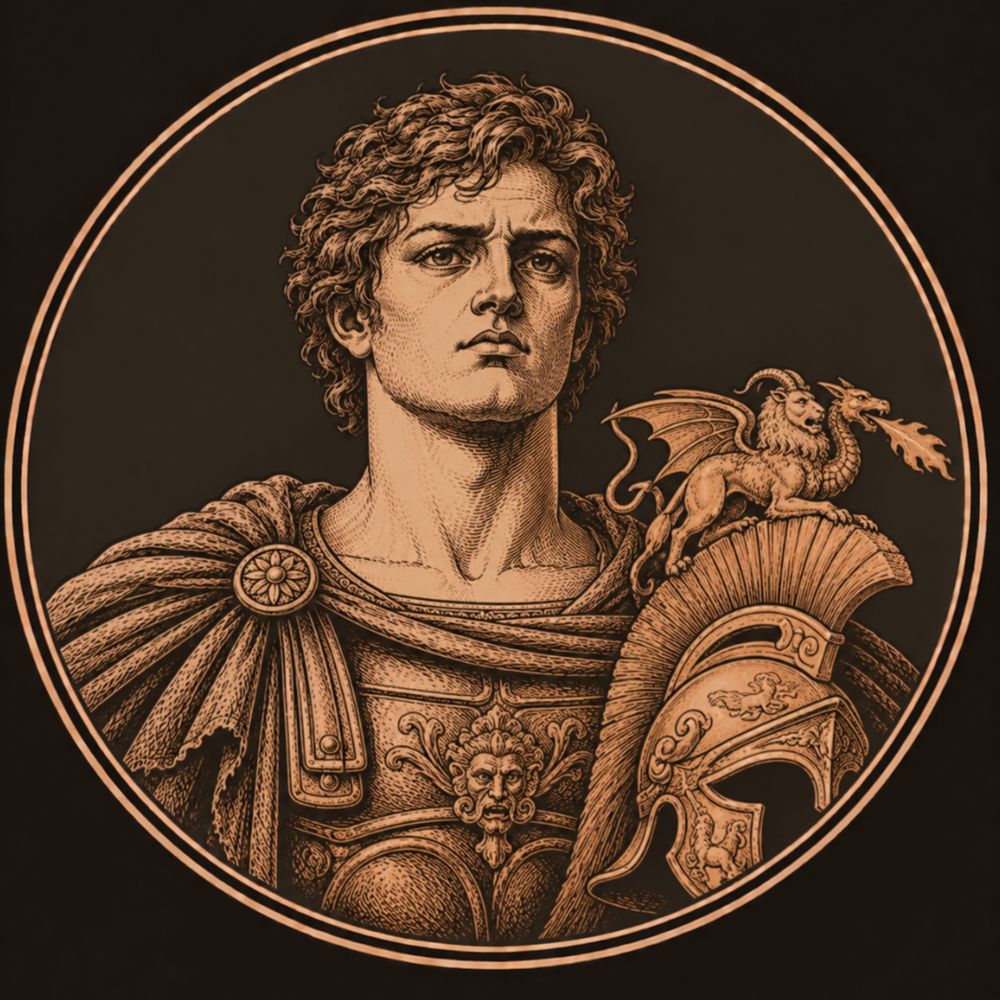
Turnus, bronze medallion illustration
Generated by AI from this page's own facts, not an ancient image or evidence of anything. How this site uses generated images
Sections on this page
Core Myth
Turnus is the king of the Rutulians, the Italian rival of Aeneas in the second half of Virgil's Aeneid. He is the handsomest of the many suitors for Lavinia, and Queen Amata favours him most (Aeneid 7.45-80). Amata traces his descent to Inachus and Acrisius of Mycenae (Aeneid 7.371-372). His father is Daunus, and Juno's own speech gives his mother as the nymph Venilia (Aeneid 12.22; Aeneid 10.62-100). He rules from Ardea, a city Virgil credits to Danae (Aeneid 7.341-474).
Latinus, warned by the oracle of Faunus, welcomes the Trojans and offers Lavinia to Aeneas. Amata pleads for Turnus, reminds her husband of the pledge given to their kinsman, and then flees into the woods with the Latin women (Aeneid 7.359-405). Juno sends the Fury Alecto to finish the work. Alecto first drives Amata mad. She then visits Turnus at Ardea disguised as an old priestess of Juno and tells him to burn the Trojan ships and defend his bride. He mocks her, so she drops the disguise and throws a firebrand into his chest. He wakes shrieking for arms (Aeneid 7.341-474). Alecto also provokes the first bloodshed, when Ascanius wounds a tame stag (Aeneid 7.475-540).
Turnus raises the war and sends the envoy Venulus to Diomedes to ask for help (Aeneid 8.1-17). While Aeneas is away seeking allies, Juno sends Iris to tell Turnus the camp lies open (Aeneid 9.1-24). He tries to burn the Trojan ships. Cybele frees them from their moorings and turns each into a sea nymph, and Turnus tells his men the sign threatens only the Trojans (Aeneid 9.107-158). Later he breaks into the camp and kills many. He escapes only by diving into the Tiber, once Jupiter has ordered Juno to withdraw her help (Aeneid 9.756-818).
His worst act comes in Book 10. He kills the young Pallas, son of the Arcadian king Evander, and strips a belt from the body. Virgil says the day will come when Turnus would pay a great price to have left Pallas unharmed (Aeneid 10.439-509). Jupiter had already said that Turnus is summoned to his doom (Aeneid 10.439-509). Juno then saves him by shaping a phantom of Aeneas from cloud. Turnus chases it onto a ship, and she cuts the cables. He drifts back toward Ardea in shame, and three times Juno stops him from killing himself (Aeneid 10.633-688).
In Book 11 the Latin noble Drances blames Turnus for the war and urges him to face Aeneas alone. Turnus accepts the challenge (Aeneid 11.336-444). The Volscian huntress Camilla then offers to meet the Trojan cavalry alone, and Turnus lays an ambush in the hills. When Acca brings word that Camilla is dead, he abandons it (Aeneid 11.469-531; 11.896-915). In Book 12 he tells Latinus to seal the terms. Latinus and Amata beg him to refuse, and Lavinia blushes at her mother's tears (Aeneid 12.1-80). The two leaders swear a treaty (Aeneid 12.161-215). His sister, the nymph Juturna, breaks it with Juno's leave (Aeneid 12.134-160). When Amata hears a false report of Turnus's death, she hangs herself (Aeneid 12.593-649).
The duel is shaped by divine deals. Turnus's sword shatters against Aeneas's divine armour. Virgil says he had snatched up his charioteer Metiscus's blade in the rush instead of his father's (Aeneid 12.697-790). Jupiter and Juno then settle it. Juno gives up his cause and asks that the Latins keep their name and language, and Jupiter agrees (Aeneid 12.791-842). A Fury sent by Jupiter, in the shape of a night bird, paralyses Turnus and drives Juturna away (Aeneid 12.843-886). Wounded in the thigh, Turnus asks Aeneas to spare him or return his body to his father Daunus, and grants that Lavinia is Aeneas's. Aeneas hesitates. Then he sees Pallas's belt on Turnus's shoulder and drives his sword into his chest in Pallas's name (Aeneid 12.887-952). Venus has helped Aeneas in the last fight by freeing his spear from the tree (Aeneid 12.697-790).
Who is Turnus to Aeneas?
Turnus is Aeneas's chief enemy in Italy. He is the Rutulian king who had the strongest claim to marry Lavinia before the Trojans arrived. In Virgil, Juno's Fury Alecto pushes him into war, and Aeneas ends it by killing him in single combat (Aeneid 7.341-474; Aeneid 12.887-952). In Livy, Lavinia was betrothed to Turnus before Aeneas landed, and he fights both Latinus and Aeneas out of anger at being passed over (Ab Urbe Condita 1.2.1).
Virgil, Aeneid 12.887-952
Did Lavinia love Turnus?
Virgil never says so. Lavinia does not speak in the Aeneid. When Amata begs Turnus not to fight, Lavinia blushes, and the poem says the sight stirs Turnus's love, not hers (Aeneid 12.19-80). Amata is the one who wants Turnus as a son-in-law. Ovid says both armies forgot Lavinia in their wish to win (Metamorphoses 14.566-572). Livy records only that she had been betrothed to Turnus before Aeneas arrived (Ab Urbe Condita 1.2.1).
Virgil, Aeneid 12.19-80
What does Turnus do in the Aeneid?
He leads the Italian resistance to the Trojans from Book 7 to Book 12. Alecto drives him to war. He tries to burn the Trojan ships, breaks into their camp, kills Evander's son Pallas and takes his belt. He agrees to settle the war by single combat, and Aeneas kills him when he sees the belt (Aeneid 7.341-474; Aeneid 9.107-158; Aeneid 10.439-509; Aeneid 12.887-952).
Virgil, Aeneid 7.341-474
What does Turnus mean?
Virgil does not explain the name, and its meaning is not settled. What he gives instead is a lineage: Amata traces Turnus to Inachus and Acrisius of Mycenae (Aeneid 7.371-372), and his father is Daunus, king of Ardea (Aeneid 12.22; Aeneid 10.688). Ovid calls him only the young chief of the Rutulians (Metamorphoses 14.445-451). This page does not offer an etymology, because none can be checked against an ancient text.
Virgil, Aeneid 7.371-372
Later Traditions
Livy tells the war without a duel or a Fury. Turnus is king of the Rutulians, and Lavinia had been betrothed to him before Aeneas arrived. Furious at seeing a stranger preferred, he declares war on both Latinus and Aeneas (Ab Urbe Condita 1.2.1). The Rutulians lose the first battle, but the victors lose Latinus. Turnus then turns to Mezentius of Caere for help (Ab Urbe Condita 1.2.2-3). Livy says Aeneas dies after a later victory over the Rutulians and Etruscans (Ab Urbe Condita 1.2.5-6).
Ovid compresses the story in Metamorphoses 14. He calls Turnus the young chief of a fierce people who fights on because his bride was promised to him (Metamorphoses 14.445-451). Turnus comes to the Trojan fleet with torches, and Cybele turns the ships into sea nymphs (Metamorphoses 14.527-565). Ovid says the fighting went on after the sign because both sides now wanted only to win, and forgot the dowry, the throne and Lavinia (Metamorphoses 14.566-572). Then Turnus falls, and so does Ardea, which the Trojans burn. From the ashes rises a bird, the heron, whose cry and pallor keep the name of the ruined city (Metamorphoses 14.567-580).
Virgil ends the poem on Turnus's death. Aeneas kills a man who has surrendered and asked for mercy, and Virgil says what tipped him: the sight of Pallas's belt, which Turnus had taken as a trophy (Aeneid 12.887-952). Ardea also appears in Livy as a Rutulian city besieged by Tarquinius Superbus. During that siege the wager among the king's sons over their wives leads to Lucretia (Ab Urbe Condita 1.57).
Also Connected
7 recorded connections, each with the ancient line behind it.
Allies
-
Camilla meets Turnus at the city gate and offers to face the Trojan cavalry alone. Turnus gives her the command of the horse. Dying, she sends Acca to tell Turnus that he must hold the field.
-

Juno sends Alecto to rouse Turnus to war and shields him until Jupiter orders her to withdraw. She then gives up his cause and asks that the Latins keep their name.
Enemies
-

Turnus tries to burn the ships made from Cybele's sacred pines. She frees them from their moorings and turns them into sea nymphs.
Connected
-

Jupiter tells Hercules that Turnus is summoned to his doom, orders Juno to withdraw her help in Book 9, and in Book 12 sends a Fury that breaks Turnus's nerve.
-
Turnus is the suitor Queen Amata favours for Lavinia. In Book 7 Latinus follows the oracle of Faunus and offers her to Aeneas. In Book 12 he tells Turnus he set the gods' command aside once, out of affection for him and pity for the queen.
-

The siege of Ardea, during which Sextus Tarquin's assault on Lucretia begins, is a siege of the city Virgil gives to Turnus. The two stories share a setting and no characters.
-

In the final fight Venus, protecting her son, pulls Aeneas's spear free from the wild olive root that held it while Turnus prays to Faunus.
Where Accounts Differ
- how Turnus dies
- what starts the war with Turnus
- how firmly Lavinia was promised to Turnus
- Turnus's parentage and origin
- the broken sword of Metiscus
- Turnus's end is told differently. In Virgil, Aeneas kills him after seeing Pallas's belt (Aeneid 12.887-952). Ovid says only that Turnus falls and that Ardea burns and gives rise to a bird (Metamorphoses 14.567-580). Livy has no duel: Aeneas dies after a battle against the Rutulians and Etruscans (Ab Urbe Condita 1.2.5-6).
- The cause of the war differs. In Virgil, Juno sends Alecto to rouse Turnus, who then leads the Rutulians (Aeneid 7.341-474). In Livy, Turnus declares war on his own, furious that a stranger was preferred to him (Ab Urbe Condita 1.2.1). Ovid gives the same motive without a Fury: he fights indignant, to keep a promised bride (Metamorphoses 14.445-451).
- The engagement to Lavinia is not equally firm. Livy says she had been betrothed to Turnus before Aeneas came (Ab Urbe Condita 1.2.1). Ovid calls her a promised bride (Metamorphoses 14.445-451). In Virgil, Amata claims a pledge was given to Turnus (Aeneid 7.359-372). Latinus later says he set aside the gods' command out of affection for Turnus and pity for the queen (Aeneid 12.19-80).
- Turnus's parentage and origin vary. Virgil gives his father as Daunus (Aeneid 12.22). Juno's speech in Book 10 says Pilumnus was his grandfather and Venilia his mother, as the Latin reads (Aeneid 10.62-100), although the Perseus English translation renders Pilumnus as his father. Book 9 places him in a grove of Pilumnus (Aeneid 9.1-24). Amata gives him an Argive descent from Inachus and Acrisius (Aeneid 7.371-372). Virgil says Ardea was built by Danae, 'so runs the tale' (Aeneid 7.341-474).
- Virgil reports the broken sword as a tradition. Fama est, he says, that Turnus left his father's sword behind and snatched up Metiscus's blade (Aeneid 12.697-790). Virgil's own wording marks it as hearsay, and no other source cited on this page repeats it.
Read the full source verification →
Mythology
Appears In
Sources
- Virgil, Aeneid 7.45-80
- Virgil, Aeneid 7.359-405
- Virgil, Aeneid 7.341-474
- Virgil, Aeneid 7.475-540
- Virgil, Aeneid 8.1-17
- Virgil, Aeneid 9.1-24
- Virgil, Aeneid 9.107-158
- Virgil, Aeneid 9.756-818
- Virgil, Aeneid 10.62-100
- Virgil, Aeneid 10.439-509
- Virgil, Aeneid 10.633-688
- Virgil, Aeneid 11.336-444
- Virgil, Aeneid 12.1-80
- Virgil, Aeneid 12.134-160
- Virgil, Aeneid 12.161-215
- Virgil, Aeneid 12.593-649
- Virgil, Aeneid 12.697-790
- Virgil, Aeneid 12.791-842
- Virgil, Aeneid 12.843-886
- Virgil, Aeneid 12.887-952
- Livy, Ab Urbe Condita 1.2.1-6
- Ovid, Metamorphoses 14.445-451
- Ovid, Metamorphoses 14.527-580
- Virgil, Aeneid 11.469-531
- Virgil, Aeneid 11.896-915
- Livy, Ab Urbe Condita 1.57