Tarquin
Tarquin is the name of two legendary kings of Rome in Livy: Lucius Tarquinius Priscus, an immigrant from Tarquinii, and Lucius Tarquinius Superbus, the Proud, the last king. Superbus took the throne after Servius Tullius was killed and reigned twenty-five years. Rome banished him after his son Sextus assaulted Lucretia. Tradition dates that fall to 509 BCE. He is not Tarchon, the Etruscan king of the Aeneid.
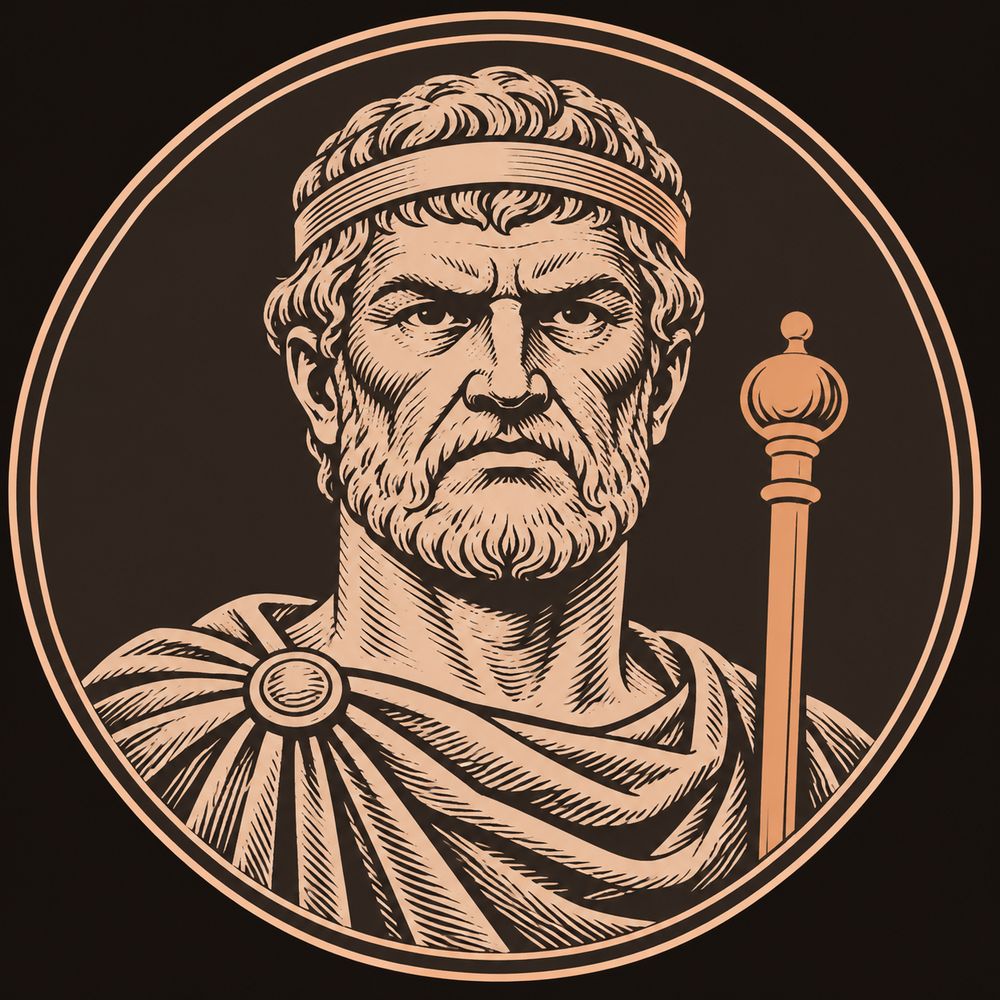
Tarquin the Proud with a royal sceptre
Generated by AI from this page's own facts, not an ancient image or evidence of anything. How this site uses generated images
Sections on this page
Core Myth
Livy gives Rome two kings of the Tarquin family, and both belong to Roman legend as much as to history. The first is Lucius Tarquinius Priscus. Livy says he was born as Lucumo, the son of Demaratus, a Corinthian exile settled in Tarquinii. Ambitious and unable to rise in that town, he moved to Rome with his wife Tanaquil and took the name Lucius Tarquinius Priscus (Ab Urbe Condita 1.34). After the death of King Ancus, he sent Ancus's sons out hunting and pressed for an early election, which he won (Ab Urbe Condita 1.35). Livy says he had been about thirty-eight years on the throne when Servius Tullius stood highest in esteem (Ab Urbe Condita 1.40).
The second is Lucius Tarquinius Superbus. In Livy, Tullia stirred his restless ambition. She and Tarquin cleared the obstacles to a new marriage by a double murder (Ab Urbe Condita 1.46). He then had the old king Servius Tullius attacked and killed by men he had sent after him. Livy adds that it is the current belief this was done at Tullia's suggestion (Ab Urbe Condita 1.48). Tarquin then reigned without being elected by the people or confirmed by the senate (Ab Urbe Condita 1.49).
Livy also credits him with one lasting work. He wanted the temple of Jupiter on the Tarpeian Mount to be a memorial of his reign and name. The omens were unfavourable for removing the shrine of Terminus, who alone of the gods was not called out of his borders. While the foundations were dug, a human head with its face perfect came to light. Livy says it was read as a sign that the place would be the head of all the world (Ab Urbe Condita 1.55).
His fall begins at the siege of Ardea. His son Sextus Tarquin raped Lucretia at Collatia, and she killed herself after telling her father and husband (Ab Urbe Condita 1.57; Ab Urbe Condita 1.58). Brutus swore to drive out the king and his family (Ab Urbe Condita 1.59). The king hurried to Rome and found the gates shut and a decree of banishment passed against him. Two of his sons followed him into exile among the Etruscans at Caere, and Sextus went to Gabii, where he was killed (Ab Urbe Condita 1.60). Livy gives Superbus a reign of twenty-five years and the kings a total of 244 years (Ab Urbe Condita 1.60).
Tarquin should not be confused with Tarchon. Tarchon is a figure in Virgil's war in Italy, set in the generation before Rome exists. In Aeneid 11 the god thrusts Tarchon into the fight as the Tyrrhene king, and he rides through the field among retreating troops (Aeneid 11.725-767). Both names have an Etruscan setting. Tarchon is a warrior in Virgil, and Tarquin is a king of Rome in Livy. The passages checked here do not link the two names or the two men.
What is Tarquin known for?
Superbus is known as the last king of Rome and as a tyrant. Livy says he earned the nickname Superbus by refusing his father-in-law burial and killing leading nobles. He surrounded himself with a guard and tried capital cases without assessors, so he could execute, exile or fine anyone he disliked. He is also known for the temple of Jupiter and for the revolt that ended his rule.
What is the meaning of Tarquin?
The lines checked here give no etymology. Livy says Lucumo came from Tarquinii and, once in Rome, was called Lucius Tarquinius Priscus, so the family name matches the town he left. Superbus is Latin for proud, and Livy says it was a nickname his conduct earned him. Priscus is a surname too, and Livy does not gloss it in the passages checked.
Was Tarquin the Proud a real person?
The sources checked here are Roman narratives of the legendary age, and they do not settle the question. Livy gives exact figures, such as a reign of twenty-five years, but the tale of the king, his sons and Lucretia is told as Roman tradition. Modern historians generally treat the early kings as semi-legendary, with the kernel of a historical expulsion possible but unproven.
What did the Romans do to Tarquin the Proud?
They banished him. In Livy, Brutus took the army in the camp at Ardea over to the revolt while the king hurried to Rome, and the king found the gates shut. A decree of banishment passed against him, and his sons were expelled. The assembly chose Brutus and Collatinus as the first consuls, ending rule by kings.
What happened to Sextus Tarquin after Lucretia died?
Livy says Sextus went to Gabii, which he treated as his own kingdom. He was killed there in revenge for the old feuds his violence had stirred up. His father and two brothers went into exile at Caere instead. Livy does not make his death a trial for the assault itself, and the passage names the earlier feuds as the cause.
Later Traditions
The sources do not agree on which Tarquin owned the Sibylline books. Gellius says the buyer was Tarquin the Proud (Aulus Gellius, Attic Nights). Lactantius, citing Varro, names the king as Tarquinius Priscus (Lactantius, Divine Institutes). The tale is told on the page for the Cumaean Sibyl. Livy's own account of the temple of Jupiter gives the building to Superbus.
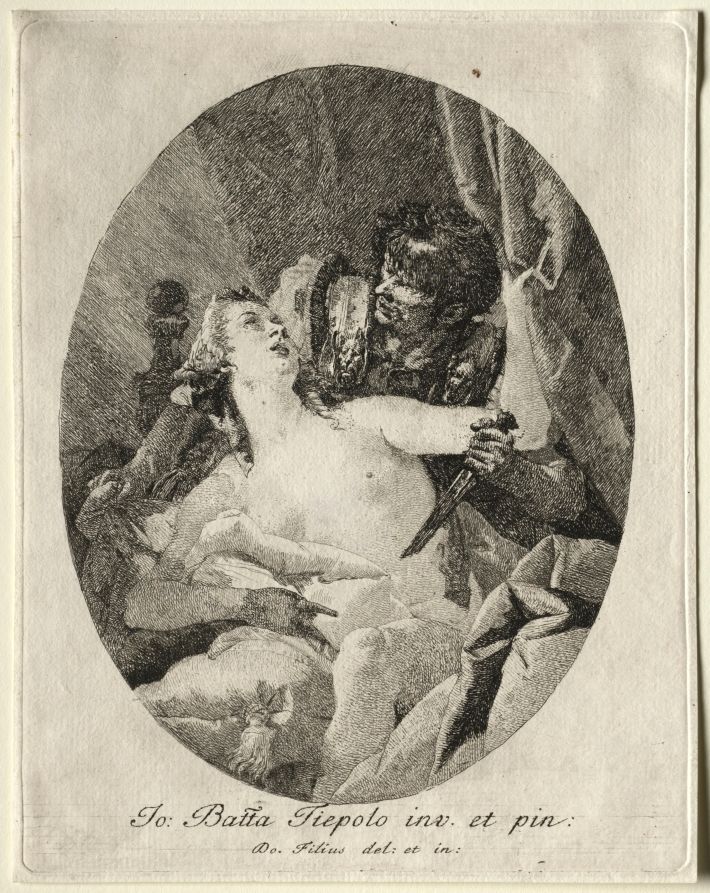
Tarquin and Lucretia - Italy, late 1700s, etching
The Cleveland Museum of Art, Cleveland, OH, 1925.1233. CC0
Also Connected
2 recorded connections, each with the ancient line behind it.
Connected
-

Livy has Tarquin build the temple of Jupiter on the Tarpeian Mount as a memorial of his reign and name.
-
In Livy, the king's son Sextus Tarquin rapes Lucretia, and her death leads to the banishment of Tarquin the Proud and his family. The king himself does not touch her.
Where Accounts Differ
- which-tarquin-and-the-sibyl
- Gellius names Tarquin the Proud as the buyer of the Sibylline books and Lactantius, citing Varro, names Priscus. Neither work is cited here by line, so the page does not choose between them.
Read the full source verification →
Mythology
Appears In
Related Terms
Referenced By
Sources
- Livy, Ab Urbe Condita 1.34
- Livy, Ab Urbe Condita 1.35
- Livy, Ab Urbe Condita 1.40
- Livy, Ab Urbe Condita 1.46
- Livy, Ab Urbe Condita 1.48
- Livy, Ab Urbe Condita 1.49
- Livy, Ab Urbe Condita 1.55
- Livy, Ab Urbe Condita 1.57
- Livy, Ab Urbe Condita 1.58
- Livy, Ab Urbe Condita 1.59
- Livy, Ab Urbe Condita 1.60
- Virgil, Aeneid 11.725-767
- Aulus Gellius, Attic Nights
- Lactantius, Divine Institutes