Cumaean Sibyl
The Cumaean Sibyl is the prophetess of Apollo who lived in a cave at Cumae, on the coast near Naples.
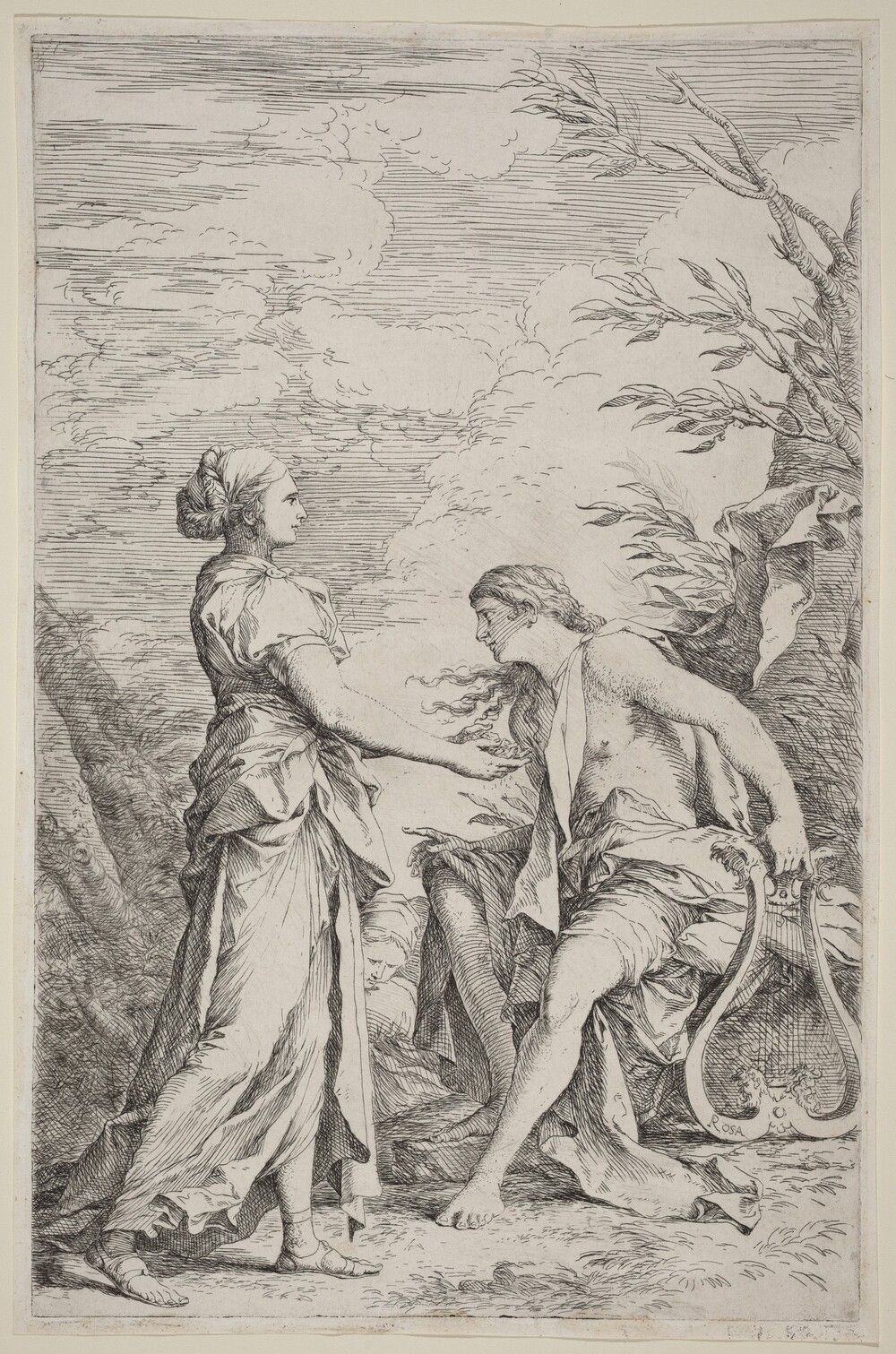
Apollo and the Cumaean Sibyl - Salvator Rosa, c. 1661, etching and drypoint on laid paper
National Gallery of Art, Washington, DC, 1995.10.3. CC0
Sections on this page
In Practice
In Roman tradition she guided Aeneas through the underworld and gave Rome its Sibylline Books. "Sibyl" is a title before it is a name. The Greeks and Romans knew several prophetesses called Sibyls, and the Cumaean was the one Rome claimed as its own.
Virgil gives the fullest portrait. His Sibyl is a priestess of Apollo and of Trivia, called Deiphobe, daughter of Glaucus (Aeneid 6.35-36). Her cave has a hundred mouths, and from them her answers pour out as voices (Aeneid 6.42-44). She speaks only when the god seizes her, and the god drives her like a horse under bit and rein (Aeneid 6.77-80). Her prophecy for Aeneas is grim: war in Latium, a new Achilles, and a first road to safety that opens from a Greek city (Aeneid 6.83-97). Helenus had already warned him to seek her out (Aeneid 3.374-462).
Her second role is guide. She tells Aeneas that the way down to Avernus is easy and the way back is the labour, and that he needs a golden bough (Aeneid 6.126-155). At the cave of Avernus she sacrifices, invokes Hecate, and walks in ahead of him (Aeneid 6.236-263). This is the fullest catabasis in Latin verse, and she is the reason it succeeds.
Ovid gives her a second story, about time. Apollo offered her whatever she asked for her virginity. She held up a handful of sand and asked for as many birthdays as the grains, and forgot to ask for youth. In Ovid she tells Aeneas she has lived seven centuries and has three hundred harvests still to come, shrinking until only her voice remains (Metamorphoses 14.101-153).
Rome's second claim on her is the Sibylline Books. A strange woman offered King Tarquin nine books of oracles, burned three, then three more, and sold him the last three for the price of nine (Gellius, Attic Nights 1.19.1-11). Dionysius tells the same sale and the later care of the books (Roman Antiquities 4.62.1-5). The books were kept for the state and consulted by order of the senate in crisis, and Augustus later moved them into the temple of Apollo on the Palatine (Suetonius, Divus Augustus 31.1). Later Roman writers tie the seller to Cumae. That is a late identification, and the earliest tellers do not make it.
Her fame outran her dignity. Petronius has the freedman Trimalchio claim he saw the Sibyl at Cumae hanging in a jar, and when boys asked what she wanted, she answered that she wanted to die (Satyricon 48). Other Greek accounts place a different woman at Cumae, and the name Sibyl is used of prophetesses from Erythrae, Delphi, Samos and elsewhere. The Cumaean is best read against the other prophetic offices, the oracle at Delphi and its Pythia.
Who is Sibyl in the Aeneid?
She is Apollo's priestess at Cumae, named Deiphobe, daughter of Glaucus. She interprets the god's oracle for Aeneas in a cave with a hundred mouths and then leads him into the underworld, where she alone knows the conditions for the journey: the golden bough, the sacrifices and the funeral of Misenus (Aeneid 6.35-36; 6.126-155; 6.236-263).
Virgil, Aeneid 6.35-36
What is the myth of the Cumaean Sibyl?
In Ovid she is a woman Apollo loved. He offered her any gift for her virginity, she asked for as many years as she held grains of sand, and she forgot to ask for youth. She refused him and aged for centuries. In Ovid's account she has lived seven hundred years and expects to shrink until only her voice survives (Metamorphoses 14.101-153).
Ovid, Metamorphoses 14.101-153
Who was the Sibyl at Cumae?
The sources do not agree on her name. Virgil calls her Deiphobe (Aeneid 6.35-36). Pausanias, citing the Cumaean historian Hyperochus, says the woman at Cumae was Demo, and the Cumaeans showed him a small stone urn in a sanctuary of Apollo that they said held her bones (Description of Greece 10.12.8). Varro, as Lactantius reports, names the seventh Sibyl, of Cumae, as Amalthaea, also called Herophile or Demophile (Divine Institutes 1.6).
Pausanias, Description of Greece 10.12.8
Who is Sibyl in Greek mythology?
The word names a type of woman before it names a person: an inspired prophetess. Pausanias lists several, among them Herophile, who chanted oracles on a rock at Delphi, and Demo at Cumae, and says the name itself was given to the first of them by the Libyans (Description of Greece 10.12.1-8). Varro, reported by Lactantius, counted ten Sibyls and derived the word from Aeolic forms meaning god's counsel (Divine Institutes 1.6). Most were later folded into one Roman tradition, and the Cumaean Sibyl is the one that tradition remembers best.
Pausanias, Description of Greece 10.12.1
Who was the Erythraean Sibyl?
In Varro's list of ten, as reported by Lactantius, she is the fifth. She was said to have foretold to the Greeks sailing for Troy that Troy would fall and that Homer would write falsehoods. Lactantius adds that she was the only Sibyl whose own books could be picked out, because she put her true name in her verse (Divine Institutes 1.6). Pausanias says the Erythraeans claimed the prophetess Herophile as their own and pointed to a cave on Mount Corycus as her birthplace (Description of Greece 10.12.7).
Lactantius, Divine Institutes 1.6
Where Accounts Differ
- her name: Deiphobe, Demo or Amalthaea
- which Tarquin bought the books
- the sand, the years and the jar
- Her name: Virgil calls the Cumaean Sibyl Deiphobe, daughter of Glaucus (Aeneid 6.35-36). Pausanias, following Hyperochus of Cumae, names the woman at Cumae Demo (Description of Greece 10.12.8). Varro, as reported by Lactantius, gives her as Amalthaea, also called Herophile or Demophile (Divine Institutes 1.6). Pausanias gives Herophile to Delphi and to the Erythraeans instead (10.12.1-7). These are different traditions, not one name with spellings.
- Which Tarquin, and which woman: Gellius says the buyer was Tarquin the Proud and calls the seller only an old woman (Attic Nights 1.19.2). Dionysius has a woman who was not a native, at the court of the tyrant Tarquinius (Roman Antiquities 4.62.1-2). Lactantius, citing Varro, says the seller was the Cumaean Sibyl and the king was Tarquinius Priscus, and gives a price of three hundred philippics (Divine Institutes 1.6). Only Lactantius names the Cumaean.
- How the books survived: Dionysius says they were kept underground in the temple of Jupiter on the Capitol until the fire after the 173rd Olympiad. The set then in use was rebuilt from copies gathered in Italian cities and at Erythrae, and false verses were detected by acrostics (Roman Antiquities 4.62.5-6). Suetonius has Augustus keep only the Sibylline books when he burned two thousand prophetic writings, and place them in the Palatine temple (Divus Augustus 31.1).
- Her age: the seven centuries and the sand belong to Ovid's telling (Metamorphoses 14.101-153). Virgil's Sibyl in the passages checked here is a priestess under the god's control, and the passages give her no story of age or a bargain with Apollo. Petronius alludes to the aged Sibyl in a jar, through a character who says he saw her himself (Satyricon 48). It is a joke about her longevity told by a freedman at dinner, not evidence about Cumae.
- Verification: Aeneid 3.374-462 and 6.9-263 and Metamorphoses 14.101-153 were read in the Perseus English text (Aeneid, Williams; Ovid, More). Gellius 1.19 and Suetonius Divus Augustus 31.1 were read in the Loeb translations on LacusCurtius, Dionysius 4.62 likewise (Cary). Pausanias 10.12 was read in Jones and Ormerod on Perseus. Lactantius 1.6 was read in the Ante-Nicene translation on New Advent, where the passage carries no numbered subsections. Petronius 48 was read in an English translation on Project Gutenberg. The Greek words of the Sibyl's answer in Petronius were not checked against the Latin text here, and the Latin section number (48.8) is not asserted. Michelangelo's Sistine Sibyls are modern reception and not covered.
Where This Appears
Referenced By
Sources
- Virgil, Aeneid 3.374-462
- Virgil, Aeneid 6.9-13
- Virgil, Aeneid 6.35-36
- Virgil, Aeneid 6.42-44
- Virgil, Aeneid 6.69-76
- Virgil, Aeneid 6.77-80
- Virgil, Aeneid 6.83-97
- Virgil, Aeneid 6.126-155
- Virgil, Aeneid 6.236-263
- Ovid, Metamorphoses 14.101-153
- Petronius, Satyricon 48
- Aulus Gellius, Attic Nights 1.19.1-11
- Dionysius of Halicarnassus, Roman Antiquities 4.62.1-6
- Suetonius, Divus Augustus 31.1
- Lactantius, Divine Institutes 1.6
- Pausanias, Description of Greece 10.12.1-8