Oracles and Fate
This cluster covers how Greek myth treats a future already fixed. The Moirai spin, measure and cut every life's thread, and sources disagree whether even Zeus can overrule them. Oracles, above all Delphi and its priestess the Pythia, reveal a fragment of that decree, usually too cryptic to act on correctly. Cassandra proves no one escapes a true prophecy, and hubris punishes anyone who claims equal standing with a god.
Sections on this page
Overview
Fate in Greek myth is not a vague force; it has three faces. The Moirai, later known as the Fates, spin, measure and cut the thread of every life. Clotho spins it at birth. Lachesis measures out what will happen along its length. Atropos cuts it at death, a cut no prayer in surviving myth ever turns aside. How far their authority reaches is a real disagreement, not a settled fact smoothed over by retelling. Homer's Zeus weighs the fates of two warriors on a golden scale and abides by what it shows, and elsewhere grieves that he cannot save his own son Sarpedon from a death already set. Hesiod calls the Moirai daughters of Zeus and Themis. He says Zeus grants them their honor, which points the other way. Aeschylus settles nothing between the two. In Prometheus Bound, even Zeus cannot escape what the three-shaped Fates have decreed.
An oracle is how a mortal hears a fragment of that fixed future without ever being able to change it. Delphi did not always belong to Apollo. The Homeric Hymn tells how Gaia, the earth herself, held the site first, guarded by the serpent Python, before Apollo killed it and installed his own priestess. Oracles rarely function as helpful guidance in the stories that survive. They function as a trap sprung in slow motion. King Acrisius hears that his grandson will kill him and locks away his daughter Danae. That very act sets in motion the birth of Perseus and Acrisius's own death. A prophecy given to a Theban king works the same way in the era's most famous case, the story of Oedipus. Fleeing the home he believes is his, to escape what he was told, he only walks into it. The oracle does not cause the outcome so much as state it in a form no one recognizes until it is too late to choose differently.
Delphi, Apollo's sanctuary on Mount Parnassus, was the most consulted of these sites. Its authority reached across the whole Greek world rather than any one city. Herodotus records the Lydian king Croesus testing several oracles at once before trusting Delphi with the question that would destroy his own empire. The sanctuary itself survived a Persian attack the Delphians credited to falling rock and lightning. The woman who answered at Delphi held a title, Pythia, not a fixed identity. Many women held the office across the site's history, one at a time. Diodorus records the office's own myth of its discovery, goats leaping strangely near a mountain chasm, and its own account of why the role changed from a young virgin to a woman past fifty, a rule rewritten after a specific assault rather than by custom. Croesus tested this same office directly, asking what he was doing on a chosen day without telling anyone. The Pythia alone among the oracles he consulted answered correctly.
Cassandra is this cluster's starkest proof that no one escapes a true prophecy, only fails to act on it. Apollo grants her real foresight. When she refuses him, he curses her so that she is never wrong and never believed. She warns Troy against the wooden horse exactly as the city falls. The same fixed order shows its other face in hubris. Cassandra's curse punishes people for disbelieving a true prophecy. Hubris instead punishes a mortal for claiming to stand outside fate's ordinary boundary between human and god altogether. Odysseus cannot resist naming himself to the blinded Polyphemus, and Niobe boasts herself superior to a goddess for having more children. Both draw down a punishment as certain as anything Atropos cuts.
In This Topic (7)
-
The Moirai (Fates) Term
The Moirai, commonly known as the Fates, are three goddesses who control the destiny of every mortal and god in Greek mythology. Clotho, the Spinner, spins the thread of a life at birth; Lachesis, the Allotter, measures out its length and what will happen along it; and Atropos, the Inflexible, cuts the thread at death, a task no pleading can turn aside. Hesiod gives them two different origins in the same poem: once as daughters of Night alone, born of no father, and once as daughters of Zeus and Themis, ranked among the honors Zeus himself grants. How far the Moirai's authority reaches, and whether it stands above Zeus's own, is a question Greek authors answer differently depending on the scene. Homer shows Zeus weighing the fates of two warriors on a golden scale and abiding by what tips, and grieving that he cannot save his own son Sarpedon from a death already set. Aeschylus goes further: in Prometheus Bound, when the Chorus asks who governs Necessity, Prometheus answers that the three-shaped Fates and the unforgetting Furies do, and confirms that even Zeus cannot escape what has been foretold. Later philosophical readings soften this into a claim about Zeus's wisdom rather than his weakness - that ruling well means governing in accordance with what is fated rather than fighting it - but the plain sense of the earlier poetry is that the Moirai's decree binds every power in the cosmos, Zeus included. The Moirai received cult worship alongside marriage and childbirth, moments understood as the points where a life's thread is first measured, and brides in several city-states made offerings to them before a wedding. Their Roman counterparts, the Parcae, keep the same three-part division of labor under different names, and the association of destiny with spinning survives into much later European folklore. In philosophical and later poetic sources the Moirai are sometimes folded into or paired with Ananke, Necessity personified, treating fate less as three individual goddesses acting on personal will and more as a single impersonal law the goddesses carry out.
-
Oracle Term
An oracle in Greek mythology is both a sacred site where a god communicates with mortals through prophecy and the prophecy delivered there. The most famous was Delphi, where the Pythia, a priestess of Apollo, spoke cryptic answers seated on a tripod over a chasm in the rock. Other major oracles included Dodona, sacred to Zeus, where priests interpreted the rustling of an ancient oak tree, and the Oracle of the Dead at Ephyra, where the living consulted the spirits of the deceased directly. Delphi did not begin as Apollo's site. The Homeric Hymn to Apollo tells how the young god had to claim it by killing Python, a monstrous serpent that Gaia, the earth herself, had set to guard the spot, since the site's prophetic power was originally hers before Apollo took possession of it and installed his own priestess. This layering - an older, earth-based oracular power beneath a newer, Olympian one - is why Gaia herself is sometimes named as an early source of prophecy in her own right, older than any of the gods who later claim oracles as their own. Oracles function in myth less as helpful guidance than as a trap sprung in slow motion: an oracle's prophecy is almost always technically true and disastrously misunderstood by the person who hears it, which is what drives plots forward rather than resolving them. Acrisius hears that his grandson will kill him and locks his daughter away, which is exactly what puts events in motion toward that death. Oedipus flees the city he believes to be his home to escape a prophecy that has already, unknowingly, come true. The oracle does not cause these outcomes so much as state them in a form no one recognizes until it is too late to act differently - which is exactly why ancient audiences found the stories satisfying rather than merely cruel. Deucalion and Pyrrha face the same problem in Ovid's flood story: the oracle tells them to throw their mother's bones behind them, and they must work out that it means stones.
-
Delphi Term
Delphi is the sanctuary of Apollo on the southern slope of Mount Parnassus, home to the most consulted oracle in the ancient Greek world and a site whose religious authority reached across the whole Greek-speaking world rather than any single city-state. The Homeric Hymn to Apollo describes the god himself choosing the site and personally laying out the plan for his temple there, declaring that it will be an oracle where people from every part of Greece and beyond will come to question him, before killing the great serpent that had guarded the spot until then. That status as common ground for the whole Greek world, not property any one city controlled, is what made Delphi's political weight so far beyond a typical temple's. Herodotus's Histories records the Lydian king Croesus sending lavish gifts and formally testing several oracles before settling on Delphi to ask whether he should go to war with Persia, receiving the famously double-edged answer that if he attacked he would destroy a great empire, advice that came true, only the empire destroyed was his own. When the Persians later invaded Greece and a detachment moved against Delphi itself, Herodotus reports that the sanctuary was defended by what the Delphians took as direct divine intervention: thunderbolts and two peaks breaking loose from Parnassus to crush the attackers, alongside supernatural apparitions the Persian survivors themselves later described. Delphi's authority was never treated in the ancient sources as automatically Apollo's to begin with. The site's oracular power originally belonged to Gaia, the earth herself, guarded by the serpent Apollo had to kill before he could claim it and install his own priestess in her place, a layered history of ownership the Homeric Hymn preserves rather than smooths over. Beyond the oracle itself, Delphi also hosted the Pythian Games, one of the four great Panhellenic athletic festivals alongside Olympia, and city-states across the Greek world built their own treasuries on the sanctuary grounds to store dedications, physical evidence of how much political and religious stock every part of Greece put in this one specific place. Aeschylus's Eumenides opens in Apollo's shrine there, where his priestess finds Orestes, blood on his hands, a suppliant beside the sleeping Furies. Apollo then sends him to Athens. His story is told in the house of Atreus.
-
Pythia Term
The Pythia is the title of the priestess who spoke Apollo's oracles at Delphi, not the name of a single individual. Diodorus Siculus records the office's own myth of how the site was found at all: goats grazing near a chasm in the ground began leaping about strangely and making unfamiliar sounds whenever they approached it, and the goatherd who investigated the chasm himself started foretelling the future, which is why the Delphians continued to favor goats when consulting the oracle long afterward. Strabo describes what the office itself involved once Delphi's prophetic role was established: the site's inner cave narrows to a mouth from which a breath rises that induces divine frenzy, and the woman holding the title mounted a high tripod set over that opening to receive it, delivering answers in both verse and prose. Strabo also gives the name's own origin, deriving Pythia and Pytho from the verb meaning "to inquire of the oracle." Who could hold the title changed over time, and the change itself is recorded as a response to a specific violation rather than an evolving custom. Diodorus explains that originally a young virgin held the office, on the reasoning that virgins' untouched nature suited them to guard the secrecy of what the oracle disclosed, matching the qualities attributed to Artemis. That practice ended after a man named Echecrates the Thessalian, visiting the shrine, became infatuated with the virgin then serving as Pythia, abducted her, and assaulted her. In response, Diodorus reports, the Delphians passed a law that no virgin would prophesy again, and that a woman of at least fifty would hold the office instead, dressed in a virgin's costume as a deliberate reminder of the practice it replaced. The office's answers, whatever their exact mechanism, were treated by contemporaries as verifiably real rather than only a matter of religious tradition. Herodotus records Croesus of Lydia testing several oracles at once by asking, on an agreed day, what he was doing at that exact hour, an act he told no one; the Pythia's answer named a tortoise and a lamb boiled together in a bronze cauldron under a bronze lid, which is exactly what Croesus had arranged to be doing, the only oracle among those tested to answer correctly. Decades later, before Xerxes' invasion, the same office told Athenian envoys their sole safety lay in a "wood-built wall," an answer disputed among the Athenians themselves until Themistocles argued it meant their fleet rather than a literal wall around the Acropolis, and pressed the city to fight at sea rather than abandon it.
The office, not a person: many different women held the title of Pythia across Delphi's history, one at a time, so this entry covers the role while Delphi covers the sanctuary itself.
-
Cassandra Term
Cassandra is the prophetess of Troy who sees the truth and is believed by no one. A princess of the city, she receives the gift of prophecy from Apollo, who desires her and grants her the power in the hope of winning her love. Aeschylus's Agamemnon has Cassandra herself explain what happens next: she accepts the god's gift, then breaks her word to him, and Apollo, unable to take back a gift he has already given, curses her instead so that she will go on prophesying true things that no one will ever believe. That curse defines every appearance she makes in the surviving tradition. Virgil's Aeneid shows her warning the Trojans not to bring the wooden horse inside the walls, a warning the poem states outright was fated never to be believed, and Troy falls exactly as she said it would. When the city is finally sacked, Cassandra takes refuge clinging to the sacred image of Athena in the goddess's own temple, and the Locrian Ajax drags her away from it and assaults her there, a sacrilege ancient sources treat as compounding the disaster already unfolding for the Greeks, since it draws Athena's own anger down on the fleet sailing home. Taken afterward as a war prize by Agamemnon, Cassandra travels with him to Mycenae, home of the house of Atreus, where Homer's Odyssey has Agamemnon's own ghost recall, still bitter in the underworld, the cry she gave as Clytemnestra murdered her at his side. What makes Cassandra's story distinct from other cursed figures in Greek myth is that her punishment never touches the accuracy of what she says, only whether anyone will act on it. Every named catastrophe in her story, the horse, the sack of the city, her own death at Mycenae, she foresees correctly and in detail. The curse does its damage entirely through the people around her, who hear a true prophecy and dismiss it as raving, which is why her name later became shorthand in English for a warning that turns out to be correct only after it is too late to matter.
-
Hubris Term
Hubris is excessive pride or self-assertion in Greek thought, most dangerously when a mortal treats themselves as the equal of, or superior to, a god. It is not simple confidence or ordinary boasting; the offense specifically involves overstepping the boundary the gods enforce between mortal and divine status, and Greek myth treats it as one of the surest ways to bring down catastrophic, often disproportionate, punishment. Odysseus provides the clearest single case in Homer: having blinded the Cyclops Polyphemus and sailed to what should have been safety, he cannot resist shouting back his true name and his home, undoing the anonymity that would have kept him safe and giving Poseidon, Polyphemus's father, exactly what he needs to curse Odysseus's journey home. His companions beg him to stay silent; he does not, and the ten extra years of wandering the Odyssey narrates follow directly from that single act of pride. Niobe's story works the same way from a different angle: boasting that her fourteen children make her superior to Leto, who had only two, she draws the deaths of all fourteen at the hands of Apollo and Artemis, Leto's own children, as retribution. Icarus's fall, by contrast, is usually read as recklessness or disobedience toward his father's warning rather than hubris in the strict sense, since he never claims equality with a god - a distinction worth keeping even though the two ideas are often blurred together in casual retellings. Narcissus's self-absorption in Narcissus and Echo gets folded into hubris just as loosely: Nemesis punishes him for spurning suitors who loved him, not for any claim to divine status, which places his story closer to Icarus's than to Odysseus's or Niobe's. Tragedy closes on the same warning. Sophocles ends Antigone with the chorus saying that the great words of arrogant men are repaid with great blows. The lesson is aimed at Creon, whose edict against burying Polynices cost him his son and his wife. The concept was not confined to myth in Greek life; Athenian law recognized hubris as an actual chargeable offense, covering acts intended to humiliate or degrade another person's honor rather than only religious overreach against a god. The mythological sense this glossary entry covers - pride that provokes divine retribution - is a specific narrative use of a broader word that also did ordinary legal and social work in Greek culture, which is worth keeping in mind whenever a myth is described as being "about hubris": the term carried real weight outside of storytelling as well.
Belongs to this cluster as the mirror case to Cassandra and the oracle-driven stories: instead of failing to believe a true prophecy, a mortal who commits hubris claims a status fate never grants them, and draws the same kind of certain, disproportionate punishment.
-
Cumaean Sibyl Term
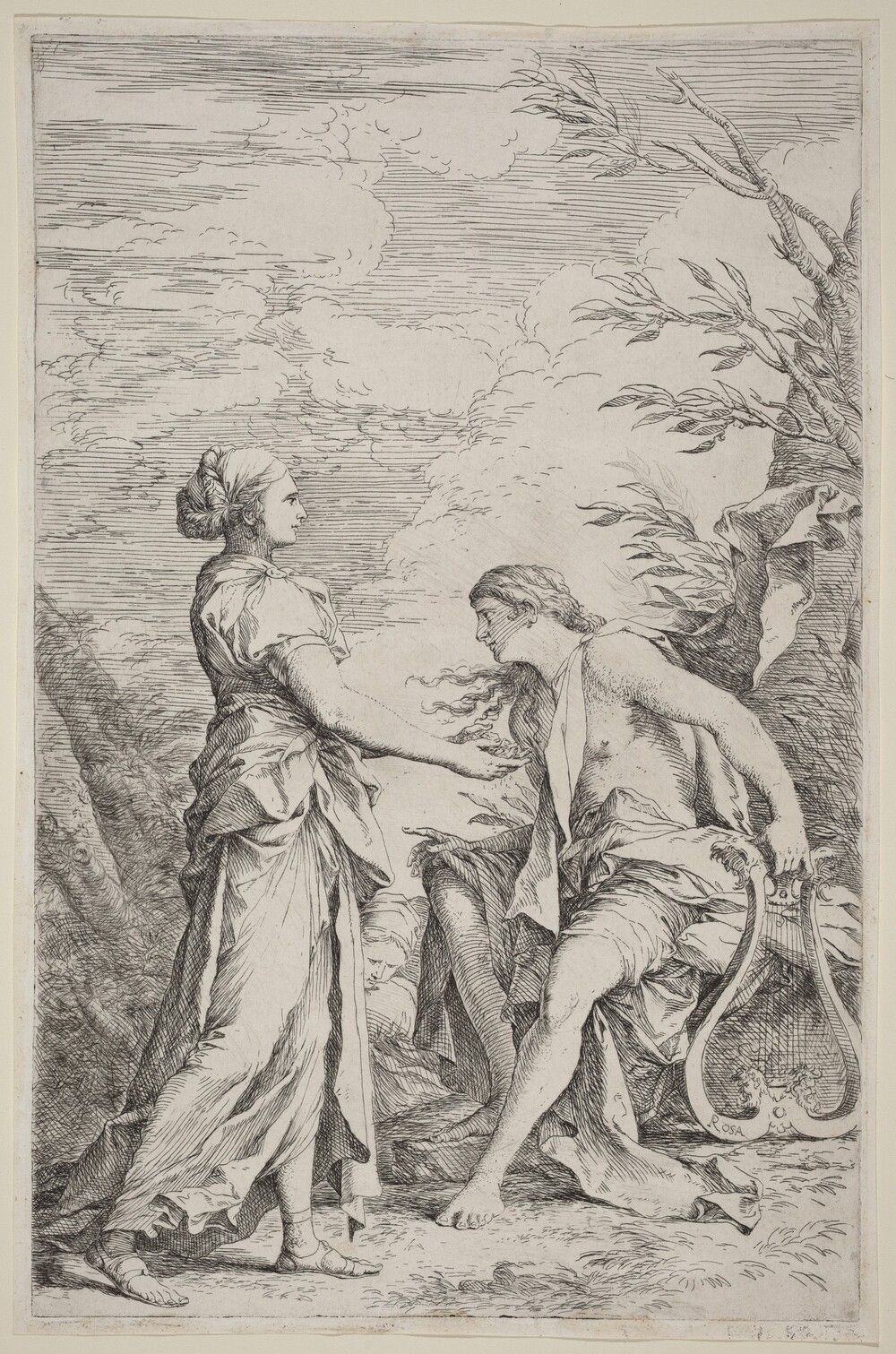
The Cumaean Sibyl is the prophetess of Apollo who lived in a cave at Cumae, on the coast near Naples. In Roman tradition she guided Aeneas through the underworld and gave Rome its Sibylline Books. "Sibyl" is a title before it is a name. The Greeks and Romans knew several prophetesses called Sibyls, and the Cumaean was the one Rome claimed as its own. Virgil gives the fullest portrait. His Sibyl is a priestess of Apollo and of Trivia, called Deiphobe, daughter of Glaucus (Aeneid 6.35-36). Her cave has a hundred mouths, and from them her answers pour out as voices (Aeneid 6.42-44). She speaks only when the god seizes her, and the god drives her like a horse under bit and rein (Aeneid 6.77-80). Her prophecy for Aeneas is grim: war in Latium, a new Achilles, and a first road to safety that opens from a Greek city (Aeneid 6.83-97). Helenus had already warned him to seek her out (Aeneid 3.374-462). Her second role is guide. She tells Aeneas that the way down to Avernus is easy and the way back is the labour, and that he needs a golden bough (Aeneid 6.126-155). At the cave of Avernus she sacrifices, invokes Hecate, and walks in ahead of him (Aeneid 6.236-263). This is the fullest catabasis in Latin verse, and she is the reason it succeeds. Ovid gives her a second story, about time. Apollo offered her whatever she asked for her virginity. She held up a handful of sand and asked for as many birthdays as the grains, and forgot to ask for youth. In Ovid she tells Aeneas she has lived seven centuries and has three hundred harvests still to come, shrinking until only her voice remains (Metamorphoses 14.101-153). Rome's second claim on her is the Sibylline Books. A strange woman offered King Tarquin nine books of oracles, burned three, then three more, and sold him the last three for the price of nine (Gellius, Attic Nights 1.19.1-11). Dionysius tells the same sale and the later care of the books (Roman Antiquities 4.62.1-5). The books were kept for the state and consulted by order of the senate in crisis, and Augustus later moved them into the temple of Apollo on the Palatine (Suetonius, Divus Augustus 31.1). Later Roman writers tie the seller to Cumae. That is a late identification, and the earliest tellers do not make it. Her fame outran her dignity. Petronius has the freedman Trimalchio claim he saw the Sibyl at Cumae hanging in a jar, and when boys asked what she wanted, she answered that she wanted to die (Satyricon 48). Other Greek accounts place a different woman at Cumae, and the name Sibyl is used of prophetesses from Erythrae, Delphi, Samos and elsewhere. The Cumaean is best read against the other prophetic offices, the oracle at Delphi and its Pythia.
Rome's prophetess of Apollo. Virgil makes her Aeneas's guide to the underworld, and the Sibylline Books linked with her were kept by the Roman state.
Can the gods change fate, or are they bound by it?
Ancient sources answer this differently depending on the scene. Homer's Iliad shows Zeus weighing the fates of Achilles and Hector on a golden scale and abiding by what it shows, and elsewhere grieving that he cannot save his own son Sarpedon from a death already fixed. Hesiod calls the Moirai daughters of Zeus and Themis and says he grants them their honor, which suggests his authority sits above theirs. Aeschylus's Prometheus Bound gives the flattest answer of all: asked who governs Necessity, Prometheus says the three-shaped Fates and the unforgetting Furies do, and that even Zeus cannot escape what has been foretold. The tradition never reconciles these into one settled picture.
Homer, Iliad 22.209-213; Hesiod, Theogony 217-222; Aeschylus, Prometheus Bound 511-518
Does anyone ever escape a prophecy?
No surviving case shows a prophecy proven false, only the different ways mortals fail to act correctly on a true one. Acrisius locks away his daughter Danae to prevent a prophesied grandson from killing him, and that very act sets in motion the birth of Perseus and Acrisius's own death. Cassandra's case is starker still: Apollo's curse never touches the accuracy of what she says, only whether anyone believes it, so she foresees the fall of Troy in exact detail and is dismissed as raving until the wooden horse is already inside the walls. Ancient myth treats a prophecy less as a warning that can be avoided than as a fact stated in a form no one recognizes in time.
Apollodorus, Library 2.4.1; Aeschylus, Agamemnon 1195-1215
Is hubris the same kind of offense as ignoring a prophecy?
No, and the two belong to opposite halves of this cluster. Cassandra's disaster comes from listeners who fail to believe a truth already fixed for them; she never claims any status beyond her own. Hubris runs the other way: a mortal like Odysseus or Niobe claims a standing fate never grants them, equal to or above a god, rather than simply failing to hear what fate has already decided. Both draw punishment that fits the offense: Odysseus's taunt costs him ten years at sea, and Niobe loses every child she boasted about. Nemesis, the retribution that answers hubris specifically, is a distinct mechanism from the Moirai's fixed decree or a curse like Cassandra's.
Homer, Odyssey 9.502-535; Homer, Iliad 24.602-617
Where Accounts Differ
- zeus-bound-by-fate-vs-granting-the-moirai-their-honor
- This hub does not restate the individual member entries' own genealogies or office histories in full; it draws the connecting line between fate as a fixed decree (Moirai), the mechanism for hearing a fragment of it (oracle, Delphi, Pythia), and the two ways mortals fail to act on it (Cassandra's disbelieved truth, hubris's claim to stand outside it).
Related Terms
Referenced By
Sources
- Homer, Iliad 22.209-213
- Homer, Iliad 16.431-461
- Hesiod, Theogony 217-222
- Hesiod, Theogony 901-906
- Aeschylus, Prometheus Bound 511-518
- Homeric Hymn to Apollo 300-374
- Apollodorus, Library 2.4.1
- Herodotus, Histories 1.47
- Herodotus, Histories 1.53
- Herodotus, Histories 8.37-39
- Diodorus Siculus, Bibliotheca Historica 16.26.1-4
- Diodorus Siculus, Bibliotheca Historica 16.26.6
- Aeschylus, Agamemnon 1195-1215
- Virgil, Aeneid 2.240-247
- Homer, Odyssey 9.502-535
- Homer, Iliad 24.602-617