Acrisius
Acrisius was a king of Argos, twin brother of Proetus and father of Danae. An oracle told him his daughter would bear a son who would kill him. He shut Danae in a bronze chamber and later cast her and the infant Perseus into the sea in a chest. Years afterward Perseus accidentally killed him with a thrown discus at Larissa, fulfilling the prophecy.
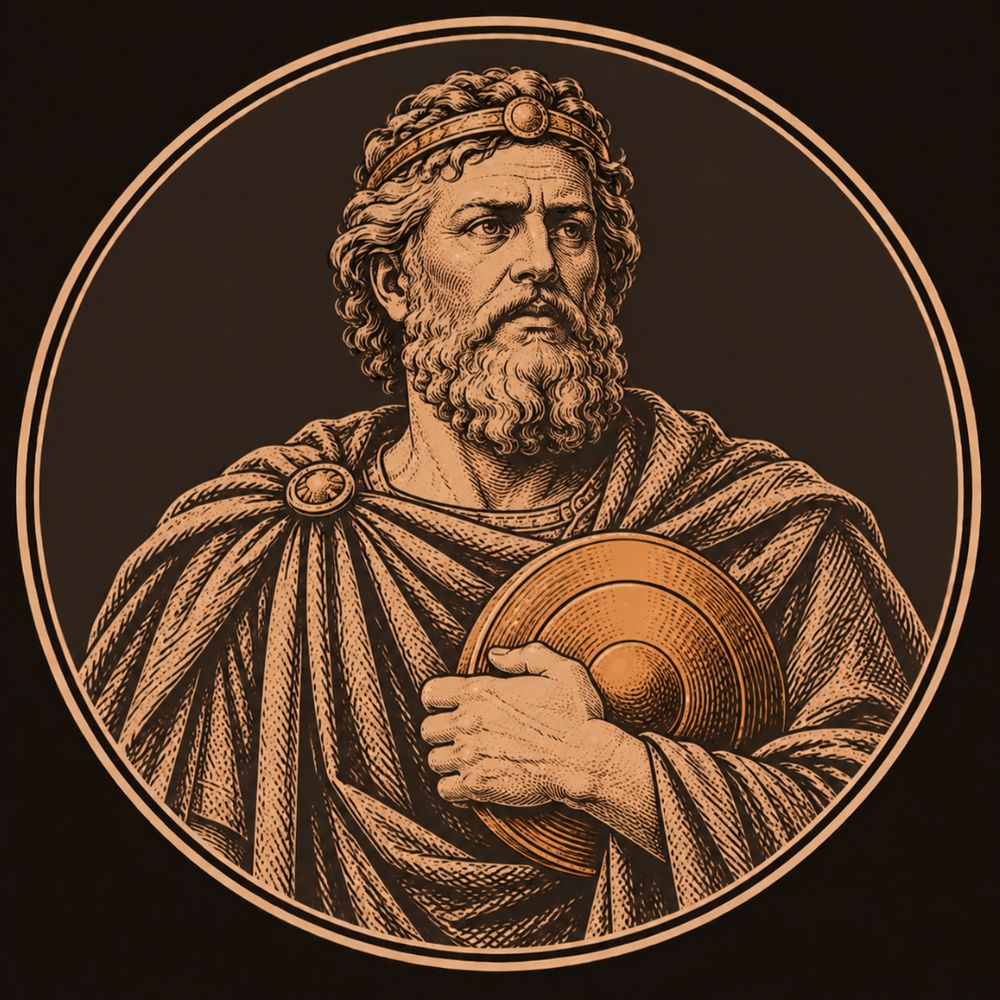
Acrisius, bronze medallion illustration
Generated by AI from this page's own facts, not an ancient image or evidence of anything. How this site uses generated images
Sections on this page
See Acrisius in the Greek family tree.
Core Myth
Apollodorus's Library makes Acrisius one of twin sons of Abas, king of Argos, and Aglaia. He and his brother Proetus quarrelled while still in the womb. When they grew up they fought a war for the kingdom, and in that war they were the first to invent shields. Acrisius won and drove Proetus out of Argos. Proetus came back with a Lycian army from his father-in-law and seized Tiryns. The brothers then divided the Argive land, Acrisius ruling Argos and Proetus Tiryns. Pausanias saw a pyramid-shaped monument on the road from Argos toward Epidauria, carved with Argive shields. He was told it marked this battle, the first fought with shields. His informants, however, said the fight ended in a draw and a reconciliation.
Acrisius had one child, a daughter, Danae, by Eurydice, daughter of Lacedaemon. According to Apollodorus he asked an oracle how he could get male children. The god answered that his daughter would bear a son who would kill him. In fear, Acrisius built a bronze chamber under the ground and kept Danae guarded in it. Pausanias was shown the underground building at Argos over which that chamber had stood, until the tyrant Perilaus pulled it down.
The chamber did not work. Apollodorus reports two explanations. Some said Proetus seduced Danae, and that this began the quarrel between the brothers. Others said Zeus reached her as a stream of gold pouring through the roof into her lap. When Acrisius learned that she had a son, Perseus, he refused to believe Zeus was the father. He shut mother and child in a chest and threw it into the sea. The chest came ashore on Seriphos, where Dictys raised the boy.
The oracle was fulfilled after Perseus came home from killing the Gorgon, the adventure told in Perseus and Medusa. Apollodorus says Perseus hurried to Argos with Danae and Andromeda to see Acrisius. The old king, dreading the oracle, left Argos for the Pelasgian land. At Larissa, King Teutamides was holding games in honor of his dead father. Perseus entered the pentathlon, and his discus struck Acrisius on the foot and killed him at once. Seeing the oracle fulfilled, Perseus buried him outside the city. Ashamed to claim Argos from the man he had killed, he exchanged kingdoms with Megapenthes, son of Proetus, and ruled Tiryns instead.
Who is Acrisius in Greek mythology?
Acrisius is a king of Argos, son of Abas and twin brother of Proetus, and the father of Danae. Apollodorus says the twins quarrelled even in the womb and later fought for the throne, inventing shields in that war. Acrisius kept Argos while Proetus took Tiryns. He is remembered above all as the grandfather of Perseus. An oracle warned that Danae's son would kill him, and every measure he took to prevent it failed.
Apollodorus, Library 2.2.1
What is the prophecy about Acrisius?
Acrisius asked the oracle how he might have sons. According to Apollodorus, the god replied that his daughter Danae would give birth to a son who would kill him. The answer gave him no son and named his future killer instead. Pausanias calls it the prediction of the god and says it came true despite Acrisius's precautions against his daughter and grandson. Neither of these accounts names the oracle's location; many modern retellings place it at Delphi.
Apollodorus, Library 2.4.1
What did Acrisius do to his daughter Danae?
He imprisoned her to keep her childless. Apollodorus says Acrisius built a bronze chamber under the ground and guarded Danae in it. When she nevertheless bore a son, Perseus, he refused to believe Zeus was the father. He shut Danae and the baby in a chest and cast it into the sea. The chest washed ashore on Seriphos. Pausanias was later shown the site at Argos where the bronze chamber had stood.
Apollodorus, Library 2.4.1
How was Acrisius killed?
A discus thrown by his grandson Perseus killed him by accident at Larissa. Apollodorus says Acrisius fled Argos in fear of the oracle and was at Larissa during funeral games held by King Teutamides. Perseus, competing in the pentathlon, hit him on the foot with the discus and killed him instantly. Pausanias has Perseus giving displays of the discus, and Acrisius stepping unnoticed into its path. Both writers treat the death as the oracle's fulfilment.
Apollodorus, Library 2.4.4
How was Acrisius related to Perseus?
Acrisius was Perseus's maternal grandfather, the father of his mother Danae. He never accepted the boy as a son of Zeus and set him adrift at sea as an infant. Ovid says Acrisius later regretted refusing to acknowledge his grandson. Pausanias says Perseus sought him out at Larissa wishing to greet him warmly. After the fatal accident Perseus was ashamed to inherit Argos and exchanged it for Tiryns.
Pausanias, Description of Greece 2.16.2
Later Traditions
Pausanias tells the ending with a different motive. In his account Acrisius heard that Perseus was alive and doing great deeds, and withdrew to Larissa on the Peneus. Perseus followed him there wanting to greet his grandfather with kind words and deeds, not to claim anything. Proud of the discus, which Pausanias says Perseus himself invented, he gave displays before everyone. Acrisius stepped unnoticed into the discus's path. Pausanias then draws the lesson plainly: the god's prediction was fulfilled, and Acrisius's precautions against his daughter and grandson did not prevent his fate. The story is one of the clearest Greek cases of a prophecy fulfilled through the very steps taken to avoid it, a pattern traced across other myths in oracles and fate and bound up with the Moirai.
Ovid's Metamorphoses gives Acrisius a second fault. It says Acrisius, son of Abas, alone resisted Bacchus. He barred the god from the walls of Argos and took up arms against him, denying he was a son of Jupiter. He likewise refused to accept that Perseus was Jupiter's son by Danae and the shower of gold. Ovid adds that Acrisius soon regretted both insults, to the god and to the grandson he had failed to acknowledge.
Herodotus uses Acrisius in a genealogical argument about the Spartan kings. He traces the Dorian kings back to Perseus and notes that counting upward from Danae, daughter of Acrisius, their forebears would prove to be Egyptians. He also reports a Persian claim that Perseus was an Assyrian, and that the ancestors of Acrisius had no kinship with him.
1 recorded relation, each with the ancient line behind it.
Children
-

Her mother, in Apollodorus, is Eurydice, a daughter of Lacedaemon.
Also Connected
1 recorded connection, each with the ancient line behind it.
Enemies
-

In Ovid, Acrisius alone refuses to admit the new god to Argos and later regrets it.
Where Accounts Differ
- outcome of the war with Proetus
- who fathered Perseus
- how Acrisius came to die at Larissa
- whether his death was a punishment
- where the oracle was consulted
- The war between Acrisius and Proetus ends differently by source. Apollodorus has Acrisius win and expel Proetus, who returns with a Lycian army before the kingdom is divided. Pausanias reports that the battle fought near Argos ended in a draw and a reconciliation.
- Who fathered Perseus is reported two ways in Apollodorus. Some said Proetus seduced Danae, which started the brothers' quarrel; others said Zeus reached her as a stream of gold. Acrisius himself, in Apollodorus and Ovid, refuses to believe Zeus was the father.
- The circumstances of Acrisius's death differ. Apollodorus has him flee Argos in fear of the oracle and die at funeral games held by Teutamides at Larissa, struck on the foot during the pentathlon. Pausanias has him withdraw to Larissa and step into the path of a discus Perseus was displaying, with Perseus seeking him out to greet him.
- Whether Acrisius was punished for impiety is not how the main accounts frame his death. Apollodorus and Pausanias present it as an oracle fulfilled, and Pausanias stresses that precaution could not prevent fate. Ovid adds a separate charge, that Acrisius opposed Bacchus and denied the divine birth of Perseus, but says only that he came to regret it.
- Apollodorus and Pausanias call the source of the prophecy only the oracle and the god. The common modern statement that Acrisius consulted Delphi is not drawn from these passages.
Read the full source verification →
Mythology
Appears In
Related Terms
Referenced By
Sources
- Apollodorus, Library 2.2.1
- Apollodorus, Library 2.2.2
- Apollodorus, Library 2.4.1
- Apollodorus, Library 2.4.4
- Pausanias, Description of Greece 2.16.2
- Pausanias, Description of Greece 2.16.3
- Pausanias, Description of Greece 2.23.7
- Pausanias, Description of Greece 2.25.7
- Ovid, Metamorphoses 4.604-614
- Herodotus, Histories 6.53-6.54
- Timothy Gantz, Early Greek Myth (1993)