Andromeda
Andromeda is the daughter of King Cepheus and Cassiopeia in Greek myth. After her mother boasted of rivalling the Nereids, Poseidon sent a flood and a sea monster, and the oracle of Ammon demanded Andromeda as its prey. Perseus found her bound to a rock, killed the monster, and married her. Their son Perses was later claimed as the ancestor of the Persians.
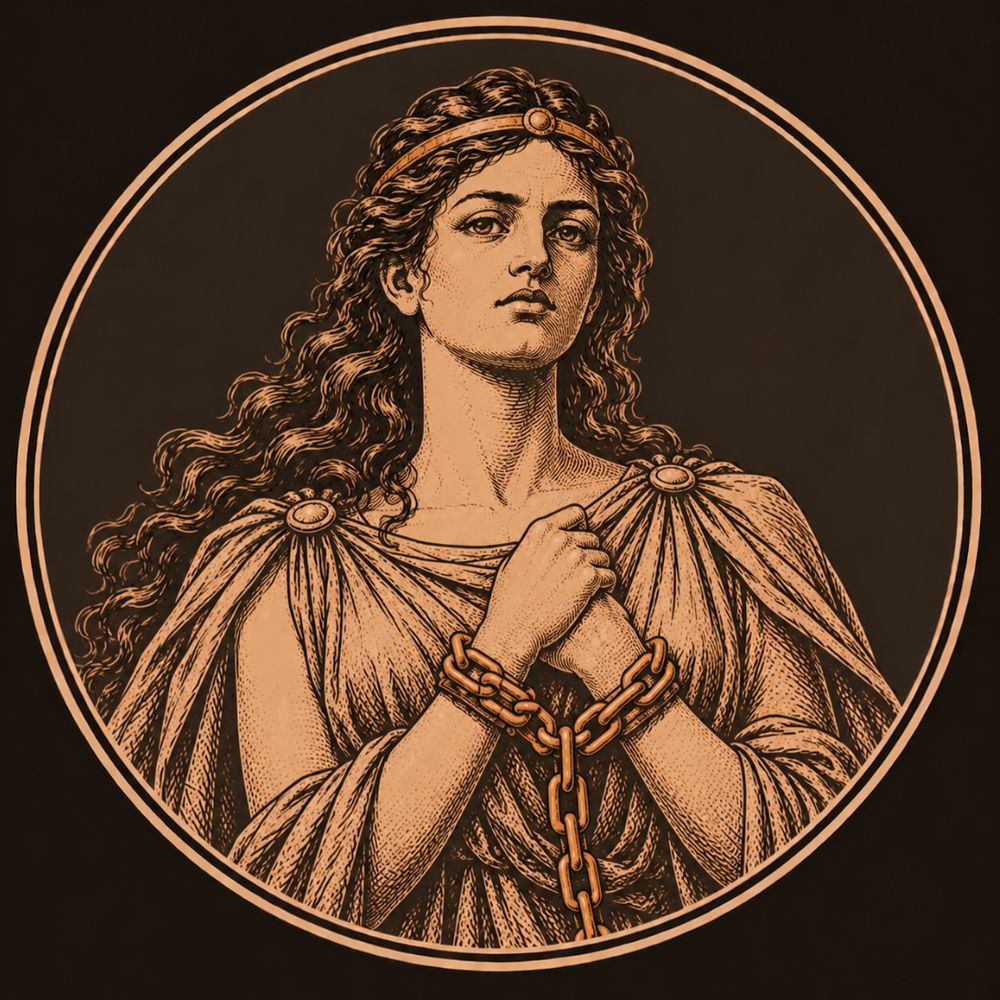
Andromeda, bronze medallion illustration
Generated by AI from this page's own facts, not an ancient image or evidence of anything. How this site uses generated images
Sections on this page
Core Myth
Andromeda was the daughter of Cepheus, king of the Ethiopians, and his wife Cassiopeia, whom Apollodorus's Library spells Cassiepea. According to Apollodorus, Cassiopeia claimed to be more beautiful than all the Nereids, the sea nymphs. The Nereids were angered, and Poseidon shared their anger, sending a flood and a sea monster against the land. The oracle of Ammon declared that the disaster would end only if Andromeda were exposed to the monster. Apollodorus adds that the Ethiopians forced Cepheus to do it, and he bound his daughter to a rock by the sea.
Perseus arrived on his way home from beheading Medusa. In Apollodorus he falls in love at first sight and makes a bargain with Cepheus: he will kill the monster if he may marry the rescued girl. Ovid's Metamorphoses tells the scene at length. Perseus at first takes the chained girl for a marble statue, until the wind stirs her hair and he sees her tears. She tells him her name and her mother's fault as the monster comes into view. Perseus attacks it from the air and drives his sword into it again and again until it dies. Her parents greet him as the saviour of their house, and her chains are struck off. Ovid adds that he took her without a dowry.
The wedding feast turned into a battle. Andromeda had first been promised to Phineus, her father's brother. Apollodorus says Phineus plotted against Perseus and was turned to stone with his fellow conspirators when Perseus showed them the Gorgon's head. Ovid expands this into a long fight in Cepheus's hall that ends the same way. Andromeda then went to Greece with her husband. Apollodorus has Perseus take her and his mother Danae to Argos to see his grandfather Acrisius, whom Perseus later killed by accident with a thrown discus.
Why was Andromeda sacrificed to the serpent?
The ancient sources describe a sea monster rather than a serpent, and Andromeda was offered to it to end a punishment brought on by her mother. Apollodorus says Queen Cassiopeia claimed to be more beautiful than the Nereids. Poseidon, sharing the sea nymphs' anger, sent a flood and a monster against Ethiopia. The oracle of Ammon then declared that the land would be saved only if Andromeda were given to the monster, and the Ethiopians forced her father Cepheus to chain her to a rock. Hyginus's Fabulae tells it differently: there Cassiopeia boasted that her daughter was more beautiful than the Nereids.
Apollodorus, Library 2.4.3
Did Perseus marry Andromeda?
Yes. Apollodorus says Perseus fell in love when he saw her bound to the rock and swore an agreement with Cepheus to kill the monster in exchange for her hand. Ovid describes the wedding feast that followed, where Perseus took her without a dowry. Her former betrothed Phineus, her uncle, attacked the feast and was turned to stone with the Gorgon's head. Andromeda went with Perseus to Greece and bore him six sons and a daughter, among them Perses, Alcaeus, Sthenelus and Electryon.
Ovid, Metamorphoses 4.706-764
Is Andromeda a demigod?
No. The ancient sources make her a mortal princess, with no god as her parent. Her father was Cepheus, king of the Ethiopians. Herodotus calls him a son of Belus, and Apollodorus notes that Euripides made Cepheus and Phineus sons of Belus, whom Poseidon fathered on Libya. That makes her a distant descendant of Poseidon, the same god who sent the monster against her. Her husband Perseus, son of Zeus and Danae, was the demigod of the pair. Her own honor came later, when she was said to have been placed among the stars.
Herodotus, Histories 7.61
What is the Andromeda Rock?
It is a rock off the coast of Jaffa, ancient Joppa, pointed out as the place where Andromeda was chained. The main mythographers, Apollodorus and Ovid, set her story in Ethiopia, but the Joppa location is itself ancient. Strabo's Geography records writers who placed her exposure at Joppa. Pliny the Elder's Natural History says a rock in front of the town still showed the marks of the chains that bound her. Pausanias adds that people near Joppa showed a spring of blood-red water where Perseus washed off the monster's blood.
Pausanias, Description of Greece 4.35.9
Later Traditions
Andromeda became the mother of a royal house. Apollodorus lists her sons by Perseus: Perses, born before they left for Greece and left behind with Cepheus, and in Mycenae Alcaeus, Sthenelus, Heleus, Mestor and Electryon, with a daughter Gorgophone. Through Electryon's daughter Alcmena she was an ancestor of Heracles, and through Sthenelus of Eurystheus, who came to rule Mycenae. Herodotus reports that the Persians took their name from her son Perses. He also tells of a Persian herald who reminded the Argives that Perses was the son of Perseus and Andromeda, and so kin to them.
Ancient writers placed her rock in different lands. Apollodorus and Ovid set the story in Ethiopia. Strabo's Geography records that some writers moved Ethiopia to the Phoenician coast and made Joppa, modern Jaffa, the scene of her exposure. Pliny the Elder's Natural History reports a rock in front of Joppa that still showed the marks of her chains. Pausanias describes a red spring near Joppa where local people said Perseus washed off the monster's blood. Later Roman star lore, in the Astronomica attributed to Hyginus, says Minerva set Andromeda among the constellations to honor Perseus's courage. Euripides and Sophocles each wrote a tragedy called Andromeda, both now lost.
Modern Influence
Titian painted Perseus and Andromeda in 1554 to 1556 as one of his mythological poesie for Philip II of Spain, drawing on Ovid's version. The painting is now in the Wallace Collection in London. The 1981 film Clash of the Titans, with stop-motion creatures by Ray Harryhausen, casts Judi Bowker as Andromeda, a princess of Joppa. In the film it is the sea goddess Thetis who punishes Cassiopeia's boast by demanding Andromeda as a sacrifice to a monster called the Kraken.
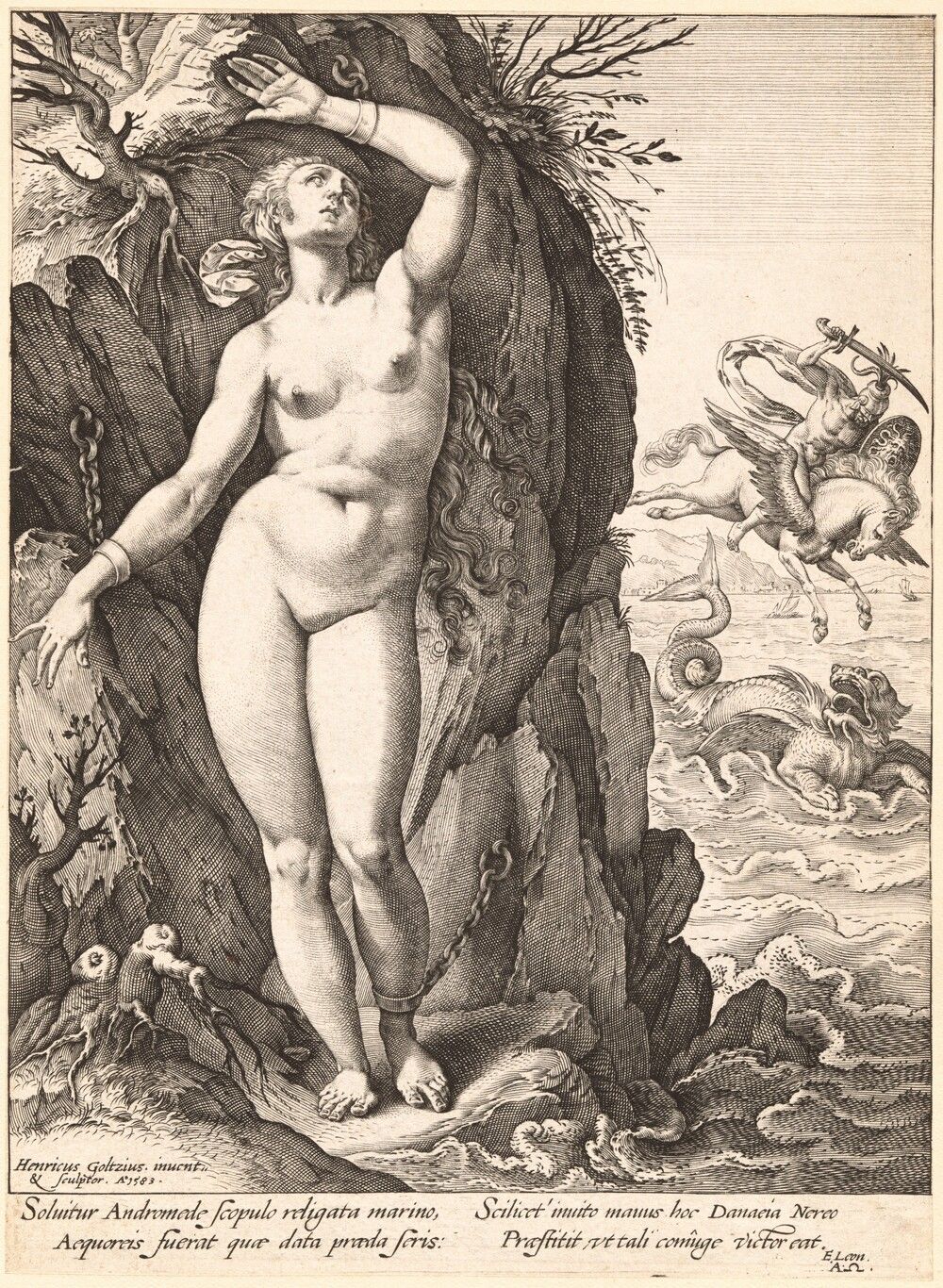
Perseus Freeing Andromeda - Hendrik Goltzius, 1583, engraving
National Gallery of Art, Washington, DC, 1980.45.1929. CC0
Also Connected
2 recorded connections, each with the ancient line behind it.
Enemies
-

Angered by Cassiepea's boast against the Nereids, Poseidon sent a flood and a sea monster, and Ammon's oracle demanded Andromeda.
Connected
-

Perseus killed the sea monster, freed her from the rock and married her.
Where Accounts Differ
- whose beauty Cassiopeia boasted of
- Ethiopia or Joppa
- who plotted at the wedding
- Whose beauty was boasted of differs by source. Apollodorus has Cassiopeia claim that she herself surpassed the Nereids, and Hyginus's Astronomica says Euripides and Sophocles told it that way. Hyginus's Fabulae instead has Cassiopeia claim that her daughter Andromeda's beauty surpassed theirs.
- The place of the rescue varies. Apollodorus and Ovid set it in Ethiopia, the kingdom of Cepheus. Strabo reports, and rejects as mythic fiction, the version that moved the story to Joppa on the Phoenician coast, and Pausanias records a local spring at Joppa tied to the monster's blood.
- The plot at the wedding is told in two ways. Apollodorus and Ovid make Phineus, Cepheus's brother and Andromeda's first betrothed, the plotter, with Cepheus on Perseus's side in Ovid. Hyginus's Fabulae names the rival suitor Agenor and has Cepheus join the plot against Perseus.
Read the full source verification →
Mythology
Appears In
Related Terms
Referenced By
Sources
- Apollodorus, Library 2.4.3
- Apollodorus, Library 2.4.4
- Apollodorus, Library 2.4.5
- Apollodorus, Library 2.1.4
- Ovid, Metamorphoses 5.1-235
- Herodotus, Histories 7.61
- Herodotus, Histories 7.150
- Pausanias, Description of Greece 4.35.9
- Hyginus, Fabulae 64
- Strabo, Geography
- Ovid, Metamorphoses 4.604-705
- Ovid, Metamorphoses 4.706-764
- Timothy Gantz, Early Greek Myth (1993)