Apollo in Rome
Apollo in Rome is the Greek god worshipped under his Greek name, with no Latin rename. Livy says Romans vowed him a healing temple during a plague, traditionally in 433 BCE, and dedicated it in 431. Sibylline oracles, the Ludi Apollinares of 212 BCE and Augustus's Palatine temple later made him a god of Rome's survival and victory.
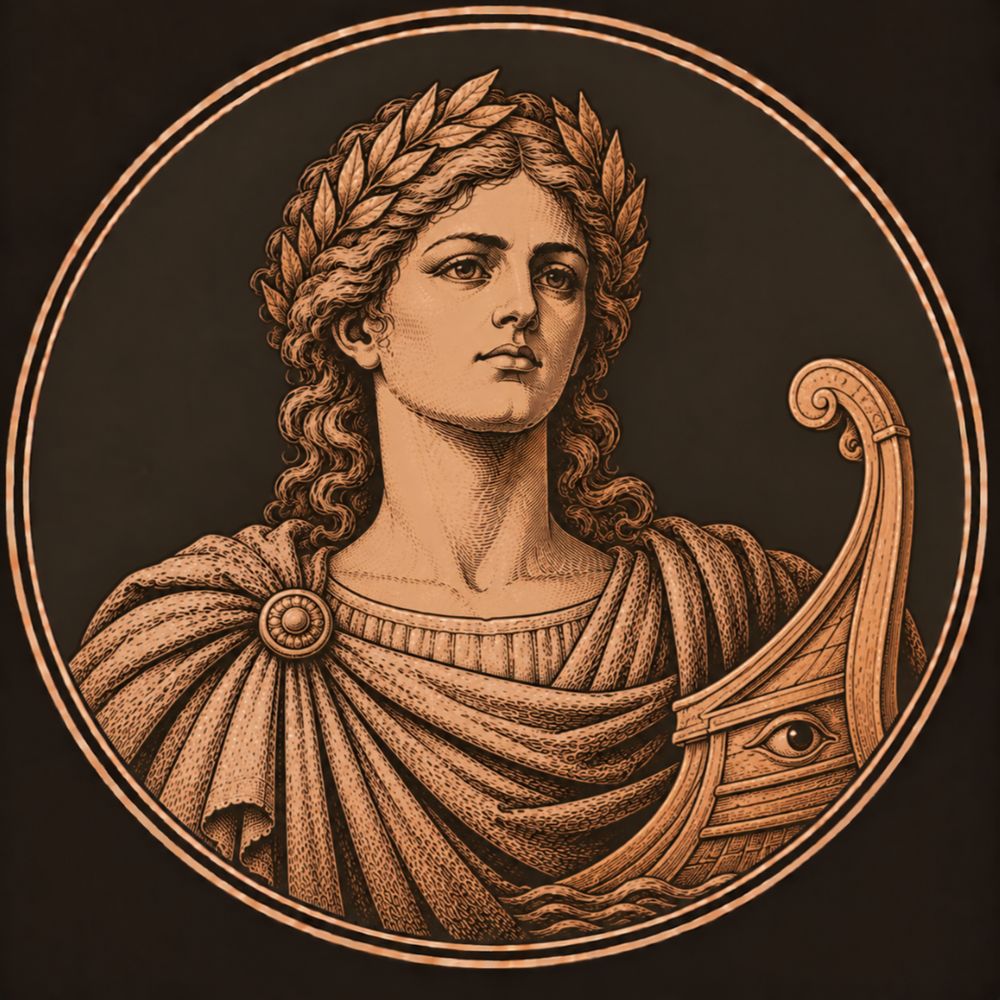
Apollo in Rome, bronze medallion illustration
Generated by AI from this page's own facts, not an ancient image or evidence of anything. How this site uses generated images
Sections on this page
Core Myth
Livy records Apollo's first state temple in Rome. In a plague year the Romans vowed a temple to Apollo for the health of the people (Ab Urbe Condita 4.25.3). The consul Julius later dedicated it while his colleague was away, and did not draw lots with him first. The colleague Quinctius protested to the senate without result (Ab Urbe Condita 4.29.6-7). The traditional dates are 433 BCE for the vow and 431 BCE for the dedication.
The god was already known on the site. Livy says that in 449 BCE the consuls called the senate to the Flaminian meadows, "where the temple of Apollo now stands, at that time already called the Apollinare" (Ab Urbe Condita 3.63.7). Livy later names the building as the temple of Apollo the physician, Apollo Medicus, when he lists the public works the censors divided among themselves (Ab Urbe Condita 40.51.2-6).
The Sibylline Books shaped his cult next. In 399 BCE a plague found no cause and no cure, so the senate had the Sibylline Books consulted (Ab Urbe Condita 5.13.5). The two priests held the first lectisternium in Rome, a banquet laid on couches for the gods. Apollo and Latona were honoured for eight days, with Hercules and Diana, Mercury and Neptune (Ab Urbe Condita 5.13.6). The rite was a Greek one, and Apollo led it.
His best-known Roman festival began in the Second Punic War. Livy says a seer named Marcius left two prophecies. The first foretold the disaster at Cannae. The second told the Romans to vow games to Apollo every year, so that the god would drive out the enemy (Ab Urbe Condita 25.12.5-10). The senate had the board of ten priests consult the books. It then ordered the games and a sacrifice in the Greek manner (Ab Urbe Condita 25.12.11-13). Apollo received a gilded ox and two white gilded goats. Latona received a gilded heifer (Ab Urbe Condita 25.12.13).
The praetor held the first Ludi Apollinares in the Circus Maximus in 212 BCE. The people watched wearing garlands, and the matrons offered prayers (Ab Urbe Condita 25.12.14-15). Livy adds that the games were vowed for victory, not for health as many believed (Ab Urbe Condita 25.12.15). A later plague led the praetor Licinius Varus to have a law passed that vowed the games for good on a fixed day (Ab Urbe Condita 27.23.5-7).
What is the difference between Greek Apollo and Roman Apollo?
They are one god under one name. The difference lies in what Rome asked of him. The first state temple was vowed for the people's health in a plague (Livy 4.25.3). His games were ordered from the Sibylline books and sacrificed in the Greek manner (Livy 25.12.11-13). Under Augustus he became the god of Actian victory, with a temple built beside the emperor's house (Suetonius, Divus Augustus 29.3). This page covers that Roman side. For his myths, see Greek Apollo.
Livy, Ab Urbe Condita 4.25.3
Did Romans believe in Apollo?
Yes. Romans worshipped Apollo as a state god from at least the fifth century BCE. Livy says a temple to him was vowed for the people's health in a plague (Ab Urbe Condita 4.25.3), and the Apollinare already stood on the Flaminian meadows in 449 BCE (Ab Urbe Condita 3.63.7). In 212 BCE the senate ordered annual games for him (Ab Urbe Condita 25.12.9-13). Augustus later placed the Sibylline oracles beneath the statue in his Palatine temple (Suetonius, Divus Augustus 31.1).
Livy, Ab Urbe Condita 3.63.7
Why does Apollo have the same name in Greek and Roman?
Rome took the god over with his Greek name instead of giving him a Latin one. Cicero's Stoic speaker says plainly that the name of Apollo is Greek (De Natura Deorum 2.68). Livy shows the Greek rite at work: the senate ordered sacrifices to Apollo and Latona in the Greek manner (Ab Urbe Condita 25.12.13). The sources checked here give no separate Latin name. Latona, by contrast, is a Latin form of the Greek goddess Leto.
Cicero, De Natura Deorum 2.68
Is Helios the Roman version of Apollo?
No. Helios is the Greek sun god, and his Roman counterpart is Sol. In Horace's Carmen Saeculare, Sol has his own stanza (Carmen Saeculare 9-12), while Apollo is invoked later, as a separate god (Carmen Saeculare 33-36). The idea that Apollo is the sun is a later equation. Cicero's Stoic speaker reports it as a view held by some (De Natura Deorum 2.68), and Macrobius argues it at length in his Saturnalia (1.17.1-4). See Helios for the Greek sun god.
Horace, Carmen Saeculare 9-12
Later Traditions
Virgil gives Apollo a Roman past. Aeneas reaches Cumae, where Apollo presides over the citadel and the Sibyl serves as priestess of Phoebus and Trivia (Aeneid 6.9-13; Aeneid 6.35-36). Aeneas vows a marble temple to Phoebus and Trivia, and festal days named after Phoebus. He also promises to place her oracles and lots in a sanctuary in his kingdom (Aeneid 6.69-74). Earlier in the poem the Trojans sail past Leucate, where Apollo is dreaded by sailors. They then celebrate Trojan games on the Actian shore (Aeneid 3.274-280). Aeneas thus meets the god at both places that Augustus later made his own.
Augustus made Apollo the god of his victory. On the shield of Aeneas, Augustus stands on the high stern at Actium with the senate and people. Above the battle, Actian Apollo draws his bow, and Egypt, India, Arabia and Saba all turn back (Aeneid 8.678-681; Aeneid 8.704-706). Venus, Minerva and Neptune are on the Roman side against the animal-headed gods of Egypt (Aeneid 8.698-700). Suetonius says Augustus founded Nicopolis to keep the victory in memory, held games there, and enlarged the ancient temple of Apollo (Divus Augustus 18.2).
The Palatine temple followed. Suetonius says Augustus built it on part of his own house that lightning had struck, which the soothsayers took as a sign of the god's wish. He added colonnades with Greek and Latin libraries and sometimes held meetings of the senate there (Divus Augustus 29.3). Augustus lists the temple with its porticoes among his buildings (Res Gestae 19). He also placed offerings from the spoils of war inside it (Res Gestae 21). He melted his own silver statues, and used the money for golden offerings in Apollo's temple (Res Gestae 24). A modern editor dates the dedication to 28 BCE.
The Sibylline oracles moved there as well. Augustus burned more than two thousand prophetic books but kept the Sibylline ones. He stored them in two gilded cases under the pedestal of the Palatine Apollo (Divus Augustus 31.1).
Horace's Carmen Saeculare sang the same partnership at the Secular Games of 17 BCE, a date known from other evidence. The poem says the Sibylline verses ordered the rite (Carmen Saeculare 5-8). It calls Apollo mild and gentle once he has laid down his arrow (Carmen Saeculare 33-36). It also asks the augur Phoebus, who heals weary limbs with a saving art, to favour Rome if he approves the altars on the Palatine (Carmen Saeculare 61-68). The chorus ends by praising Phoebus and Diana (Carmen Saeculare 73-76).
Suetonius reports two stories about Augustus and the god. In one, Atia slept in a temple of Apollo, a serpent visited her, and Augustus was regarded as the son of Apollo (Divus Augustus 94.4). In the other, a private banquet of the twelve gods had Augustus play Apollo. Critics then called him Apollo the Tormentor (Divus Augustus 70.1-2).
Ovid's Fasti gives Phoebus an oracle before the fall of the kings. After a snake seizes the entrails from an altar, the reply is that whoever first kisses his mother will win. Brutus kisses the earth, the setup for the revolt after Lucretia's death (Fasti 2.711-720).
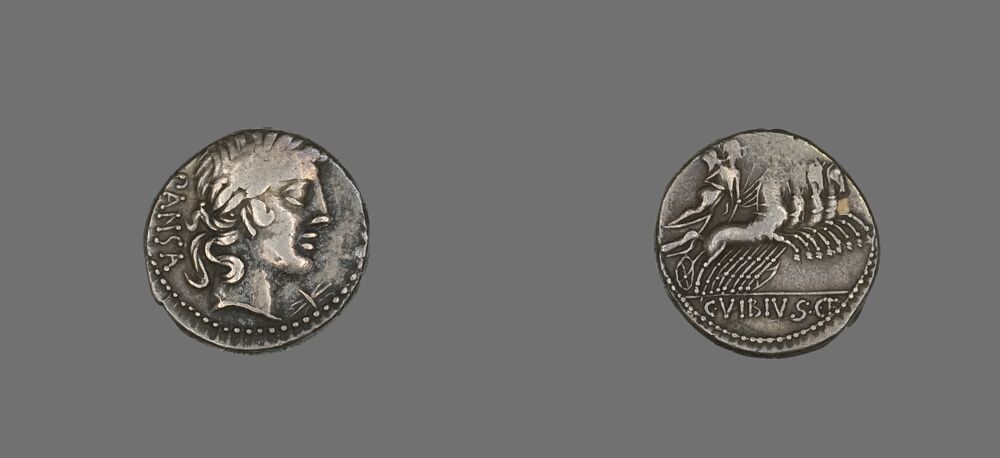
Denarius (Coin) Depicting the God Apollo - Italy, 90 BCE, Silver
The Art Institute of Chicago, Chicago, IL, 1923.1261. CC0
Also Connected
5 recorded connections, each with the ancient line behind it.
Connected
-
In Virgil, Aeneas vows a marble temple and festal days to Phoebus and Trivia at Cumae (Aeneid 6.69-70) and celebrates games on the Actian shore (Aeneid 3.274-280). Augustus's Actian Apollo later repeats both places.
-

Apollo and Diana are among the six gods honoured at the first lectisternium, on separate couches (Livy 5.13.6). Horace's Carmen Saeculare invokes them together (lines 1-4 and 73-76).
-

Some Romans equated Apollo with the sun, but Helios is the Greek sun god and Rome's own sun god is Sol. Horace addresses Sol and Apollo in separate stanzas (Carmen Saeculare 9-12, 33-36). Cicero's Stoic speaker reports the equation (De Natura Deorum 2.68).
-

Apollo and Latona head the six gods of the first lectisternium (Livy 5.13.6). At the Ludi Apollinares Latona receives a gilded heifer beside Apollo's gilded ox (Livy 25.12.13).
-
Ovid opens the Lucretia episode with the oracle that Brutus, feigning foolishness, reads correctly: whoever first kisses his mother will rule. Apollo's oracle is the setup for Brutus, who later leads the revolt after her death.
Where Accounts Differ
- the dates of the temple of Apollo Medicus
- why the Ludi Apollinares began
- who urged the Ludi Apollinares
- whether Apollo is the sun in Roman thought
- Augustus as the son of Apollo or Apollo the Tormentor
- how the Palatine temple came to be built
- The temple's dates rest on Livy's text plus a modern conversion. Livy places the vow in the year of the consular tribunes Fabius Vibulanus, Folius and Sergius Fidenas (Ab Urbe Condita 4.25.1-3) and the dedication under the consul Julius (Ab Urbe Condita 4.29.7). The BCE years 433 and 431 are the conventional equivalents. The English translation on Perseus omits the vow sentence in 4.25.3, which the Latin has, and numbers the dedication as 4.29.6 rather than 4.29.7. The Latin numbering is used here.
- The sources disagree on why the Ludi Apollinares began. Livy says the games were vowed for victory, not for health as many believed (Ab Urbe Condita 25.12.15). Macrobius agrees that they were instituted for victory (Saturnalia 1.17.27), but also reports a battle story: the crowd rose to arms during the games and a cloud of arrows put the enemy to flight (Saturnalia 1.17.25). He records a view that the games belong to the summer sun (Saturnalia 1.17.26), and says other annalists thought of a plague (Saturnalia 1.17.27). Livy makes the games annual only later, after a plague (Ab Urbe Condita 27.23.5-7).
- Who was behind the games differs as well. Livy credits the seer Marcius and the board of ten priests (Ab Urbe Condita 25.12.9-13). Macrobius adds that the decemvir Cornelius Rufus, nicknamed Sibylla, urged the games, and that Sulla's name is a corruption of it (Saturnalia 1.17.27). Macrobius is a writer of about 400 CE and the story is not in Livy.
- Sources differ on how far Apollo is the sun. Cicero's Stoic speaker says people identify Apollo with the sun and Diana with the moon (De Natura Deorum 2.68). Macrobius has a character argue that Apollo is the sun (Saturnalia 1.17.1-4; 1.17.30). Horace's chorus addresses Sol and Apollo in separate stanzas (Carmen Saeculare 9-12; 33-36). The Greek Apollo page notes that Homer and Hesiod do not make him the sun.
- Suetonius's stories about Augustus and Apollo are reports, not proof. He says Atia's serpent encounter is taken from a book by Asclepias of Mendes, called Theologumena (Divus Augustus 94.4). He says the banquet of the twelve gods was known from Antony's letters and from anonymous verses, and that Augustus's critics used it to mock him (Divus Augustus 70.1-2).
- The Palatine temple has two accounts of its origin. Suetonius says lightning struck part of Augustus's house and the soothsayers read it as the god's wish for a temple there (Divus Augustus 29.3). Augustus himself only lists the temple among his buildings (Res Gestae 19). The dedication date of 28 BCE is a modern editor's note, not a statement by Augustus or Suetonius.
Read the full source verification →
Mythology
Equivalent Figures
Related Terms
Referenced By
Sources
- Livy, Ab Urbe Condita 3.63.7
- Livy, Ab Urbe Condita 4.25.3
- Livy, Ab Urbe Condita 4.29.6-7
- Livy, Ab Urbe Condita 5.13.5-6
- Virgil, Aeneid 3.274-280
- Virgil, Aeneid 6.9-13
- Virgil, Aeneid 6.35-36
- Virgil, Aeneid 6.69-74
- Virgil, Aeneid 8.678-681
- Virgil, Aeneid 8.698-706
- Horace, Carmen Saeculare 5-12
- Horace, Carmen Saeculare 33-36
- Horace, Carmen Saeculare 61-76
- Suetonius, Divus Augustus 18.2
- Suetonius, Divus Augustus 29.3
- Suetonius, Divus Augustus 31.1
- Suetonius, Divus Augustus 70.1-2
- Suetonius, Divus Augustus 94.4
- Augustus, Res Gestae 19
- Augustus, Res Gestae 21
- Augustus, Res Gestae 24
- Cicero, De Natura Deorum 2.68
- Macrobius, Saturnalia 1.17.1-4
- Macrobius, Saturnalia 1.17.25-30
- Ovid, Fasti 2.711-720