Lucretia
Lucretia is the legendary Roman wife of Collatinus. Livy, Ovid and Dionysius tell that Sextus Tarquin, son of the last king, raped her at knifepoint. She told her father and husband, then killed herself. Lucius Junius Brutus swore over her body to drive out the Tarquins. Romans dated the fall of the kings to 509 BCE and made Brutus and Collatinus the first consuls.
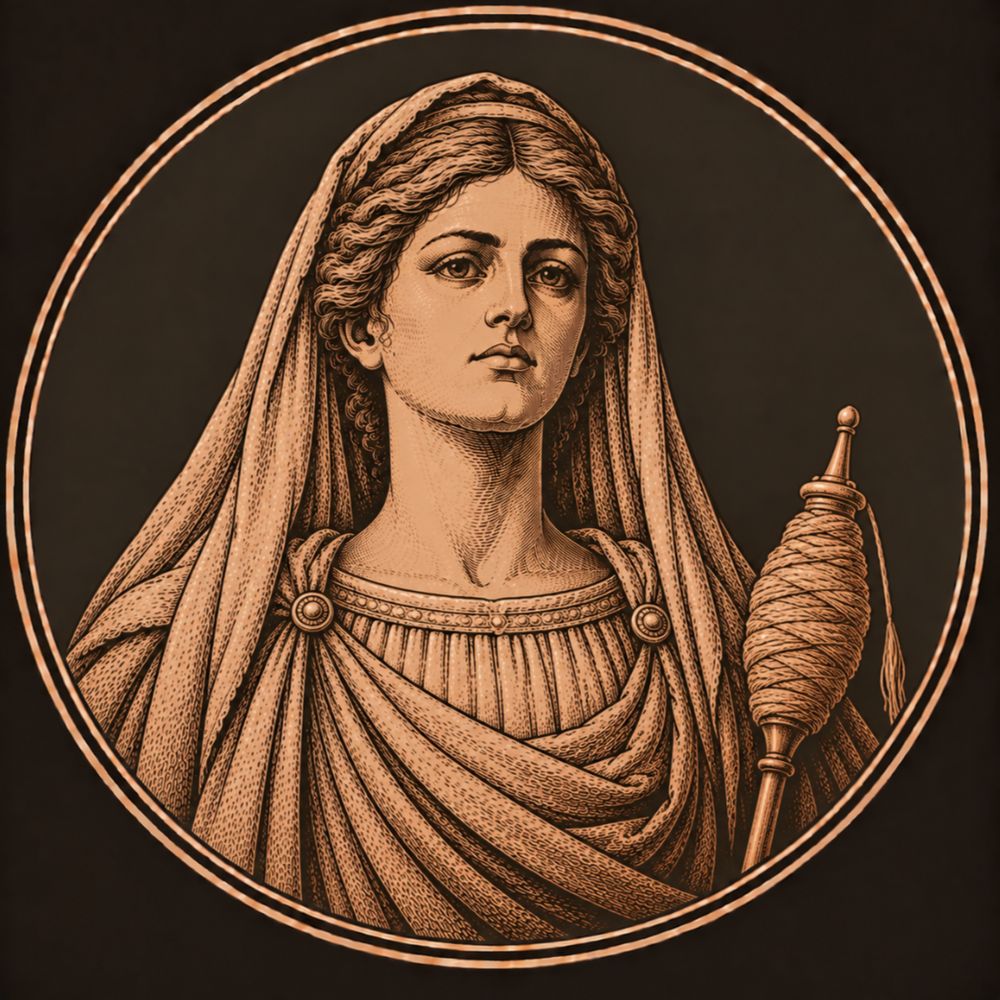
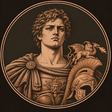
Lucretia, bronze medallion illustration
Generated by AI from this page's own facts, not an ancient image or evidence of anything. How this site uses generated images
Sections on this page
Core Myth
Lucretia is a figure of Roman legend, not of documented history. Livy tells her story at the end of Book 1 of his history of Rome. She is the wife of Collatinus, and her death is the turning point of Rome's story of how the kings fell. Romans reckoned that fall at 509 BCE, and Livy says the monarchy had lasted 244 years from the founding of the City (Ab Urbe Condita 1.60). That founding began with Romulus, told in the founding of Rome.
The story opens in the camp outside Ardea, which the Romans under King Tarquinius Superbus were besieging. Virgil gives the same city to Turnus in the Aeneid (Aeneid 7.341-434). At a wine party the king's son Sextus Tarquin and other young men fell to boasting about their wives. Collatinus, son of Egerius, said he could prove in a few hours that his Lucretia was best (Ab Urbe Condita 1.57).
They rode to Rome, where the king's daughters-in-law were feasting late, and on to Collatia. There they found Lucretia at her wool-work in the hall, with her maids around her. Livy gives her the prize for wifely virtue. Sextus Tarquin was struck by her beauty and her chaste bearing, and he formed a plan against her (Ab Urbe Condita 1.57).
A few days later Sextus returned to Collatia with one companion and was received as a guest. That night he came to her room with a drawn sword, and threatened to kill her if she cried out. When death did not move her, he threatened to lay a slave's body beside hers and say he had caught them together. Fear of that disgrace overcame her resistance, and he raped her (Ab Urbe Condita 1.58).
Lucretia sent to her father Spurius Lucretius in Rome and to her husband at Ardea. Each was to bring one trusted friend. Her father came with Publius Valerius, and Collatinus came with Lucius Junius Brutus. She told them what Sextus had done and asked for their word that he would be punished. They said the guilt lay with the man and not with her, since where there was no consent there was no guilt (Ab Urbe Condita 1.58).
She did not accept this. She said she acquitted herself of the sin but would not free herself of the penalty, and that no unchaste woman should ever plead Lucretia's example. She drew a knife hidden in her dress and stabbed herself in the heart, and died on the floor (Ab Urbe Condita 1.58).
Brutus drew the knife from the wound. Holding it up, he swore by her blood to drive out Lucius Tarquinius Superbus, his wife and their children, and to let no one reign in Rome. He passed the knife to Collatinus, Lucretius and Valerius, who swore the same (Ab Urbe Condita 1.59).
They carried her body to the Forum. Brutus, then holding the office of Tribune of the Celeres, called an assembly and spoke of the king's tyranny as well as the crime. The people voted to strip Tarquin of power and banish the whole family. Brutus took a force of volunteers to the camp at Ardea to win over the army, and Tarquin arrived at Rome to find the gates shut (Ab Urbe Condita 1.59; Ab Urbe Condita 1.60).
Tarquin went into exile among the Etruscans at Caere, with two of his sons. Livy says Sextus went to Gabii and was killed there in revenge for old feuds. The first consuls, chosen in the assembly of centuries, were Brutus and Lucius Tarquinius Collatinus, her husband (Ab Urbe Condita 1.60).
Who is Lucretia?
Lucretia is a legendary Roman noblewoman, wife of Collatinus and daughter of Spurius Lucretius. Livy, Ovid and Dionysius tell that she killed herself after Sextus Tarquin raped her (Ab Urbe Condita 1.58; Fasti 2.813-852; Roman Antiquities 4.67). Her death led to the expulsion of the kings and the start of the Roman Republic.
Livy, Ab Urbe Condita 1.58
What was Lucretia known for?
Romans remembered her as the model of a chaste wife. In Livy she wins a contest of wifely virtue at Collatia, and after the assault she refuses to let her family's forgiveness save her (Ab Urbe Condita 1.57; Ab Urbe Condita 1.58). Valerius Maximus calls her the leader of Roman chastity (Facta et Dicta Memorabilia 6.1.1). She is also known as the spark of the revolt against the kings.
Livy, Ab Urbe Condita 1.58
What is the story of Tarquin and Lucretia?
During the siege of Ardea, the king's son Sextus Tarquin heard Collatinus praise his wife Lucretia and later came to her house as a guest. He raped her under threat of death and disgrace. She told her father and husband, and stabbed herself. Brutus swore over her body to end Tarquin rule (Ab Urbe Condita 1.57; Ab Urbe Condita 1.58; Ab Urbe Condita 1.59).
Livy, Ab Urbe Condita 1.58
What did Tarquin do to Lucretia?
Sextus Tarquin, son of the last king, raped her. In Livy he came to her room at night with a sword and threatened to kill her and a slave and claim adultery, so she yielded (Ab Urbe Condita 1.58). Ovid tells it the same way (Fasti 2.784-852). Dionysius has him first offer her marriage and a crown (Roman Antiquities 4.65).
Livy, Ab Urbe Condita 1.58
Who was the husband of Lucretia?
Her husband was Collatinus, called Lucius Tarquinius Collatinus and son of Egerius in Livy. He proposed the ride to Collatia that settled the wine-party dispute about wives (Ab Urbe Condita 1.57). After the revolt he and Brutus became the first consuls (Ab Urbe Condita 1.60).
Livy, Ab Urbe Condita 1.57
Later Traditions
Livy is the fullest and most read account, but he is not alone. Ovid tells the story in Book 2 of the Fasti as the origin of the Regifugium, the Flight of the King, on 24 February. His Lucretia is spinning wool when the men arrive, and Sextus makes the same threat about a slave. Ovid ends with the people assembled by Brutus, Tarquin and his family banished, and a consul governing for a year. He calls the day the last of kingly rule (Fasti 2.685-852).
Dionysius of Halicarnassus, a Greek writing in Rome, tells it more expansively and changes several details. Sextus offers her marriage and a share in the kingdom if she agrees, and death and disgrace if she refuses (Roman Antiquities 4.65). She then drives to her father's house in Rome, asks him to gather kinsmen, tells them, and kills herself with a dagger she brought under her robes (Roman Antiquities 4.66; Roman Antiquities 4.67). In this version Brutus swears only after Valerius reports her death to him (Roman Antiquities 4.70-4.71).
Valerius Maximus made her an exemplar. He calls her the leader of Roman chastity, a woman with a man's spirit, and says her death gave the Roman people cause to exchange consular for regal rule (Facta et Dicta Memorabilia 6.1.1). This is the reading that shaped later art and literature. She becomes a model of virtue, and the political revolution is read as a consequence of her suicide.
The sources disagree on where and how she is found, but not on the outline. Each has her attacked, her family told, her death by her own hand and Brutus turning it into a revolt. None dates the event in years before Christ, since that scheme is modern. The date of 509 BCE is the Roman traditional reckoning of the Republic's first year.
Modern Influence
William Shakespeare retold her story as the narrative poem The Rape of Lucrece, entered in the Stationers' Register in May 1594 and published that year. It draws on Ovid's Fasti and on Livy's account in Book 1. The poem is a retelling in English verse, and its title uses the form Lucrece.
Sandro Botticelli painted The Story of Lucretia in Florence around 1500, a panel now in the Isabella Stewart Gardner Museum in Boston. The museum describes it as tempera and oil on panel, and it shows the story in three episodes across one panel.
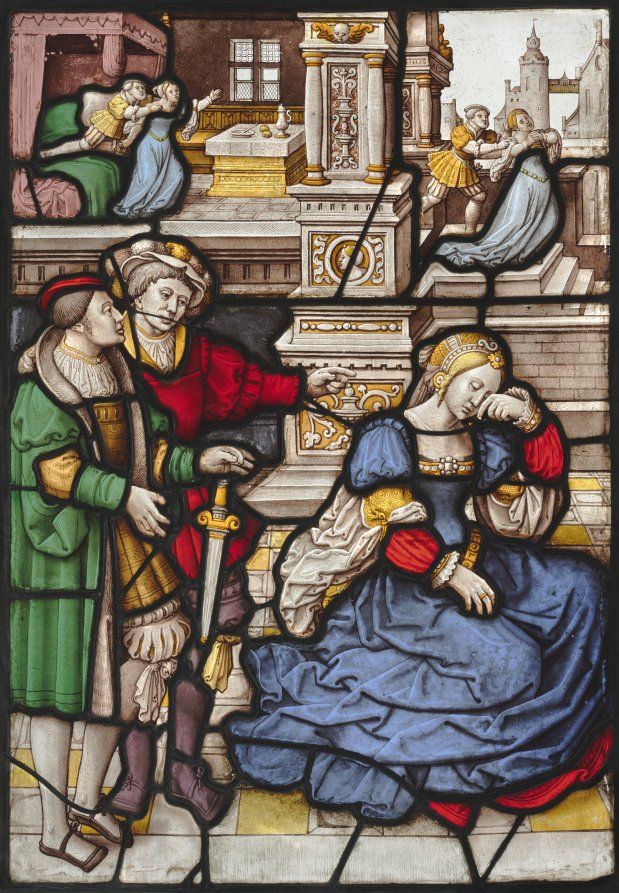
The Story of Lucretia - Netherlands, Nijmegen, 16th century, c. 1530, pot-metal and white glass, silver stain and sanguine
The Cleveland Museum of Art, Cleveland, OH, 1951.335. CC0
Also Connected
4 recorded connections, each with the ancient line behind it.
Connected
-
Ovid opens the Lucretia episode with the oracle that Brutus, feigning foolishness, reads correctly: whoever first kisses his mother will rule. Apollo's oracle is the setup for Brutus, who later leads the revolt after her death.
-

In Dionysius, Brutus hears the report of Lucretia's death and calls on Jupiter and the gods who watch over human life, asking whether Rome is to be delivered from tyranny through him.
-
Livy counts the regal period from the foundation of the City to its liberation as 244 years. Lucretia's death is the event that ends it, and Brutus and Collatinus become the first consuls.
-
The siege of Ardea, during which Sextus Tarquin's assault on Lucretia begins, is a siege of the city Virgil gives to Turnus. The two stories share a setting and no characters.
Where Accounts Differ
- where Lucretia dies
- what Sextus Tarquin says to Lucretia
- when Brutus swears the oath
- whether Lucretia is historical
- Lucretia is legendary. Livy, Ovid and Dionysius write centuries after the events they place at the end of the Roman kings, and the traditional date, 509 BCE, is a later reckoning. No source cited here is contemporary.
- Where she dies is disputed. In Livy she dies at Collatia, in front of her father and husband, whom she summoned (Ab Urbe Condita 1.58). In Dionysius she drives to her father's house in Rome and kills herself before assembled kinsmen (Roman Antiquities 4.66; Roman Antiquities 4.67). Ovid has her summon father and husband from the camp and die at home (Fasti 2.813-852).
- What Sextus says to her differs. Livy and Ovid give a threat to kill her and a slave and claim adultery (Ab Urbe Condita 1.58; Fasti 2.784-852). Dionysius adds an offer of marriage and rule over Rome, the Latins and the Etruscans before the same threat (Roman Antiquities 4.65).
- The order of Brutus's oath differs. Livy and Ovid have him draw the knife from her body and swear at once (Ab Urbe Condita 1.59; Fasti 2.813-852). Dionysius has him swear after Valerius brings news of her death (Roman Antiquities 4.70-4.71).
- Ovid's exact line for the assault is 2.784 onward and for her suicide 2.813 onward, checked against the Theoi English text, which marks those line numbers. The lines between them are cited only as the whole passage. Dionysius is cited by chapter, because the translation checked shows chapters, not lines.
Read the full source verification →
Mythology
Appears In
Sources
- Livy, Ab Urbe Condita 1.57
- Livy, Ab Urbe Condita 1.58
- Livy, Ab Urbe Condita 1.59
- Livy, Ab Urbe Condita 1.60
- Virgil, Aeneid 7.341-434
- Ovid, Fasti 2.685-852
- Ovid, Fasti 2.784-852
- Ovid, Fasti 2.813-852
- Dionysius of Halicarnassus, Roman Antiquities 4.65
- Dionysius of Halicarnassus, Roman Antiquities 4.66
- Dionysius of Halicarnassus, Roman Antiquities 4.67
- Dionysius of Halicarnassus, Roman Antiquities 4.70-4.71
- Valerius Maximus, Facta et Dicta Memorabilia 6.1.1