Romulus
Romulus is the founder and first king of Rome in Roman legend. Livy and Plutarch make him a twin son of the Vestal Rhea Silvia, who named Mars as the father. Exposed on the Tiber and suckled by a she-wolf, he outlived his brother Remus, founded the city, and vanished in a storm. Romans then worshipped him as the god Quirinus.
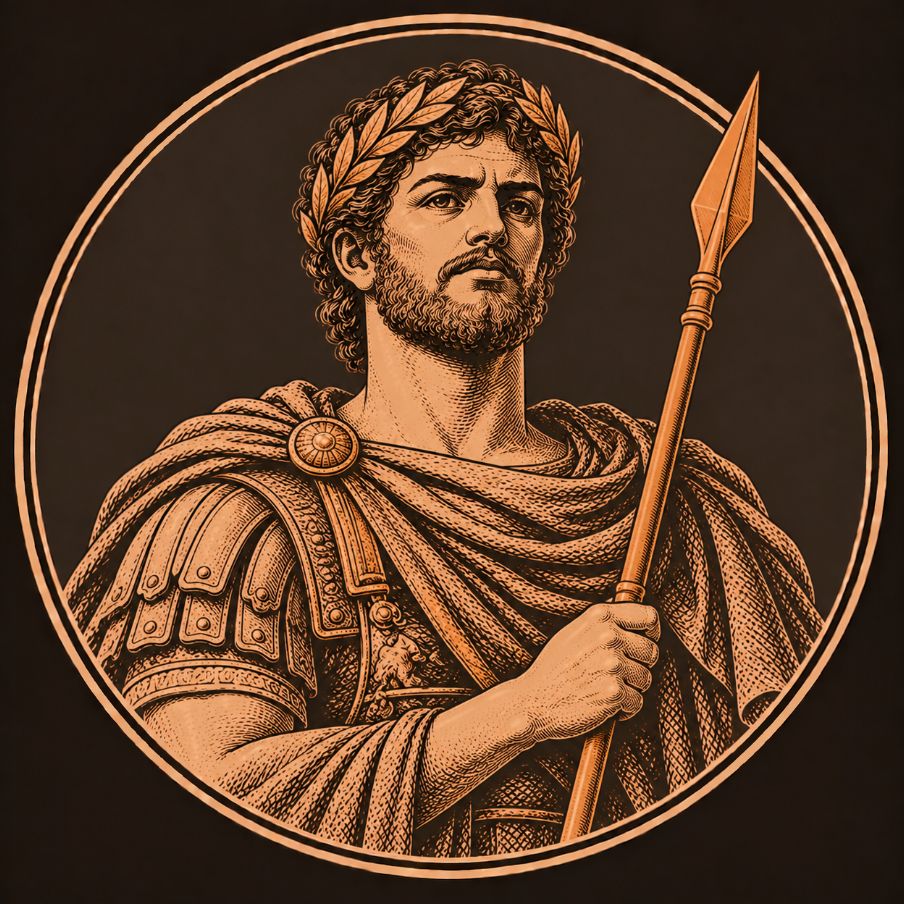
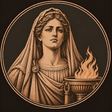
Romulus, bronze medallion illustration
Generated by AI from this page's own facts, not an ancient image or evidence of anything. How this site uses generated images
Sections on this page
Core Myth
Livy traces Romulus's line to the kings of Alba Longa. Amulius drove out his elder brother Numitor, killed Numitor's sons, and made his niece Rhea Silvia a Vestal Virgin so that she could have no children. She bore twins anyway and named Mars as their father. Livy adds that she may have believed it, or may have wanted a god to carry the blame. Plutarch records a darker rumour: Amulius himself, dressed in armour, was the father.
Amulius ordered the babies drowned in the Tiber. The river was in flood, so his servants left them at the edge of the overflow. Livy says a thirsty she-wolf found them and gave them her teats, and the royal herdsman Faustulus took them home to his wife Larentia. Plutarch adds a woodpecker that helped feed them. Both creatures were sacred to Mars, he says, which is why the mother's claim was believed. Ovid's Fasti has the wolf give her name to the Lupercal, and Plutarch says the priests of the Lupercalia begin their run where Romulus is said to have been exposed (Life of Romulus 21). Plutarch's essay on the Fortune of the Romans credits Fortuna with laying the foundations of Romulus's life and Virtue with finishing the building.
Grown up, the twins lived as herdsmen and raided brigands. Remus was captured and handed to Numitor, who began to recognise his grandson, while Faustulus told Romulus the truth about their birth. The brothers attacked the palace from two sides and killed Amulius. They restored Numitor to the throne of Alba, then left to found a city where they had been exposed.
They quarrelled over who would name and rule it, and took the auspices: Romulus on the Palatine, Remus on the Aventine. Remus saw six vultures first; Romulus then saw twelve. Plutarch reports a version in which Romulus lied about his twelve. The quarrel ended with Remus dead, told in several ways below, and the city took Romulus's name. Livy says the one foreign rite he adopted was the cult of Hercules at the Ara Maxima, as though he sensed that courage could win a man immortality. Plutarch says Romulus drove its boundary furrow with a bronze ploughshare drawn by a bull and a cow, and that the founding fell on 21 April, the shepherds' festival of the Parilia.
To fill the city, Romulus opened an asylum for fugitives and created a hundred senators, the Patres. When the neighbours refused intermarriage, he invited them to games he called the Consualia, and his men carried off the Sabine daughters. The wars that followed produced the first spolia opima: Romulus killed the king of Caenina and dedicated his armour to Jupiter Feretrius, founding Rome's first temple. When the Sabines took the citadel and routed the Romans, he vowed a temple to Jupiter Stator, the Stayer, and turned the battle. Ovid's Metamorphoses adds that when Juno opened a gate to the Sabines, the nymphs of a spring beside the shrine of Janus heated their waters with sulphur and flooded it. The Sabine women then ran between the armies, and the two peoples merged under a shared kingship with the Sabine king Titus Tatius.
After Tatius was killed at Lavinium, Romulus ruled alone and defeated Fidenae and Veii. Livy says he was more popular with the people than with the patricians, and above all with his soldiers. While he reviewed the army at the Goat's Marsh in the Campus Martius, a thunderstorm wrapped him in cloud, and he was never seen on earth again. Proculus Julius later swore that Romulus had come down from heaven to him. In Plutarch's telling, Romulus announced that he would now be their god, Quirinus. Livy says the Romans then offered the crown to the Sabine Numa Pompilius, a man of Cures known for justice and piety (Ab Urbe Condita 1.18).
Who was the father of Romulus and Remus?
Roman tradition names the war god Mars. Livy says their mother, the Vestal Rhea Silvia, was violated and named Mars as the father, either because she believed it or because a god made the fault seem less shameful. Plutarch says the she-wolf and the woodpecker that fed the twins were both sacred to Mars, which is why her claim was believed. He also reports a rumour that her uncle Amulius, disguised in armour, was the real father. Ovid's Fasti speaks of the twins as plainly Mars's sons.
Livy, Ab Urbe Condita 1.4
Why did Romulus kill Remus?
Not every ancient source says he did. Livy gives two versions. In the first, the twins' followers fought over whose augury had won, six vultures for Remus or twelve for Romulus, and Remus died in the brawl. In the second, which Livy calls more common, Remus mocked the new walls by jumping over them and Romulus killed him in anger. Plutarch says some blamed Romulus and others his companion Celer. Ovid's Fasti names only Celer and has Romulus mourn his brother.
Livy, Ab Urbe Condita 1.7
Was Romulus a real person or a myth?
The ancient texts cannot settle it, and their own authors had doubts. Plutarch says the main account was first published by the Greek writer Diocles of Peparethus and followed by Fabius Pictor, and that some readers suspected its fabulous quality. He answers only that fortune is sometimes a poet. He also records several rival stories of who Romulus was. Livy hedges the divine birth and passes on a rational reading of the she-wolf. Both treat Romulus as the founder while admitting the story reached them as tradition.
Plutarch, Life of Romulus 8
What happened to the founder of Rome?
Romulus vanished. Plutarch dates it to the Nones of Quintilis. In one account he was holding an assembly at the Goat's Marsh when darkness, thunder and rain scattered the crowd. The nobles told the people he had been caught up to heaven, and Proculus Julius swore that Romulus had appeared to him as the god Quirinus. Plutarch also reports a darker account: that the senators killed him in the temple of Vulcan and carried the pieces of his body away under their robes. Livy records the same suspicion.
Plutarch, Life of Romulus 27
Later Traditions
The death of Remus is told three ways. Livy's first version has him killed in the brawl after the augury, with no killer named. His "more common report" has Romulus kill him for jumping the new walls, with the words "So shall it be henceforth with every one who leaps over my walls." Plutarch says Remus was struck as he leapt the trench, by Romulus in some accounts and by his companion Celer in others. Ovid's Fasti gives the blow to Celer alone, and has Romulus hide his tears, then weep at the pyre for a brother taken from him against his will.
Even the she-wolf had a rational reading in antiquity. Livy notes that some thought Larentia had been nicknamed "she-wolf" by the shepherds for her unchaste life, and that this was the origin of the story. Plutarch makes the same point: the Latin lupa meant both a she-wolf and a woman of loose character, and Acca Larentia, wife of Faustulus, was such a woman. He adds that the priest of Mars still poured libations to her at the Larentalia.
His end is the sharpest dispute. Livy follows the ascent to heaven, but admits that some hinted even then that the senators had torn him limb from limb. Plutarch explains why suspicion fell on them: late in his reign Romulus had grown haughty and ignored the senate. One account he gives has the senators kill him in the temple of Vulcan, cut up the body, and carry the pieces away in their robes. Ovid's Fasti calls that charge false. His Metamorphoses has Mars carry Romulus up with Jupiter's consent, the mortal body melting away like a lead sling-bullet. The apotheosis page compares this with the ascent of Heracles.
As Quirinus, Romulus had a temple on the hill called the Quirinal after him, Plutarch says, and Ovid's Fasti gives him a feast day in February. In the Metamorphoses, his wife Hersilia is carried up by a falling star to join him and renamed Hora. Plutarch records the ancient guesses at the name: from Mars, from Quirites, the name of the citizens, or from quiris, an old word for a spear. He also collects rival origin stories, in which Romulus was a son of Aeneas, or of Latinus and a woman named Roma. Livy counts the kingship from the founding of the City to its end at 244 years. It ended in the revolt that followed the death of Lucretia (Ab Urbe Condita 1.59; Ab Urbe Condita 1.60).
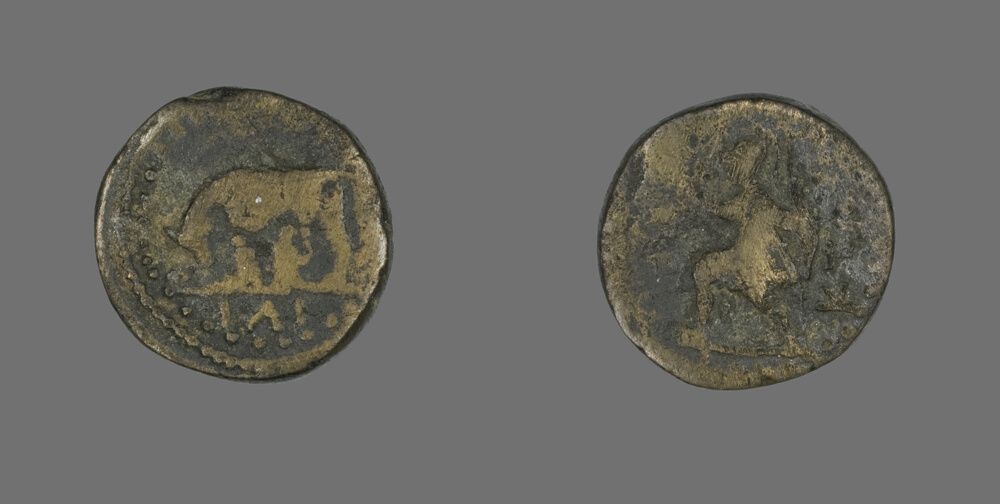
Coin Depicting a She-Wolf Nursing Romulus and Remus - Rome, 117-192, Bronze
The Art Institute of Chicago, Chicago, IL, 1920.2856. CC0
Lineage
See the full family tree2 recorded relations, each with the ancient line behind it.
Parents
-

Livy reports the paternity as Rhea Silvia's own claim, made either from belief or to lessen her fault, and Plutarch records a rumour that Amulius in armour was the real father.
Siblings
-
Twin sons of Rhea Silvia who restored Numitor at Alba, then quarrelled over the augury for the new city. Livy gives two accounts of Remus's death, one of them at Romulus's hand.
Also Connected
9 recorded connections, each with the ancient line behind it.
Allies
-
When the Sabines of Titus Tatius reach Rome's opened gate, heated springs beside the shrine of Janus hold them back until Romulus's soldiers are armed.
Connected
-
Plutarch argues that Virtue made Romulus great but Fortune watched over him until he became great, and that Fortune provided the founding of the city by preserving its founder (On the Fortune of the Romans 321b).
-

Livy says the rite of Hercules at the Ara Maxima was the only foreign rite Romulus adopted, as though he felt that an immortality won through courage would one day be his own reward.
-
Livy says Romulus adopted the cult of Hercules, alone of all foreign rites, and kept it according to the rites Evander instituted.
-

Romulus dedicates the first spolia opima and Rome's first temple to Jupiter Feretrius, and later vows a temple to Jupiter Stator in the Sabine war (Livy 1.12).
-
Livy counts the regal period from the foundation of the City to its liberation as 244 years. Lucretia's death is the event that ends it, and Brutus and Collatinus become the first consuls.
-
Livy sets Numa after Romulus as the second king, and contrasts the greatness Romulus won by war with the greatness Numa won by peace.
-
Romulus's mother Rhea Silvia was a Vestal, made so by Amulius, and she named Mars as the father of her twins.
-

Plutarch has Romulus dedicate a bronze four-horse chariot taken from Cameria in the temple of Vulcan (Romulus 24), and names the same temple as the place where, in one conjecture, the senators killed him (Romulus 27).
Where Accounts Differ
- who killed Remus
- whether the she-wolf was Larentia
- whether Romulus was taken to heaven or murdered by the senators
- whether Mars or Amulius fathered the twins
- whether Romulus lied about the augury
- Who killed Remus differs by source. Livy (1.7) gives an unnamed death in the brawl after the augury, then the more common report that Romulus killed him for leaping the walls. Plutarch (Romulus 10) names either Romulus or his companion Celer. Ovid (Fasti 4.837-856) names Celer alone and has Romulus mourn.
- Livy (1.4) and Plutarch (Romulus 4) both record that the she-wolf may have been Larentia, the herdsman's wife, since lupa also meant a woman of loose character.
- Romulus's end is disputed. Livy (1.16) follows the disappearance in a storm but notes a hint that the senators tore him apart. Plutarch (Romulus 27) gives the murder in the temple of Vulcan as one conjecture beside the storm. Ovid (Fasti 2.475-512) calls the charge against the senators false, and his Metamorphoses (14.805-828) has Mars carry Romulus to heaven.
- His paternity is hedged in the sources themselves. Livy (1.4) says Rhea Silvia named Mars either from belief or to lessen her fault, and Plutarch (Romulus 4) reports that Amulius in armour may have been the father.
- Plutarch (Romulus 9) records a version in which Romulus lied about seeing twelve vultures and saw them only when Remus arrived.
- Plutarch is cited from Bernadotte Perrin's translation on Perseus. Ovid's Fasti is not in the site's live citation registry, so its line numbers were checked by hand against the Latin text on Perseus. Dionysius of Halicarnassus's Roman Antiquities, a major source for Romulus, is not cited here because the site holds no checkable edition of it.
Read the full source verification →
Mythology
Appears In
Related Terms
Referenced By
Sources
- Livy, Ab Urbe Condita 1.3
- Livy, Ab Urbe Condita 1.4
- Livy, Ab Urbe Condita 1.5
- Livy, Ab Urbe Condita 1.6
- Livy, Ab Urbe Condita 1.7
- Livy, Ab Urbe Condita 1.8
- Livy, Ab Urbe Condita 1.9
- Livy, Ab Urbe Condita 1.10
- Livy, Ab Urbe Condita 1.12
- Livy, Ab Urbe Condita 1.13
- Livy, Ab Urbe Condita 1.14
- Livy, Ab Urbe Condita 1.15
- Livy, Ab Urbe Condita 1.16
- Plutarch, Life of Romulus 2
- Plutarch, Life of Romulus 4
- Plutarch, Life of Romulus 8
- Plutarch, Life of Romulus 9
- Plutarch, Life of Romulus 10
- Plutarch, Life of Romulus 11
- Plutarch, Life of Romulus 12
- Plutarch, Life of Romulus 24
- Plutarch, Life of Romulus 26
- Plutarch, Life of Romulus 27
- Plutarch, Life of Romulus 28
- Plutarch, Life of Romulus 29
- Ovid, Fasti 2.381-424
- Ovid, Fasti 2.475-512
- Ovid, Fasti 4.837-856
- Ovid, Metamorphoses 14.805-851
- Ovid, Metamorphoses 14.778-804
- Plutarch, Life of Romulus 21
- Plutarch, On the Fortune of the Romans
- Livy, Ab Urbe Condita 1.59
- Livy, Ab Urbe Condita 1.60
- Livy, Ab Urbe Condita 1.18