The Rape of the Sabine Women
The rape of the Sabine women is the Roman legend of how a city without wives seized young women at a festival. “Rape” translates Latin raptus, “carrying off”. Livy, Plutarch and Dionysius describe a mass abduction for marriage, then wars with four neighbouring peoples, ended when the women stepped between their fathers and husbands. Romans and Sabines then shared one city and one kingship.
Sections on this page
What Led To It
The story follows straight on from the founding. Plutarch describes the problem in one line: a city filling at once with aliens, few of whom had wives, most of them a mixed rabble of needy and obscure people (Life of Romulus 14). The founding and the asylum are told on the founding of Rome page, and the reign as a whole on the Romulus page.
The Myth
“Rape” in this story's title translates the Latin raptus, from rapere, “to seize or carry off”. The ancient accounts describe a mass abduction of young women for marriage, and this page says “abduction” for the event itself. The sources treat it as a founding-era necessity. Modern readers recognise forced marriage and sexual violence in it, and the ancient texts themselves record the women's grief and anger (Livy 1.9).
Rome, once founded, had men and no wives. Livy says the new state could match any neighbour in war, but with no women it had no hope of offspring, and no neighbour granted the right of intermarriage (Livy 1.9). The city's beginning is told on the founding of Rome page and its founder's life on the Romulus page. This page starts once the city stands.
Romulus tried diplomacy first. On the senate's advice he sent envoys to the surrounding peoples to ask for alliance and intermarriage. Livy says they were refused everywhere, in part from contempt and in part from fear of Rome's rapid growth. Envoys were often asked whether Rome had opened an asylum for women, since nothing less would win marriage on equal terms (Livy 1.9).
Romulus then chose a trick. Livy says he hid his anger and prepared games in honour of “Equestrian Neptune”, which he called the Consualia. Plutarch says Romulus announced that he had found a hidden altar of the god Consus in the Circus Maximus, a god of counsel or else an equestrian Neptune (Plutarch, Life of Romulus 14). Dionysius reports both explanations and says it is hard to tell which is true (Roman Antiquities 2.31.2-3).
Word went out to the neighbouring towns. Livy says the people of Caenina, Antemnae and Crustumerium came, and the whole Sabine population with their wives and children. Roman households hosted them. The guests toured the city and its walls and were astonished at how fast it had grown (Livy 1.9).
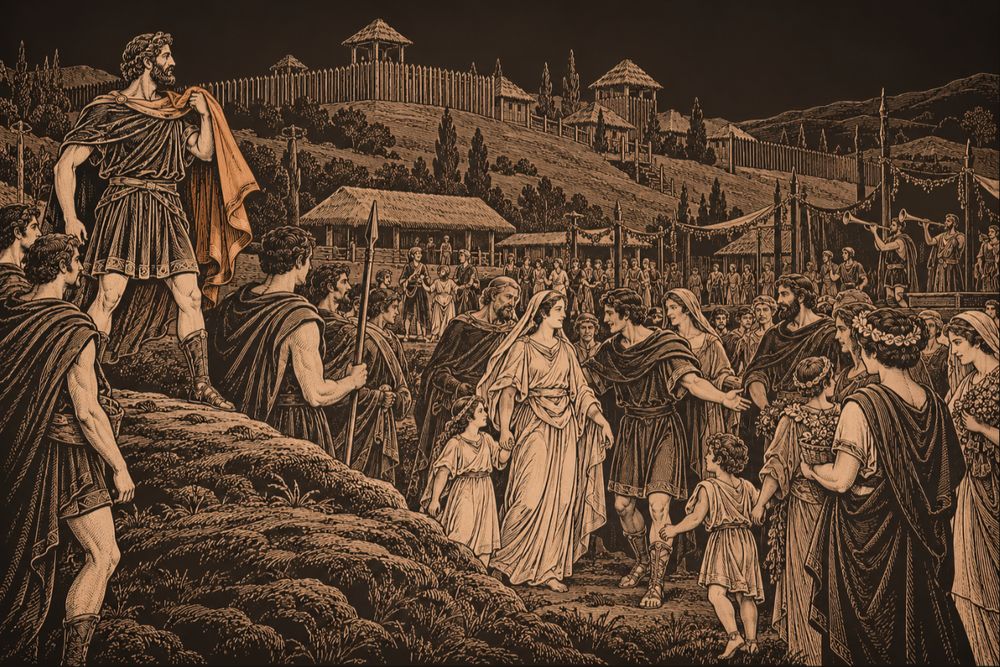
The games before the seizure
Generated by AI from this page's own facts, not an ancient image or evidence of anything. How this site uses generated images
When the games began, a preconcerted signal was given. Livy says the Roman youth dashed in all directions to carry off the young women present. Some were taken to the leading patricians' houses. One especially striking girl was carried off by a group led by a certain Talassius, and to every question about her the answer was “For Talassius”. Livy says that is the origin of the word in the marriage rites (Livy 1.9). Plutarch gives the signal as Romulus rising, folding his cloak and throwing it round him again. He adds that the men were allowed to escape (Plutarch, Life of Romulus 14).
The families fled. Livy says the parents left in grief, accusing the Romans of breaking the laws of hospitality and calling on the god at whose games they had been betrayed. The women were as despondent and indignant. Romulus went round in person. He told them that their parents' pride in refusing intermarriage was to blame, and that they would have honourable marriage, shared property and civil rights, and children who would be free citizens. He asked them to give their affection to the men fortune had made their masters (Livy 1.9).
The numbers differ. Plutarch reports some writers giving thirty, Valerius Antias 527 and Juba 683. He also says only one married woman, Hersilia, was taken, and by mistake (Plutarch, Life of Romulus 14). Dionysius says his 683 were kept overnight without violation and brought to Romulus next day. Romulus told them the seizure was for marriage, an old Greek custom. They were married to Roman men by the customs of each woman's country (Roman Antiquities 2.30.4-6). Plutarch dates the event to 18 August, the day of the Consualia (Life of Romulus 15).
Ovid puts the abduction in the mouth of Mars. In his Fasti the god says Rome's neighbours would not marry Romans, so he told Romulus that arms would grant what prayers could not. He then has Romulus prepare a feast for Consus (Fasti 3.195-199).
The neighbours reacted in stages. The parents sent to Titus Tatius, king of the Sabines, whose was the most influential name in the region. Livy says they thought him too slow, and the men of Caenina, Antemnae and Crustumerium prepared to fight alone (Livy 1.10). Plutarch adds that the Sabines first sent envoys with moderate demands: give the women back, disown the violence and establish friendship by agreement. Romulus refused and asked for intermarriage instead (Plutarch, Life of Romulus 16).
The Caeninenses struck first, and Romulus beat them quickly. Livy says he killed their king, took the town at the first assault and hung the king's spoils on a sacred oak on the Capitol. There he dedicated the first temple in Rome, to Jupiter Feretrius, and vowed that later victors would bring their own spoils (Livy 1.10). Plutarch names the king Acron and makes the fight a single combat (Life of Romulus 16). Dionysius agrees that Romulus killed the king (Roman Antiquities 2.33.2).
Antemnae raided the empty Roman land next and fell to Romulus's return attack. Livy says his wife Hersilia, moved by the abducted women's entreaties, asked him to forgive their parents and receive them into citizenship, and he agreed. Crustumerium then resisted only weakly. Colonies were planted in both places, and many of the women's parents and relatives migrated to Rome (Livy 1.11). Dionysius likewise has Romulus treat the conquered mildly, sending colonies instead of destroying the towns (Roman Antiquities 2.35-36).
The last war was the Sabines' and the hardest, because they masked their plans until war had begun. Livy says Spurius Tarpeius commanded the Roman citadel. His daughter went out to fetch water for a religious ceremony, and Tatius bribed her to let his troops in. Once inside, they crushed her under their shields. Livy gives two reasons: to make the fall of the citadel look like an assault, or as a warning that no faith is kept with traitors (Livy 1.11).
The story of her price is told two ways. In one, the Sabines wore heavy gold armlets on their left arms, and she asked for “what they had on their left arms”. In another, she expressly asked for their shields and was killed for her own bargain (Livy 1.11). Plutarch says Tarpeia wanted the armlets and got both armlet and shield from every man (Life of Romulus 17).
Dionysius records a more sympathetic version from Lucius Piso. In it Tarpeia meant to disarm the Sabines and hand them over to her countrymen. Dionysius argues the ending favours Piso, since she received a monument and yearly libations, and he tells readers to judge for themselves (Roman Antiquities 2.38-40). Plutarch says the Capitoline was called Tarpeius's hill until Tarquin dedicated it to Jupiter, and the cliff still bears her name (Life of Romulus 18).
With the citadel lost, the armies met in the valley between the Palatine and the Capitoline. Livy says the champions Mettius Curtius for the Sabines and Hostius Hostilius for the Romans fought first, and Hostilius fell. The Roman line broke and fled to the Palatine gate. Romulus, swept along, prayed to Jupiter and vowed a temple to “Jove the Stayer”. The Romans stopped as if a voice had ordered it, and Romulus charged Curtius down (Livy 1.12). Curtius escaped a marsh that Livy says was later called the Curtian lake. Plutarch says the Sabine leader's horse sank in the mud and he saved himself on foot (Life of Romulus 18).
Plutarch adds that Romulus was struck on the head by a stone and nearly fell, and that the temple of Jupiter Stator stands where the Romans first made a stand (Life of Romulus 18). Dionysius has two great battles instead of one, with Curtius rallying the Sabine centre and Romulus wounded by a stone thrown from the heights (Roman Antiquities 2.41-43).
The Sabine women ended it. Livy says the women, whose wrongs had caused the war, threw off their fear and went into the flying missiles with loosened hair and torn clothes (Livy 1.13).
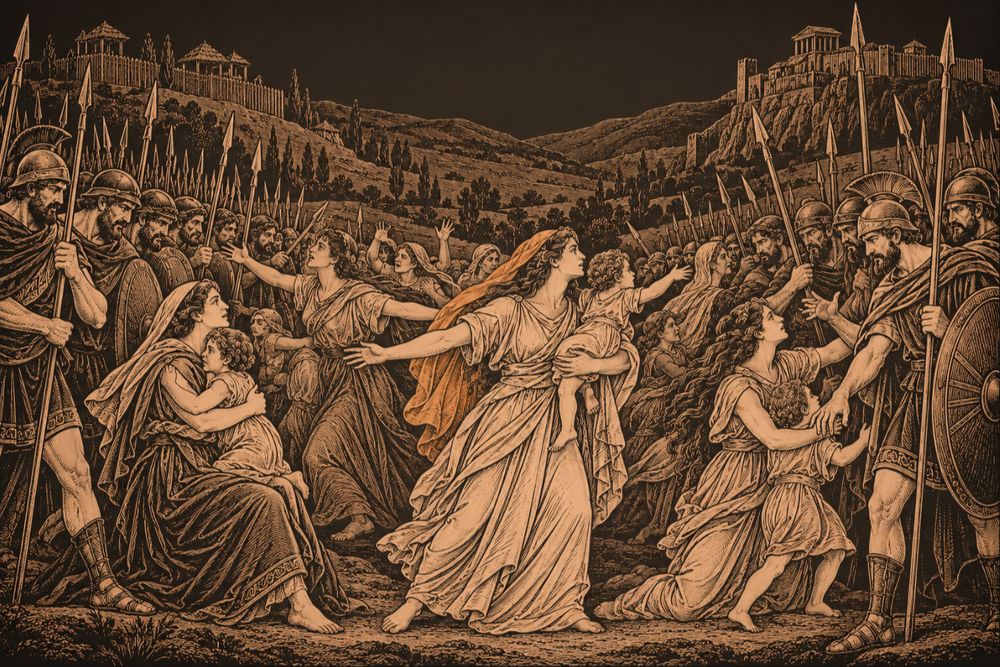
The Sabine women between the armies
Generated by AI from this page's own facts, not an ancient image or evidence of anything. How this site uses generated images
Running across the space between the two armies they tried to stop any further fighting and calm the excited passions by appealing to their fathers in the one army and their husbands in the other not to bring upon themselves a curse by staining their hands with the blood of a father-in-law or a son-in-law, nor upon their posterity the taint of parricide. “If,” they cried, “you are weary of these ties of kindred, these marriage-bonds, then turn your anger upon us; it is we who are the cause of the war, it is we who have wounded and slain our husbands and fathers. Better for us to perish rather than live without one or the other of you, as widows or as orphans.”
The sources disagree about how it was organised. In Plutarch, Hersilia and the other women rushed through the armed men and the dead. Some carried children, some were veiled in their loosened hair, and their words moved from reproach to entreaty. The armies drew apart to make room. Plutarch says the women then carried food and drink to those who needed it and took the wounded home to nurse (Life of Romulus 19). Dionysius has the women plan it first. Hersilia proposed the embassy, the senate gave leave, and the women went first to the Sabine camp in mourning, some with infants (Roman Antiquities 2.45). Ovid has the women meet in the temple of Juno. A daughter-in-law of Mars advises them to loosen their hair and put on funeral dress, and they step between the ranks with their children in their arms. The grandfathers and fathers embrace them, and one carries a grandchild on his shield (Fasti 3.205-228).
Livy says the appeal worked at once. There was sudden silence, the leaders stepped forward to make a treaty, and the two nations became one state. The royal power was shared, and the seat of government for both was Rome (Livy 1.13). The Sabines gave Rome a second name for its people, Quirites, from their old capital Cures (Livy 1.13; Plutarch, Life of Romulus 19; Dionysius, Roman Antiquities 2.46.2). Livy says the two kings then ruled together in perfect harmony (Livy 1.13). Plutarch says the women agreed to do no work for their husbands except spinning and that the meeting place was called the Comitium (Life of Romulus 19).
The harmony did not last forever. Livy says Tatius was killed at Lavinium some years later, after his kinsmen ill-treated Laurentine envoys. Romulus grieved less than he should, whether from the insincerity of joint rule or because he thought Tatius deserved it (Livy 1.14). Dionysius says the joint reign lasted five years (Roman Antiquities 2.50.4).
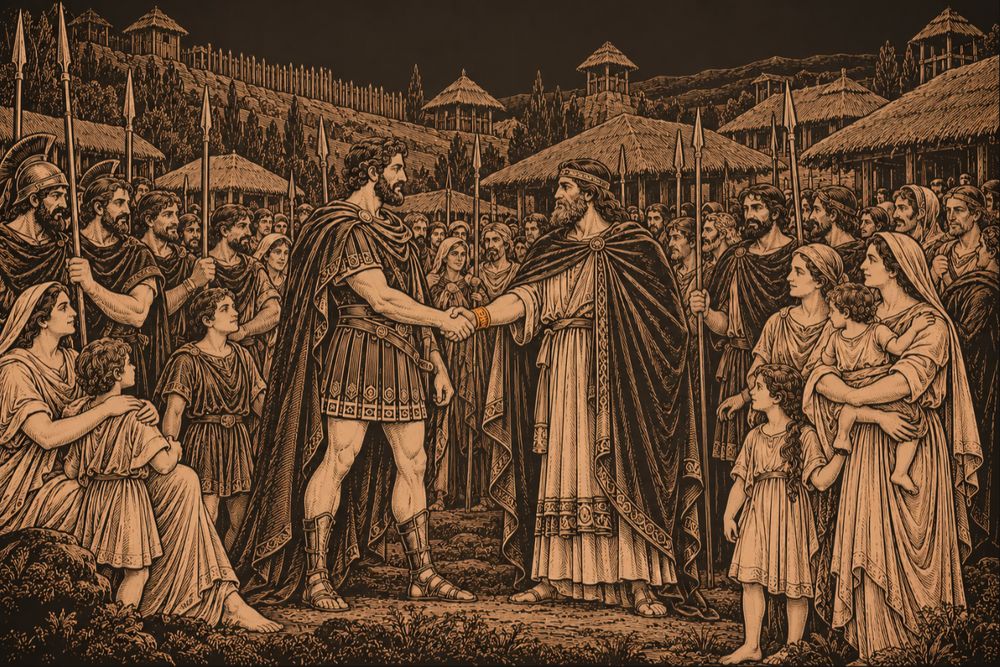
Romulus and Titus Tatius make peace
Generated by AI from this page's own facts, not an ancient image or evidence of anything. How this site uses generated images
What Followed
Livy says the joint kingship gave the city its Sabine names and its first divisions. The people were arranged in curiae named, on one tradition, for the abducted women, and in three centuries of knights, two named for Romulus and Tatius (Livy 1.13). Plutarch calls the naming of the curiae after women false, since many bear place names, and lists honours given the women: the right of way, no indecent talk before them, and the bulla and purple-bordered robe for their children (Life of Romulus 20). Dionysius records that a hundred Sabines were added to the senate (Roman Antiquities 2.47.1). Both wars left temples. Livy dates the first Roman temple, to Jupiter Feretrius, to the war with Caenina, and Romulus's vow at the Palatine gate promised another to Jupiter Stator (Livy 1.10; 1.12). After Tatius died, Romulus went on to fight Fidenae (Livy 1.14).
Afterlife and Modern Influence
Jacques-Louis David painted The Intervention of the Sabine Women in 1799, and it is in the Louvre. It shows Hersilia between her husband and her father, her children held out between them. According to Wikipedia's summary, David conceived it in prison after the Terror, and it was read as a plea for Frenchmen to reunite after the Revolution's bloodshed. Some read the towering walls in the picture as an allusion to the Bastille.
What was the abduction of the Sabine women?
It is the Roman legend that Romulus's new city, refused wives by its neighbours, seized young women from the guests at the Consualia games. Plutarch dates it to 18 August and Dionysius counts 683 women. The sources say marriage, not killing, was the aim. The women's own intervention later ended the war that followed.
Plutarch, Life of Romulus 15
Why did the Romans kidnap the Sabine women?
Because no neighbour would let its daughters marry Romans. Livy says the envoys Romulus sent were refused intermarriage and mocked, so he planned the seizure at a festival. Other writers give other motives. Plutarch mentions a view that Romulus wanted war, and Dionysius lists a scarcity of women, a pretext for war and an alliance by kinship, preferring the last.
Dionysius of Halicarnassus, Roman Antiquities 2.31
Did Rome conquer the Sabines?
Not in the legend. Romulus beat Caenina, Antemnae and Crustumerium, but the war with Tatius's Sabines ended when the women stopped the fighting. Livy says the two nations became one state under two kings with the seat of government at Rome, and the Romans took the name Quirites. Dionysius says the kings had equal authority.
Livy, Ab Urbe Condita 1.13
What were the Sabines known for?
Within the legend, for being numerous and warlike. Plutarch says they lived in unwalled villages and thought themselves bold because they descended from Spartan colonists. Dionysius records the same Spartan tradition and says it explains their fondness for war, their frugality and their severity. Livy adds that Rome took the name Quirites from their old capital Cures.
Dionysius of Halicarnassus, Roman Antiquities 2.49
What is the meaning behind the painting The Intervention of the Sabine Women?
David painted it in 1799, and it hangs in the Louvre. It shows Hersilia placing her children between her husband Romulus and her father Tatius. Wikipedia's summary says David began it in prison after the Terror and that it was read as a plea for reconciliation after the Revolution. The scene follows Livy's account of the women ending the battle.
Livy, Ab Urbe Condita 1.13
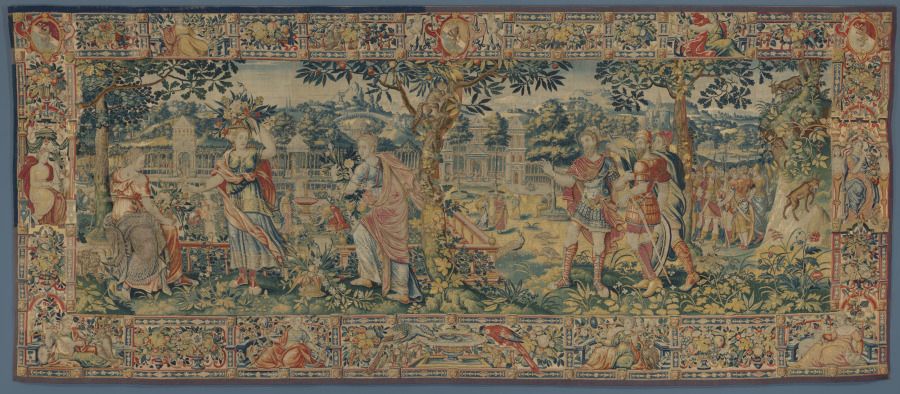
Romans Admiring the Sabine Women - Belgium, Brussels, 1570–90, silk and wool: tapestry weave
The Cleveland Museum of Art, Cleveland, OH, 1942.820. CC0
Where Accounts Differ
- motive-of-the-abduction
- number-of-women
- date-of-the-abduction
- god-of-the-games
- the-first-enemy
- tarpeia-motive-and-fate
- who-arranged-the-intervention
- hersilia-status
- honours-to-the-women
- end-of-the-joint-rule
- framing-of-consent
- The motive is disputed. Livy, Ab Urbe Condita 1.9, gives necessity: no wives and no right of intermarriage. Plutarch, Life of Romulus 14, reports a view that Romulus wanted war and took only thirty women, and rejects it as unlikely. Dionysius, Roman Antiquities 2.31.1, lists a scarcity of women, a pretext for war and alliance by kinship, and prefers the last.
- The number of women differs. Plutarch, Life of Romulus 14, gives thirty, 527 (Valerius Antias) and 683 (Juba). Dionysius, Roman Antiquities 2.30.6, counts 683, and at 2.47.4 gives Varro's 527 as the women who went on the embassy, not the women seized.
- The date differs. Plutarch, Life of Romulus 14, says the fourth month after the founding, following Fabius, and names 18 August, the Consualia, at 15. Dionysius, Roman Antiquities 2.31.1, says some place it in Romulus's first year and Gnaeus Gellius in the fourth, which he thinks likelier.
- The god of the games is uncertain. Livy, Ab Urbe Condita 1.9, says Equestrian Neptune. Plutarch, Life of Romulus 14, says Consus, god of counsel or an equestrian Neptune. Dionysius, Roman Antiquities 2.31.2-3, gives Consus as an earth-god or a hidden divinity of counsels, and says the truth is hard to tell.
- The first enemy is told differently. Livy, Ab Urbe Condita 1.10, has the Caeninenses raid Roman land and Romulus kill their unnamed king in the fighting. Plutarch, Life of Romulus 16, names the king Acron and has the two leaders fight a single combat. Dionysius, Roman Antiquities 2.33, has Romulus kill the king as he meets the Caeninenses.
- Tarpeia's motive and fate are disputed. Livy, Ab Urbe Condita 1.11, gives bribery and two versions of her price, gold or shields, and two reasons for her death. Plutarch, Life of Romulus 17, adds that some make her the daughter of Tatius acting at his command, and that Simylus makes her betray Rome to the Gauls. Dionysius, Roman Antiquities 2.38-2.40, records Lucius Piso's version, in which she meant to disarm the Sabines.
- Who arranged the women's intervention differs. Livy, Ab Urbe Condita 1.13, gives it as a spontaneous act. Plutarch, Life of Romulus 19, and Dionysius, Roman Antiquities 2.45, name Hersilia as the leader, and Dionysius has the senate approve the embassy. Ovid, Fasti 3.205-228, has the women meet in Juno's temple on a daughter-in-law of Mars's advice.
- Hersilia's status differs. Livy, Ab Urbe Condita 1.11, calls her Romulus's wife. Plutarch, Life of Romulus 14, says she was the one married woman taken, wife of Hostilius or, in other accounts, of Romulus. Dionysius, Roman Antiquities 2.45.2, says some make her a married woman seized as a virgin, but the more probable account is that she stayed of her own free will with her daughter.
- The honours to the women are disputed. Livy, Ab Urbe Condita 1.13, says the curiae took their names from the women and admits tradition is silent on how they were chosen. Plutarch, Life of Romulus 20, calls that false, since many curiae bear place names. Dionysius, Roman Antiquities 2.47.3-4, reports both views, with Varro against.
- The end of the joint rule differs. Livy, Ab Urbe Condita 1.14, has Tatius killed at Lavinium after his kinsmen ill-treated Laurentine envoys. Dionysius, Roman Antiquities 2.50.4, says the kings reigned together five years first, and at 2.52 gives two versions of the killing.
- The ancient accounts frame the abduction as a route to marriage and record the women's persuasion. Livy, Ab Urbe Condita 1.9, says the women were despondent and indignant until Romulus reasoned with them, and Dionysius, Roman Antiquities 2.30.5, says he told them it was for marriage. The consent this implies is the historians' claim, not the women's. This page reports the framing and does not endorse it.
Read the full source verification →
Mythology
Figures In This Myth
Also Connected
Referenced By
Sources
- Livy, Ab Urbe Condita 1.9
- Livy, Ab Urbe Condita 1.10
- Livy, Ab Urbe Condita 1.11
- Livy, Ab Urbe Condita 1.12
- Livy, Ab Urbe Condita 1.13
- Livy, Ab Urbe Condita 1.14
- Plutarch, Life of Romulus 14
- Plutarch, Life of Romulus 15
- Plutarch, Life of Romulus 16
- Plutarch, Life of Romulus 17
- Plutarch, Life of Romulus 18
- Plutarch, Life of Romulus 19
- Plutarch, Life of Romulus 20
- Dionysius of Halicarnassus, Roman Antiquities 2.30
- Dionysius of Halicarnassus, Roman Antiquities 2.31
- Dionysius of Halicarnassus, Roman Antiquities 2.33
- Dionysius of Halicarnassus, Roman Antiquities 2.35-2.36
- Dionysius of Halicarnassus, Roman Antiquities 2.38-2.40
- Dionysius of Halicarnassus, Roman Antiquities 2.41-2.43
- Dionysius of Halicarnassus, Roman Antiquities 2.45
- Dionysius of Halicarnassus, Roman Antiquities 2.46
- Dionysius of Halicarnassus, Roman Antiquities 2.47
- Dionysius of Halicarnassus, Roman Antiquities 2.49
- Dionysius of Halicarnassus, Roman Antiquities 2.50
- Ovid, Fasti 3.195-199
- Ovid, Fasti 3.205-228
- Wikipedia, The Intervention of the Sabine Women (year, exhibition, prison origin and political reading; read 2026-09-29)