Sabines
The Sabines are the neighbours of early Rome in Roman legend: Romulus's men seized their daughters at a festival, and their king, Titus Tatius, later ruled Rome beside Romulus. Livy says the women ended the war between the peoples, who became one state with shared royal power. The Romans gained the name Quirites from the Sabine town of Cures (Ab Urbe Condita 1.13).
Titus Tatius with a small altar of Jupiter
Generated by AI from this page's own facts, not an ancient image or evidence of anything. How this site uses generated images
Sections on this page
Core Myth
Livy brings the Sabines in soon after the founding. Romulus became sole ruler, the city took his name, and his first work was to fortify the Palatine (Ab Urbe Condita 1.7.3). When Rome's envoys were refused the right of intermarriage, Romulus held games for the neighbouring towns. Livy says the people of Caenina, Antemnae and Crustumerium came, and so did the whole Sabine population with their wives and children (Ab Urbe Condita 1.9). The seizure that followed is told on the abduction of the Sabine women page. This page follows the Sabines themselves.
Livy's war with the Sabines runs in six steps. First, the Roman youth seize the women at the games, and the guests leave in grief (Ab Urbe Condita 1.9). Second, the parents appeal to Titus Tatius, king of the Sabines, because his was the most influential name in the region (Ab Urbe Condita 1.10). Third, Caenina, Antemnae and Crustumerium fight on their own, and Romulus beats each in turn (Ab Urbe Condita 1.10; Ab Urbe Condita 1.11). Fourth, Tatius bribes the daughter of the Roman commander Tarpeius and takes the citadel (Ab Urbe Condita 1.11). Fifth, the armies fight in the valley between the hills, and Romulus vows a temple to Jupiter Stator when the Romans flee (Ab Urbe Condita 1.12). Sixth, the women run between the armies, a treaty follows, and the two peoples become one state (Ab Urbe Condita 1.13).
Titus Tatius is the one Sabine king the sources name. Plutarch gives a different route to his command. He says the other Sabines were angered because Romulus let the abducted women's parents keep their land, and they chose Tatius as their general (Life of Romulus 17). The peace then made him the colleague of Romulus. Plutarch lists the terms. There would be one city, called Rome after Romulus. Its citizens would be called Quirites after Cures, the home town of Tatius. The two men would rule jointly as kings and army leaders (Life of Romulus 19).
The joint rule ended when Tatius was killed at Lavinium some years later (Ab Urbe Condita 1.14). Livy says Romulus took the death more calmly than a colleague should. He gives two reasons: the insincerity of shared rule, or a belief that Tatius deserved it (Ab Urbe Condita 1.14).
Hersilia is the one abducted woman the sources checked here name. Livy has her ask Romulus to pardon the women's parents and admit them to citizenship, and Romulus agrees (Ab Urbe Condita 1.11). Plutarch says she was the one married woman among those taken, seized by mistake. Some said she married a Roman named Hostilius, and others that she married Romulus. Plutarch also has her lead the women's appeal to both armies (Life of Romulus 14; Life of Romulus 19).
Did the Sabines merge with the Romans?
In the legend, yes, and Livy lists what the merger changed. The royal power was shared, Rome became the seat of government for both peoples, and the Romans gained the name Quirites. Livy adds that the people were divided into thirty curiae and the knights into three centuries, two of them named for Romulus and Tatius. A Sabine, Numa, later received the crown. Whether any real merger lies behind this, the sources checked here do not say.
What were the Sabines known for?
For boldness and strict discipline. Plutarch says the Sabines were numerous and warlike and lived in unwalled villages. They thought of themselves as colonists from Lacedaemon, which made them hold boldness and fearlessness a duty. Livy stresses another trait. He credits the rigorous, austere discipline of the old Sabines with shaping the character of Numa (Ab Urbe Condita 1.18). Livy also calls Tatius the most influential name in the region (Ab Urbe Condita 1.10).
Where did the Sabines live in Italy?
The texts checked here name towns, not a map. Livy and Plutarch make Cures the old Sabine capital that gave the Romans the name Quirites (Livy, Ab Urbe Condita 1.13; Plutarch, Life of Romulus 19). Virgil's catalogue of the Sabine host names Amiternum, Eretum, Mutusca, Nomentum, Casperia and Nursia, and men who drink from the Tiber. Modern locations belong to modern geography and are not taken from these texts.
Why are the Romans called Quirites?
Livy and Plutarch tie the name to the Sabine town of Cures. Livy says that when the two peoples joined, the Romans took the name Quirites from Cures, the Sabines' old capital, beside the name Romans (Ab Urbe Condita 1.13). Plutarch makes it a term of the treaty: the city would be called Rome after Romulus and its citizens Quirites after the home town of Tatius (Life of Romulus 19). Virgil already lists the ancient Quirites in the Sabine host (Aeneid 7.706-722).
How did Titus Tatius die?
Livy and Plutarch both place his death at Lavinium after a quarrel over envoys from Laurentum, but they tell the details differently. Livy says Tatius's kinsmen ill-treated the envoys, he gave no redress, and a mob killed him at the annual sacrifice. Romulus renewed the treaty with Lavinium and did not go to war (Ab Urbe Condita 1.14). Plutarch says the kinsmen robbed and killed the envoys, and friends of the dead killed Tatius as he sacrificed with Romulus, who buried him but did not prosecute the killers (Life of Romulus 23).
Later Traditions
A Sabine also succeeds Romulus. Livy says Numa Pompilius lived at Cures, a Sabine city, and was known for justice and piety. The Roman senators saw that a Sabine king would put the balance of power on the Sabine side, yet they offered the crown to him (Ab Urbe Condita 1.18). Plutarch says in his Life of Numa that Numa came from Cures and married Tatia, the only daughter of Tatius. The tie to the earlier Sabine king is therefore a family one in Plutarch. The page on Numa Pompilius tells his reign.
Virgil places the Sabines in the army that fights Aeneas. In his catalogue of Italian forces a large Sabine host marches under Clausus, from whom the Claudian tribe descends. The contingent includes the ancient Quirites and men of Amiternum, Eretum, Nomentum and Nursia (Aeneid 7.706-722). On the shield Vulcan made for Aeneas, Virgil shows the seizure of the Sabine women at the games and the new war with Tatius and the men of Cures. He then shows the peace made before an altar of Jupiter (Aeneid 8.635-641). Both scenes sit beside the figures of Rome's legendary age on the Roman heroes page.
Ovid tells the war's end by a different route. In the Metamorphoses, soldiers from Cures come to Rome's gates and Juno opens one. Venus calls on the Naiads of a spring beside the shrine of Janus, and boiling water bars the gate until the Roman soldiers have taken up their arms (Metamorphoses 14.778-804). Romulus then drives the Sabines out, and he and Tatius make peace and share the throne. After Romulus is carried up to heaven, Juno sends Iris to Hersilia, and a falling star takes her up to join him as the goddess Hora (Metamorphoses 14.805-851).
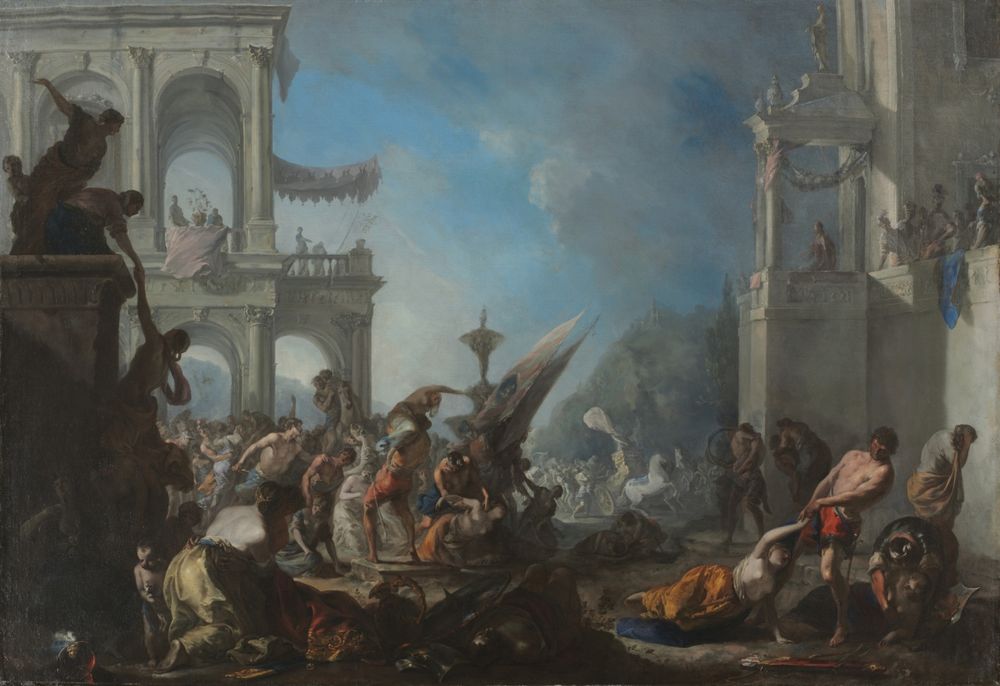
Abduction of the Sabine Women - Germany, c. 1640, oil on canvas
The Cleveland Museum of Art, Cleveland, OH, 1982.143. CC0
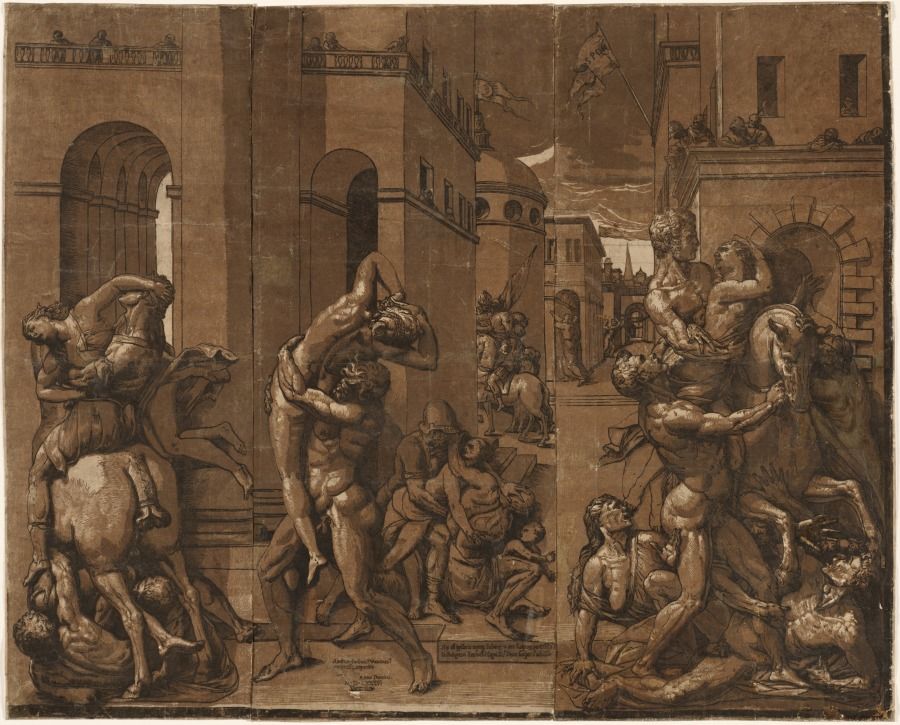
The Abduction of the Sabine Women - Italy, 1585, chiaroscuro woodcut (in three shades of brown and black)
The Cleveland Museum of Art, Cleveland, OH, 1981.15. CC0
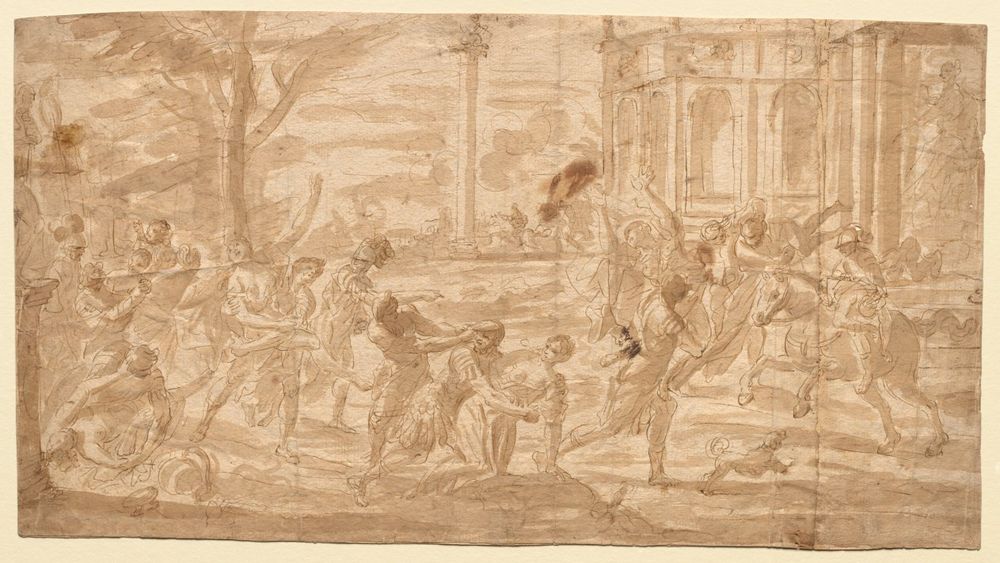
Rape of the Sabines - France, 1700s, pen and brown ink and brush and brown wash, with traces of black chalk?
The Cleveland Museum of Art, Cleveland, OH, 1954.678. CC0
Also Connected
4 recorded connections, each with the ancient line behind it.
Connected
-
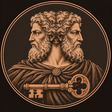
In Ovid, soldiers from the Sabine town of Cures reach a gate Juno has opened, and boiling water from a spring beside the shrine of Janus holds them back.
-

When the Sabines drive the Romans back toward the Palatine gate, Romulus prays to Jupiter and vows a temple to Jupiter Stator.
-
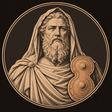
Numa lived at the Sabine city of Cures, and Livy says the senators saw that a Sabine king would tip the balance of power toward the Sabines before they offered him the crown.
-
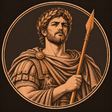
After the Sabine women stop the war, Livy has the two peoples become one state, with royal power shared between Romulus and the Sabine king Titus Tatius.
Where Accounts Differ
- how Titus Tatius came to lead the Sabines
- how Titus Tatius died
- whom Hersilia married
- where the Sabines' boldness came from
- how the Sabines reached the city
- How Titus Tatius came to lead the Sabines differs. Livy (Ab Urbe Condita 1.10) has the parents of the women turn to him as the most influential king in the region. Plutarch (Life of Romulus 17) says the other Sabines chose him as general after Romulus let the women's parents keep their land.
- How Titus Tatius died differs. Livy (Ab Urbe Condita 1.14) says his kinsmen ill-treated Laurentine envoys and a mob killed him at Lavinium, and that Romulus renewed the treaty with Lavinium. Plutarch (Life of Romulus 23) says the kinsmen robbed and killed the envoys, that friends of the dead killed him, and that Romulus buried him without prosecuting the killers.
- Hersilia's husband differs. Plutarch (Life of Romulus 14) says she was the one married woman taken, wife of a Roman named Hostilius in some accounts and of Romulus in others. Ovid (Metamorphoses 14.805-851) treats her as the wife of Romulus, who joins him as a goddess.
- The origin of the Sabines' boldness differs. Plutarch (Life of Romulus 16) says the Sabines thought themselves colonists from Lacedaemon. Livy (Ab Urbe Condita 1.18) explains Numa's character by the austere discipline of the old Sabines and gives no such origin in the passage checked here.
- How the Sabines reached the city differs. Livy (Ab Urbe Condita 1.11) has Tatius take the citadel through the daughter of its commander. Ovid (Metamorphoses 14.778-804) has soldiers from Cures reach a gate that Juno opens, held back by boiling water from a spring beside the shrine of Janus.
Read the full source verification →
Mythology
Appears In
Referenced By
Sources
- Livy, Ab Urbe Condita 1.7.3
- Livy, Ab Urbe Condita 1.9
- Livy, Ab Urbe Condita 1.10
- Livy, Ab Urbe Condita 1.11
- Livy, Ab Urbe Condita 1.12
- Livy, Ab Urbe Condita 1.13
- Livy, Ab Urbe Condita 1.14
- Livy, Ab Urbe Condita 1.18
- Plutarch, Life of Romulus 14
- Plutarch, Life of Romulus 16
- Plutarch, Life of Romulus 17
- Plutarch, Life of Romulus 19
- Plutarch, Life of Romulus 23
- Plutarch, Life of Numa
- Virgil, Aeneid 7.706-722
- Virgil, Aeneid 8.635-641
- Ovid, Metamorphoses 14.778-804
- Ovid, Metamorphoses 14.805-851