The Founding of Rome
The founding of Rome is the story of how Romulus and Remus, after restoring their grandfather Numitor to the throne of Alba, set out to found a city where they had been exposed. They asked the birds who should rule it: Remus saw six vultures, Romulus twelve. Romulus ploughed the boundary, Remus died at the wall, and the city took Romulus's name. The ancient writers disagree over who struck Remus.
Sections on this page
What Led To It
The founding comes at the end of a chain of quarrels between brothers in the royal house of Alba. Livy traces the Alban kings from Aeneas's son Ascanius down to Proca, whose sons Numitor and Amulius fought over the throne. Amulius expelled Numitor, killed his sons and made Numitor's daughter Rhea Silvia a Vestal (Livy 1.3). Alba itself descends from the Trojans. In Livy's account Aeneas founded Lavinium in Latium, and Ascanius, leaving Lavinium to his mother or stepmother, built Alba Longa thirty years later (Livy 1.1; 1.3). Dionysius adds a prodigy. The Trojan images Aeneas brought, which the Romans call Penates, were moved to a new temple at Alba and returned overnight to their old pedestals at Lavinium (Roman Antiquities 1.67.1-3). For Aeneas's own war in Italy, see Aeneas and Turnus.
The Myth
Rome was founded, in the Roman telling, by two brothers who had just given a kingdom away. Romulus and Remus were twins, sons of the Vestal Rhea Silvia, who named Mars as their father. Her uncle Amulius had seized the throne of Alba Longa and made her a Vestal so that she would have no children (Livy 1.3). He had the babies exposed on the Tiber, where a she-wolf suckled them and the herdsman Faustulus took them home (Livy 1.4). Their birth and youth are told on the pages of Romulus and Remus. This page begins where those end.
The founding starts with a killing and a coronation. While the twins attacked Amulius, their grandfather Numitor spread word that an enemy was in the city, to draw the Alban soldiers away to the citadel. Afterwards he called the people together and told them who the young men were. The twins marched through the assembly and saluted him as king, and the crowd ratified it (Livy 1.6).
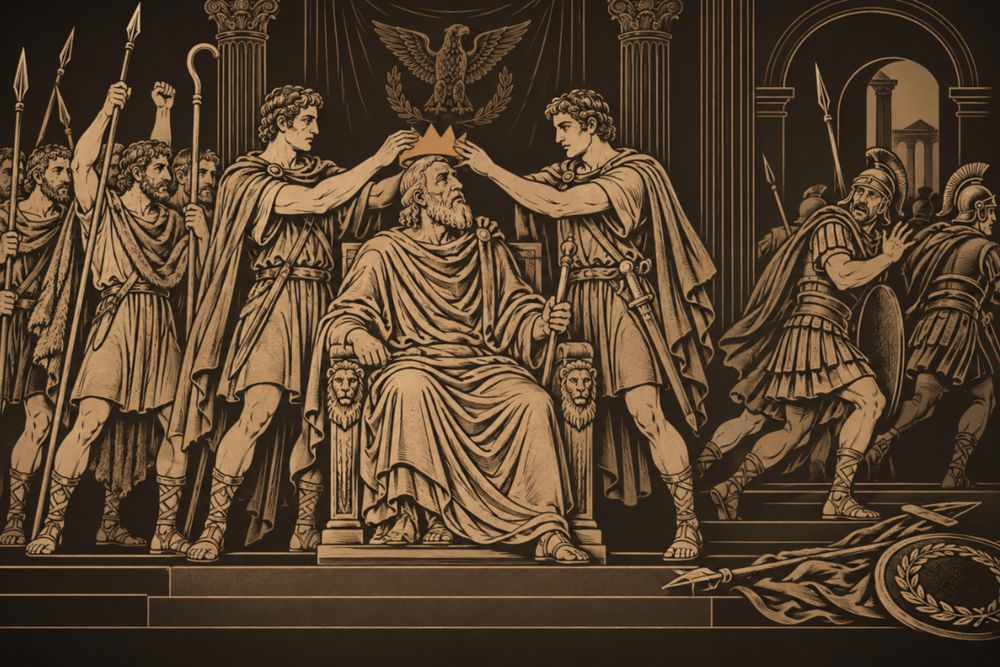
The twins restore Numitor
Generated by AI from this page's own facts, not an ancient image or evidence of anything. How this site uses generated images
Why the twins left Alba is told three ways. In Livy they were simply seized with a wish to build a city where they had been exposed. Alba and the Latin towns had people to spare, and the shepherds joined them. A new city seemed likely to dwarf Alba and Lavinium (Livy 1.6). Plutarch gives a practical reason. The brothers would not live in Alba unless as its rulers, and would not rule while their grandfather lived. Slaves and fugitives were also gathering around them (Plutarch, Life of Romulus 9). Dionysius of Halicarnassus makes it Numitor's plan. Numitor wanted the youths to rule a city of their own, and to send away people he suspected of disloyalty (Roman Antiquities 1.85).
The brothers then disagreed about the site. Plutarch says Romulus built Roma Quadrata, "square Rome", and wanted the city there. Remus laid out a strong precinct on the Aventine, called the Remonium (Life of Romulus 9). Dionysius has Romulus favour the Palatine, where they had been saved and raised. Remus favoured a hill later called Remoria, about thirty stades from Rome (Roman Antiquities 1.85).
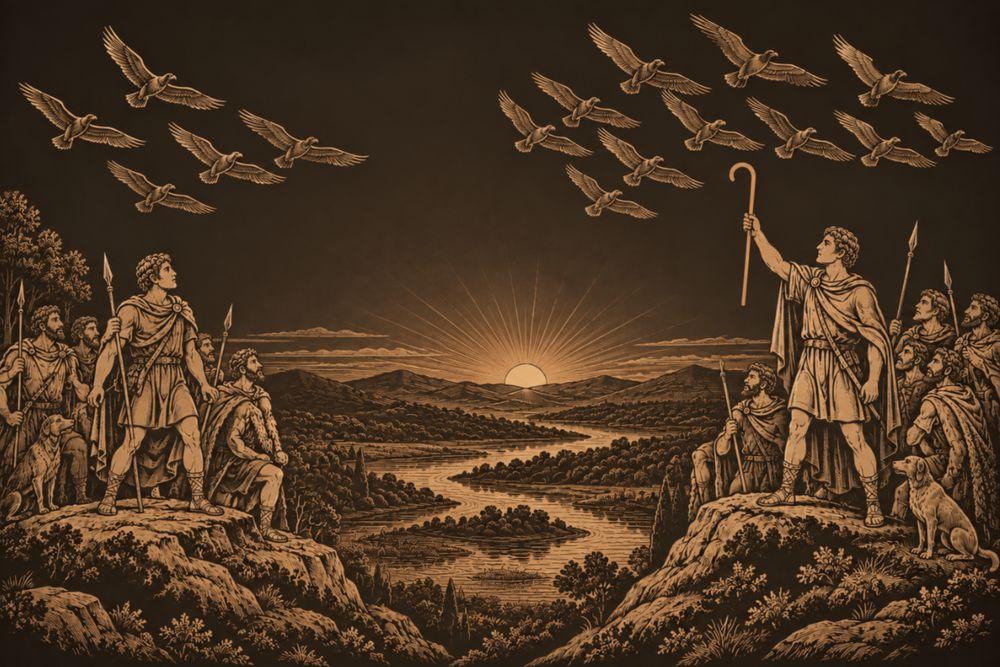
The augury of the vultures
Generated by AI from this page's own facts, not an ancient image or evidence of anything. How this site uses generated images
Because they were twins, neither could claim precedence by age. Livy says they agreed to ask the gods, by augury, which of them would name the city and rule it. Romulus took the Palatine for his station and Remus the Aventine (Livy 1.6). In Dionysius, Numitor himself set the test, and guards stood by each brother to stop false reports (Roman Antiquities 1.86).
The birds came in two waves. Remus is said to have seen six vultures first. Then twelve appeared to Romulus. Each was hailed as king by his own party, one side arguing from the earlier sighting and the other from the larger number (Livy 1.7). Plutarch adds that some said Romulus lied about his twelve, and that he saw them only once Remus came to him (Life of Romulus 9). Dionysius makes the trick larger. Romulus sent for his brother before he had seen any bird. Six vultures then flew to Remus from the right, and twelve showed themselves only after the two met (Roman Antiquities 1.86). Plutarch says the Romans still watch vultures when they take auguries (Life of Romulus 9).
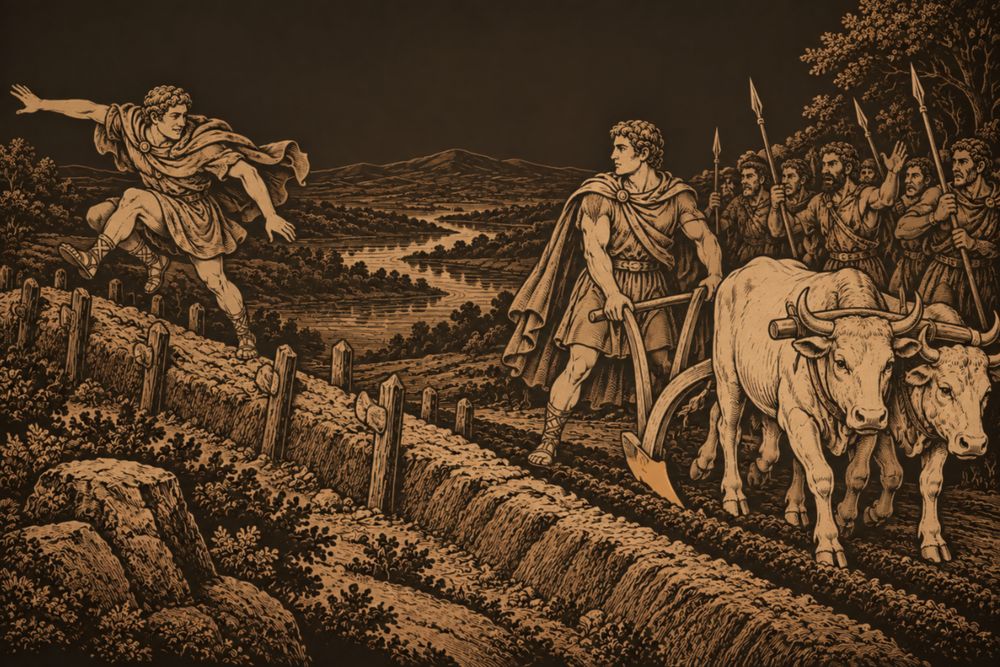
Romulus ploughs the furrow
Generated by AI from this page's own facts, not an ancient image or evidence of anything. How this site uses generated images
The city was marked out with a plough. Plutarch says Romulus sent for men from Tuscany, who taught him every detail as a religious rite. A circular trench was dug and filled with first-fruits and a handful of soil from each man's native land. Romulus then shod a plough with a bronze ploughshare, yoked a bull and a cow, and drove a deep furrow around the boundary. Those who followed turned every clod inward, toward the city (Life of Romulus 11). That line was the pomerium, the sacred boundary. Where a gate would stand, the ploughman lifted the plough and left the ground unbroken. Plutarch says this is why the Romans held the whole wall sacred except the gates (Life of Romulus 11). Dionysius also has Romulus plough a furrow with a bull and a cow. He says the Romans kept the custom when founding cities (Roman Antiquities 1.88).
Ovid tells the same rite in a shepherd's key. His Romulus digs the trench to solid rock, throws in fruits and local earth, and sets an altar and a fire on top. He then ploughs with a white cow and a snow-white steer. He prays to Jupiter, Father Mavors and Mother Vesta that the city may rule a conquered world. Jupiter answers with thunder on the left (Fasti 4.809-856).
Remus died at the wall, and the ancient writers cannot agree how. Livy gives two versions. In the first, the quarrel over the birds turned to bloodshed and Remus fell in the tumult. In the second, which Livy calls more common, Remus leapt contemptuously over the newly raised walls and Romulus killed him in a rage (Livy 1.7). Plutarch says Remus, angry at the deceit, mocked and obstructed the trench as it was dug. When he leapt across it he was struck, by Romulus in some accounts and by his companion Celer in others. Celer fled to Tuscany, and Plutarch says the Latin word celeres, for swift men, comes from him (Life of Romulus 10).
Ovid gives the blow to Celer alone. Romulus had ordered Celer to kill anyone who crossed the wall or the trench. Remus mocked the low wall and jumped it, and Celer struck him down with a shovel (Fasti 4.837-856). Dionysius prefers a battle. The followers of the two brothers fought, Faustulus died trying to part them, and Remus fell in the fighting (Roman Antiquities 1.87). He gives the wall story only as an alternative. In it Remus leaps the finished wall and Celer kills him with a mattock (Roman Antiquities 1.87). Livy compresses the whole quarrel into a few lines.
Remus is said to have been the first to receive an omen: six vultures appeared to him. The augury had just been announced to Romulus when double the number appeared to him. Each was saluted as king by his own party. The one side based their claim on the priority of the appearance, the other on the number of the birds. Then followed an angry altercation; heated passions led to bloodshed; in the tumult Remus was killed. The more common report is that Remus contemptuously jumped over the newly raised walls and was forthwith killed by the enraged Romulus, who exclaimed, “So shall it be henceforth with every one who leaps over my walls.” Romulus thus became sole ruler, and the city was called after him, its founder.
Romulus's grief is a detail the later sources add. In Ovid he hides his tears when he hears the news, saying only that so fares the foe who crosses his walls. Then he gives Remus a funeral, kisses the bier and weeps (Fasti 4.837-856). Plutarch has Romulus bury Remus in the Remonium, together with his foster-fathers, before he sets about the building (Life of Romulus 11). Dionysius buries Remus at Remoria. He says Romulus lost the wish to live until his foster-mother Laurentia comforted him (Roman Antiquities 1.87).
Plutarch says it is agreed that the city was founded on 21 April. The Romans kept the day as the birthday of their country. At first, he says, they sacrificed no living creature at the festival, to keep it free of blood. The day was already a pastoral feast called the Parilia (Life of Romulus 12). Ovid ties the founding to the same holiday: the feast of Pales was at hand when the work began (Fasti 4.809-856). Dionysius says the Parilia was one of the greatest Roman festivals, when farmers and herdsmen give thanks for the increase of their cattle. He cannot say whether the day was already a feast or became one because the city was begun on it (Roman Antiquities 1.88).
The year is less settled. Plutarch reports that some tied the founding day to an eclipse seen by the poet Antimachus. He also tells how Varro set his friend Tarutius, an astrologer, to work out the day of the founding from the events of Romulus's life. Plutarch judges that such speculations will attract readers by their novelty and extravagance, not offend them by their fabulous character (Life of Romulus 12).
With his brother gone, Livy says Romulus became sole ruler and the city took his name. His first work was to fortify the Palatine, where he had been raised. He worshipped the other gods by Alban custom but Hercules by Greek rites, the only foreign rite he adopted (Livy 1.7).
A city needs people, so Romulus opened an asylum. Livy places it where, coming down from the Capitol, one finds an enclosed space between two groves. A mixed crowd of freemen and slaves, eager for change, fled there from the neighbouring states. This was the first addition to the strength of the new city (Livy 1.8). Livy calls it an old policy of founders. They gather people of obscure and low origin and give out that they are children of the soil. Plutarch says the sanctuary belonged to the God of Asylum. Romulus gave no one up, neither slave, debtor nor murderer, and claimed a Delphic oracle for it (Life of Romulus 9). Livy adds twelve lictors and a hundred senators, called the Patres. Some thought the twelve came from the twelve vultures, but Livy prefers an Etruscan source (Livy 1.8).
What Followed
The founding did not settle the city. Romulus's first crowd was made up of men, and the neighbouring peoples refused intermarriage. That led to the abduction of the Sabine women and a war that ended in a shared kingship (Livy 1.9-1.13). The rest of the reign, and the tradition that Romulus vanished in a storm to become the god Quirinus, are told on the Romulus page. The Parilia stayed on the Roman calendar as the city's birthday, and the plough furrow became the model for marking a new town's boundary (Plutarch, Life of Romulus 11-12). The kings Romulus began ruled for 244 years from the founding, Livy says, until the revolt that followed the death of Lucretia drove them out (Ab Urbe Condita 1.58-1.60).
Who is the mythological founder of the city of Rome?
Romulus. Livy says the city was called after him as its founder, and Plutarch says the most authentic tradition gives him the name. The legend has rivals. Plutarch lists writers who named the city for a Roma, a Romanus or a Romus. Livy also has Aeneas found only Lavinium, and his son Ascanius found Alba Longa, the city Romulus and Remus came from.
Livy, Ab Urbe Condita 1.7
Is the story of Romulus and Remus true?
The ancient writers themselves had doubts. Livy says in his preface that he will neither affirm nor refute the traditions from before the city's founding, and Plutarch calls the horoscope that dated Romulus's birth extravagant. Archaeology finds huts on the Palatine from the ninth or eighth century BC. The Wikipedia summary of modern scholarship says there is no persuasive archaeological evidence for a foundation by Romulus, though Andrea Carandini has argued for a real founding event.
Plutarch, Life of Romulus 12
Why was Rome named after Romulus and not Remus?
The birds went Romulus's way. Livy says the twins agreed to let augury decide who would name the city and rule it. Each side claimed the win, Remus's on priority and Romulus's on the larger number of vultures. After Remus died, Romulus ruled alone and the city was called after him. Plutarch says some claimed Romulus lied about his twelve, and he also lists writers who derive the name from a woman called Roma.
Livy, Ab Urbe Condita 1.7
Why do Romans tell the myth of Romulus and Remus?
It gave Rome a founder with a divine father and a birthday the whole city could keep. Livy says peoples may blend human and divine to make their origins more venerable, and that Rome's record in war lets it name Mars as parent of its founder. The story also explained rites. The plough furrow marked the sacred boundary, and the Parilia was kept as the birthday of the country, Plutarch says.
Plutarch, Life of Romulus 12
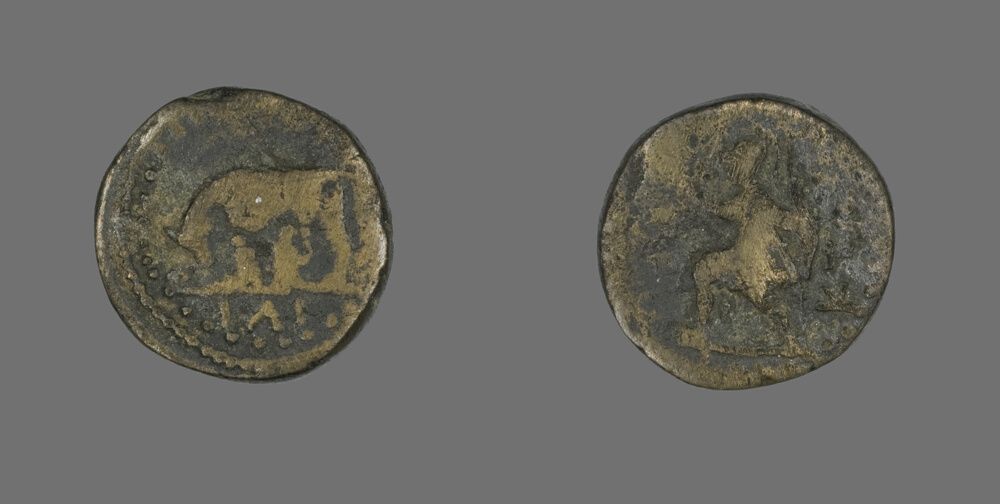
Coin Depicting a She-Wolf Nursing Romulus and Remus - Rome, 117-192, Bronze
The Art Institute of Chicago, Chicago, IL, 1920.2856. CC0
Where Accounts Differ
- who-killed-remus
- augury-and-the-vultures
- order-of-founding-rites
- who-proposed-the-city
- date-of-the-founding
- the-asylum
- archaeology-and-the-legend
- Who killed Remus is disputed. Livy, Ab Urbe Condita 1.7, gives two versions: Remus died in the tumult after the augury, or Romulus killed him for leaping the new walls, which Livy calls the more common report. Plutarch, Life of Romulus 10, says Romulus struck him in some accounts and Celer in others. Ovid, Fasti 4.837-856, names Celer alone, on Romulus's own order to kill anyone who crossed the wall. Dionysius, Roman Antiquities 1.87, prefers death in a battle between the two parties and gives Celer's mattock as a second story.
- The augury is told with different details. Livy, Ab Urbe Condita 1.6-1.7, puts Remus on the Aventine and gives no hint of fraud. Plutarch, Life of Romulus 9, reports that some said Romulus lied about his twelve vultures. Dionysius, Roman Antiquities 1.86, says Romulus sent for Remus before seeing any bird, and places Remus's station on the Aventine or, according to others, at Remoria. He also has Numitor set the test, where Livy has the twins choose it.
- The order of the founding rites differs. Ovid, Fasti 4.809-856, has Romulus plough the boundary first, and Remus leap the raised wall afterwards. Plutarch, Life of Romulus 11, says Romulus buried Remus first and then built the city with Tuscan ritual. Dionysius, Roman Antiquities 1.87-1.88, likewise has the ploughing follow Remus's death. Plutarch and Dionysius yoke a bull and a cow to the plough. Ovid has a white cow and a snow-white steer.
- Who proposed the new city is not agreed. In Livy, Ab Urbe Condita 1.6, the twins conceive the wish themselves once Numitor is restored. Plutarch, Life of Romulus 9, gives a practical reason: they would not rule under their grandfather, and fugitives were gathering around them. Dionysius, Roman Antiquities 1.85, makes it Numitor's own plan, with a district granted to the twins and the disloyal sent along.
- The date and year are told in different ways. Plutarch, Life of Romulus 12, says it is agreed that the city was founded on 21 April, the Parilia, and reports a rival dating from an eclipse and a horoscope worked out by the astrologer Tarutius, which he treats as a curiosity. Dionysius, Roman Antiquities 1.88, says he cannot tell whether the Parilia was already a feast or became one because of the founding. The Livy passages read for this page give no date.
- The asylum is explained in different ways. Livy, Ab Urbe Condita 1.8, calls it an old founders' policy for gathering a crowd of obscure origin. Plutarch, Life of Romulus 9, says the founders called it the sanctuary of the God of Asylum and claimed a Delphic oracle for it, and that the lack of marriages with Alba made the fugitives a people apart. Livy does not mention the oracle in the passage read.
- The archaeology and the age of the legend are modern judgments, not ancient testimony. The Wikipedia article on the founding of Rome, read for this page, reports that huts on the Palatine date to the ninth or eighth century BC and that there is no persuasive archaeological evidence for a foundation by Romulus. It calls Andrea Carandini's view that the legend reflects a real founding event a minority position. This page reports that summary and does not test it.
Read the full source verification →
Mythology
Figures In This Myth
Also Connected
Related Terms
Sources
- Livy, Ab Urbe Condita 1.1
- Livy, Ab Urbe Condita 1.3
- Livy, Ab Urbe Condita 1.4
- Livy, Ab Urbe Condita 1.6
- Livy, Ab Urbe Condita 1.7
- Livy, Ab Urbe Condita 1.8
- Livy, Ab Urbe Condita 1.9
- Livy, Ab Urbe Condita 1.13
- Plutarch, Life of Romulus 2
- Plutarch, Life of Romulus 9
- Plutarch, Life of Romulus 10
- Plutarch, Life of Romulus 11
- Plutarch, Life of Romulus 12
- Dionysius of Halicarnassus, Roman Antiquities 1.85
- Dionysius of Halicarnassus, Roman Antiquities 1.86
- Dionysius of Halicarnassus, Roman Antiquities 1.87
- Dionysius of Halicarnassus, Roman Antiquities 1.88
- Ovid, Fasti 4.809-856
- Ovid, Fasti 4.837-856
- Dionysius of Halicarnassus, Roman Antiquities 1.67.1-3
- Livy, Ab Urbe Condita 1.58-1.60
- Wikipedia, Founding of Rome (section on archaeological evidence and the modern scholarly view, read 2026-09-29)