Aeneas and Turnus
Aeneas and Turnus fight the war in Latium that Virgil tells in Aeneid 7 to 12. Juno sends the Fury Allecto to break the peace between the Trojans and the Latins, and Turnus leads the Rutulians against Aeneas. The war ends in single combat, when Aeneas sees the baldric of the dead Pallas on Turnus's shoulder and kills him. Livy tells the war differently.
Sections on this page
What Led To It
The war has two roots. The first is Juno's old grievance against the Trojans. Virgil opens the Aeneid by saying she remembered her defeat at Troy, the judgement of Paris, her slighted beauty and the honours given to Ganymede, and drove the survivors across the sea for years. The second is the marriage. Aeneas arrives in Latium as the man fate has chosen for Lavinia, the daughter of Latinus, and Turnus is the suitor he displaces. Amata backs Turnus, and Livy says Lavinia had already been betrothed to him. Juno's plan in Book 7 is to accept the marriage but make the Trojans pay for it in blood. For the fall of Troy itself, see the Trojan War.
The Myth
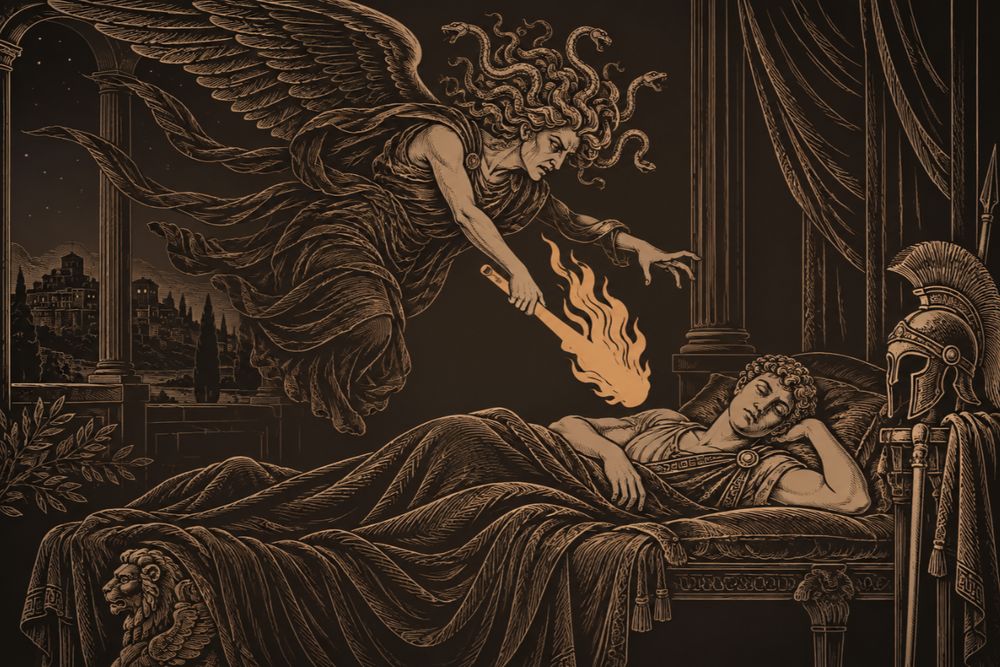
Allecto rouses Turnus
Generated by AI from this page's own facts, not an ancient image or evidence of anything. How this site uses generated images
The war in Latium begins with a goddess who cannot accept defeat. In Book 7 of the Aeneid, Juno sees the Trojan fleet safe in the Tiber and admits she cannot stop Aeneas from taking the Latin throne, because fate has given him Lavinia. She will delay him instead. "Let sire and son buy with their people's blood this marriage-bond," she says, and she summons the Fury Allecto from hell.
Allecto goes first to Queen Amata, the wife of King Latinus. She throws a snake from her hair into the queen's breast. Amata pleads with her husband to keep Lavinia for her kinsman Turnus, then runs raving through the woods with the women of Latium. Allecto next flies to Ardea, where Turnus lies asleep. She takes the shape of an old priestess of Juno and tells him the Trojans are stealing his bride. Turnus laughs at her. Allecto drops the disguise and throws a burning torch into his chest. He wakes sweating and screaming for arms.
The first blood is drawn by accident. Allecto sets the hunting dogs of Ascanius on a tame stag that belongs to the herdsman Tyrrhus and his daughter Silvia. Ascanius shoots the stag, the herdsmen answer with clubs, and the first men die. Allecto sounds a horn from a barn roof and both sides run to arms.
Latinus tries to hold the peace and cannot. Virgil says he refused to open the Gates of War, the ritual that begins a Roman war, and withdrew into seclusion. Juno came down herself and swung the gates open. Turnus then raised the war cry from Laurentum and sent messengers to seek help from the Greek hero Diomedes. Aeneas, after the river god Tiberinus appeared to him in a dream, went to the Arcadian king Evander. There Evander's son Pallas met the strangers with a spear in his hand, took Aeneas by the hand and led him to his father's hall.
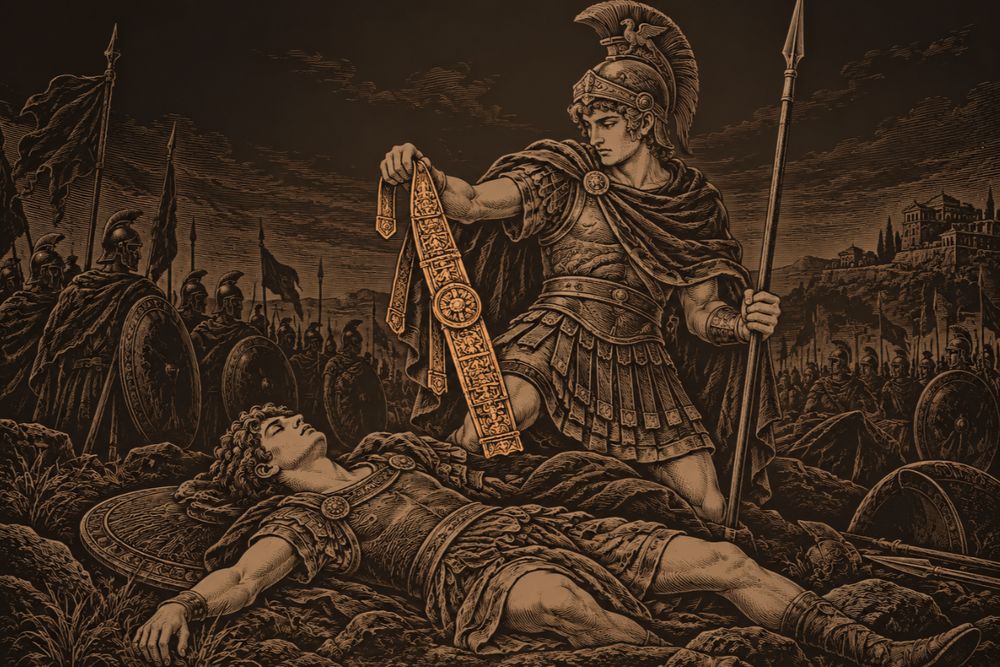
Turnus takes the belt of Pallas
Generated by AI from this page's own facts, not an ancient image or evidence of anything. How this site uses generated images
Pallas dies in Book 10. He fights on Aeneas's side and meets Turnus in the open field. Before the fight he prays to Hercules for help. Virgil says Hercules wept, and Jupiter told him that each man has his day, and that Turnus was near his own. Pallas's spear glances off Turnus. Turnus's spear goes through Pallas's shield and corselet into his heart.
Turnus stands over the body and takes Pallas's sword-belt, which shows a scene of murdered bridegrooms in gold. Virgil stops the story to say that the human heart does not know its fate. When the news reaches Aeneas, he cuts through the enemy line, and the poem says his sword was heading for Turnus. He takes eight captives alive to sacrifice on Pallas's pyre. To a man begging for his life he answers that such bargains ended "with Turnus, when fair Pallas fell."
Book 11 opens with Aeneas beside Pallas's body. He grieves that he must send the boy home to Evander dead, and he sends a guard of a thousand men with the bier. Turnus, meanwhile, answers those in Latinus's council who want peace by offering to fight Aeneas alone. The Volscian warrior Camilla then vows to meet the Trojan cavalry herself. Her death brings Turnus out of his ambush in the hills.
In Book 12 both leaders swear the terms. Aeneas promises that if Turnus wins, the Trojans will leave for Evander's city. If he wins, Latinus keeps his throne and the two peoples share their gods. The treaty does not last. Turnus's sister, the nymph Juturna, disguises herself as a Rutulian officer and stirs the army to break it, and a stray arrow wounds Aeneas as he calls for calm. Turnus rides out and slaughters the Trojan line while Aeneas is carried wounded to camp.
Aeneas returns and turns on the city itself. Virgil says his goddess-mother, Venus, put the plan in his mind. Amata, believing Turnus dead, hangs herself.
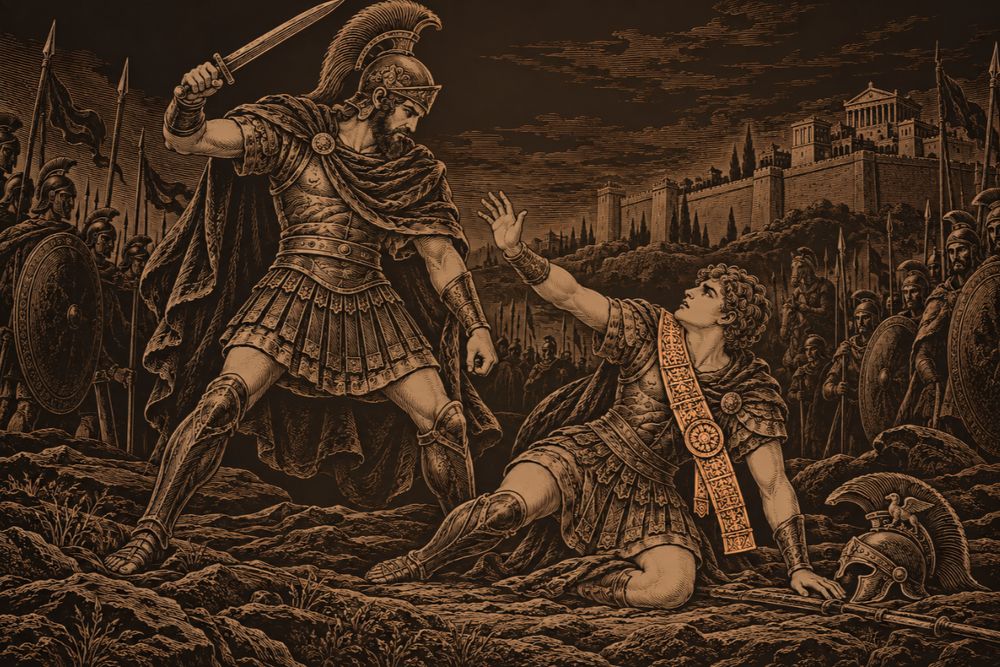
Aeneas sees the belt of Pallas
Generated by AI from this page's own facts, not an ancient image or evidence of anything. How this site uses generated images
The duel comes only after the gods have finished their argument. Jupiter tells Juno the day has come. She has done all she could against the Trojans on land and sea, and he will allow no more. Juno gives way on one condition: the Latins must keep their name and speech, and Troy's name must die. Jupiter grants it, and promises that the mixed people will surpass all other men. He then sends a Fury in the shape of a small night bird to terrify Turnus, and Juturna, seeing it, abandons her brother.
The fight itself is short. Turnus's sword shatters on Aeneas's divine armour, because in his haste he had grabbed the blade of his charioteer Metiscus instead of his father's sword. Vulcan made that armour, and Virgil says its shield showed the wolf and her twins, then Rome's walls and the seizure of the Sabine women (Aeneid 8.626-670). He runs, and Aeneas chases him despite his wound. Turnus grabs a huge boundary stone and hurls it, but his strength fails and it falls short. Aeneas's spear goes through his shield and pierces his thigh. Turnus falls to one knee and asks for mercy for his father Daunus's sake. Virgil's last lines follow.
With swift and dreadful arms Aeneas o'er him stood, with rolling eyes, but his bare sword restraining; for such words moved on him more and more: when suddenly, over the mighty shoulder slung, he saw that fatal baldric studded with bright gold which youthful Pallas wore, what time he fell vanquished by Turnus' stroke, whose shoulders now carried such trophy of a foeman slain. Aeneas' eyes took sure and slow survey of spoils that were the proof and memory of cruel sorrow; then with kindling rage and terrifying look, he cried, "Wouldst thou, clad in a prize stripped off my chosen friend, escape this hand? In this thy mortal wound 't is Pallas has a victim; Pallas takes the lawful forfeit of thy guilty blood!" He said, and buried deep his furious blade in the opposer's heart. The failing limbs sank cold and helpless; and the vital breath with moan of wrath to darkness fled away.
What Followed
The Aeneid ends at the killing, so the marriage and the founding lie outside the poem. In Book 12 Aeneas swears that the citadel he builds will bear Lavinia's name, and Jupiter promises Juno that Latium will keep its name and language while the Trojans blend into the people. Livy carries the story on. He says Aeneas led the Latins to a last victory over the Etruscans and Rutulians, and that his tomb stands on the bank of the river Numicius, where he is called Jupiter Indiges.
Who is Turnus to Aeneas?
Turnus is Aeneas's rival in Italy: the king of the Rutulians, who expected to marry Lavinia and lose her to the newcomer. In Virgil, the Latin queen Amata favours Turnus as her kinsman and sides with him against the Trojans. Livy says Lavinia had been betrothed to him before Aeneas arrived. In both accounts he goes to war against Aeneas and Latinus.
Virgil, Aeneid 7.341-405
Why does Aeneas kill Turnus?
Aeneas is about to spare the wounded Turnus when he sees Pallas's baldric on Turnus's shoulder. Turnus had killed Pallas, the young son of Aeneas's ally Evander, and taken the belt as a trophy. Aeneas says Pallas himself takes the forfeit of Turnus's blood, and kills him. Earlier, after Pallas fell, he had already told a suppliant that such mercy ended with Turnus.
Virgil, Aeneid 12.887-952
Why does Hera hate Aeneas?
In the Roman version she is Juno, and Virgil gives several reasons. She fought for the Greeks at Troy, Paris rejected her beauty in his judgement, and Jupiter honoured Ganymede. She also feared a Trojan people would one day destroy her favourite city, Carthage. She drove the Trojans across the sea for years and, once they reached Latium, stirred up the war against them.
Virgil, Aeneid 1.12-33
Who kills Turnus?
Aeneas strikes the blow, but he says Pallas does it. As he drives his sword into Turnus's chest, he cries that Pallas takes the lawful forfeit of his guilty blood. Virgil does not say what happens next. The poem ends with Turnus's spirit fleeing to the dark, and the question of whether the act is justice or rage is left to the reader.
Virgil, Aeneid 12.938-952
Where Accounts Differ
- virgil-vs-livy-on-the-war
- who-is-to-blame-for-the-war
- who-shot-aeneas
- aeneas-mercy-or-vengeance
- Virgil and Livy give different wars. In Virgil, Aeneid 12.887-952, the war ends with Aeneas killing Turnus in single combat, and the poem stops there. Livy, Ab Urbe Condita 1.2, has Turnus, the Rutulian king to whom Lavinia had been betrothed, declare war on Latinus and Aeneas. Livy says the Aborigines and Trojans lost their leader Latinus in the first battle. Turnus then allies with Mezentius of Caere, and in the second battle Aeneas wins but dies, and his tomb is on the Numicius. Livy 1.2 as read for this page does not say how Turnus dies. In Virgil, Latinus survives the war and Aeneas is alive at its end.
- Who is to blame for the war depends on the reading. In Virgil, Aeneid 7.286-340, Juno openly sets out to delay the marriage with war and sends Allecto. In Aeneid 7.601-640 Latinus refuses to open the Gates of War and Juno does it herself. Turnus and Amata are agents of the Fury, but in Aeneid 7.341-445 Turnus first rejects Allecto's message and is not persuaded until she attacks him, so Virgil leaves some of the choice to him. This page reports the sequence rather than assigning the guilt.
- Virgil says nobody knew who shot the arrow that wounded Aeneas during the broken truce (Aeneid 12.311-323). The poem lets Juturna's meddling, chance or a god stand as possible causes and does not choose. The broken sword is also told as a rumour: Virgil says Turnus took Metiscus's sword by mistake, but adds that this is the tale (Aeneid 12.697-766).
- Whether the killing is justified is disputed by readers, not by the text. Virgil gives Aeneas both a reason to spare Turnus (his suppliant plea, and the memory of his father Anchises) and a reason to kill (the baldric), and he ends the poem at the moment of the stroke (Aeneid 12.887-952). Modern scholars have argued over whether this shows lawful vengeance or a loss of self-control. The page does not take a side.
Read the full source verification →
Mythology
Figures In This Myth
Also Connected
Related Terms
Referenced By
Sources
- Virgil, Aeneid 1.12-33
- Virgil, Aeneid 7.286-340
- Virgil, Aeneid 7.341-405
- Virgil, Aeneid 7.341-445
- Virgil, Aeneid 7.475-510
- Virgil, Aeneid 7.601-640
- Virgil, Aeneid 8.1-18
- Virgil, Aeneid 8.102-152
- Virgil, Aeneid 10.439-509
- Virgil, Aeneid 10.510-530
- Virgil, Aeneid 11.29-58
- Virgil, Aeneid 11.434-444
- Virgil, Aeneid 12.161-195
- Virgil, Aeneid 12.216-260
- Virgil, Aeneid 12.311-323
- Virgil, Aeneid 12.554-590
- Virgil, Aeneid 12.593-611
- Virgil, Aeneid 12.697-766
- Virgil, Aeneid 12.791-842
- Virgil, Aeneid 12.843-886
- Virgil, Aeneid 12.887-952
- Virgil, Aeneid 12.938-952
- Livy, Ab Urbe Condita 1.2
- Virgil, Aeneid 11.469-531
- Virgil, Aeneid 11.896-915
- Virgil, Aeneid 8.626-670