Camilla
Camilla is the Volscian huntress and warrior who fights for Turnus in Virgil's Aeneid. Her exiled father Metabus vowed her to Diana as an infant, and she grew up refusing marriage. She commands Turnus's cavalry, kills many Trojans and Etruscans, and is speared by Arruns while chasing a priest's gold armour. Diana's attendant Opis kills Arruns.
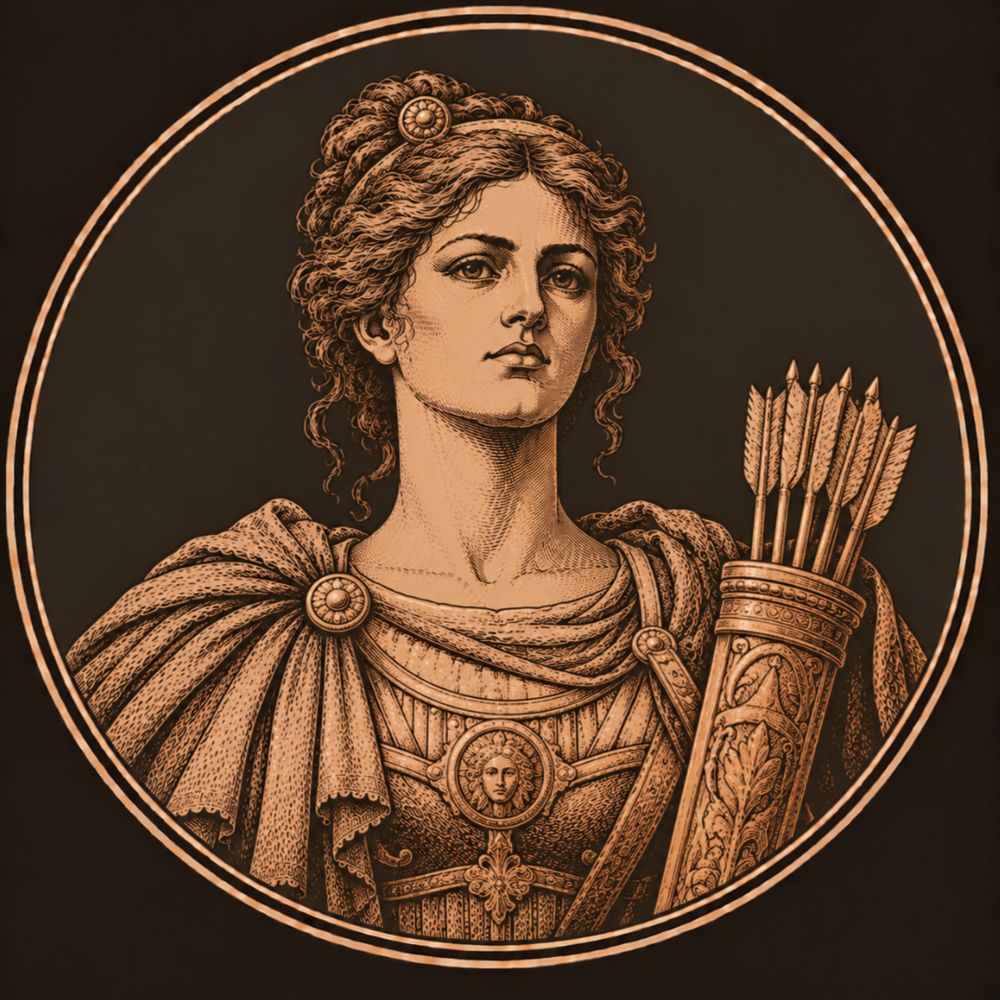
Camilla, bronze medallion illustration
Generated by AI from this page's own facts, not an ancient image or evidence of anything. How this site uses generated images
Sections on this page
Core Myth
Camilla is the Volscian warrior-maiden who fights for Turnus against the Trojans in Virgil's Aeneid. She appears twice: in the catalogue of Italian forces in Book 7, and in Book 11, where she has her great day in battle and dies. The Trojans she fights serve Aeneas, who does not meet her in the poem.
Virgil introduces her last in the catalogue of Turnus's allies. She leads a radiant troop of horse, a virgin who never took to the loom and distaff of Minerva. She is so fast that she could run over standing grain without bending the ears, or skim the sea without wetting her feet (Aeneid 7.803-817). Young men and matrons crowd to watch her pass, in a purple scarf, with a Lycian quiver and a myrtle shaft tipped with steel (Aeneid 7.803-817).
Her origin comes in Book 11, from Diana herself. Her father Metabus, driven out of Privernum for his overbearing rule, fled with the infant Camilla. He named her by altering her mother's name, Casmilla, in the Williams translation. The Volscian soldiers pressed him, and the Amasenus lay in flood across his path (Aeneid 11.532-556).
Metabus tied the child to his spear with a strip of cork-tree bark and vowed her to Diana. He hurled the spear across the river with a prayer that the goddess take the girl as her handmaid. Then he swam over and found her safe on the far bank (Aeneid 11.557-596). He raised her in the wild. A mare suckled her, and she carried a javelin as soon as she could walk. She wore a tigress skin and hunted cranes and swans with a sling. Etruscan matrons sought her as a bride for their sons, but she kept her virginity for Diana (Aeneid 11.557-596).
Diana tells this to her attendant Opis because Camilla is about to die. Diana wishes the girl had never gone to war against the Teucrians, since she would then still be a wood-nymph. She gives Opis a bow and arrows and orders her to kill whoever wounds Camilla, Trojan or Italian, and to bring her body home hidden in a cloud (Aeneid 11.557-596).
Camilla's command comes in the city gate. She jumps from her horse and offers to meet the Trojan cavalry alone, leaving Turnus to hold the walls. Turnus calls her the glory of Italy and gives her the cavalry and the command. He goes off to lay an ambush in a mountain pass for Aeneas (Aeneid 11.469-531).
In battle Virgil compares her to an Amazon, one breast bared, throwing javelins and swinging a battle-axe, with three named companions, Larina, Tarpeia and Tulla. He likens her band to the Thracian women who fight around Hippolyta and to Penthesilea returning in her chariot (Aeneid 11.648-663). She kills a long list of named Trojans and Etruscans, among them Eunaeus, Liris, Pagasus, Amastrus and Ornytus (Aeneid 11.664-689). She also kills Butes and Orsilochus. When a Ligurian dares her to fight on foot, she dismounts, he flees, and she runs down his horse and kills him (Aeneid 11.690-724).
Tarchon, the Etruscan king, shames his men for being beaten by a woman and rallies them. Then Arruns begins to stalk her, waiting for a chance to throw (Aeneid 11.725-767). It comes when she chases Chloreus, a former priest of Cybele in gold Phrygian armour. Virgil says she wanted the splendid spoil, perhaps to hang in a temple or to wear (Aeneid 11.768-793). Arruns prays to Apollo of Soracte. He asks not for spoils but for her death, and for a safe return home (Aeneid 11.768-793).
Apollo grants half of it. Arruns's spear strikes Camilla in the bare breast, and she does not see it coming. She pulls the shaft out but the barb stays in the rib. With her last words she sends her companion Acca to Turnus: he must take up the battle and hold the Trojans back from the city (Aeneid 11.794-835). Arruns flees, glad and frightened, and hides among his men.
Opis, watching from a hill, sees her die. She says Diana will not leave the day unhonoured. She finds Arruns from the tomb of Dercennus, shoots him with one arrow, and he dies unnoticed on the field while she flies back to Olympus (Aeneid 11.836-867). Camilla's troop breaks and the Rutulians run for the walls, where the gates are shut against their own men (Aeneid 11.868-895). Acca reaches Turnus, who abandons his ambush, and the armies of Aeneas and Turnus camp face to face at nightfall (Aeneid 11.896-915).
Who is Camilla in the Aeneid?
Camilla is a Volscian maiden who leads Turnus's cavalry against the Trojans and their Etruscan allies. Virgil lists her in the catalogue of Italian forces, gives her a great day of battle in Book 11, and has Arruns kill her in an ambush (Aeneid 7.803-817; Aeneid 11.648-663; Aeneid 11.794-835). Diana's attendant Opis avenges her (Aeneid 11.836-867).
Virgil, Aeneid 7.803-817
Who was Camilla in Roman mythology?
She is a figure of Virgil's poem, and the sources cited here know her from nowhere else. Her father Metabus, an exile from Privernum, vowed her to Diana as a child, and she grew up as a huntress who refused marriage (Aeneid 11.532-556; Aeneid 11.557-596). Virgil frames her as an Italian answer to the Amazons (Aeneid 11.648-663).
Virgil, Aeneid 11.557-596
What did Camilla do?
She joined the Latin war, took command of Turnus's cavalry, and killed many Trojans and Etruscans, among them Eunaeus, Liris, Pagasus, Amastrus, Ornytus, Butes and Orsilochus (Aeneid 11.469-531; Aeneid 11.664-689; Aeneid 11.690-724). She died when Arruns speared her as she chased the priest Chloreus for his armour, and her last request was that Turnus hold the field (Aeneid 11.768-793; Aeneid 11.794-835).
Virgil, Aeneid 11.664-689
Later Traditions
Every account of Camilla on this page rests on Virgil. No other ancient source cited here tells her story. Her Amazon look is the poet's own comparison, made in the narrator's voice (Aeneid 11.648-663). He does not call her an Amazon. She is an Italian girl compared to them.
The name itself was explained in antiquity. Servius, the Virgil commentator, notes on Aeneid 11.543 that Romans called noble boys and girls who served priests camilli and camillae. He adds that Statius Tullianus reports Callimachus saying the Etruscans called Mercury Camillus, an attendant of the gods. On that reading, Metabus named his daughter for her service to Diana (Servius, Commentary on the Aeneid 11.543).
Virgil is also less than wholly admiring. The poem shows her both as glorious and as a woman who charges after gold armour (Aeneid 11.768-793). Diana mourns her, and Opis says her vow to Diana did not shield her (Aeneid 11.836-867). For the wider Latin war that Camilla dies in, see the story of Aeneas and Turnus and the page on Latinus, the king whose Latins she fights for.
Also Connected
5 recorded connections, each with the ancient line behind it.
Allies
-
Camilla meets Turnus at the city gate and offers to face the Trojan cavalry alone. Turnus gives her the command of the horse. Dying, she sends Acca to tell Turnus that he must hold the field.
Enemies
-
Camilla fights for the Latin side against the Trojans and their Etruscan allies. She never meets Aeneas in the poem.
Connected
-

Arruns prays to Apollo to help him kill Camilla, and Apollo grants half the prayer: her death, but not his safe return.
-

Metabus vows the infant Camilla to Diana, and she grows up as the goddess's huntress. Diana sends Opis to avenge her death.
-
Virgil compares Camilla and her women to the Thracian Amazons around Hippolyta and Penthesilea. Camilla is an Italian virgin warrior, not an Amazon.
Where Accounts Differ
- Camilla's parentage and name
- whether Camilla is an Amazon
- who is to blame for Camilla's death
- Diana's promise to hide Camilla's body
- what Camilla's name means
- Camilla's parentage is given only by Diana in Book 11: her father is Metabus of Privernum, and the child's name is a change of her mother's name Casmilla in the Williams translation (Aeneid 11.532-556). Book 7 gives only that she is bred of the Volscians (Aeneid 7.803-817). No other source cited here says more.
- The meaning of the name is disputed. Virgil says only that Metabus changed her mother's name Casmilla (Aeneid 11.532-556). Servius reads it as the Roman word for a young attendant of priests and cites Statius Tullianus and Callimachus for an Etruscan Camillus as attendant of the gods (Servius, Commentary on the Aeneid 11.543). Servius is a much later commentator, so this is an ancient guess, not a recorded fact.
- Whether Camilla is an Amazon is a matter of comparison, not descent. Virgil compares her to Thracian women who fight around Hippolyta and to Penthesilea (Aeneid 11.648-663), yet Diana's account makes her an Italian huntress raised in exile (Aeneid 11.557-596).
- Apollo's answer to Arruns is split. He grants Camilla's death but denies Arruns his return home, and Opis then kills Arruns (Aeneid 11.794-835; Aeneid 11.836-867). Virgil does not say whether Camilla's death is fated or is a result of her chase after spoils (Aeneid 11.768-793).
- Diana's promise to hide Camilla's body in a cloud and return it to her country is her plan at the start of the episode (Aeneid 11.557-596). The scenes that follow show Opis's arrow and the rout of the Rutulians, and the passage checked here does not show the promise carried out.
Read the full source verification →
Mythology
Appears In
Sources
- Virgil, Aeneid 7.803-817
- Virgil, Aeneid 11.469-531
- Virgil, Aeneid 11.532-556
- Virgil, Aeneid 11.557-596
- Virgil, Aeneid 11.648-663
- Virgil, Aeneid 11.664-689
- Virgil, Aeneid 11.690-724
- Virgil, Aeneid 11.725-767
- Virgil, Aeneid 11.768-793
- Virgil, Aeneid 11.794-835
- Virgil, Aeneid 11.836-867
- Virgil, Aeneid 11.868-895
- Virgil, Aeneid 11.896-915
- Servius, Commentary on the Aeneid 11.543