Fortuna
Fortuna is the Roman goddess of luck and chance. She has almost no myths of her own, and her one love story is with King Servius Tullius (Ovid, Fasti 6.569-584). Horace calls her the goddess who can raise a mortal from the lowest step or turn proud triumphs into funerals (Odes 1.35.1-4). Later writers gave her a wheel.

Fortuna, bronze medallion illustration
Generated by AI from this page's own facts, not an ancient image or evidence of anything. How this site uses generated images
Sections on this page
Core Myth
Fortuna is a cult figure more than a mythic character. Roman writers describe her temples, her festivals and the honours paid to her. They tell almost no adventures and give her no family. The one story that clings to her concerns Servius Tullius, the sixth king of Rome, and the temples he founded for her.
Ovid meets her on 24 June, the festival of Fors Fortuna. He calls the Romans to celebrate on the Tiber's bank, some on foot and some by boat, and to come home merry with wine (Fasti 6.771-784). The common people worship her, he says, because the founder of her temple rose from humble rank. Slaves worship her because Servius was born of a slave woman (Fasti 6.771-784). In Ovid's account the king's father was Vulcan and his mother the captive Ocresia of Corniculum (Fasti 6.569-636).
The love story explains a puzzle in Servius's temple, where a statue stood hidden under layers of cloth. Ovid gives three reasons and admits he is unsure which is right. In the first, Fortuna loved the king. She was ashamed that a goddess should lie with a mortal, so she entered his house by a small window. That is why the gate is called the Fenestella, the Little Window. Of all men, Servius was the only one for whom she was not blind (Fasti 6.569-584).
The second reason is grief. After the murder of the gentle king, the people wrapped his statue in robes because the sight of it increased their sorrow. The third is the crime of his daughter Tullia, who drove her chariot over her father's body. The statue of Servius is said to have covered its eyes and cried out that its face must be hidden. Fortuna herself forbade anyone to move the robe and spoke from her temple. The day the statue is uncovered will be the first day that modesty is cast to the winds (Fasti 6.585-636). Ovid adds that the temple once burned, but the fire spared the statue (Fasti 6.569-636).
Plutarch tells a related tale in Greek. Servius, he says, attached himself to Fortune and bound his rule to her, until people believed she visited him through a window later called the Porta Fenestella (On the Fortune of the Romans 322f-323a). Plutarch reports that Servius built her a temple on the Capitoline, now called Fortuna Primigenia, and another of Fortuna Obsequens, and founded most of her other titles (On the Fortune of the Romans 322f-323a). The list includes a Private Fortune on the Palatine, a Virgin Fortune, a Fortune of Good Hope and a Men's Fortune beside the altar of Venus of the Basket. Her cult, on this reading, grew from many shrines rather than one story.
Is there a goddess of fortune?
Yes. The Romans worshipped Fortuna as goddess of luck and chance, with temples across Rome. Plutarch says the city's shrines to Fortune were splendid and ancient, while it had none for Wisdom or Prudence (On the Fortune of the Romans 318e-f). Pliny says Fortune alone is invoked in all places and at all hours (Natural History 2.22). She was not one goddess with one cult. Plutarch lists many titles, such as Private Fortune, Virgin Fortune and Men's Fortune (On the Fortune of the Romans 322f-323a).
Plutarch, On the Fortune of the Romans 318
What does Fortuna mean?
Fortuna is the Latin word for luck or chance, and also the name of the goddess who was thought to bring it. Pliny shows both senses. He says Fortune alone is invoked everywhere, as the one to praise or blame for everything that happens (Natural History 2.22). Ovid's festival of Fors Fortuna uses the paired name (Fasti 6.771-784). Plutarch, writing in Greek, explains her Latin titles in Greek terms (On the Fortune of the Romans 322f-323a). Ancient etymologies of the word were not checked for this page.
Pliny the Elder, Natural History 2.22
Is Fortuna considered good or bad luck?
Both. Fortuna gave and took, and Roman writers stress the turn. Horace says she can raise a mortal from the lowest step or turn proud triumphs into funerals (Odes 1.35.1-4). In his poem, Hope and Faith stay with her, but false friends leave when she departs (Odes 1.35.21-28). Pliny says she is praised and blamed at once, and thought blind, fickle and uncertain (Natural History 2.22). Boethius writes that her nature is change (Consolation of Philosophy 2, prose 1).
Horace, Odes 1.35.1-4
What is the myth of Fortuna?
Fortuna has no full myth. Her main story is Ovid's tale of her love for King Servius Tullius. She was ashamed to love a mortal, so she entered his house by a small window (Fasti 6.569-584). Ovid also explains why his statue in her temple was veiled, and gives a second and third reason (Fasti 6.585-636). Plutarch tells of the same window (On the Fortune of the Romans 322f-323a). Apart from this, she is known through cults and titles, not adventures.
Ovid, Fasti 6.569-584
What is the history of Lady Fortuna?
Her cult is old, and Roman writers date it to the kings. Plutarch says Ancus Marcius built the first temple to Fortune (On the Fortune of the Romans 318e-f) and that Servius Tullius founded most of her later shrines (On the Fortune of the Romans 322f-323a). Livy dates the Women's Fortune temple to the story of Coriolanus (Ab Urbe Condita 2.40.12). Horace and Pliny show how central she remained in their Rome (Odes 1.35; Natural History 2.22). The Boethian wheel and the Machiavellian river came later.
Plutarch, On the Fortune of the Romans 318
Why is goddess Fortuna blindfolded?
The ancient sources say she is blind, not blindfolded. Cicero says Fortune is blind herself and makes blind those she embraces (De Amicitia 54). Pliny says most people think her blind and a friend to the unworthy (Natural History 2.22). Boethius calls her the blind goddess (Consolation of Philosophy 2, prose 1). The blindfold is a later visual choice, and no ancient text checked for this page describes it. Ovid says the opposite of Servius's lover, that she was not blind for him (Fasti 6.569-584).
Cicero, De Amicitia 54
Later Traditions
Fortuna's best-known cult in the early Republic belonged to women. Livy tells how the matrons of Rome went to Veturia, the mother of Coriolanus, and to his wife Volumnia. They persuaded Veturia to plead with her son, and he withdrew the Volscian army from Rome. In thanks, Livy says, a temple was built and dedicated to Fortuna Muliebris, the Women's Fortune, as a memorial of their deed (Ab Urbe Condita 2.40.12). Plutarch adds that the statue, once consecrated, spoke and told the women of the city that they had dedicated it by the holy law of Rome (On the Fortune of the Romans 318f-319a).
Ovid records a second women's cult. On the Kalends of April, Roman women burn incense to Virile Fortune in the warm-water baths, where all strip and their blemishes show. Ovid says she hides the flaws from the men (Fasti 4.133-162). Horace turns the goddess into a poem of power and dread. He addresses her as the goddess who rules Antium, able to lift a mortal from the lowest step or turn proud triumphs into funerals (Odes 1.35.1-4). The poor farmer prays to her, and so does the sailor on the Carpathian sea, and Dacians, Scythians, Latium and kings' mothers fear her (Odes 1.35.5-14). Grim Necessity walks before her with nails and wedges in her bronze hand (Odes 1.35.17-20). Hope and Faith follow her, but the faithless crowd and false friends leave when she departs (Odes 1.35.21-28). Horace also asks her to keep Caesar safe on his way to the far Britons (Odes 1.35.29-30).
Cicero and Pliny supply the idea that Fortune is blind. Cicero says Fortune is not only blind herself but usually makes blind those whom she embraces, and that a fortunate fool is intolerable (De Amicitia 54). Pliny the Elder says that in all places and at all hours Fortune alone is invoked and named. She is praised and blamed, and worshipped with abuse. Most people, he adds, think her blind, fickle, uncertain and a supporter of the unworthy (Natural History 2.22).
Plutarch argues that Fortune helped make Rome great. He says Virtue made Romulus great, but Fortune watched over him until he became great (On the Fortune of the Romans 321b). In his Gallic siege story, Rome's Fortune raised the alarm through the sacred geese kept at the temple of Juno (On the Fortune of the Romans 325c). He observes that the Romans built splendid, ancient shrines to Fortune but none for Wisdom or Prudence. He says Ancus Marcius, fourth king after Romulus, built the first (On the Fortune of the Romans 318e-f). Livy gives another Fortuna temple with a clear date. Publius Sempronius vowed a temple to Fortuna Primigenia in battle against Hannibal in the Croton countryside (Ab Urbe Condita 29.36). It was dedicated on the Quirinal hill ten years later by the duumvir Quintus Marcius Ralla (Ab Urbe Condita 34.53).
Modern Influence
Boethius gave Fortuna her medieval image. In the Consolation of Philosophy, written in prison in the early sixth century, Lady Philosophy tells him that Fortune has not changed. Change is her nature, and she keeps her constancy in her very inconstancy. Boethius calls her the blind goddess and her face changeful (Consolation of Philosophy 2, prose 1). Philosophy asks whether he would stop the turning of the wheel. If it stood still, she says, it would cease to be the wheel of Fortune (Consolation of Philosophy 2, prose 1). In prose 2, Fortune answers in her own voice. She says she turns the wheel and delights to see the high come down and the low ascend (Consolation of Philosophy 2, prose 2).
Machiavelli, in the early sixteenth century, takes the goddess into politics. In chapter 25 of The Prince he says fortune may rule half our actions but leaves the other half, or a little less, to us. He compares her to an impetuous river that floods the plains but can be held by dikes and banks built in quiet times (The Prince 25). He concludes that it is better to be impetuous than cautious, since fortune is a woman who is mastered by force (The Prince 25).
Nothing in the ancient passages checked for this page describes a blindfold. Cicero, Pliny and Boethius call Fortuna blind, and Ovid says she was not blind for Servius. The blindfolded image belongs to later art.
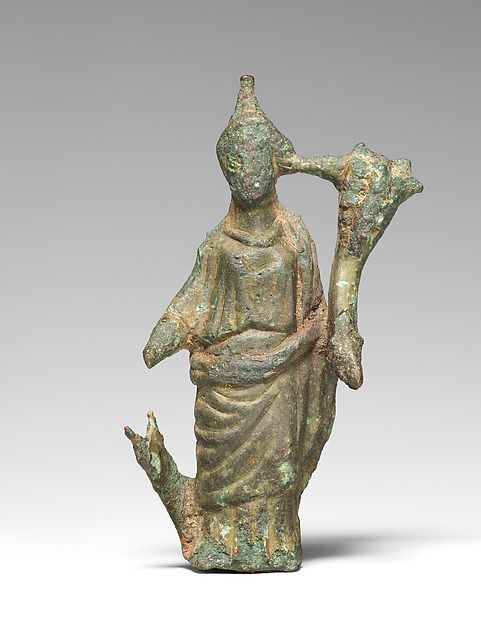
Bronze statuette of the goddess Fortuna - Roman, ca. 2nd century CE, Bronze
Metropolitan Museum of Art, New York, NY, 96.9.400. CC0
Also Connected
4 recorded connections, each with the ancient line behind it.
Connected
-

In Plutarch's account of the Gallic night attack, Rome's Fortune raised the alarm through the sacred geese kept at the temple of Juno (On the Fortune of the Romans 325c).
-

Plutarch argues that Virtue made Romulus great but Fortune watched over him until he became great, and that Fortune provided the founding of the city by preserving its founder (On the Fortune of the Romans 321b).
-

Ovid places the rite of Virile Fortune beside the rite of Venus in the baths on the Kalends of April, and Venus is Verticordia (Fasti 4.133-162). Plutarch places a shrine of the Men's Fortune beside the altar of Venus of the Basket (On the Fortune of the Romans 322f-323a).
-

In Ovid's account, Servius Tullius, the king Fortuna loved, was fathered by Vulcan, and Vulcan saved the statue in her temple from a fire (Fasti 6.569-636). Plutarch says some named the household Lar instead (On the Fortune of the Romans 322f-323a).
Where Accounts Differ
- why the statue of Servius was veiled
- who built the first temple of Fortune
- where Fortuna Primigenia stood
- the Women's Fortune and the speaking statue
- who fathered Servius Tullius
- blind or blindfolded
- Fortuna has almost no narrative myth. What survives is cult: temples, festivals, titles and the Servius Tullius story. Ovid's Fasti (6.569-636, 6.771-784) and Plutarch's On the Fortune of the Romans (322f-323a) are the fullest accounts, and neither gives her a genealogy.
- Why the statue in Servius's temple was veiled is disputed. Ovid gives three reasons and does not choose. Fortuna loved the king and hid her face from shame (Fasti 6.569-584). Or the people covered his statue in grief after his murder. Or the statue hid its eyes from his daughter Tullia (Fasti 6.585-636). Plutarch has the window visits but not the three explanations (On the Fortune of the Romans 322f-323a).
- The first temple of Fortune is placed differently. Plutarch says Ancus Marcius built the first (On the Fortune of the Romans 318e-f), yet a few pages on he credits Servius Tullius with the Capitoline temples and most of her titles (322f-323a). Ovid credits Servius with the temple beside the Tiber (Fasti 6.569-636, 6.771-784).
- Fortuna Primigenia is placed differently. Plutarch makes it a temple of Servius on the Capitoline (On the Fortune of the Romans 322f-323a). Livy describes a temple to Fortuna Primigenia vowed by Publius Sempronius in the Hannibalic war and dedicated on the Quirinal (Ab Urbe Condita 29.36; 34.53). They may be different buildings or different traditions.
- The Women's Fortune is told differently. Livy records a temple and the women's deed (Ab Urbe Condita 2.40.12). Plutarch adds that the statue spoke (On the Fortune of the Romans 318f-319a). Plutarch also says the temple stood before the time of Camillus (On the Fortune of the Romans 318f-319a).
- Servius's father is given differently. Ovid says Vulcan was his father and Ocresia his mother (Fasti 6.569-636). Plutarch reports that some named the household Lar and others Vulcan as the father (On the Fortune of the Romans 322f-323a).
- The blindfold is not ancient. Cicero, Pliny and Boethius call Fortune blind (De Amicitia 54; Natural History 2.22; Consolation of Philosophy 2, prose 1). The sources checked never describe a blindfold. The iconography of the cornucopia as her symbol was not checked in a text for this page.
Read the full source verification →
Mythology
Related Terms
Sources
- Ovid, Fasti 4.133-162
- Ovid, Fasti 6.569-636
- Ovid, Fasti 6.771-784
- Horace, Odes 1.35
- Livy, Ab Urbe Condita 2.40.12
- Plutarch, On the Fortune of the Romans 318e-325c
- Cicero, De Amicitia 54
- Pliny the Elder, Natural History 2.22
- Boethius, Consolation of Philosophy 2
- Machiavelli, The Prince 25