Cybele
Cybele is the Phrygian Mother of the Gods, a tower-crowned goddess of mountains, lions and ecstatic music. Livy says Rome brought her sacred stone from Pessinus in 204 BCE, after a Sibylline oracle promised that a foreign invader could then be driven from Italy. Romans called her the Magna Mater. Strabo says the Phrygians worshipped her as Rhea.
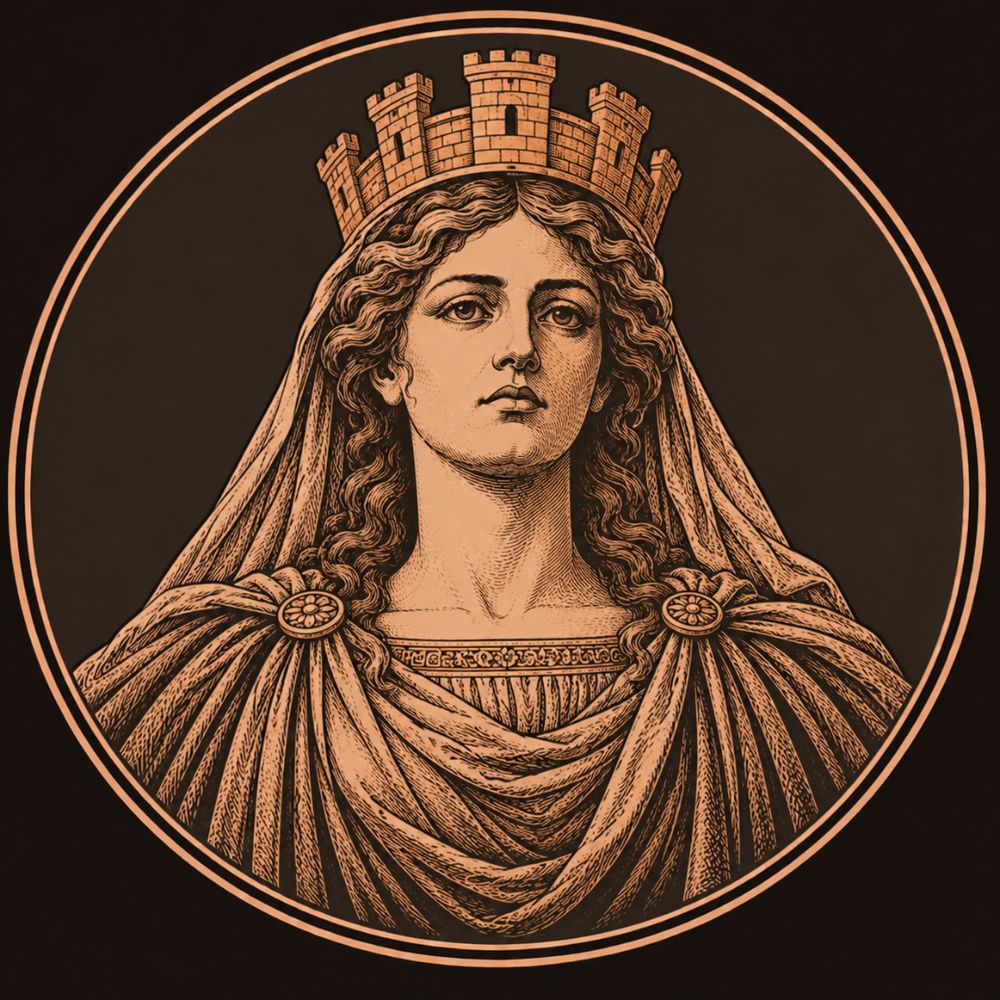
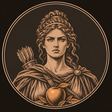
Cybele, bronze medallion illustration
Generated by AI from this page's own facts, not an ancient image or evidence of anything. How this site uses generated images
Sections on this page
Core Myth
Livy tells how Cybele came to Rome. Late in the war with Hannibal, frequent showers of stones led the Romans to consult the Sibylline Books. There they found a verse about any foreign enemy who brought war into Italy. He could be driven out and beaten if the Idaean Mother were brought from Pessinus to Rome (Livy, Ab Urbe Condita 29.10). Envoys sailed east and stopped at Delphi. The oracle told them they would get what they sought through King Attalus, and that the best man in Rome must receive the goddess. Attalus led them to Pessinus in Phrygia. There he handed over a sacred stone that the local people said was the Mother of the Gods (29.11).
The Senate judged Publius Scipio, son of the Gnaeus who had fallen in Spain, the best man in the state. He was a young man who had not yet held the quaestorship. He went out to Ostia with the matrons of Rome, took the goddess from the ship, and handed her to the leading women. They passed her from hand to hand through a city lined with burning incense. They carried her to the temple of Victory on the Palatine, and the games called the Megalesia were held (29.14).
Ovid's Fasti tells the same arrival as a miracle. The ship stuck fast in the shallows of the Tiber and no team of men could move it. Claudia Quinta, a noblewoman falsely suspected of unchastity, prayed to the goddess to follow her only if she was pure. She then drew the ship upstream with a light pull on the rope (Fasti 4.291-328). The procession washed the goddess in the river Almo and brought her through the Capene Gate, with Claudia walking first (Fasti 4.337-346).
The myth most tied to her is the story of Attis. In Catullus, Attis is a young Greek who sails to Phrygia, castrates himself in a frenzy, and leads the Gallae up Mount Ida with the drum (Carmina 63.1-34). Waking, he regrets it. Cybele unyokes one of her lions and sends it to drive him back into the woods, where he serves her for the rest of his life (Carmina 63.76-90). Ovid's Attis is a Phrygian boy whom the tower-crowned goddess loved chastely. He broke his vow with the nymph Sagaritis, the goddess destroyed the nymph, and Attis castrated himself in madness (Fasti 4.223-244).
What is the symbol of Cybele?
Her chief symbols are lions and a crown shaped like city walls. Virgil pictures her riding in a chariot through Phrygian cities, crowned with towers (Aeneid 6.784-787). Aeneas's prayer names her yoked lions and her turreted cities (Aeneid 10.252-253). In Ovid's Fasti the poet asks the Muse why lions draw her. The answer is that she tamed their wildness, and she agrees that the towered crown recalls her gift of towers to the first cities (Fasti 4.215-221). Her rites belong to the tympanum, a hand drum, played with cymbals and the Phrygian pipe (Fasti 4.181-184). Lucretius reads each emblem as an allegory of the Earth (De Rerum Natura 2.600-607).
Virgil, Aeneid 10.252-255
What is the relationship between Cybele and Dionysus?
Greek tragedy joins their worship. In Euripides' Bacchae, the chorus blesses whoever keeps the rites of the great mother Cybele and serves Dionysus with thyrsus and ivy (Bacchae 78-82). Dionysus himself calls the drum the invention of mother Rhea and himself (Bacchae 58-59). A later ode says the Corybantes made the drum in a Cretan cave and gave it to Rhea. Raving satyrs joined the mother goddess's rites, and the drum passed into the festival dances Dionysus loves (Bacchae 120-134). Apollodorus adds a myth: Dionysus came to Cybela in Phrygia, where Rhea purified him and taught him the rites (Library 3.5.1). Neither source makes Cybele his mother.
Euripides, Bacchae 78-82
Who were the children of the goddess Cybele?
Roman poets make her the mother of the gods in a literal sense. In the Aeneid she addresses Jupiter as her son, and he answers her as his mother (Aeneid 9.83-94). Virgil also pictures her glad in her offspring of gods, embracing a hundred descendants who all dwell in heaven (Aeneid 6.784-787). Ovid's Muse says her games come first in the year because she bore the gods, and they gave their mother first place (Fasti 4.357-360). This family comes from her identification with Rhea, who bore Hestia, Demeter, Hera, Hades, Poseidon and Zeus to Kronos (Hesiod, Theogony 453-458). Attis is her devotee, not her son (Catullus, Carmina 63).
Virgil, Aeneid 9.77-122
Was Cybele a hermaphrodite?
Not in the sources used here. The idea comes from a related figure, Agdistis. Pausanias reports the local legend of Pessinus. Seed that Zeus let fall in his sleep produced a spirit with both male and female organs, called Agdistis. The gods, fearing it, cut off the male organ (Description of Greece 7.17.10). Pausanias tells this as the start of the Attis story, not as a story about the Mother. The link comes from Strabo. He says the people of Pessinus call the Mother of the Gods Agdistis (Geography 12.5.3), and he lists Agdistis among the names the Phrygians give Rhea (Geography 10.3.12). Whether Agdistis and Cybele were one goddess is disputed.
Pausanias, Description of Greece 7.17.10-12
Is Cybele the same as Rhea?
Ancient writers often treat them as one goddess, but not always. Strabo says the Phrygians and the Trojans around Ida honor Rhea with orgiastic rites. They call her Mother of the Gods, Agdistis, Idaea, Dindymene, Cybele and Cybebe (Geography 10.3.12). Euripides uses both names in one play, Rhea in one ode and Cybele in another (Bacchae 58-59, 78-79). Virgil's Cybele calls Jupiter her son, the role Hesiod gives Rhea (Aeneid 9.83-84). Yet the goddess Rome fetched was Phrygian, a sacred stone from Pessinus (Livy, Ab Urbe Condita 29.11). This site keeps two pages: Rhea for Hesiod's Titaness, and this one for the Phrygian and Roman goddess.
Strabo, Geography 10.3.12
How did Cybele come to Rome?
By order of an oracle, during the war with Hannibal. Livy says a verse in the Sibylline Books promised that a foreign invader could be driven from Italy. The condition was that the Idaean Mother be brought from Pessinus to Rome (Ab Urbe Condita 29.10). King Attalus of Pergamum led the Roman envoys to Pessinus and gave them a sacred stone, which the locals said was the goddess (29.11). The young Publius Scipio, judged the best man in Rome, received her at Ostia in 204 BCE. Matrons carried her to the Palatine (29.14). Strabo confirms that Rome sent for the goddess from Pessinus on the Sibyl's advice (Geography 12.5.3).
Strabo, Geography 12.5.3
Later Traditions
Her Greek cult is older than her Roman one. The short Homeric Hymn to the Mother of the Gods praises the mother of all gods and men. She delights in rattles, drums, flutes, and the cry of wolves and lions (lines 1-5). The hymn never names her. Herodotus tells of the Scythian Anacharsis, who saw the people of Cyzicus keep the Mother's festival and vowed to do the same at home. He carried out her rite in a Scythian wood with a small drum, and the Scythian king shot him dead for it (Histories 4.76).
In Euripides' Bacchae, the chorus of maenads keeps her rites alongside those of Dionysus (Bacchae 78-82). In Ovid's Metamorphoses, she turns Atalanta and Hippomenes into lions and yokes them to her chariot, after they defile her shrine (Metamorphoses 10.686-704).
Virgil gives her a place in Rome's founding story. The pines that built Aeneas's fleet came from her sacred grove on Mount Ida, and she asks Jupiter, her son, to protect them (Aeneid 9.80-92). When Turnus tries to burn the ships, they break their moorings and become sea nymphs (Aeneid 9.107-122). Before his decisive battle Aeneas prays to her as the kindly Idaean mother of the gods (Aeneid 10.252-255).
Rome kept her festival every April. Livy dates her arrival to the day before the Nones of April (Ab Urbe Condita 29.14). Ovid describes the Megalesia with its Phrygian pipe, drums and cymbals, played by half-men, while her companions carry the goddess through the streets (Fasti 4.179-190). He derives the name of her priests, the Galli, from a Phrygian river called Gallus whose water drives drinkers mad (Fasti 4.361-366). Livy records that her temple on the Palatine was dedicated thirteen years after its contract was let (Ab Urbe Condita 36.36). Lucretius reads her whole procession as an allegory of the Earth. The lions show that even wild offspring are tamed by parental care. The walled crown shows that the Earth holds up cities (De Rerum Natura 2.600-607).
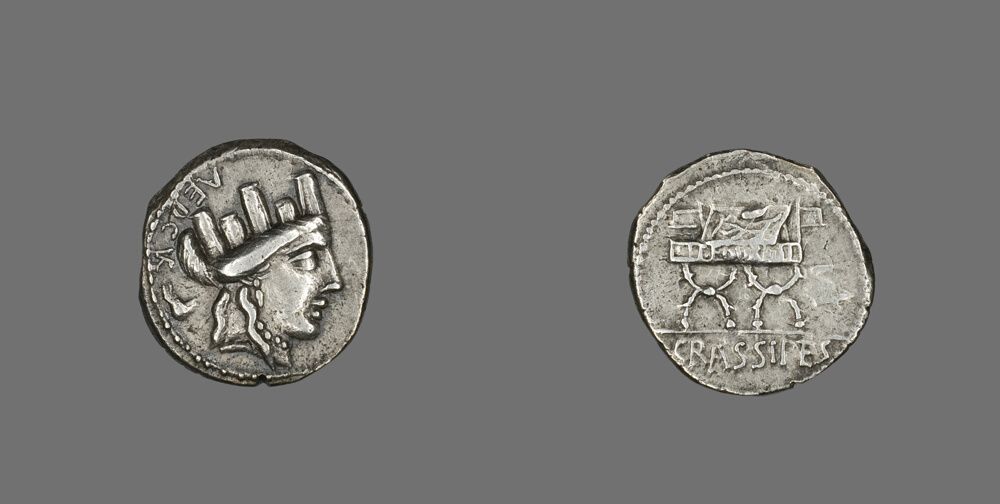
Denarius (Coin) Depicting the Goddess Cybele - Italy, 84 BCE, Silver
The Art Institute of Chicago, Chicago, IL, 1923.1249. CC0
Also Connected
6 recorded connections, each with the ancient line behind it.
Enemies
-
Turnus tries to burn the ships made from Cybele's sacred pines. She frees them from their moorings and turns them into sea nymphs.
Connected
-
Aeneas builds his fleet from Cybele's sacred pines on Ida, and she turns the ships into sea nymphs when Turnus tries to burn them. Aeneas later prays to her before battle (Aeneid 10.252-255).
-
After Atalanta and Hippomenes defile a shrine of the Mother of the Gods, the tower-crowned goddess turns them into lions that draw her chariot.
-

The chorus of the Bacchae blesses whoever keeps the rites of Cybele, the great mother, and serves Dionysus with thyrsus and ivy.
-

Virgil's Berecyntian mother of the gods addresses Jupiter as her son and asks him to protect the ships cut from her sacred pines on Ida.
-

Strabo says the Phrygians and the Trojans around Ida worship Rhea under the names Mother of the Gods, Idaea, Dindymene, Cybele and Cybebe.
Where Accounts Differ
- Cybele as Rhea or a separate Phrygian goddess
- Attis in Catullus, Ovid and Pausanias
- Claudia Quinta: matron or miracle worker
- sacred stone, image or statue
- who founded her Palatine temple
- why lions draw her chariot
- why her priests are called Galli
- Cybele and Rhea are identified in some sources and kept apart in others. Strabo says the Phrygians honor Rhea under the names Mother of the Gods, Agdistis, Idaea, Dindymene, Sipylene, Pessinuntis, Cybele and Cybebe (Geography 10.3.12). Euripides calls the goddess of the drum Rhea in one ode and Cybele in another (Bacchae 58-59, 78-79, 120-134). Ovid's Muse tells Rhea's grief at Saturn swallowing her children as the reason for Cybele's noisy rites (Fasti 4.197-214), and Virgil's Cybele calls Jupiter her son (Aeneid 9.83-84). The Homeric Hymn to the Mother of the Gods names no one. Lucretius treats the Great Mother as the Earth itself, read allegorically (De Rerum Natura 2.598-643). Livy's Romans fetched a Phrygian cult object, a sacred stone from Pessinus (Ab Urbe Condita 29.11).
- The Attis story survives in incompatible versions. Catullus makes Attis a Greek youth who sails to Phrygia, castrates himself in a frenzy, regrets it, and is driven back to serve Cybele by her lion (Carmina 63). There is no love story. Ovid makes him a Phrygian boy whom the goddess loved chastely. He broke his vow with the nymph Sagaritis, the goddess killed the nymph by felling her tree, and he castrated himself in madness, the model for her priests (Fasti 4.223-244). Pausanias gives two more. Hermesianax made Attis a eunuch from birth, son of Galaus, killed by a boar that Zeus sent (Description of Greece 7.17.9-10). The local legend of Pessinus has him born from an almond of the two-sexed Agdistis. Agdistis loved him and drove him mad at his wedding (Description of Greece 7.17.10-12).
- Livy and Ovid tell the arrival of the goddess differently. In Livy, Claudia Quinta is simply one of the leading matrons who received the goddess, and the service is said to have made her doubted chastity famous (Ab Urbe Condita 29.14). Ovid adds the miracle: the ship ran aground in the Tiber, and Claudia alone drew it free after praying to the goddess (Fasti 4.291-344). Livy's Attalus hands over the stone courteously (Ab Urbe Condita 29.11). Ovid's Attalus refuses until the earth trembles and the goddess speaks from her shrine (Fasti 4.265-272). Livy names the receiver as Publius Scipio, son of Gnaeus (Ab Urbe Condita 29.14), while Ovid calls him Nasica (Fasti 4.347).
- The sources differ on what Rome received. Livy calls it a sacred stone that the locals said was the Mother of the Gods (Ab Urbe Condita 29.11). Ovid speaks of the goddess's image, before which Claudia kneels (Fasti 4.317). Strabo says the Romans sent for the goddess's statue (Geography 12.5.3).
- The founding of her Palatine temple is credited differently. Livy says the censors let the contract and Marcus Junius Brutus dedicated it thirteen years later, with games called the Megalesia (Ab Urbe Condita 36.36). Ovid says Metellus was its founder, that Augustus was now its restorer, and that the people paid for it with coins (Fasti 4.347-352). Livy also dates the goddess's journey in two ways. Her arrival falls in the year after the oracle (Ab Urbe Condita 29.14). A later book says she was brought from Asia in the consulship of Scipio and Licinius (Ab Urbe Condita 36.36).
- Different reasons are given for her lions. In Ovid's Metamorphoses, the lions that draw her chariot were once Atalanta and Hippomenes, punished for defiling her shrine (Metamorphoses 10.686-704). In the Fasti, the lions show that she tamed their wildness (Fasti 4.215-218). Lucretius says poets yoked wild beasts to her because even wild offspring must be softened by their parents' care (De Rerum Natura 2.600-605).
- Her priests' name is explained two ways. Ovid derives the Galli from the Phrygian river Gallus, whose water maddens those who drink it (Fasti 4.361-366). Lucretius says the goddess is given eunuch priests to signify that those who dishonor their parents are unworthy to bring children into the world (De Rerum Natura 2.614-617). Catullus calls the self-castrated followers Gallae, in the feminine (Carmina 63.12).
Read the full source verification →
Mythology
Appears In
Related Terms
Sources
- Livy, Ab Urbe Condita 29.10
- Livy, Ab Urbe Condita 29.11
- Livy, Ab Urbe Condita 29.14
- Livy, Ab Urbe Condita 36.36
- Ovid, Fasti 4.179-372
- Catullus, Carmina 63
- Virgil, Aeneid 6.784-787
- Virgil, Aeneid 9.77-122
- Virgil, Aeneid 10.252-255
- Ovid, Metamorphoses 10.686-704
- Euripides, Bacchae 58-59
- Euripides, Bacchae 78-82
- Euripides, Bacchae 120-134
- Apollodorus, Library 3.5.1
- Herodotus, Histories 4.76
- Strabo, Geography 10.3.12
- Strabo, Geography 12.5.3
- Pausanias, Description of Greece 7.17.9-12
- Hesiod, Theogony 453-458