Atalanta and the Race
Atalanta and the race is the myth of a huntress who would marry only the man who outran her, and who killed the men she caught. One suitor won with three golden apples from Aphrodite, which he dropped so she would stop to pick them up. Ovid names him Hippomenes and Apollodorus names him Melanion. Both end with the couple turned into lions.
Sections on this page
What Led To It
Atalanta is the Arcadian huntress of her own page, where her exposure as an infant and her place at the Calydonian boar hunt are told. This page follows only the race. Apollodorus places it after she found her parents, when her father tried to persuade her to wed.
The name of the husband depends on the teller. Apollodorus calls him Melanion and reports that Euripides called him Hippomenes. Ovid uses Hippomenes throughout and adds a family for him, Megareus of Onchestus as father and Neptune as ancestor. Ovid is also the only one of the two who gives the race a frame: Venus recounts it to Adonis as a warning.
The Myth
The race is a contract with a single term. A suitor who ran faster than Atalanta won her, and a suitor she overtook lost his life. Apollodorus tells it in a few lines. When her father tried to persuade her to marry, she went to a place that could serve as a racecourse and planted a stake three cubits high in the middle of it. She made the wooers race before her from that stake, and she ran behind them in arms. A wooer who was caught up was killed on the spot. One who was not caught up got marriage.
Ovid explains why she set the terms. In his Metamorphoses she once asked an oracle about marriage, and the god told her she would never need a husband, that a husband would be her harm, and that while still living she would lose herself. Frightened, she lived unwed in the shaded woods and drove off the crowd of suitors by making them race.
I will not be won,” she said, “Till I am conquered first in speed. Contest the race with me. A wife and couch shall both be given to reward the swift, but death must recompense the one who lags behind. This must be the condition of a race.
Ovid is blunt about the result. She was pitiless, he says, yet her beauty was so powerful that a rash crowd of men accepted the terms. The two ancient tellings picture the start differently. In Apollodorus the suitors run ahead of her and she pursues with a weapon. In Ovid the runners crouch at the trumpet and both spring away, and no weapon is mentioned.
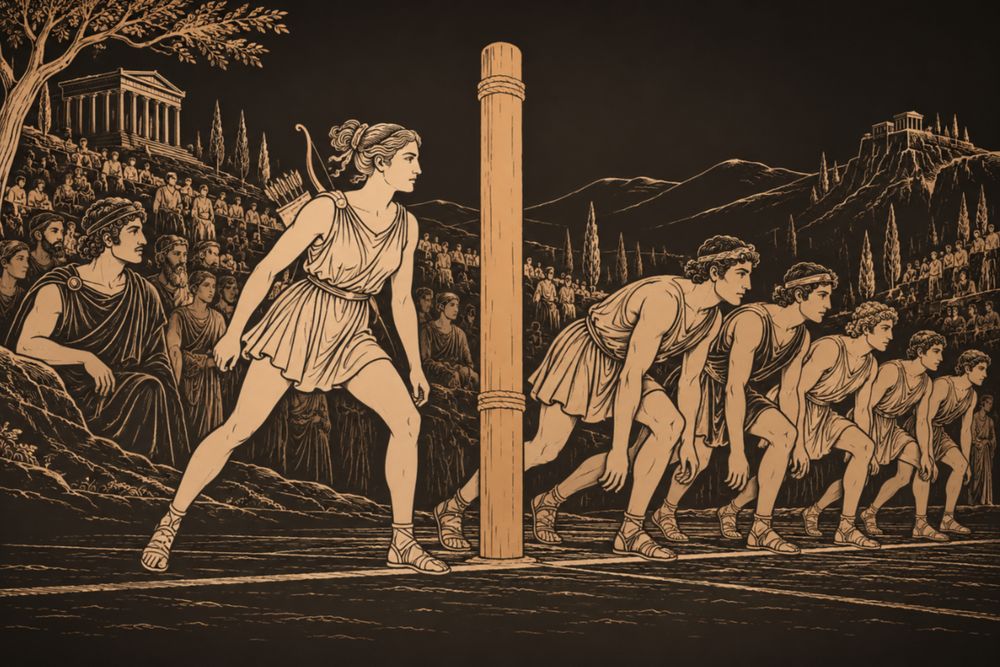
Atalanta at the starting post
Generated by AI from this page's own facts, not an ancient image or evidence of anything. How this site uses generated images
Hippomenes comes to the racecourse as a spectator. Ovid says he sat down to watch a cruel contest and asked why anyone would seek a wife at such risk. Then he saw her stripped for running, and he apologised aloud to the men he had blamed. Ovid lets her ribbons, her streaming hair and the pink flush on her skin do the work of persuading him. She won the race he watched, was crowned with a festal wreath, and the beaten suitors paid the penalty they had agreed to.
Hippomenes was not deterred. He stood in the middle of the crowd and challenged her. His father was Megareus of Onchestus, he said, and Neptune was Megareus's grandfather, so he was a great-grandson of the king of the waters. If he lost, she would at least be beaten by a man of name. If he won, she would have the fame of being the only woman to lose to him.
Atalanta hesitates, and Ovid gives her a speech. She wonders which god envies this handsome youth enough to send him to his death. She tells herself that it is his age that moves her, and his fearless spirit, more than his looks. She tells him to leave while he can, then wishes he might prove the faster runner. Ovid says she was untouched by desire until then, and that she loves without knowing she is in love.
The story reaches us through Venus. In Ovid she tells it to Adonis as a warning, and she stops to complain in her own voice. The crowd and her father demand the usual race, and Hippomenes prays to her: be near, and smile on the love you have inspired. She says the prayer moved her.
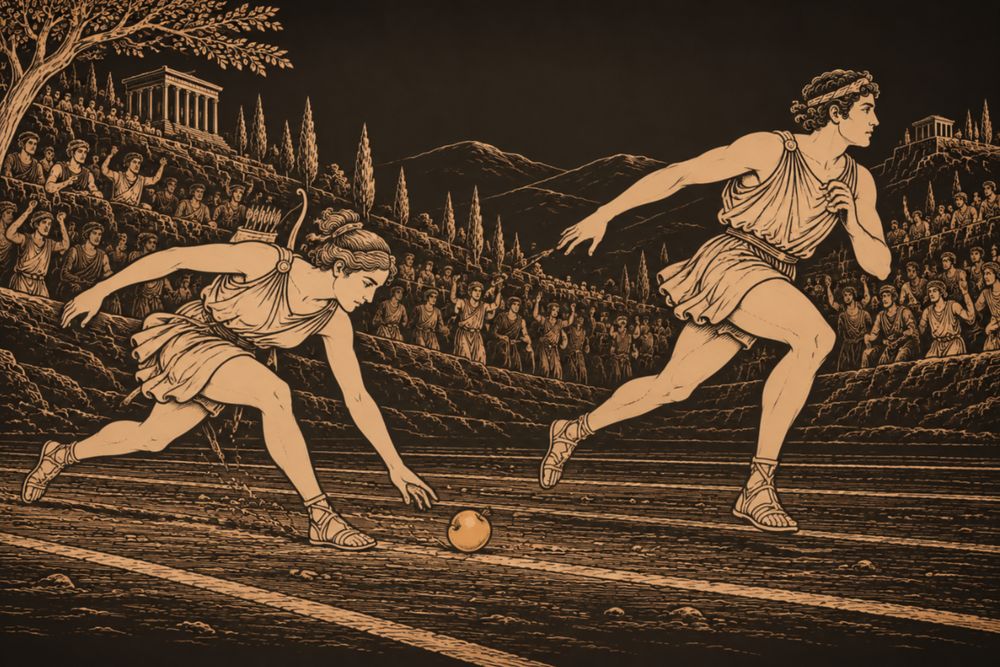
The golden apple
Generated by AI from this page's own facts, not an ancient image or evidence of anything. How this site uses generated images
Her help is a tree. In Ovid's Venus, there is a field on Cyprus that the islanders call Tamasus, the best land on the island, which old men once consecrated to her. A tree in its middle shines with gold leaves and crackling gold branches. She was coming from there with three apples she had picked, and she went to Hippomenes, visible to no one else, and taught him how to use them.
The apples change the race. Hippomenes runs and the crowd shouts him on. Ovid says Atalanta often slowed when she could have passed him, and left his face reluctantly. When he tires, with the goal still far off, he throws the first apple. She is amazed, turns out of her course and picks up the rolling gold. He passes her. She makes up the lost time and passes him again.
The second apple works the same way. She is delayed, then catches him and overtakes him. Only the last stretch remains when he calls on the goddess and throws the third apple, in Ovid's words, from the side and at an angle, so that she would have to run wide to fetch it. She seems to hesitate. Venus says she forced her to pick it up, and made the apple heavy, so the girl was held back by its weight as well as by the delay. Venus does not linger over the finish. The girl was beaten, and Hippomenes led away his prize.
Apollodorus keeps only the outline. Melanion, a son of Amphidamas, ran for love of her carrying golden apples from Aphrodite. While she chased him he threw them down, she picked up the fruit, and she lost the race. So Melanion married her. He gives no count of apples and no wayside speeches, and Aphrodite does not appear as a speaker.
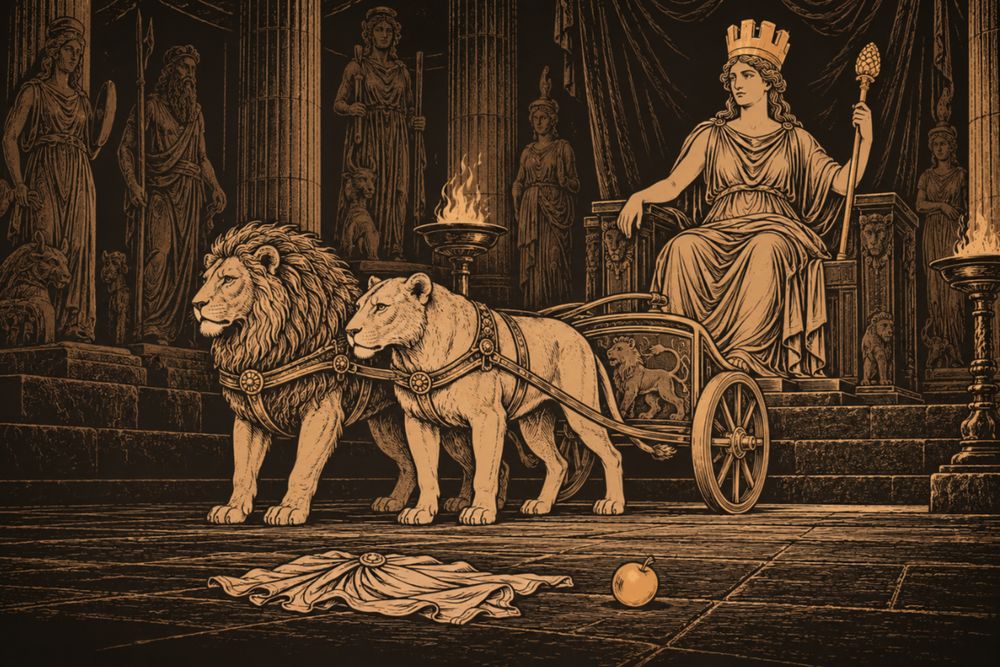
Two lions for Cybele
Generated by AI from this page's own facts, not an ancient image or evidence of anything. How this site uses generated images
The marriage does not last. In Apollodorus, once out hunting, the pair entered a precinct of Zeus, took their fill of love there and were changed into lions. He says no more about why.
Ovid supplies a reason. Hippomenes never thanked Venus or burned incense to her. She turned her anger on them and decided to make an example of them. On a long journey they passed a temple hidden in the woods, which Echion had built to the Mother of the gods in fulfilment of a vow. Venus filled Hippomenes with a sudden desire. Near the temple was a cave of pumice where a priest had stored wooden images of old gods, and the two lovers went in and profaned it. The images turned their eyes away.
The tower-crowned Mother, Cybele, first thought of sinking the guilty pair in the Stygian water, then judged that too light. Their necks grew tawny manes, their fingers curved into claws, and they swept the ground with tails. They growled instead of speaking and lived in the woods. Ovid ends with them as lions, fierce to every creature except Cybele, whose harness has tamed their jaws. Venus then warns Adonis to avoid any wild beast that offers its chest to a hunter rather than its back.
What Followed
The couple's end is the story's second half. Apollodorus says they were changed into lions after they took their fill of love in a precinct of Zeus. Ovid has Cybele change them after they profane her hidden shrine. The Cybele page covers the goddess and her lions.
Apollodorus adds that by Melanion or by Ares, Atalanta had a son, Parthenopaeus, who went to the war against Thebes. Ovid does not mention a child. In Ovid the story ends by turning back to Venus and Adonis, and the warning to keep away from beasts that turn and fight is the reason she tells it.
Afterlife and Modern Influence
The golden apples make the story easy to confuse with other apple myths. Ovid's own apples grow on a single tree in a field on Cyprus that was sacred to Venus, and they are hers to give. Ovid frames the race as a warning: Venus tells it to Adonis so that he will avoid dangerous game.
Who was Atalanta's lover?
The race stories name one, the man who beat her. Apollodorus calls him Melanion and says he ran for love of her. Ovid calls him Hippomenes and says he fell in love when he saw her run. Apollodorus adds that Euripides gave the husband's name as Hippomenes rather than Melanion, so the two names are one figure in different sources.
Apollodorus, Library 3.9.2
Who was Hippomenes in Greek mythology?
Ovid's name for the suitor who won Atalanta's race. He says Hippomenes was the son of Megareus of Onchestus and a great-grandson of Neptune. He began as a spectator who scorned the suitors, then saw her and fell in love. He prayed to Venus, who gave him three golden apples. Apollodorus attributes the same role to Melanion.
Ovid, Metamorphoses 10.560-680
Who fell in love with Atalanta?
In the race stories, the winning suitor does, and she may share it. Ovid's Hippomenes is struck the moment he sees her stripped to run. Ovid's Atalanta feels desire too but cannot name it, so she loves and does not know she is in love. Apollodorus says only that Melanion ran for love of her, and gives her no feelings.
Ovid, Metamorphoses 10.560-680
What goddess does Atalanta serve?
Artemis, in the sources that name a patron. Callimachus says the goddess greatly praised swift-footed Atalanta, the slayer of boars, and taught her to hunt with dogs and shoot well. Neither race telling calls her Artemis's servant. Ovid has her live unwed in the woods, and the goddess who acts in the race is Venus, who helps the suitor.
Callimachus, Hymn to Artemis 215-224
Where Accounts Differ
- melanion-or-hippomenes
- how-the-race-starts
- how-many-apples
- precinct-of-zeus-or-cave-of-cybele
- The husband's name differs. Apollodorus, Library 3.9.2, calls him Melanion, a son of Amphidamas, and reports that Euripides said the husband was Hippomenes and that Atalanta was a daughter of Maenalus. Ovid, Metamorphoses 10.560-680, uses Hippomenes, son of Megareus of Onchestus. This page uses Melanion for Apollodorus's account and Hippomenes for Ovid's.
- The start of the race differs. Apollodorus, Library 3.9.2, has the wooers run ahead from a stake three cubits high while Atalanta follows in arms and kills the one she overtakes. Ovid, Metamorphoses 10.560-680, has both runners start together at the trumpet, gives death as the price for losing, and mentions no weapon.
- The apples differ. Apollodorus, Library 3.9.2, says only golden apples from Aphrodite. Ovid, Metamorphoses 10.560-680, has Venus bring three from a tree in the field of Tamasus on Cyprus and gives each throw in turn, the last from the side so she must run wide. Ovid also has Venus force Atalanta to lift the third apple and make it heavier.
- The place of the transformation differs. Apollodorus, Library 3.9.2, has the couple enter a precinct of Zeus while hunting and turn into lions. Ovid, Metamorphoses 10.686-704, has them profane a hidden cave near the temple that Echion built to the Mother of the gods, and Cybele changes them because Venus, offended by Hippomenes's ingratitude, roused his desire.
- Atalanta's father is named Iasus in Apollodorus, Library 3.9.2, and Apollodorus reports Hesiod and others naming Schoeneus and Euripides naming Maenalus. Ovid's Metamorphoses 10.660 calls her Schoeneus's daughter. That question belongs to her character page and is not settled here.
- The Perseus English of Ovid used for the quotation is an older verse rendering. The translator's name was not confirmed on the served page, so the quote block carries no translator credit.
Read the full source verification →
Mythology
Figures In This Myth
Also Connected
Related Terms
Referenced By
Sources
- Apollodorus, Library 3.9.2
- Ovid, Metamorphoses 10.560-574
- Ovid, Metamorphoses 10.560-680
- Ovid, Metamorphoses 10.686-704
- Callimachus, Hymn to Artemis 215-224