Meleager
Meleager was the prince of Calydon who killed the Calydonian boar. Homer's Iliad tells of his wrath: cursed by his mother Althaea over her brother's death, he refused to fight until his wife Cleopatra persuaded him. Later writers, including Bacchylides and Apollodorus, add a burning brand. The Fates tied his life to it, and Althaea burned it after he killed her brothers.
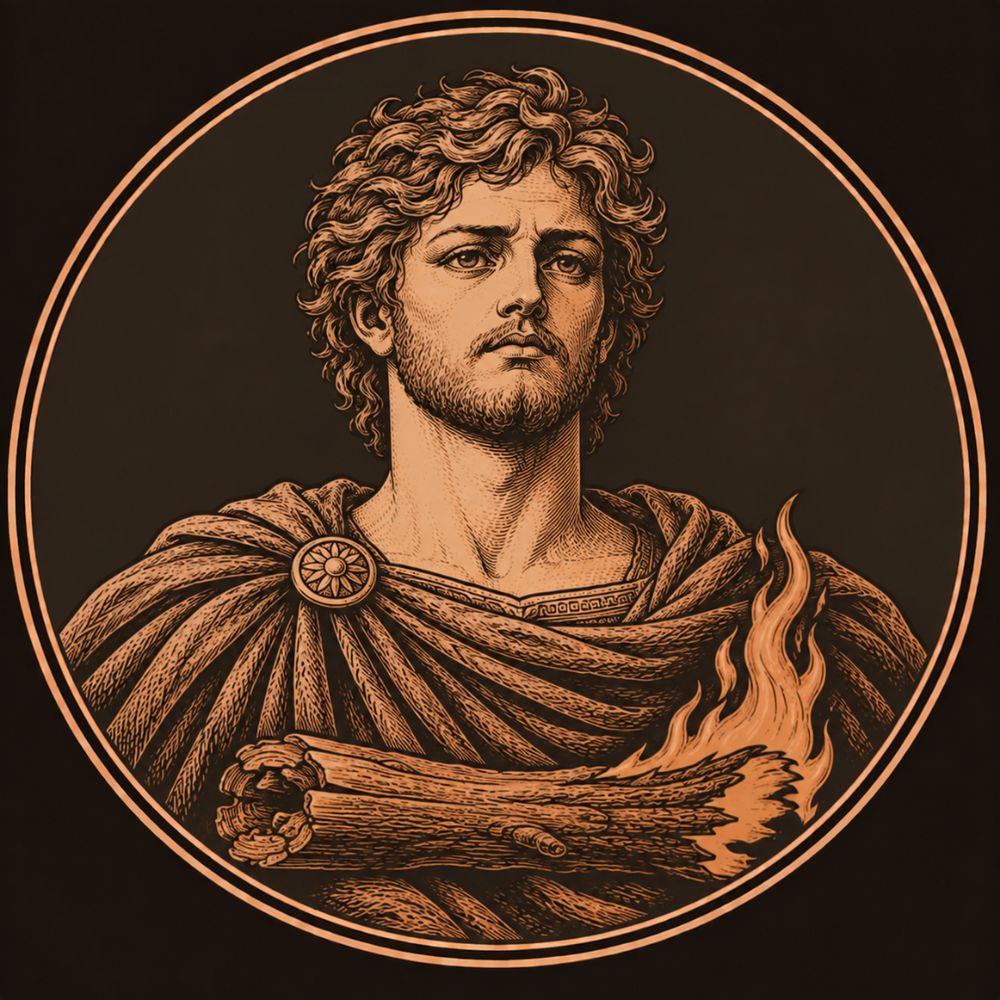
Meleager, bronze medallion illustration
Generated by AI from this page's own facts, not an ancient image or evidence of anything. How this site uses generated images
Sections on this page
Core Myth
Apollodorus's Library makes Meleager the son of Oeneus, king of Calydon, and Althaea, daughter of Thestius. It adds that some said Ares fathered him. When the baby was seven days old, the Fates declared that he would die when the brand burning on the hearth burned out. Althaea snatched up the brand and hid it in a chest. Hyginus's Fabulae names the three Fates. Clotho said he would be noble, Lachesis brave, and Atropos tied his life to the brand.
The trouble began with a sacrifice. Oeneus offered first fruits to every god but forgot Artemis. Homer's Iliad says he either forgot or did not notice, and was greatly blinded in heart. The goddess sent a huge boar to ravage Calydon. Apollodorus says Meleager grew up invulnerable and gallant, and that he killed the beast with a stab in the flank. The hunt itself, and Atalanta's part in it, is told on her own page.
In Apollodorus, the prize caused his death. Meleager gave the boar's skin to Atalanta. Her later footrace is told in Atalanta and the Race. His uncles, the sons of Thestius, took it from her, scorning that a woman should win it. Meleager killed them in a rage and gave it back. Althaea, grieving for her brothers, kindled the brand, and he died at once. Ovid's Metamorphoses turns the moment into a long struggle. Four times Althaea lifts the brand to the flames, and four times she holds back.
Homer's Iliad tells an older story with no brand at all. In Book 9, old Phoenix tells it to Achilles as a warning. After the hunt, the Curetes and the Aetolians fought over the boar's head and hide. While Meleager fought, the Curetes could not hold the field. Then his mother, grieving for her brother, beat the earth and called on Hades and Persephone to kill her son. The Erinys that walks in darkness heard her from Erebus.
Meleager withdrew to lie beside his wife Cleopatra, nursing his anger. The elders offered him fifty acres of the best land in Calydon. His father, sisters, mother and closest friends all begged him. He refused until the Curetes were on the walls and firing the city. Only Cleopatra moved him, by listing what happens to the people of a captured city. He armed and saved the Aetolians, but they never paid him the gifts. Phoenix's lesson for Achilles is plain: accept the gifts while they are offered.
Bacchylides's fifth Ode meets Meleager in the underworld. When Heracles went down for Cerberus, he saw Meleager's shade shining in armour and drew his bow. Meleager calmed him and told his story. In the war with the Curetes over the hide, he killed his mother's brothers, Iphiclus and Aphares. Althaea took the log of his doom from its chest and burned it. His strength failed while he fought before the towers and the enemy fled toward Pleuron.
In the same Ode, Heracles wept, they say for the only time in his life. Then he asked whether Oeneus had a daughter who looked like Meleager, because he would gladly marry her. Meleager named his sister Deianira, still untouched by love. Apollodorus's Library later says that Heracles came to Calydon and wooed Deianira, daughter of Oeneus. Apollodorus also says that when the souls of the dead saw Heracles, all fled except Meleager and the Gorgon Medusa.
What is the story of Meleager?
Meleager was the son of Oeneus, king of Calydon. Apollodorus's Library says the Fates tied his life to a brand on the hearth, which his mother Althaea hid in a chest. When Oeneus forgot Artemis at a sacrifice, she sent a boar, and Meleager killed it. He gave its skin to Atalanta and killed his uncles when they took it from her. Althaea then burned the brand, and he died. Homer's Iliad tells a version with a curse instead of a brand.
Apollodorus, Library 1.8.2
Was Meleager in love with Atalanta?
In the later sources, yes. Ovid's Metamorphoses says he longed for her the moment he saw her, though some god forbade it. Apollodorus's Library says he forced the other hunters to accept her because he wanted a child by her, although he was married to Cleopatra. Hyginus's Fabulae says he killed his uncles putting love before kinship. Homer and Bacchylides tell his story without mentioning Atalanta at all.
Apollodorus, Library 1.8.2
Who were Meleager and Cleopatra?
Cleopatra was Meleager's wife. Homer's Iliad makes her the daughter of Idas and Marpessa. Her parents called her Alcyone, after the mournful halcyon bird, because of a grief Apollo had caused Marpessa. When Meleager refused to fight, Cleopatra alone persuaded him, by describing what happens to a captured city. Apollodorus says she hanged herself after his death. Hyginus names Meleager's wife Alcyone and says she died of grief.
Homer, Iliad 9.538-580
Why was Meleager angry?
Because his mother cursed him. In Homer's Iliad, Althaea grieved for her brother's death and called on Hades and Persephone to kill her son. Meleager, angry at her curses, stayed home beside his wife while the Curetes attacked Calydon. Apollodorus gives the background as a variant. The sons of Thestius claimed the boar's skin, war broke out, and Meleager killed some of them. Only then did Althaea curse him.
Homer, Iliad 9.538-580
How did Meleager die?
The sources give three answers. Bacchylides, Apollodorus, Ovid and Hyginus say Althaea burned the brand his life depended on, after he killed her brothers. Homer's Iliad mentions only her curse and the Erinys who heard it, and Pausanias reads that as the cause of his death. Pausanias adds that the Eoeae and the Minyad had Apollo kill him in battle. Apollodorus reports a version where he simply fell fighting the Curetes.
Pausanias, Description of Greece 10.31.3
Who was Meleager's father?
Usually Oeneus, king of Calydon. Homer's Iliad calls Meleager son of Oeneus, and Bacchylides's fifth Ode has Meleager name horse-driving Oineus as his father. Apollodorus agrees but adds that some said Ares begot him. Hyginus's Fabulae says both Oeneus and Mars slept with Althaea on the same night. Homer calls Meleager dear to Ares, but names Oeneus as his father.
Apollodorus, Library 1.8.2
Later Traditions
Apollodorus's Library lists Meleager, son of Oeneus, among the heroes who sailed with Jason on the Argo. The same catalogue names Atalanta. The site's Argonauts page covers the crew lists and where they disagree.
Pausanias describes Meleager as he appears in an ancient painting. There he sets out the rival accounts of his death. He reads Homer as saying that the Fury heard Althaea's curses and so caused Meleager's death. He adds that the Eoeae and the Minyad disagree. In those poems Apollo helped the Curetes against the Aetolians and killed Meleager himself.
Pausanias also dates the brand. He says Phrynichus first put it on the stage, in his Pleuronian Women. Phrynichus did not invent it, Pausanias adds, but only touched on a story already told everywhere in Greece. Apollodorus reports one more version. The sons of Thestius claimed Iphiclus had hit the boar first, and war broke out. Meleager killed the rest of his uncles and then fell fighting himself.
The women of his house did not survive him. Apollodorus says Althaea and Cleopatra hanged themselves, and the women who mourned him became birds. In Ovid, Althaea stabs herself, and Latona's daughter turns his weeping sisters into birds, all but Gorge and Deianira. Hyginus calls the birds meleagrides, guinea hens. He names Meleager's wife Alcyone and says she died of grief. Homer had already said that Cleopatra's parents called her Alcyone.
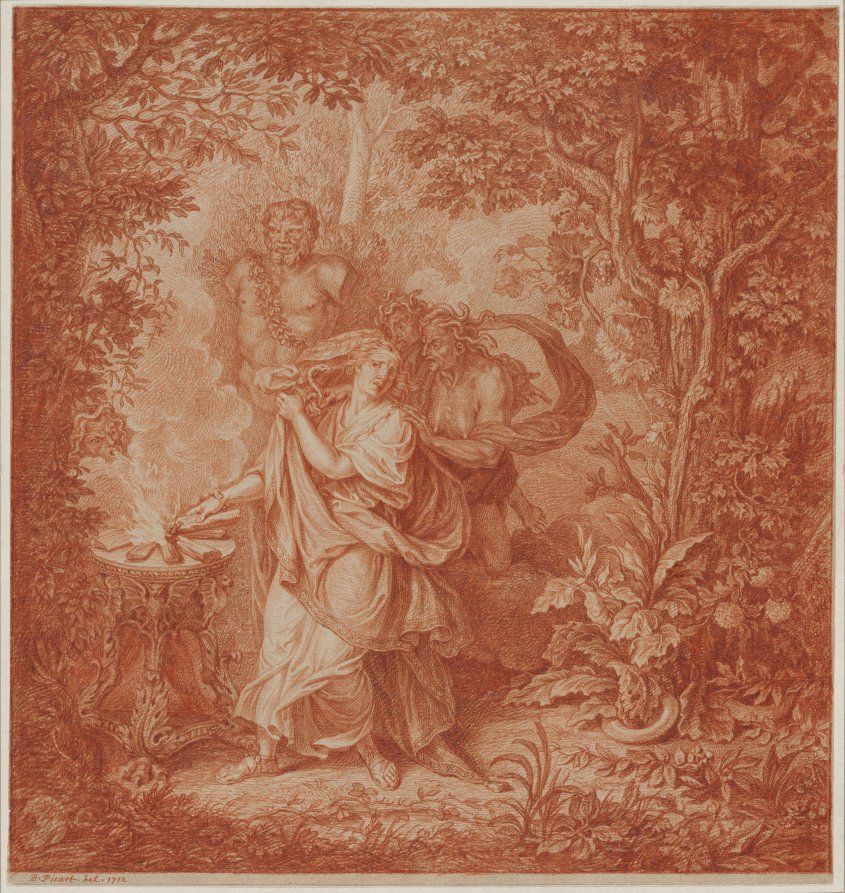
Althaea Putting the Fatal Log on the Fire - France, 1712, Red chalk on beige laid paper, incised for transfer
The Cleveland Museum of Art, Cleveland, OH, 2008.360. CC0
Also Connected
7 recorded connections, each with the ancient line behind it.
Connected
-

In the Iliad, Phoenix tells Achilles the story of Meleager's wrath as a warning to accept the gifts while they are offered.
-

Pausanias reports that the Eoeae and the Minyad had Apollo help the Curetes and kill Meleager, against Homer's account of the Erinys.
-

Apollodorus calls Meleager the son of Oeneus but reports that some said Ares begot him.
-

In Bacchylides, Meleager tells Heracles that Oeneus could not appease Artemis, who sent the boar against Calydon.
-
Apollodorus says Meleager made the other hunters accept Atalanta because he wanted a child by her, and gave her the Calydonian boar skin.
-

Bacchylides has Heracles meet the shade of Meleager in Hades while fetching Cerberus and draw his bow on him.
-

Apollodorus lists Meleager, son of Oeneus, among the heroes who sailed with Jason on the Argo.
Where Accounts Differ
- how Meleager died
- who first told the story of the brand
- who fathered Meleager
- which uncles Meleager killed, and where
- whether Atalanta was part of his story
- how Althaea and Cleopatra died
- How Meleager died is the central disagreement. Homer (Iliad 9.538-580) has Althaea curse him and the Erinys hear her, but never narrates his death and never mentions a brand. Pausanias (10.31.3) reads Homer's curse as the cause of death. Bacchylides (Ode 5.121-151), Apollodorus (Library 1.8.3), Ovid (Metamorphoses 8.451-546) and Hyginus (Fabulae 174) make Althaea burn the brand. Apollodorus (1.8.3) also reports a version in which he fell fighting the Curetes. Pausanias (10.31.3) says the Eoeae and the Minyad had Apollo kill him.
- Pausanias (10.31.4) says the brand story was first put on stage by Phrynichus in his Pleuronian Women, but that it was already widely told in Greece.
- His father is Oeneus in Homer (Iliad 9.538-580), Bacchylides (Ode 5.56-81) and Apollodorus (Library 1.8.2). Apollodorus adds that some said Ares begot him. Hyginus (Fabulae 171) says Oeneus and Mars both slept with Althaea on the same night.
- Which uncles he killed, and where, varies. Apollodorus (Library 1.8.3) and Ovid (Metamorphoses 8.380-444) place the killing after the hunt, over the boar's skin, and Ovid names Plexippus and Toxeus. Bacchylides (Ode 5.121-151) places it in the war with the Curetes and names Iphiclus and Aphares. Homer (Iliad 9.538-580) speaks of Althaea's brother, unnamed.
- Atalanta appears only in the later accounts. Apollodorus (Library 1.8.2), Ovid (Metamorphoses 8.260-327) and Hyginus (Fabulae 174) make Meleager's love for her the cause of the quarrel. Homer and Bacchylides do not mention her.
- The deaths of his mother and wife differ. Apollodorus (Library 1.8.3) says Althaea and Cleopatra hanged themselves. Ovid (Metamorphoses 8.451-546) has Althaea stab herself. Hyginus (Fabulae 174) names the wife Alcyone and says she died of grief; Homer (Iliad 9.538-580) says Alcyone was Cleopatra's name at home.
Read the full source verification →
Mythology
Appears In
Related Terms
Referenced By
Sources
- Homer, Iliad 9.492-537
- Homer, Iliad 9.538-580
- Homer, Iliad 9.581-599
- Bacchylides, Ode 5.56-81
- Bacchylides, Ode 5.90-110
- Bacchylides, Ode 5.121-151
- Bacchylides, Ode 5.155-175
- Apollodorus, Library 1.8.1
- Apollodorus, Library 1.8.2
- Apollodorus, Library 1.8.3
- Apollodorus, Library 1.9.16
- Apollodorus, Library 2.5.12
- Apollodorus, Library 2.7.5
- Ovid, Metamorphoses 8.260-327
- Ovid, Metamorphoses 8.380-444
- Ovid, Metamorphoses 8.451-546
- Pausanias, Description of Greece 10.31.3
- Pausanias, Description of Greece 10.31.4
- Hyginus, Fabulae 171
- Hyginus, Fabulae 172
- Hyginus, Fabulae 174