Atalanta
Atalanta was an Arcadian huntress who, in Apollodorus's Library, was left to die as a baby and nursed by a she-bear. She drew first blood on the Calydonian boar and won its hide. She made her suitors race her and killed the losers, until one won by dropping golden apples from Aphrodite. Later she and her husband were turned into lions.
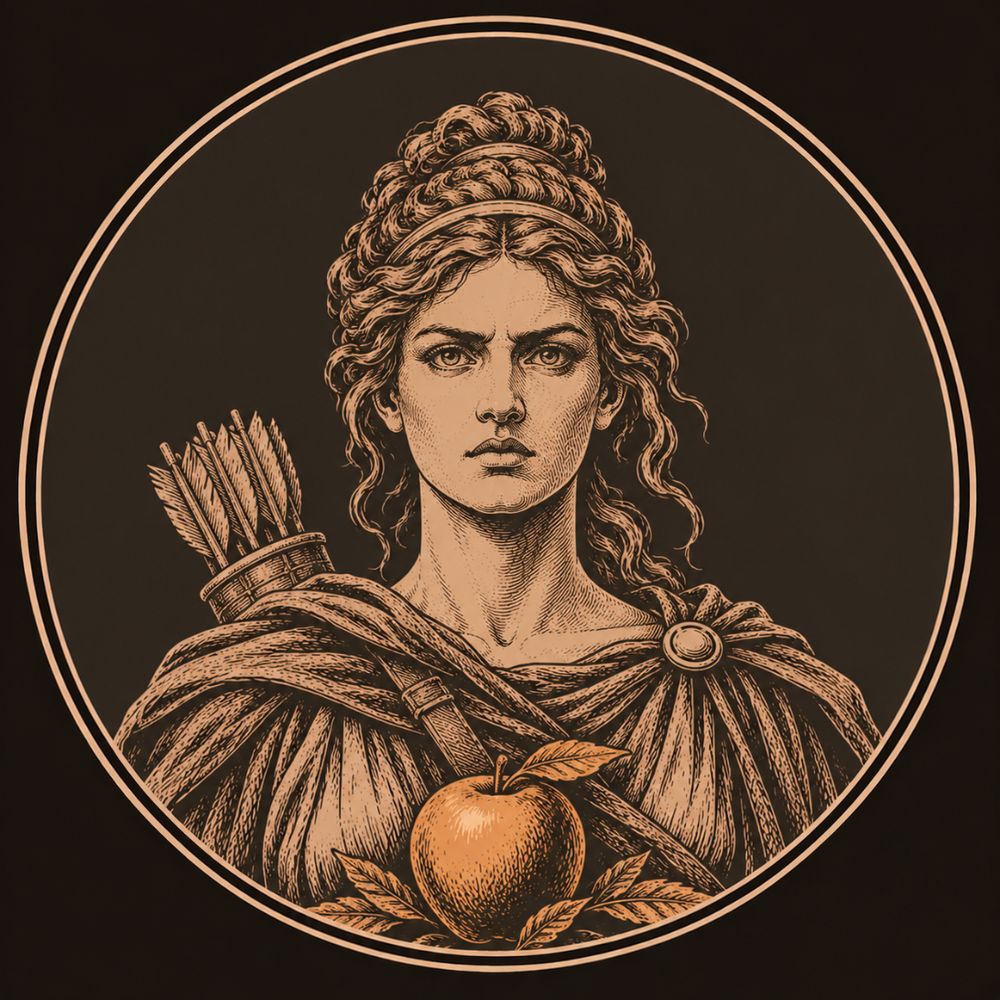
Atalanta, bronze medallion illustration
Generated by AI from this page's own facts, not an ancient image or evidence of anything. How this site uses generated images
Sections on this page
Core Myth
Apollodorus's Library tells Atalanta's early life in one passage. Her father exposed her at birth because he wanted sons. A she-bear came often and suckled her, until hunters found her and raised her among themselves. Grown up, she kept herself a virgin and lived armed in the wilds. Two centaurs, Rhoecus and Hylaeus, tried to rape her, and she shot them both dead.
Callimachus's Hymn to Artemis gives her a divine patron. Artemis, the poet says, praised swift-footed Atalanta, the slayer of boars, and taught her to hunt with dogs and shoot well. He adds that the Arcadians still kept the tusks of the Calydonian boar, and that the blood of Hylaeus and Rhoecus once ran on Mount Maenalus.
The Calydonian hunt is her best-known exploit. Apollodorus says King Oeneus forgot Artemis in his harvest sacrifice, and the goddess sent a huge boar to ravage Calydon. Oeneus summoned the best men of Greece, Theseus, Jason and Peleus among them. Some refused to hunt beside a woman, but Meleager, the king's son, made them. Atalanta shot the boar first, in the back. Amphiaraus hit it in the eye, and Meleager killed it and gave her the skin.
The gift caused a killing. In Apollodorus, the sons of Thestius, Meleager's uncles, took the skin from her, scorning that a woman should win it. Meleager killed them and gave it back. His mother Althaea, grieving for her brothers, burned the log on which his life depended, and he died. Ovid's Metamorphoses tells the same hunt at length. Meleager falls in love with her the moment he sees her.
Her second famous story is the race. Apollodorus says that once she found her parents, her father pressed her to marry. She set up a racecourse, gave each suitor a head start, and ran after him armed. A suitor she caught died on the spot; one she did not catch would marry her. Many died. Then Melanion ran, carrying golden apples from Aphrodite. He dropped them as she chased him, and she stopped to pick them up and lost.
Apollodorus ends briefly. Once, out hunting, the couple entered a precinct of Zeus and made love there, and they were turned into lions. He adds that Atalanta had a son, Parthenopaeus, by Melanion or by Ares. Parthenopaeus later marched in the Seven against Thebes.
What was Atalanta known for?
Speed, hunting and a deadly footrace. Apollodorus's Library says she was the first to shoot the Calydonian boar, and that Meleager gave her its skin. He adds that she wrestled Peleus at the funeral games for Pelias and won. She is best remembered for racing her suitors and killing those she caught. Ovid's Metamorphoses says she outran swift-footed men, and that no one could say whether her speed or her beauty deserved more praise.
Apollodorus, Library 3.9.2
Who fell in love with Atalanta?
Meleager and the man who won her race. In Ovid's Metamorphoses, Meleager longs for her the moment he sees her at the Calydonian hunt. Apollodorus says he even hoped for a child by her, although he was married. Her husband's name depends on the source. Apollodorus calls him Melanion, who ran for love of her. Ovid and Hyginus call him Hippomenes. Apollonius of Rhodes adds that Jason kept her off the Argo, fearing strife on account of love.
Apollodorus, Library 1.8.2
Did Atalanta love Hippomenes?
In Ovid's version, yes, before she understood it. When Hippomenes steps forward to race, Atalanta argues with herself. She pities him, wishes he had never seen her, and hopes he may prove the swifter. Ovid says she loves and does not know she is in love. During the race she slows to look at his face before passing him. Apollodorus and Hyginus tell the race without saying anything about her feelings.
Ovid, Metamorphoses 10.560-680
Who is Atalanta in Greek mythology?
She is an Arcadian huntress who hunts and competes alongside the great heroes. Apollodorus's Library says she was exposed at birth, nursed by a she-bear and raised by hunters. She hunted the Calydonian boar with Meleager and raced her suitors for her hand. Her father is Iasus in one passage of Apollodorus but Schoeneus in two others, as in Ovid and Hyginus. Ancient writers never settled on one answer.
Apollodorus, Library 3.9.2
Did Atalanta sail with the Argonauts?
The sources disagree. Apollodorus's Library includes Atalanta, daughter of Schoeneus, in its list of the heroes who gathered for Jason's voyage. Apollonius of Rhodes, whose Argonautica is the fullest account of the voyage, leaves her out on purpose. He says she gave Jason a spear as a guest-gift in Maenalus and eagerly wanted to follow. Jason himself stopped her, because he feared bitter strife on account of love.
Apollonius of Rhodes, Argonautica 1.769-773
Why were Atalanta and her husband turned into lions?
Because they made love in a sacred place. Apollodorus says only that they entered a precinct of Zeus while hunting and were changed into lions. In Ovid's Metamorphoses the cause is Venus. Hippomenes forgot to thank her for the apples, so she drove him to lie with Atalanta in a shrine of the Mother of the Gods. Cybele then turned them into lions to draw her chariot. Hyginus blames Venus too, but makes Jupiter the god who transforms them.
Ovid, Metamorphoses 10.686-704
Later Traditions
Ovid's Metamorphoses gives the fullest race, and Venus tells it to Adonis. An oracle warns Atalanta that a husband will be her harm and that she will lose herself while still alive. She lives unwed in the woods and makes the race her condition. Her challenger here is Hippomenes, great-grandson of Neptune. She half wishes he would win, and she loves him without knowing it.
In Ovid, Hippomenes prays to Venus, who brings him three golden apples from a tree in the field of Tamasus on Cyprus. He throws them one at a time, and the third makes her swerve off the course. He wins but forgets to thank the goddess. Venus fills him with desire as they pass a temple of the Mother of the Gods, and they lie together in a sacred cave there. The tower-crowned Mother, Cybele, turns them into lions and yokes them to her chariot.
Hyginus's Fabulae mixes the two versions. His Atalanta is the daughter of Schoeneus, and her husband is Hippomenes with Venus's apples, as in Ovid. His race is harsher: the suitor ran unarmed and she chased him with a weapon, then set the losers' heads up in the stadium. The couple sin in a shrine of Jupiter the Victor on Mount Parnassus, and Jupiter makes them lion and lioness, animals the gods deny love.
Her place among the Argonauts is disputed. Apollodorus lists Atalanta, daughter of Schoeneus, in the crew of the Argo. Apollonius of Rhodes says the opposite. In his Argonautica, Jason holds a spear she gave him as a guest-gift in Maenalus. She wanted to join the voyage, but he kept her back himself, fearing strife on account of love. The site's Argonauts page covers the crew lists.
Arcadia kept her memory in stone. Pausanias says the Tegeans claimed that Atalanta hit the boar first and received its head and hide as the prize for valor. The front gable of Athena Alea's temple at Tegea showed the hunt, with Atalanta beside Meleager, Theseus and Peleus. Near a place called Schoenus, Pausanias saw race-courses named after her. On the chest of Cypselus at Olympia he saw her holding a young deer beside Melanion.
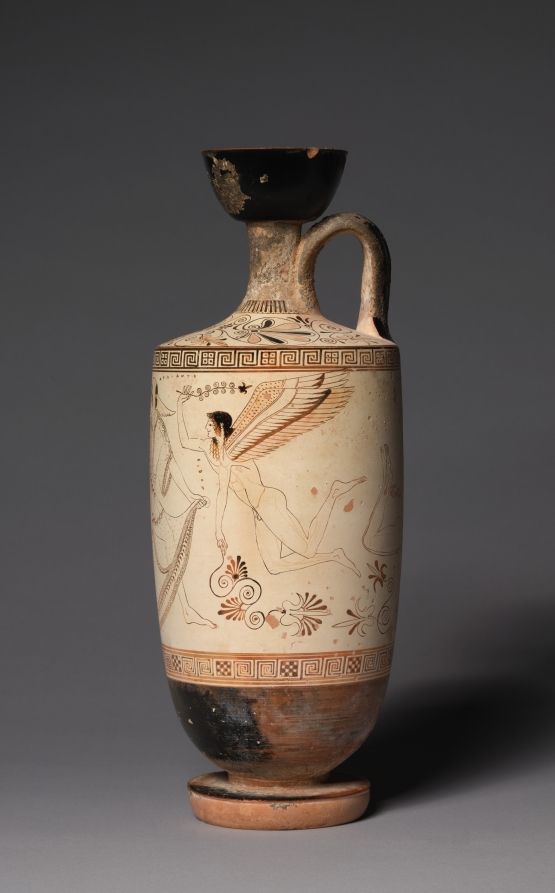
White-Ground Lekythos (Oil Vessel): Atalanta and Erotes - Greek, Attic, c. 500–490 BCE, ceramic
The Cleveland Museum of Art, Cleveland, OH, 1966.114. CC0
Also Connected
8 recorded connections, each with the ancient line behind it.
Connected
-
Venus tells Adonis the story of Atalanta and Hippomenes as a warning while they rest on the grass.
-

Aphrodite supplies the golden apples that beat Atalanta in the footrace.
-

Callimachus says Artemis praised Atalanta and taught her to hunt with dogs and shoot well.
-
After Atalanta and Hippomenes defile a shrine of the Mother of the Gods, the tower-crowned goddess turns them into lions that draw her chariot.
-

Apollodorus lists Atalanta among the Argonauts; Apollonius says she gave Jason a spear but he kept her off the voyage.
-
Apollodorus says Meleager made the other hunters accept Atalanta because he wanted a child by her, and gave her the Calydonian boar skin.
-
Atalanta wrestles Peleus at the funeral games for Pelias and wins.
-

Atalanta and her husband make love in a precinct of Zeus and are turned into lions.
Where Accounts Differ
- who was Atalanta's father
- whether her husband was Melanion or Hippomenes
- whether Atalanta sailed with the Argonauts
- whose shrine the couple profaned and who punished them
- the rules of the footrace
- who fathered Parthenopaeus
- who struck the Calydonian boar first
- Her father is named differently, even within one author. Apollodorus (Library 3.9.2) makes her the daughter of Iasus and Clymene, and Callimachus (Hymn to Artemis 215-224) calls her daughter of Arcadian Iasius. Yet Apollodorus's own lists of the boar hunters (1.8.2) and of the Argonauts (1.9.16) call her daughter of Schoeneus. Apollodorus (3.9.2) reports that Hesiod and others named Schoeneus and that Euripides named Maenalus. Ovid (Metamorphoses 10) and Hyginus (Fabulae 185) call her Schoeneus's daughter.
- Her husband is Melanion in Apollodorus (Library 3.9.2), who reports that Euripides called him Hippomenes. Ovid (Metamorphoses 10.560-680) and Hyginus (Fabulae 185) call him Hippomenes, son of Megareus. Pausanias (5.19.2) describes Melanion beside her on the chest of Cypselus.
- Apollodorus (Library 1.9.16) lists her among the Argonauts. Apollonius of Rhodes (Argonautica 1.769-773) says Jason refused to take her, fearing strife on account of love.
- The sacrilege and the god who punished it vary. Apollodorus (Library 3.9.2) places it in a precinct of Zeus. Ovid (Metamorphoses 10.686-704) places it at a shrine of the Mother of the Gods, and Cybele transforms them. Hyginus (Fabulae 185) places it in a shrine of Jupiter the Victor on Parnassus, with Venus causing the desire and Jupiter the transformation.
- The race itself differs. Apollodorus (Library 3.9.2) has her run armed behind each suitor and kill him on the spot if caught. Hyginus (Fabulae 185) has the suitor run unarmed while she pursues with a weapon, and the losers' heads set up in the stadium. Ovid (Metamorphoses 10.560-680) says only that the slow suitor paid with death.
- Parthenopaeus's father is Melanion or Ares in Apollodorus (Library 3.9.2), but Meleager in Hyginus (Fabulae 70 and 99), who says she exposed the child on Mount Parthenius. Euripides (Phoenissae 145-155) calls Parthenopaeus Atalanta's son without naming a father.
- Who struck the boar first is also disputed. Apollodorus (Library 1.8.2) and Pausanias (8.45.2) give first blood to Atalanta. Apollodorus (1.8.3) reports a variant in which the sons of Thestius claimed that Iphiclus hit it first.
Read the full source verification →
Mythology
Appears In
Related Terms
Referenced By
Sources
- Apollodorus, Library 3.9.2
- Apollodorus, Library 1.8.2
- Apollodorus, Library 1.8.3
- Apollodorus, Library 1.9.16
- Ovid, Metamorphoses 8.260-327
- Ovid, Metamorphoses 8.380-444
- Ovid, Metamorphoses 10.560-680
- Ovid, Metamorphoses 10.686-704
- Apollonius of Rhodes, Argonautica 1.769-773
- Callimachus, Hymn to Artemis 215-224
- Euripides, Phoenissae 145-155
- Pausanias, Description of Greece 8.45.2
- Pausanias, Description of Greece 8.45.6
- Pausanias, Description of Greece 8.35.10
- Pausanias, Description of Greece 5.19.2
- Hyginus, Fabulae 185
- Hyginus, Fabulae 173
- Hyginus, Fabulae 99
- Hyginus, Fabulae 70