Adonis
Adonis is a beautiful youth loved by Aphrodite and killed by a boar while hunting. In Apollodorus, Aphrodite hides him as a baby in a chest with Persephone, who refuses to give him back, so Zeus divides his year in three. Ovid makes him the son of Myrrha and Cinyras, and turns his blood into the anemone.
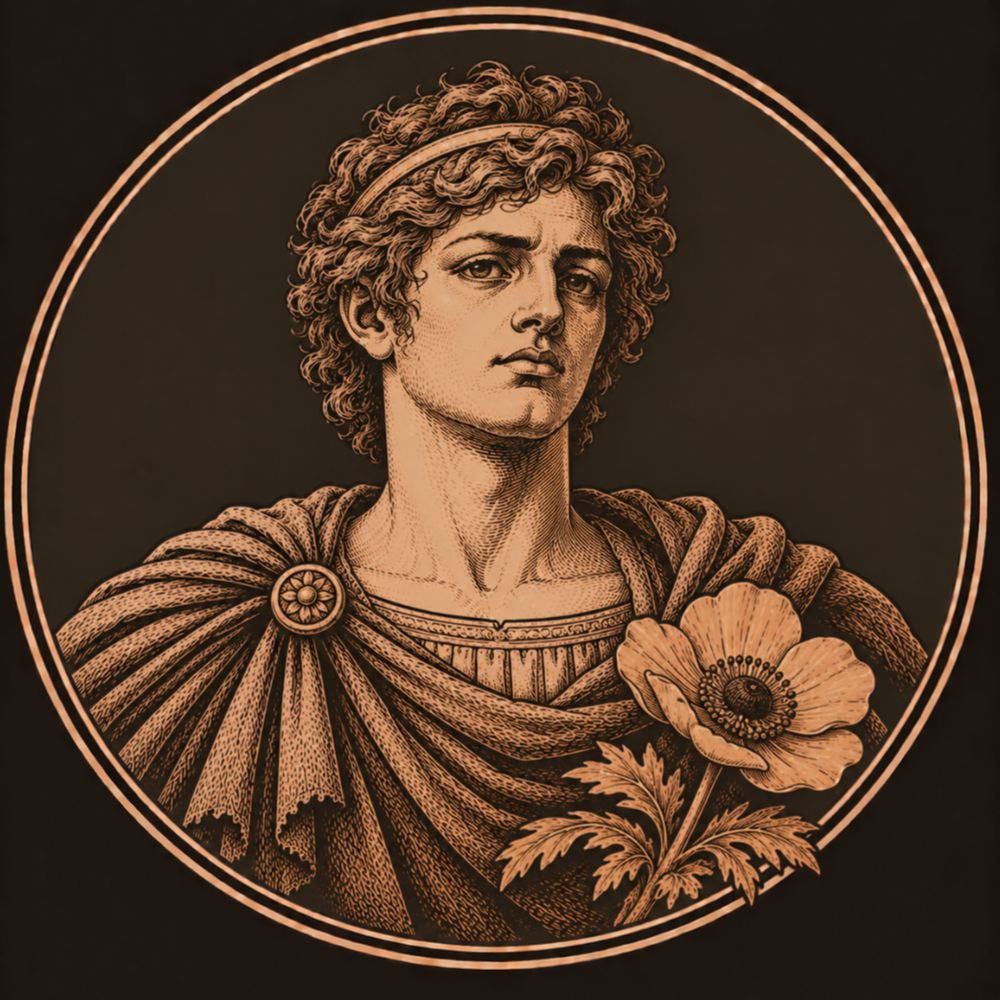
Adonis, bronze medallion illustration
Generated by AI from this page's own facts, not an ancient image or evidence of anything. How this site uses generated images
Sections on this page
Core Myth
Adonis was born from a tree, and his parentage is told several ways. Apollodorus's main account, in Library 3.14.3, makes him a son of Cinyras, founder of Paphos in Cyprus, and Metharme, daughter of King Pygmalion. Hesiod, Apollodorus adds, called him a son of Phoenix and Alphesiboea. Panyasis made him the son of Thias, king of Assyria, and Thias's daughter Smyrna. Ovid names Cinyras as father and Myrrha as mother, and Myrrha is also Cinyras's own daughter.
The Panyasis version, kept in Library 3.14.4, is the origin of the myrrh tree. Aphrodite was angry that Smyrna did not honor her, so the girl fell in love with her father. With her nurse's help she shared his bed for twelve nights without his knowledge. When he found out, he drew his sword and chased her. She prayed to be invisible, and the gods turned her into the smyrna tree, which is myrrh. Ten months later the tree burst and Adonis was born.
Ovid tells the same birth at greater length in Metamorphoses 10. The nurse leads a drunken Cinyras to the disguised Myrrha during the nine nights of the festival of Ceres. Cinyras finds out and draws his sword, and Myrrha flees through Arabia to Sabaea. She prays to be neither living nor dead, and turns into the myrrh tree. Lucina eases the birth, the bark splits, and the Naiads lay the baby on soft leaves and anoint him with his mother's tears.
Adonis grows into a youth of great beauty, and here the accounts turn to Aphrodite. In Apollodorus she hides the infant in a chest, unknown to the gods, and entrusts it to Persephone. Persephone looks inside and will not give him back. The dispute goes before Zeus, who divides the year into three parts: one for Adonis alone, one for Persephone, and one for Aphrodite. Adonis then gives his own share to Aphrodite as well.
Ovid tells it differently. Cupid, kissing his mother, grazes her breast with an arrow, and Venus falls for the youth she sees. She leaves heaven, Paphos and Cnidos to follow him through the woods, dressed like Diana and hunting only hares, deer and does. She warns him against lions, wolves and boars. To explain her fear she tells him the story of Atalanta and Hippomenes, whose race for her hand ends with both as lions after offending Cybele. The lesson is that courage is not safe against the bold.
Why did Aphrodite hide Adonis?
Apollodorus says she hid him for his beauty, while he was still an infant. She put him in a chest, unknown to the other gods, and gave the chest to Persephone to keep. When Persephone saw the child she refused to return him. Aphrodite brought the case to Zeus, who split the year into three parts. The hiding is Apollodorus's Panyasis version. Ovid has no chest and no Persephone in this scene, and has Venus fall for him after Cupid's arrow grazes her.
Apollodorus, Library 3.14.4
Is Adonis Greek or Lebanese?
He belongs to Greek myth, but his name is probably Semitic. Apollodorus makes him a Cypriot, son of Cinyras of Paphos and Metharme, though Panyasis calls his father king of Assyria and Hesiod calls him son of Phoenix. Scholars derive the name from Semitic adon, lord, but Burkert notes no Semitic cult matches the Greek one exactly. The Greek sources never place him in Lebanon, so Lebanese claims rest on modern scholarship, not on any passage we have.
Apollodorus, Library 3.14.3
Did Aphrodite and Adonis have a child?
Nonnus's Dionysiaca says so. There Beroe, a girl born of Aphrodite to Assyrian Adonis, is courted by suitors. Nonnus wrote in the fifth century AD, long after the earlier sources. Apollodorus and Ovid, the fullest older accounts, record no child of the pair. Ovid gives Venus only a short season of hunting beside him before he dies.
Apollodorus, Library 3.14.4
Does Persephone love Adonis?
The sources do not say she loves him. Apollodorus says only that when she opened the chest and saw him, she would not give him back. That refusal is why Zeus split his year among Adonis, Persephone and Aphrodite. Bion's lament ends with Adonis gone down to Acheron, where Persephone keeps him, and Ovid mentions her only as the goddess who once turned the nymph Menthe into mint. Her desire is an inference, not a stated motive.
Apollodorus, Library 3.14.4
What is the story of Adonis?
Adonis is born from the myrrh tree into which his mother is changed. Aphrodite falls for him and hides him in a chest with Persephone, who refuses to return him. Zeus divides his year among the two goddesses and Adonis himself. Later Adonis is killed by a boar while hunting, and Aphrodite mourns him. Ovid turns his blood into the anemone, and Theocritus shows Alexandria celebrating him at the Adonia.
Apollodorus, Library 3.14.4
How was Adonis killed?
A boar killed him during a hunt. Apollodorus says it gored him through the anger of Artemis. Ovid has him wound the boar with a spear, after which it drove its tusk into his groin, and adds that Venus had warned him against wild boars. Bion places the wound in the thigh. Nonnus makes the boar Ares in disguise, driven by jealousy.
Ovid, Metamorphoses 10.652-716
Later Traditions
Adonis dies hunting. In Apollodorus he is gored by a boar while still a boy, through the anger of Artemis. Ovid gives the boar no divine sender. Adonis wounds it with a spear, it knocks the spear loose, and it drives its tusk into his groin. Aphrodite, flying home in a chariot drawn by swans, hears his groans, sees the blood, tears her hair and garment, and vows that the yearly memory of his death will repeat her grief.
The flower is her answer to loss. Ovid's Venus sprinkles his blood with nectar. It bubbles like rainwater, and within an hour a blood-red flower grows, the anemone, which the wind shakes down as easily as it opens it. Ovid says she wants this change to match what Persephone once did to the nymph Menthe, turning her to mint. The poet Bion's Lament for Adonis has a different flower story, in which his blood becomes a rose and her tears the wind-flower.
Bion's lament is the main poem of mourning. In Elizabeth Barrett Browning's translation, the boar's white tusk pierces Adonis's thigh, the Loves weep, and Aphrodite calls out for her Assyrian husband. She begs one last kiss before he passes to Acheron, and the poem ends with him in Persephone's keeping. The mourning is one of the few passages that treats Aphrodite's grief as ritual, telling her to weep again when a new year returns.
In Theocritus's fifteenth Idyll the ritual is on stage. Two Syracusan women go to see the Adonis at the palace of Ptolemy in Alexandria. They admire the tapestries and the beautiful Adonis lying on a silver couch, then hear a singer's hymn to Aphrodite. The hymn says the Hours bring Adonis back from Acheron in the twelfth month. It adds that next morning the women will carry him out to the waves on the shore. Pausanias adds that Amathus in Cyprus had an old sanctuary of Adonis and Aphrodite.
The name is probably not Greek. It is usually derived from the Semitic word adon, meaning lord, but Walter Burkert cautions that no Semitic cult matches the Greek Adonis exactly. Panyasis calls his father the king of Assyria, and Bion's Aphrodite calls him her Assyrian. Yet the Greek sources anchor his birth and love story in Cyprus, and Ovid's version begins with the Cypriot dynasty of Pygmalion and Cinyras. The myth we read in Apollodorus and Ovid is told in Greek and Latin, in a Cypriot setting.
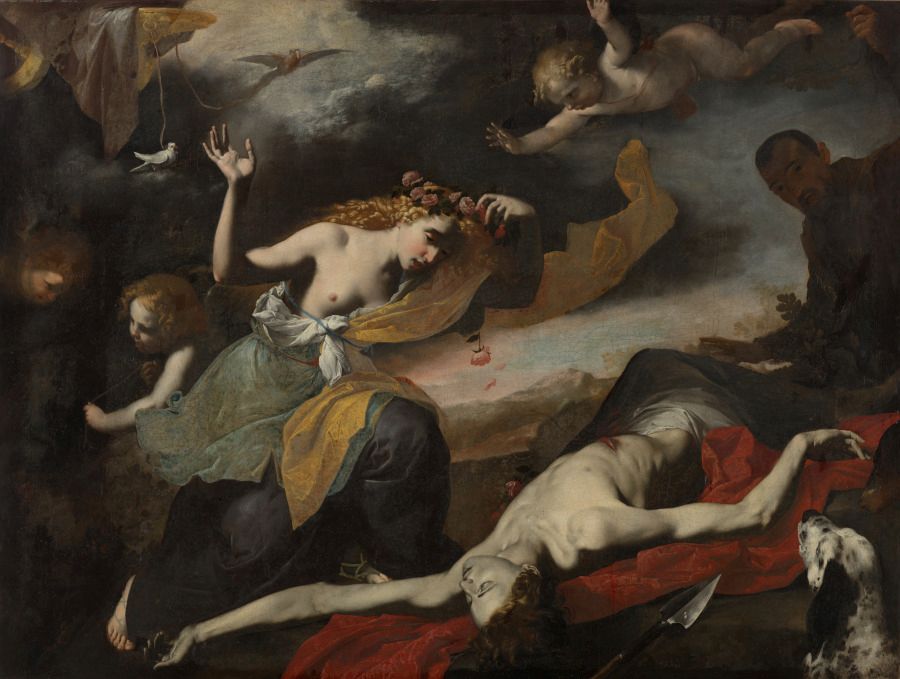
Venus Discovering the Dead Adonis - Italy, Naples, c. 1650, oil on canvas
The Cleveland Museum of Art, Cleveland, OH, 1965.19. CC0
Also Connected
4 recorded connections, each with the ancient line behind it.
Connected
-

Aphrodite loves Adonis, warns him against the hunt, and mourns him after the boar kills him.
-

In Apollodorus the boar kills Adonis through the anger of Artemis.
-
Venus tells Adonis the story of Atalanta and Hippomenes as a warning while they rest on the grass.
-

Aphrodite entrusts the infant Adonis to Persephone in a chest, and Persephone refuses to give him back.
Where Accounts Differ
- who Adonis's parents were
- who sent the boar
- where the boar wounded Adonis
- how Adonis's year was divided
- which flower grew from his death
- whether Adonis had a child
- whether Adonis is Greek or Semitic
- Adonis's parents differ by source. Apollodorus (Library 3.14.3) makes him a son of Cinyras and Metharme, daughter of Pygmalion, and then reports that Hesiod called him a son of Phoenix and Alphesiboea, and Panyasis a son of Thias, king of Assyria, and Smyrna (Library 3.14.4). Ovid gives Myrrha and Cinyras (Metamorphoses 10.298-518). Bion calls him the son of Cinyras.
- The cause of the boar's attack differs. Apollodorus says it came through the anger of Artemis (Library 3.14.4). Ovid gives no divine cause, only Adonis's own courage against Venus's warning (Metamorphoses 10.652-716). Nonnus makes the boar Ares in disguise, moved by jealousy (Dionysiaca 42).
- The wound is placed in two spots. Ovid has the tusk enter the groin (Metamorphoses 10.652-716), while Bion's lament has it pierce the white thigh.
- Adonis's share of the year is told in three ways. Apollodorus splits it among Adonis, Persephone and Aphrodite, and adds that Adonis gave his own share to Aphrodite (Library 3.14.4). Theocritus has the Hours bring him from Acheron in the twelfth month (Idyll 15). Bion leaves him with Persephone.
- The flower differs. Ovid makes the anemone from Adonis's blood (Metamorphoses 10.652-739). In the Barrett Browning translation of Bion, his blood becomes a rose and Aphrodite's tears the wind-flower.
- Whether Aphrodite and Adonis had a child differs by period. Nonnus gives them a daughter, Beroe (Dionysiaca 42), while Apollodorus and Ovid mention none.
- The Semitic origin of the name is a modern scholarly view, not an ancient statement. Burkert holds that adon, lord, is the likely source of the name, but that no Semitic cult matches the Greek one exactly.
Read the full source verification →
Mythology
Appears In
Related Terms
Referenced By
Sources
- Apollodorus, Library 3.14.3
- Apollodorus, Library 3.14.4
- Ovid, Metamorphoses 10.298-502
- Ovid, Metamorphoses 10.298-518
- Ovid, Metamorphoses 10.519-559
- Ovid, Metamorphoses 10.560-680
- Ovid, Metamorphoses 10.652-716
- Ovid, Metamorphoses 10.652-739
- Theocritus, Idyll 15
- Pausanias, Description of Greece 9.41.2
- Walter Burkert, Greek Religion (1985), pp. 176-177