Sinon
Sinon was the Greek who stayed behind when the fleet pretended to sail away from Troy. In Virgil's Aeneid he lets Trojan shepherds capture him, tells King Priam a false story about the horse, and later opens its hatch at night. Apollodorus's Epitome gives him a smaller job: he lights a beacon on Achilles's grave to guide the fleet back from Tenedos.
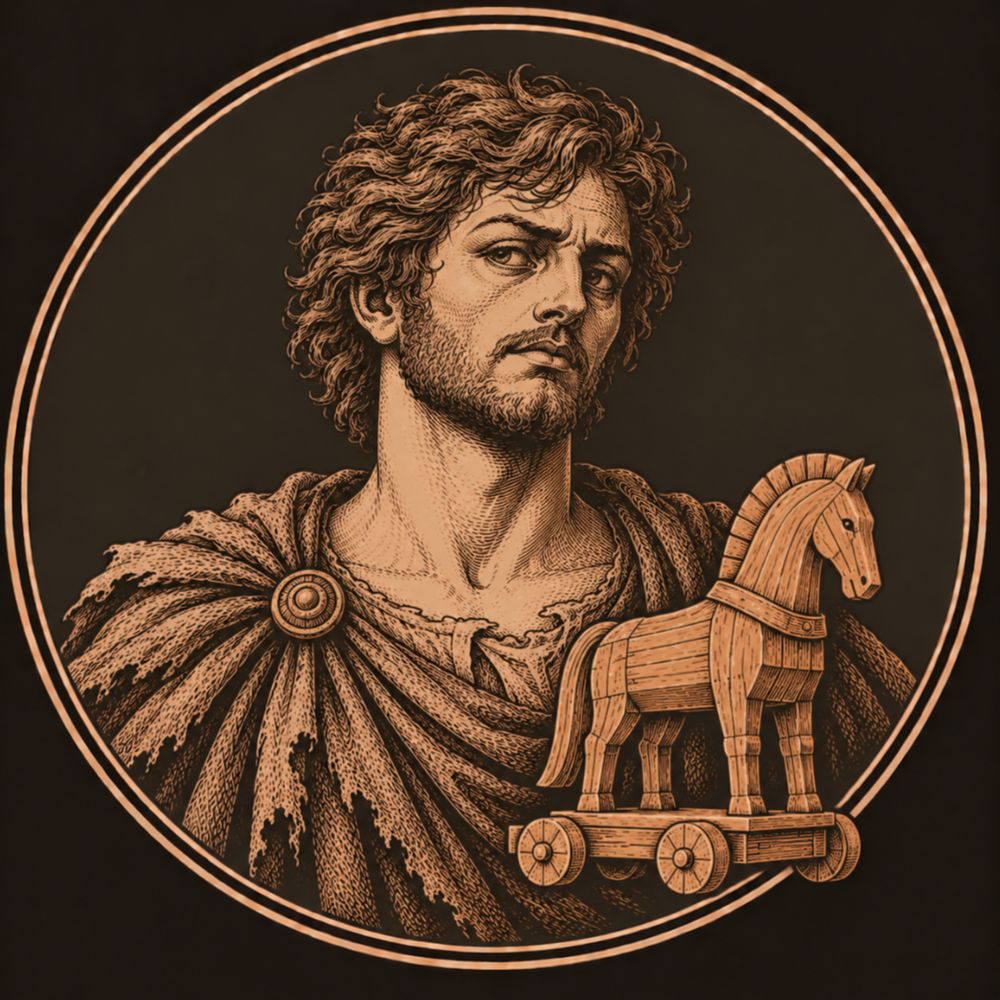
Sinon, bronze medallion illustration
Generated by AI from this page's own facts, not an ancient image or evidence of anything. How this site uses generated images
Sections on this page
Core Myth
Sinon's part is the second half of the Trojan Horse plan. The horse alone was not enough, because the Trojans had to choose to bring it inside. In Apollodorus's Epitome, the Greeks put their best men into the horse under Odysseus, then burned their tents and left Sinon behind with orders to light a beacon. They sailed off by night and waited near Tenedos.
Virgil, in Aeneid Book 2, gives Sinon a far larger role. Trojan shepherds drag him before Priam with his hands bound. Aeneas, who narrates, says he let himself be caught on purpose, so that although a nameless stranger he might deliver the gates of Troy to the Greeks. He was ready either to succeed or to die.
His story has three parts. First he cries that he has lost all foothold with the Greeks and that the Trojans want his blood. Then he says he was a companion of Palamedes, whom the Greeks condemned on false evidence, and that Ulysses, the Latin name for Odysseus, hated him for it. Finally he says Ulysses used the seer Calchas to name him as the human sacrifice the gods demanded. He claims he escaped his chains and hid in the marsh.
Priam believes him and orders him unbound. Sinon then explains the horse. He says Diomedes and Ulysses stole the Palladium, the image of Athena, and the goddess turned against the Greeks. The horse, he claims, was built to atone for that theft. Calchas made it huge, he says, so the Trojans could not take it through their gates. If they did, Sinon warns, Asia would one day turn the tables and invade Greece.
Virgil's Aeneas sums it up in one line: Sinon's guile and practiced perjury did what Diomedes, Achilles and ten years of war could not. Immediately after, the serpents kill Laocoon, and the Trojans take that as proof of the horse's holiness. That night the fleet returns from Tenedos. In Virgil, Sinon lets the imprisoned Greeks out of the horse, and they open the gates to the rest of the army.
Did Sinon know about the Trojan Horse?
Yes. He was left behind because he knew. In Apollodorus's Epitome the Greeks put their best men inside the horse, burn their tents and leave Sinon to light a beacon. In Virgil's Aeneid he invents a story to make the Trojans take the horse in, and at night he lets the hidden Greeks out of it. His whole role depends on knowing what the horse holds.
Apollodorus, Epitome 5.15-5.19
Who is Sinon in the Trojan War?
He is the Greek who deceives Troy. When the fleet feigns retreat, Sinon stays behind and is taken prisoner. In Virgil's Aeneid, he persuades Priam that the horse is a religious offering, which convinces the Trojans to drag it into their city. He then helps the hidden warriors out. He is not a major fighter. Both Virgil and Apollodorus treat him as the plan's inside man.
Virgil, Aeneid 2.145-2.194
What happened to Sinon after Troy fell?
The ancient sources checked for this page do not say. Virgil's Aeneid follows Sinon only to the night he opens the horse, and Apollodorus's Epitome stops at his beacon on Achilles's grave. Quintus Smyrnaeus gives the Trojans' treatment of him before the fall, when they cut off his ears and nose. No fate after the sack appears in any of these accounts.
Virgil, Aeneid 2.250-2.267
Later Traditions
The sources do not agree about what Sinon actually did. Apollodorus's Epitome has no interrogation scene in the passage on the horse. There Sinon simply lights the beacon on the grave of Achilles once the Trojans are asleep. Virgil is the source for the speech, the capture and the opening of the horse. Later Greek epic adds a violent detail Virgil leaves out.
Quintus Smyrnaeus, in Book 12 of the Posthomerica, makes Sinon a volunteer who promises to do the work even if the Trojans torture him or throw him alive into fire. The Trojans find him, and cut off his ears and nose to make him talk. He holds to his tale that the Greeks fled and that the horse is an offering to Athena. Some Trojans believe him and others suspect him.
Homer does not name him. In the Odyssey, the passages on the horse describe it as filled with men and as dragged into the citadel by the Trojans themselves. Menelaus recalls how Helen circled it, imitating the voices of the chiefs' wives, until Odysseus clamped a hand over Anticlus's mouth. Demodocus sings of the horse at the Phaeacian court. In the passages checked, none names Sinon.
What the sources never supply is an ending. Virgil follows Sinon only to the night he opens the horse. Apollodorus stops at the beacon, and Quintus gives his treatment before the city falls. None of the accounts checked for this page tells what became of him after the sack.
Also Connected
4 recorded connections, each with the ancient line behind it.
Allies
-

In the Epitome, the Greeks follow Odysseus's advice and appoint him leader of the men in the horse, and they leave Sinon to light the beacon. In Virgil, Sinon falsely calls Ulysses his persecutor.
Connected
-
In Virgil, Sinon's lie wins the Trojans over, and the serpents then kill Laocoon, who had struck the horse. The Trojans read his death as the price of that sacrilege and haul the horse into the citadel.
-
In Virgil, Sinon is brought bound before Priam, who orders him unbound and asks what the horse means. Sinon's false answer persuades the Trojans to take it in.
-
Sinon tells the Trojans that Ulysses persecuted him. In the same book Ulysses is one of the Greeks who come down from the horse.
Where Accounts Differ
- what Sinon did at Troy
- how the Trojans treated Sinon
- whether Homer names Sinon
- what the horse was for
- Sinon's task is told two ways. Virgil (Aeneid 2.57-2.198, 2.250-2.267) gives him the captive's speech to Priam and makes him the one who lets the Greeks out of the horse. Apollodorus (Epitome 5.15-5.19) says only that he was left to light a beacon and that he lit it on the grave of Achilles.
- His treatment by the Trojans differs. In Virgil (Aeneid 2.57-2.76) he is bound and questioned, and no mutilation is described. Quintus Smyrnaeus (Posthomerica 12) has the Trojans cut off his ears and nose. This page cites Quintus by work and book only, because his lines were not checked against a registered text.
- The Odyssey never names Sinon in the horse passages checked (4.271-4.289, 8.492-8.520 and the nearby lines). In those passages Odysseus is among the men hidden inside, and the Trojans themselves drag the horse in.
- The horse's meaning is given two ways. Apollodorus (Epitome 5.15) says the inscription read as a thank-offering to Athena for a safe homecoming. Virgil's Sinon (Aeneid 2.145-2.194) says the horse atones for the theft of the Palladium. The second is his lie, told to Priam.
Read the full source verification →
Mythology
Appears In
Related Terms
Referenced By
Sources
- Virgil, Aeneid 2.57-2.76
- Virgil, Aeneid 2.77-2.104
- Virgil, Aeneid 2.105-2.144
- Virgil, Aeneid 2.145-2.194
- Virgil, Aeneid 2.195-2.233
- Virgil, Aeneid 2.250-2.267
- Apollodorus, Epitome 5.15-5.19
- Homer, Odyssey 4.271-4.289
- Homer, Odyssey 8.492-8.520