The Fall of Troy
Troy falls in a single night. The Greeks hide armed men in a wooden horse, sail out of sight to Tenedos, and leave the Trojans to drag the horse inside their own walls. The hidden men climb out in the dark and open the gates to the returning fleet. The Iliad ends before this, so the account rests on the Odyssey, Virgil, Apollodorus and Quintus Smyrnaeus.
Sections on this page
What Led To It
The Greeks came to Troy for the reasons told on the page for the Trojan War. The Iliad alludes to the judgement of Paris only once, and says that Hera, Poseidon and Athena never forgave Paris's choice and stayed hostile to the city (Iliad 24.25-30).
The Myth
The Iliad ends before Troy falls, so the plan first appears in the Odyssey. At the Phaeacian court the bard Demodocus sings of the wooden horse that Epeius built with Athena's help and that Odysseus brought into the citadel full of men (Homer, Odyssey 8.492-520).
Apollodorus gives the preparations in order. Odysseus devises the horse, and Epeius builds it from timber cut on Mount Ida, with a hollow body and an opening in its side (Epitome 5.14). The chosen men go in under Odysseus. An inscription dedicates the horse to Athena as a thank-offering for the Greeks' return. The rest burn their tents and sail to Tenedos, and Sinon stays behind to light a signal (Epitome 5.15).
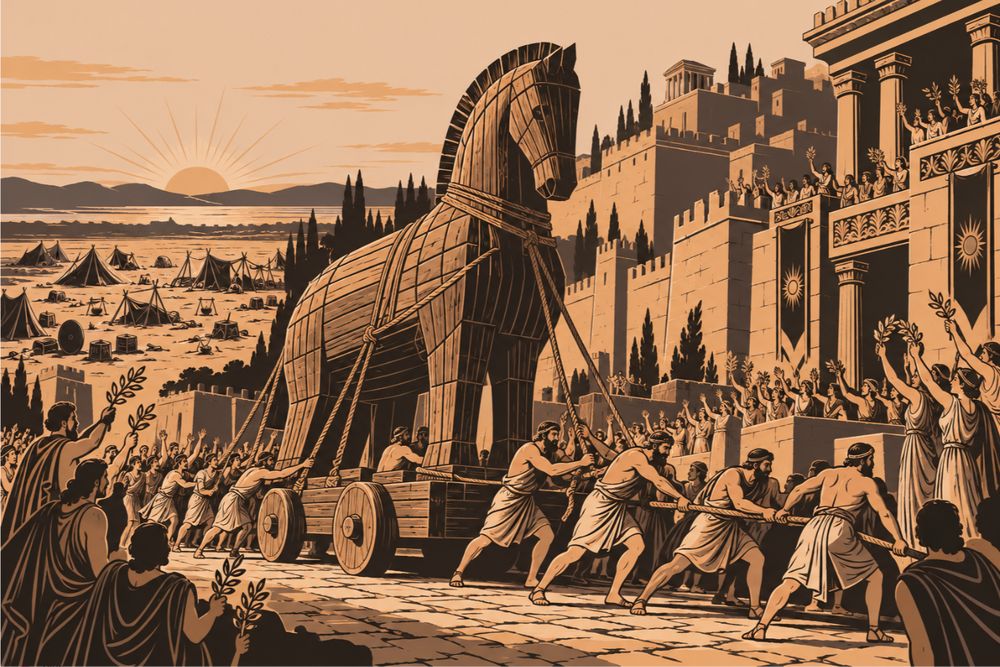
Trojans haul the horse toward Priam's palace
Generated by AI from this page's own facts, not an ancient image or evidence of anything. How this site uses generated images
In Apollodorus, the Trojans find the camp empty at dawn and drag the horse to Priam's palace. Cassandra and the seer Laocoon warn that armed men are inside. Some Trojans want to burn the horse or throw it from a cliff. Most prefer to spare it as a votive offering, and the city holds sacrifices and feasts (Epitome 5.16-5.17). Then two serpents swim over from the nearby islands and devour Laocoon's two sons (Epitome 5.18).
Virgil tells the same night through Aeneas, and he makes it longer. Laocoon runs down from the citadel, warns the Trojans not to trust the horse, and hurls his spear into its flank (Aeneid 2.40-56). Shepherds then drag in the bound Greek Sinon, and his false story persuades Priam (Aeneid 2.57-194). Aeneas sums up the result in his own words.
Thus Sinon's guile and practiced perjury our doubt dispelled. His stratagems and tears wrought victory where neither Tydeus' son, nor mountain-bred Achilles could prevail, nor ten years' war, nor fleets a thousand strong.
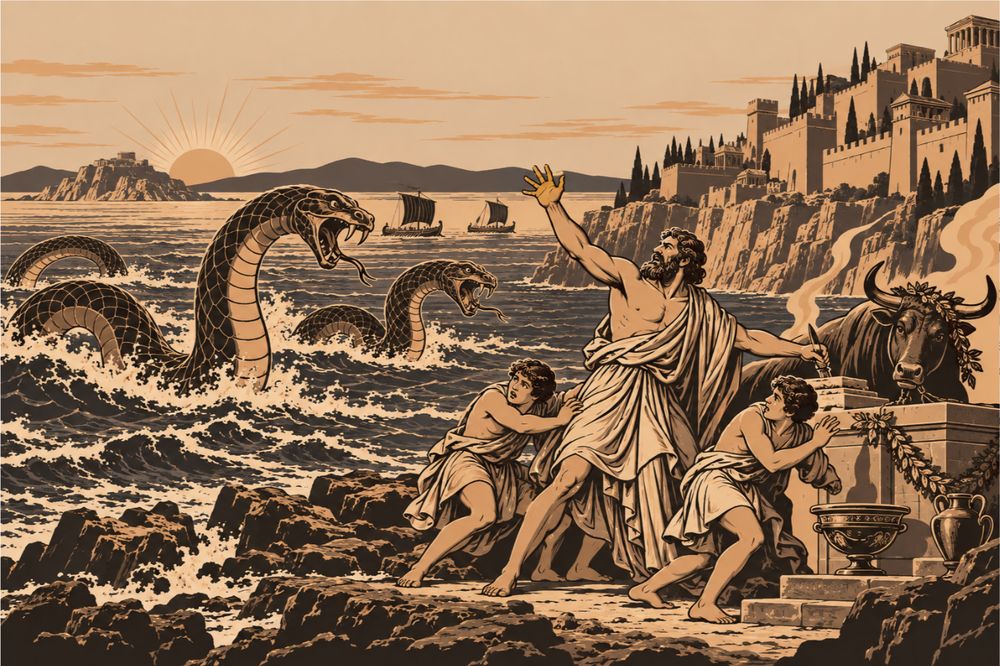
Laocoon sacrifices a bull as serpents rise from the sea
Generated by AI from this page's own facts, not an ancient image or evidence of anything. How this site uses generated images
Virgil then lets Laocoon die. As he sacrifices a bull to Neptune, two serpents come over the sea from Tenedos and kill him and both sons (Aeneid 2.199-231). The Trojans conclude that he was punished for striking the sacred horse. They open a breach in their own wall to bring it in. The horse stalls four times in the gateway and the armour inside rings, but nobody stops. Cassandra warns of the coming fall and is not believed (Aeneid 2.234-249).
Quintus Smyrnaeus tells the horse's making and entry in Book 12 of the Posthomerica, and differs from both. Athena helps Epeius in a dream. Neoptolemus enters the horse first and Epeius last. The Trojans torture Sinon, who keeps to his story. Athena blinds Laocoon before the serpents kill his sons. The Trojans pull down part of their own walls to bring the horse in, and Cassandra tries to burn it and is held back (Posthomerica 12).
In Apollodorus, the Greeks return from Tenedos once the city sleeps, and Sinon lights the beacon on the grave of Achilles. Helen walks around the horse and imitates the wives of the chiefs to lure the men out. Anticlus is about to answer, and Odysseus clamps his hand over his mouth (Epitome 5.19). Menelaus tells the same story in the Odyssey (Homer, Odyssey 4.271-289). Echion dies leaping from the horse. The others let themselves down by rope, open the gates and admit the army from Tenedos (Epitome 5.20). Virgil gives the opening of the horse to Sinon (Aeneid 2.250-267).
In Book 2 Aeneas meanwhile dreams of Hector, who warns him that Troy is falling and tells him to flee (Aeneid 2.268-297).
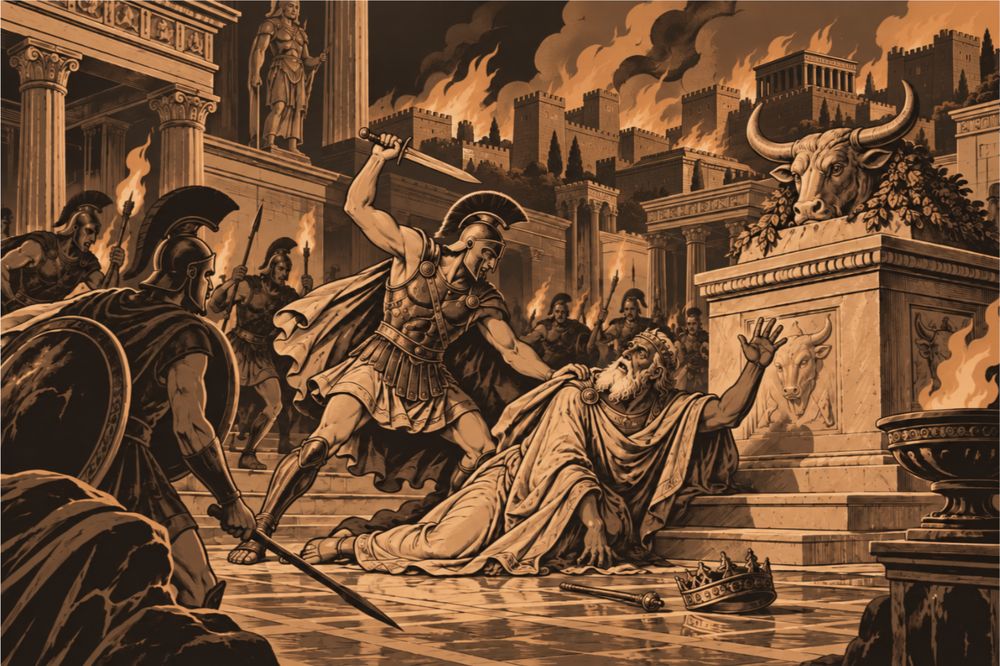
Neoptolemus strikes Priam at the altar
Generated by AI from this page's own facts, not an ancient image or evidence of anything. How this site uses generated images
The sack follows. The Greeks kill the sleeping inhabitants. In Apollodorus, Neoptolemus kills Priam at the altar of Zeus of the Courtyard. Menelaus kills Deiphobus and leads Helen to the ships, and the Locrian Ajax violates Cassandra as she clings to the wooden image of Athena (Epitome 5.21-5.22). The Odyssey also puts Odysseus and Menelaus together at the house of Deiphobus (Homer, Odyssey 8.492-520). Virgil's Pyrrhus, another name for Neoptolemus, kills Priam's son Polites before his parents and then Priam at the altar (Aeneid 2.469-558). The Greeks burn the city and divide the spoils (Epitome 5.23).
What Followed
The fall begins the homecomings. Agamemnon takes Cassandra home to Mycenae, where Aegisthus and Clytaemnestra murder him (Apollodorus, Epitome 6.23). Aeneas leaves Troy with his father Anchises on his back, and Virgil carries his story on to Italy in the poem told on the page for Aeneas and Turnus (Aeneid 2.707-729).
Is The Fall of Troy in The Odyssey?
Yes, but only in pieces. Demodocus sings of the horse and the sack at the Phaeacian court. Menelaus recalls Helen circling the horse. In the underworld Odysseus tells the shade of Achilles that his son Neoptolemus, one of the best of the Argives who went down into the horse, never grew pale. The Odyssey never tells the night as one continuous story.
Homer, Odyssey 8.492-520
Why did Zeus let Troy fall?
In the Iliad Zeus yields to Hera, though unwillingly. He says that of all the cities of men, sacred Ilios was most honoured in his heart, because Priam and his people never failed to give him offerings. In Virgil, Venus tells Aeneas that no mortal fault destroyed the city. He sees Neptune, Juno and Pallas at the walls, while Jupiter gives the Greeks strength.
Homer, Iliad 4.30-49
How many men were inside the wooden horse?
The sources give no single number. Apollodorus says Odysseus planned to send fifty men in, and adds that the Little Iliad, a lost epic, says three thousand. Homer gives no count and calls them the best of the Argives. Quintus Smyrnaeus lists many heroes, with Neoptolemus entering first and Epeius, who built the horse, last.
Apollodorus, Epitome 5.14
Did anyone escape from Troy?
Aeneas did. In Apollodorus the Greeks see him carry out his father Anchises and let him go in honour of his piety. They also spare Glaucus, the son of Antenor. In Virgil, Aeneas lifts Anchises onto his shoulders, with his son at his side, and loses his wife Creusa in the confusion.
Apollodorus, Epitome 5.21
What happened to the Trojan women after the city fell?
The captives were shared out as prizes. Apollodorus says Agamemnon took Cassandra, Neoptolemus took Andromache and Odysseus took Hecuba. He adds that the Greeks slaughtered Polyxena on the grave of Achilles and threw Astyanax from the battlements. Euripides's Trojan Women opens on the same fates, and Talthybius announces the allotment to Hecuba.
Euripides, Trojan Women 271-278
Where Accounts Differ
- laocoon-three-fates
- men-inside-the-horse
- who-opened-the-horse
- iliad-does-not-narrate-the-fall
- Laocoon's death is told three ways. Apollodorus (Epitome 5.18) has two serpents devour only his sons. Virgil (Aeneid 2.199-231) has them kill Laocoon as well, after he threw his spear at the horse. Quintus Smyrnaeus (Posthomerica 12) has Athena blind him before the serpents kill his sons. Quintus is cited by work and book only, because his lines were not checked against a registered text.
- The men in the horse are counted differently. Apollodorus (Epitome 5.14) gives fifty and reports the Little Iliad as saying three thousand. Homer gives no number (Odyssey 8.492-520). The Little Iliad is lost and is known here only through Apollodorus.
- The opening of the horse is given to different hands. In Apollodorus (Epitome 5.19-5.20) Sinon lights a beacon and the hidden men let themselves down by rope and open the gates. In Virgil (Aeneid 2.250-267) Sinon opens the horse. The Odyssey does not say.
- The Iliad does not narrate the fall. It ends with Hector's funeral, and the plan, the night and the sack come from the Odyssey (8.492-520), Virgil, Apollodorus and Quintus, written centuries after the Iliad. Only Apollodorus gives the events in a single order.
Read the full source verification →
Mythology
Figures In This Myth
Related Terms
Referenced By
Sources
- Homer, Iliad 4.30-49
- Homer, Iliad 24.25-30
- Homer, Odyssey 4.271-289
- Homer, Odyssey 8.492-520
- Homer, Odyssey 11.523-532
- Apollodorus, Epitome 5.14
- Apollodorus, Epitome 5.15
- Apollodorus, Epitome 5.16-5.17
- Apollodorus, Epitome 5.18
- Apollodorus, Epitome 5.19
- Apollodorus, Epitome 5.20
- Apollodorus, Epitome 5.21
- Apollodorus, Epitome 5.22
- Apollodorus, Epitome 5.23
- Apollodorus, Epitome 6.23
- Virgil, Aeneid 2.40-56
- Virgil, Aeneid 2.195-198
- Virgil, Aeneid 2.199-231
- Virgil, Aeneid 2.234-249
- Virgil, Aeneid 2.250-267
- Virgil, Aeneid 2.268-297
- Virgil, Aeneid 2.469-558
- Virgil, Aeneid 2.589-623
- Virgil, Aeneid 2.707-729
- Euripides, Trojan Women 271-278
- Quintus Smyrnaeus, Posthomerica 12